Hi, what do you want to do?





Teachnology
Teachnology: Science Lesson Plans
Great lesson plans covering a wide-range of science-related subjects. A wonderful resource for wonderful teachers!

American Chemical Society
Middle School Chemistry: Molecules in Motion
Students observe, on a molecular level, how heating and cooling affect molecular motion.

National Geographic
National Geographic: Human Impacts on Marine Species
Young scholars learn about three examples of human impacts on marine life: migration patterns and shipping, algal blooms and water chemistry, and marine debris. Some of these impacts are due to human activity in the ocean, and some...
TeachEngineering
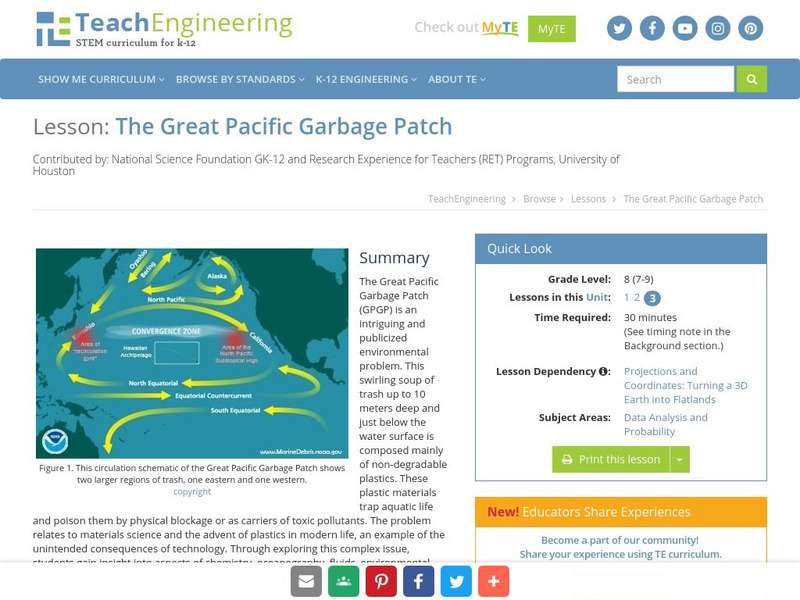
Teach Engineering: The Great Pacific Garbage Patch
The Great Pacific Garbage Patch (GPGP) is an interesting and somewhat publicized environmental problem. A swirling soup of trash up to 10 meters deep and just below the water surface is composed mainly of non-degradable plastics. These...
Science Education Resource Center at Carleton College
Serc: Classifying Chemical and Physical Changes in Various Materials/substances
In this classroom lab, students will investigate the characteristics of a chemical change. Students will also provide a definition of what constitutes a physical change through observation of several examples. Students will use/create...
Chem Tutor
Chem Tutor: Chemistry: Compounds
This lesson focuses on chemical compounds including Ionic and Covalent Bonds, Valences, Lewis Structures, Binary Covalent Compounds, Radicals or Polyatomic Ions, and much more. It also includes a compound worksheet in which the students...
Science Education Resource Center at Carleton College
Serc: Does It All Add Up?
In this chemistry classroom lab activity, students use critical thinking to investigate the molecular properties of different liquids: rubbing alcohol and water.
Science Education Resource Center at Carleton College
Serc: Investigating Precipitation: Snow
In this chemistry field/class based activity, students investigate snow and, more specifically, why snowflakes have six sides. Students will individually fossilize a snowflake and observe similarities and differences with other members...
Science Education Resource Center at Carleton College
Serc: Mn Step: Solutions: Solubility and Miscibility
For this activity, students will test the solubility and miscibility of various substances in water, and explain the chemistry involved. They will also be given a solid and a liquid and asked to predict what will happen when each is...