Hi, what do you want to do?






Teach Engineering
Efficiency of a Water Heating System
Tired of waiting for hot water? Groups of three determine the efficiency of an electric water-heating device. They calculate the amount of energy it takes to heat the water and the theoretical amount of energy required to heat the water....
Science Buddies
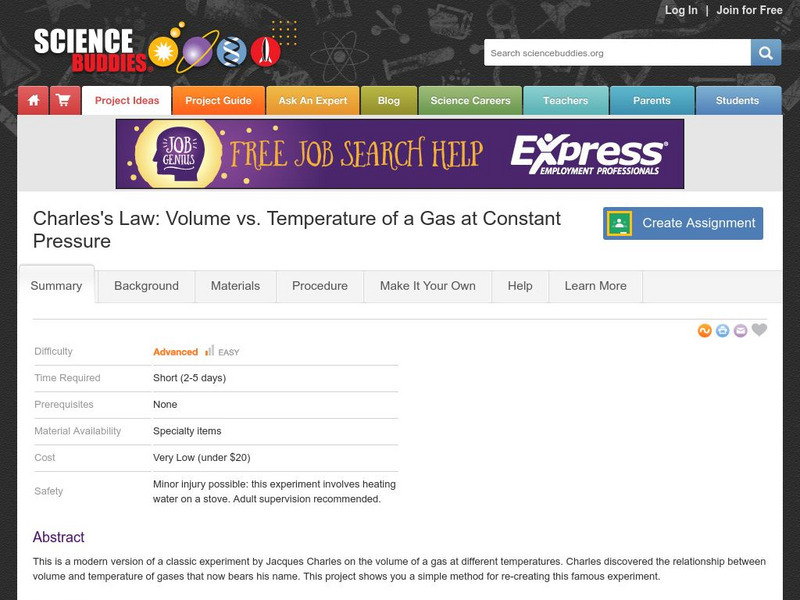
Science Buddies: Charles's Law
This is a modern version of a classic experiment by Jacques Charles on the volume of a gas at different temperatures. Charles discovered the relationship between volume and temperature of gases that now bears his name. This project shows...
University of Maryland
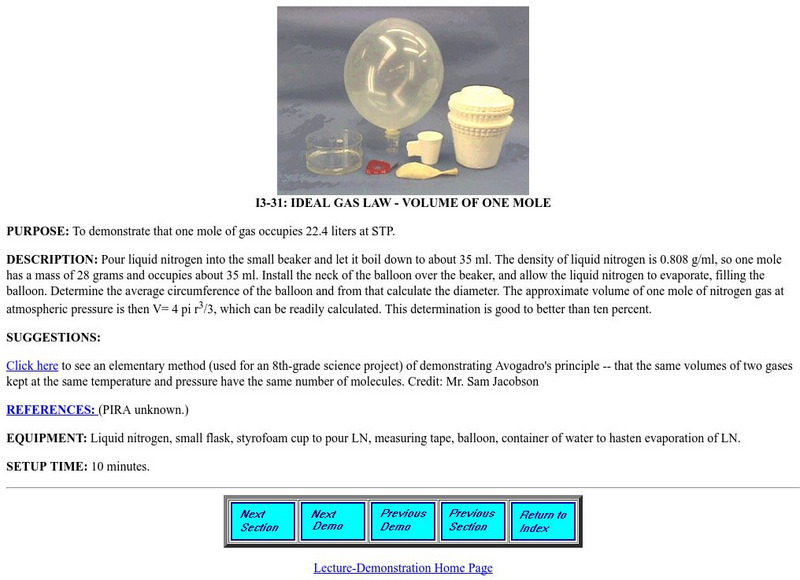
University of Maryland: Ideal Gas Law Volume of One Mole
A page from the University of Maryland Physics Lecture Demonstration Facility. Provides directions for a teacher demonstration of the ideal gas law. Shows apparatus and set-up; provides suggestions. Easily adaptable as a student project...
Science Buddies
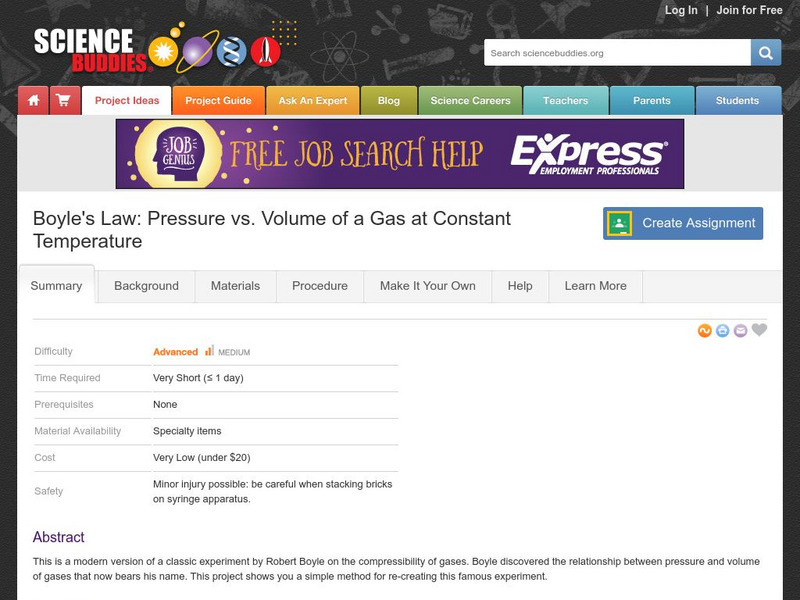
Science Buddies: Boyle's Law
This is a modern version of a classic experiment by Robert Boyle on the compressibility of gases. Boyle discovered the relationship between pressure and volume of gases that now bears his name. This project shows you a simple method for...

University of Nebraska
David Brooks: Henry's Law Experiment
At this site learn about Henry's law through this hands-on experiment. Lab instructions are complete including step-by-step pictures an worksheet.
University of Nebraska
Do Chem: Graham's Law
A lab setup, fairly simple, to illustrate Graham's Law. Check it out!
Science Buddies
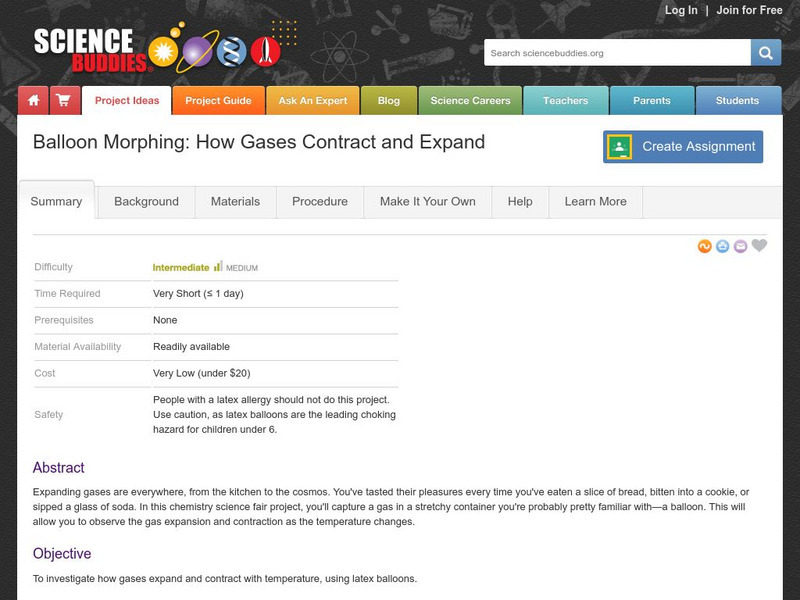
Science Buddies: Balloon Morphing: How Gases Contract and Expand
Expanding gases are everywhere, from the kitchen to the cosmos. You've tasted their pleasures every time you've eaten a slice of bread, bitten into a cookie, or sipped a glass of soda. In this chemistry science fair project, you'll...
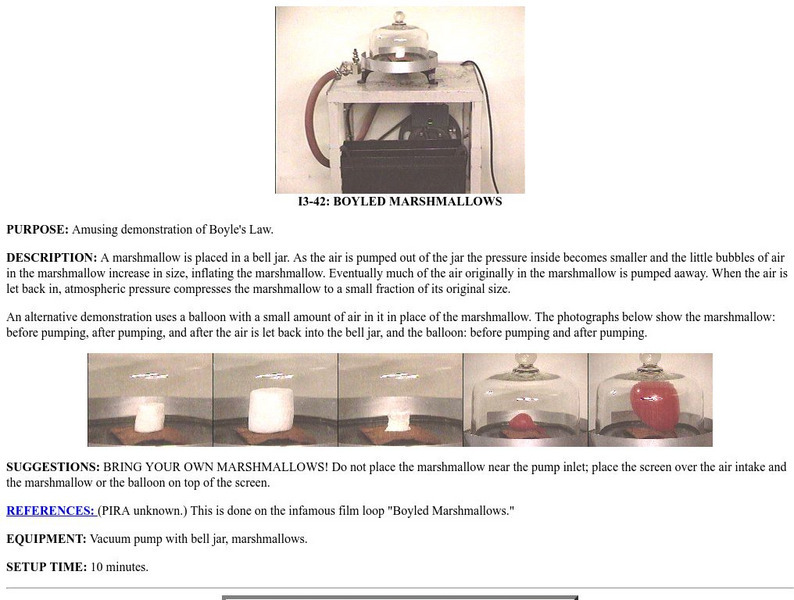
University of Maryland
University of Maryland: Boyled Marshmallows
A page from the University of Maryland Physics Lecture Demonstration Facility. Provides directions for a teacher demonstration of Boyle's law. Shows apparatus and set-up; provides suggestions. Easily adaptable as a student project or lab...
Concord Consortium
Concord Consortium: Molecular Workbench Showcase: Chemistry, Thermodynamics
Explore some virtual experiments on gases and vapor pressure, the Maxwell speed distribution, the barometric formula, and heat and temperature.
Other
The Science House: Floating Candles
In this experiment students observe a combustion reaction and deduce the components necessary for the reaction to occur. They also see the relationship between pressure, volume, and number of molecules for gases.