Hi, what do you want to do?






TED Talks
Taylor Wilson: My radical plan for small nuclear fission reactors
Taylor Wilson was 14 when he built a nuclear fusion reactor in his parents' garage. Now 19, he returns to the TED stage to present a new take on an old topic: fission. Wilson, who has won backing to create a company to realize his...
SciShow
What Really Happened the First Time We Split a Heavy Atom in Half
When scientists first split the atom, they didn’t realize what they’d done until physicist Lise Meitner figured out they had discovered what we now call nuclear fission.
SciShow
What Really Happened the First Time We Split a Heavy Atom in Half
When scientists first split the atom, they didn't realize what they'd done until physicist Lise Meitner figured out they had discovered what we now call nuclear fission.
Crash Course
Nuclear Chemistry Part 2: Fusion and Fission - Crash Course Chemistry
Continuing our look at Nuclear Chemistry, Hank takes this episode to talk about Fusion and Fission. What they mean, how they work, their positives, negatives, and dangers. Plus, E=mc2, Mass Defect, and Applications of Fission and...
Crash Course
Nuclear Chemistry: Crash Course Chemistry
In this episode, Hank welcomes you to the new age, to the new age, welcome to the new age. Here he'll talk about transmutation among elements, isotopes, calculating half-life, radioactive decay, and spontaneous fission....
Bozeman Science
Nuclear Reactions
Mr. Andersen contrasts nuclear reactions to chemical reactions. He explains the four main forces of nature; including gravity, electromagnetism, strong, and weak nuclear forces. He also explains how fusion differs from fission.

Curated Video
What Is Nuclear Fission? | Radioactivity | Physics | FuseSchool
How does a nuclear reactor provide energy? What causes a nuclear meltdown? And how do we make this safe? All of these questions are answered in this 'Radioactivity' video from The Fuse School GCSE / K12. At Fuse School, teachers and...
MinutePhysics
The Unreasonable Efficiency of Black Holes
This video is about how efficient various reactions are at converting mass to energy (as we know from the Einstein mass-energy equivalence of E=mc^2). Antimatter is very efficient but it is not...
Higgsino Physics
Chernobyl Accident - Simulation only
Understand how the Chernobyl reactor melted down and triggered one of the biggest nuclear disasters in history. This unvoiced simulation of the events leading up to the disaster creates a visual explanation of what went wrong on a...
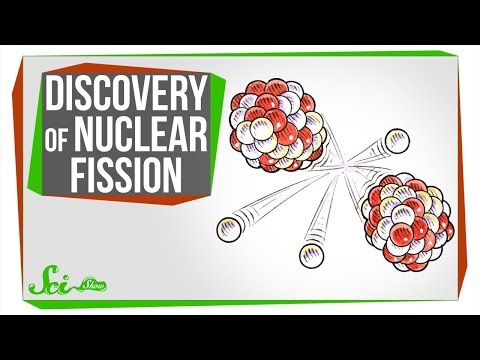
SciShow
What Really Happened the First Time We Split a Heavy Atom in Half
This episode was produced in collaboration with and sponsored by Emerson. Click here to learn more about their We Love STEM initiativettp://bit.ly/2fnBiHO' target='_blank' rel='nofollow'>initiative When scientists first split the...
SciShow
The Manhattan Project
Some of the greatest advances in science have come from humanity's more destructive impulses. This is not the fault of science - when we discover powerful truths about the universe it's up to us to decide how to use them because...
Curated Video
The Four Fundamental Forces: Their Origins and Roles in Nature
if you took a notebook, a plastic bottle, a toaster, and a glass container and burned them in a fire hot enough, around 10^31 degrees Celsius, all the particles and forces, would become one entity. This is what...
SciShow
Why Does Everything Decay Into Lead
If you look at a copy of the periodic table, you might notice that basically every element after lead is labelled as radioactive. And the vast majority of those elements wind up decaying into some version of lead eventually. But why is...
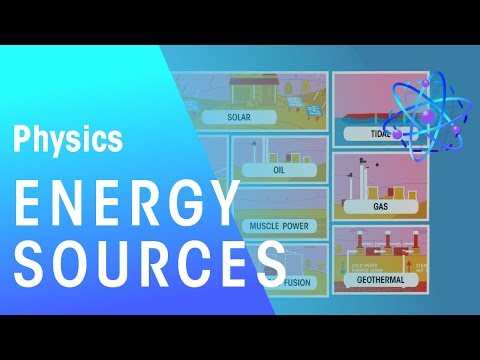
Curated Video
Energy Sources | Energy | Physics | FuseSchool
Energy Sources | Energy | Physics | FuseSchool There are many different sources of energy, how many can you name? Sources of energy include burning coal, oil, gas and biomass, solar, hydroelectric, tidal, wind, muscle power, geothermal,...

Crash Course
Nuclear Chemistry Part 2: Fusion and Fission
Go into depth with an investigation of fusion and fission area, how they work, the pros and cons and the many dangers of these reactions. The video also covers e = mc^2 and mass defects.

Crash Course
Nuclear Chemistry
Radioactivity and nuclear chemistry, transmutation of elements and isotopes, calculating half lives and radioactive decay. Introduce these concept and more with a video on carbon dating. The show concludes with an explanation of...

Crash Course
Stoichiometry: Chemistry for Massive Creatures
Moles exist in chemistry? These are not animals that live underground and dig through your gardens — they are quantities of elements. Learn about moles and how they help chemists determine amounts of substances (from atomic mass to grams).

Crash Course
Entropy: Embrace the Chaos!
Chemistry makes it seem that everything has its place and behaves according to different laws. Not always true! Disorder and chaos can and do happen in chemistry; scientists call this disorder entropy. Learn about entropy and its...

Crash Course
Unit Conversion and Significant Figures
Science is full of big numbers, each of which can be several digits long. Learn how to determine the appropriate amount of numbers to display in answers as well as how to shorten those big numbers down to only a few and still display the...

PBS
Pbs Learning Media: Crash Course Chemistry: Nuclear Chemistry Part 2: Fusion and Fission
Continuing our look at Nuclear Chemistry, Hank takes this episode to talk about Fusion and Fission. What they mean, how they work, their positives, negatives, and dangers. Plus, E=mc2, Mass Defect, and Applications of Fission and Fusion...
PBS
Pbs Learning Media: Crash Course Chemistry: Nuclear Chemistry
In this episode, Hank talks about transmutation among elements, isotopes, calculating half-life, radioactive decay, and spontaneous fission. [9:56]

Crash Course
Crash Course Chemistry #39: Nuclear Chemistry Part 2: Fusion and Fission
Hank discusses and explains nuclear chemistry with an in-depth look at fusion and fission.
Crash Course
Crash Course Chemistry #38: Nuclear Chemistry
In this episode, Hank welcomes you to the new age, where he talks about transmutation among elements, isotopes, calculating half-life, radioactive decay, and spontaneous fission. [9:58]