Hi, what do you want to do?






Center for Learning in Action
Investigating Physical and Chemical Changes
Super scientists visit ten stations to predict, observe, and draw conclusions about the physical and chemical changes that occur when different states of matter—liquid, solid, and gas—are placed under a variety of conditions. To...

National Institute of Open Schooling
Chemical Equilibrium
Le Chatelier's interest in thermodynamics and building materials such as cement and plaster led to the Le Chatelier Principle in 1884. Activity 13 in a series of 36 extensively explores chemical equilibrium. Learners read about...

It's About Time
Chemical Names and Formulas
Abracadabra! Provide your class with the tools to perform a chemical "magic show" as they predict the charges of various ions, determine ionic compound formulas, and make observations to determine when a chemical reaction between...

eSchool Today
E School Today: What Is Matter
Learn about matter, its three states, changes of state, how matter behaves, and physical and chemical changes in matter.
Frostburg State University
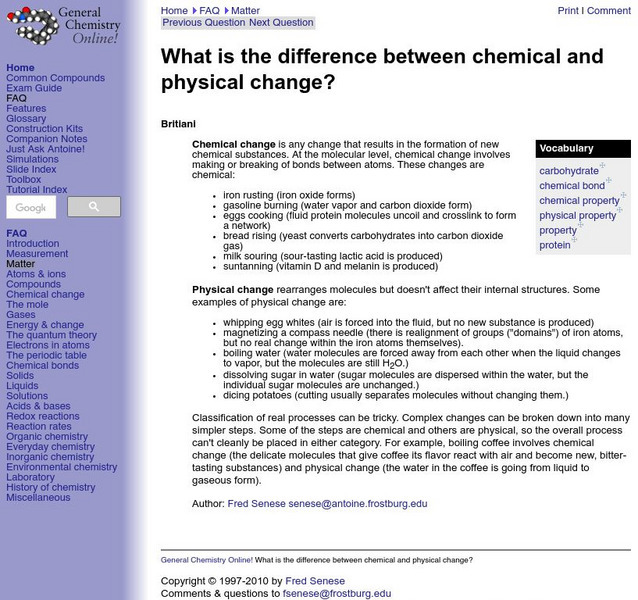
General Chemistry Online: Physical and Chemical Changes
Resource provides information about the difference between physical and chemical changes. Includes a definition and examples of each.

Other
Homewood City Schools: Classification of Matter
This Homewood City Schools site has an outline form and contains lots of information about the classification and composition of matter. Some of the topics covered are matter and temperature, changes in state, composition of matter, and...
San Diego Natural History Museum
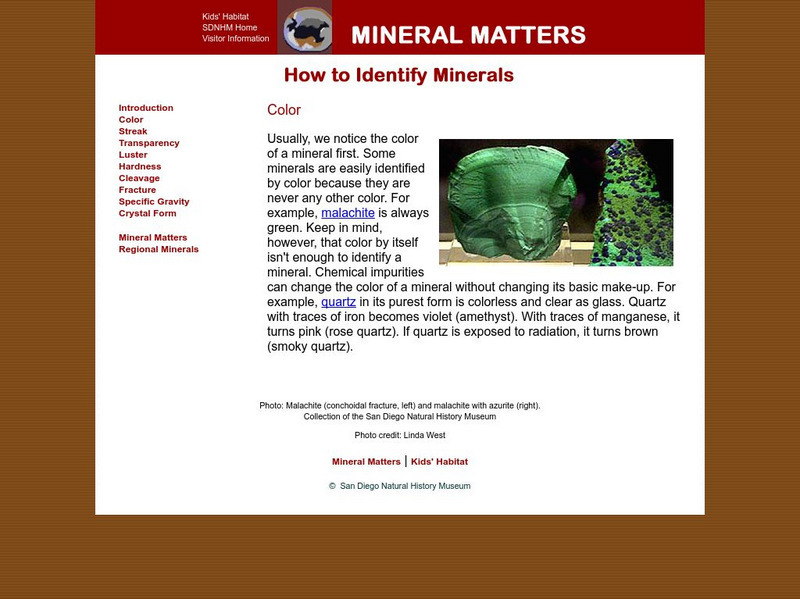
San Diego Natural History Museum: Mineral Matters: Color
Don't be fooled! While color is one way to identify a mineral, it can often be misleading. Quartz is one example of a mineral that can change colors depending on its chemical make-up.