Hi, what do you want to do?






Curated OER
Stones, Bones & Telephones: Analyzing Artifacts Using Bloom's Taxonomy
Seventh graders define metacognition, Bloom's Taxonomy, and artifacts. They, in groups, try to identify a mystery artifact using the Artifact Analysis sheet. They present their findings to the class.

Curated OER
My Likes And Dislikes
Young scholars practice conversational conventions when expressing their likes and dislikes, with a partner. Individually, they write a paragraph explaing a tiem when they felt acceptance or rejection.

Curated OER
Money, Money, Honey Bunny!
Students determine the differences between goods and services, and saving and spending. In this economics lesson, students listen to a rhyming story about a bunny with money. They play a matching game with the associated cards and work...

Curated OER
Tree-Mendous!
Young scholars classify trees. In this tree-mendous instructional activity, students categorize a variety of trees to assist them in playing a Jeopardy like game. Young scholars identify new vocabulary terms and classify the uses...

Curated OER
Water Around Us
Third graders learn the effects of temperature on the states of water. Then students create paper snowflakes. Finally students complete a computer project with software which teaches the different states of water.

Curated OER
Which One Doesn't Belong?
Third graders identify words that are related with 80% accuracy. Given a list of four vocabulary words, 3rd graders identify specific relationships between three of the four words. They also identify which of the four words are not...

Curated OER
Decoding
Students decode words containing r-controlled vowels. In this r-controlled vowel lesson plan, students use letter tiles to make words containing specific vowel patterns, and substitute letters to make new words, while the teacher writes...

Curated OER
Cultural Geography
In this Cultural Geography worksheet, students fill in answers to ten questions about cultural factors such as language and religion without using a word bank.

Curated OER
Bill of Rights -- Texas v. Johnson, 1989
Students examine the First Amendment of the Bill of Rights. During a visit to the George Bush Presidential Museum, they watch a video about the Texas v. Johnson flag burning case. In groups, they discover the role of the Supreme Court...

Curated OER
Atlatl Lessons Grades 4-12
Students examine motion and how to describe it qualitatively. In this investigative lesson students see how aboriginal people were environmentally responsible.

Curated OER
Geo Jammin' - Day 2, Lesson 5: Eeny, Meeny, Miney, Mo
Pupils, in groups, use song lyrics and math to descrie two and three dimensional shapes.

Curated OER
Homeless
Students explore homelessness through the reading of "Homeless" by Anna Quindlen. They discuss their thoughts about homelessness and how they feel about the problem. They complete a reader response sheet.

Curated OER
Vertebrates And Invertebrates
In this science lesson, students classify pictures into categories of vertebrates or invertebrates. After a class discussion, students divide into groups, and are given plastic baggies that contain photographs of each. The groups must...

Curated OER
Where Is Japan? How Far Is That?
First graders use literature and hands-on activities with maps and globes to explain distance and tools used to measure distance. They select tools to measure various objects in the classroom, then apply those concepts to their map...

Curated OER
Explora-Pond: 1st Grade Shore Count
First graders experience addition through the exploration of a virtual pond. They categorize the various plants around the pond, count the number of various types of plants on the pond shore, and calculate the number of shrubs.

Curated OER
Nationalism and the Olympics
Students discuss the topic of nationalism in the Olympics. After viewing video segments, they discuss how politics and nationalism have influenced the Olympic Games in various ways. They also examine the main reasons why a country...

Curated OER
Fruits and Veggies - Yum!
Pupils use Inspiration to drag pictures of fruits and vegetables into the correct category. They discuss the name of other fruits and vegetables. They explain why or why not they like that particular fruit or vegetable. Students...
Read Works
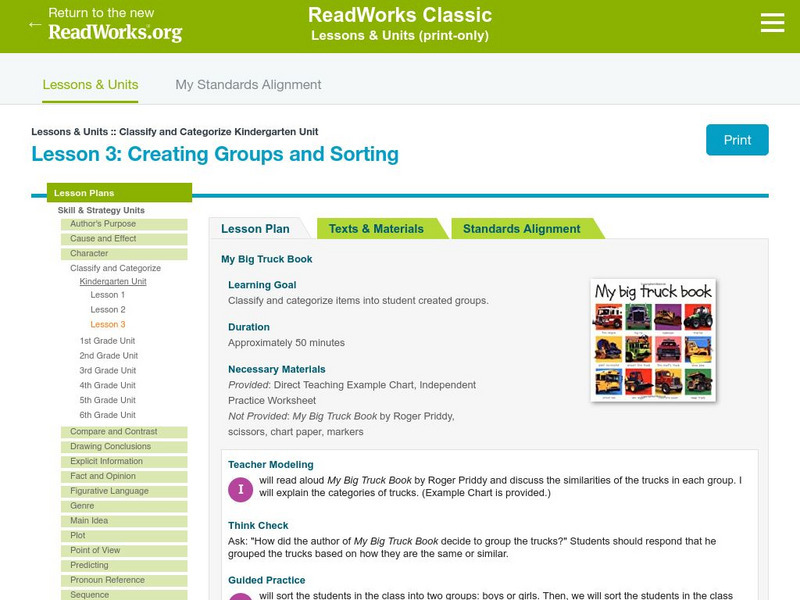
Read Works: Classify/categorize Kindergarten Unit: Creating Groups and Sorting
[Free Registration/Login Required] A lesson using the book My Big Truck Book by Roger Priddy in which young scholars learn to sort items into categories they create for themselves. Ideas for teaching, guided practice, and independent...
TESL Journal
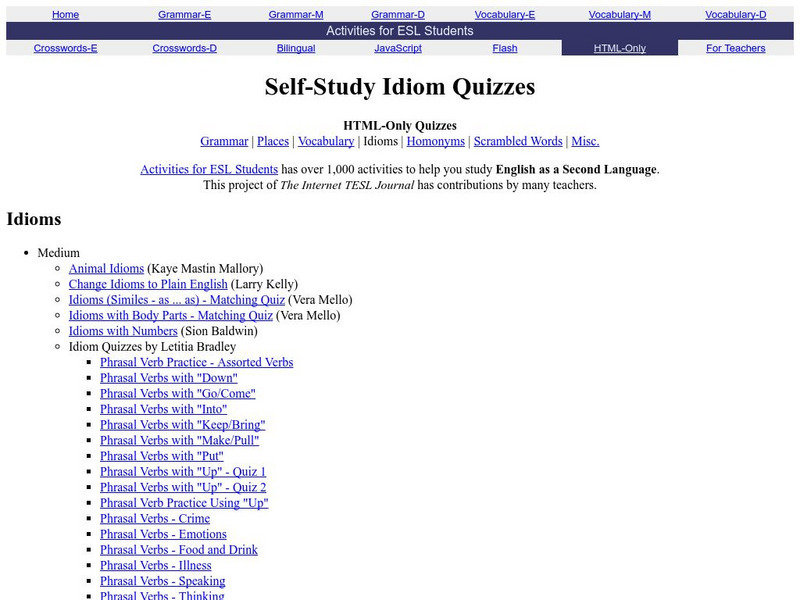
Activities for Esl Students: Self Study Idiom Quizzes
Vast array of quizzes and self-study exercises based on idioms and idiomatic expressions, categorized in a variety of ways (beginning with A, B, etc., by keyword, or by association with other groupings). Great practice for the ELL/ESL...
Read Works
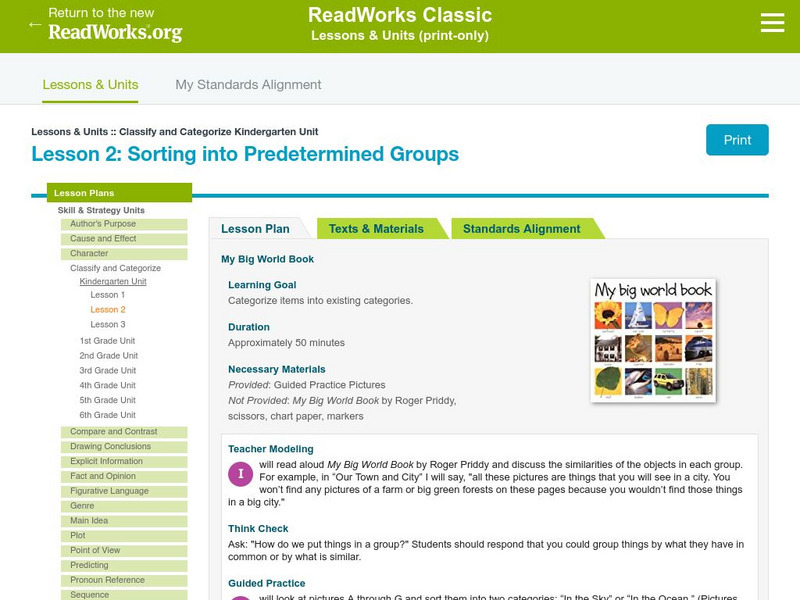
Read Works:classify/categorize Kindergarten Unit: Sorting to Predetermined Groups
[Free Registration/Login Required] A lesson using the book My Big World Book by Roger Priddy in which learners learn to sort items into predetermined categories. Ideas for teaching, guided practice, and independent practice are included....
Read Works
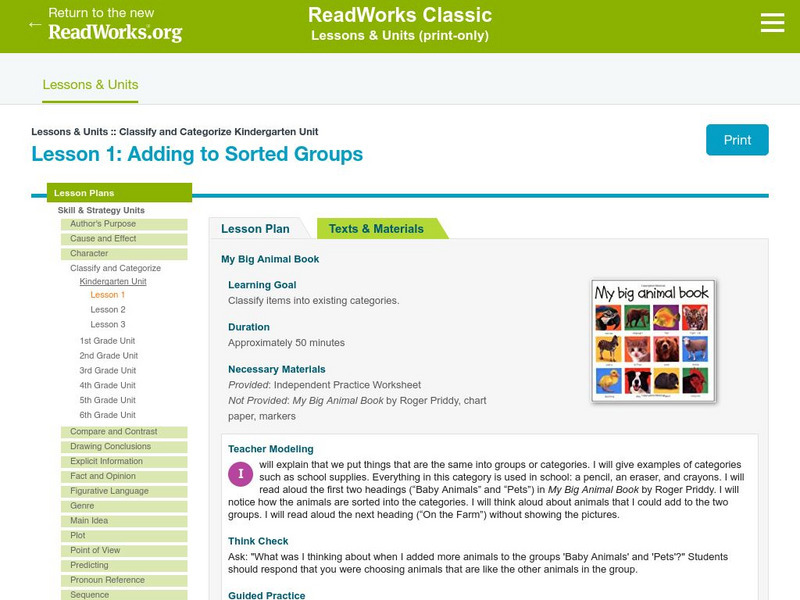
Read Works: Classify and Categorize Kindergarten Unit: Adding to Sorted Groups
[Free Registration/Login Required] A lesson using the book My Big Animal Book by Roger Priddy in which students learn to sort items into predetermined categories. Ideas for teaching, guided practice, and independent practice are...
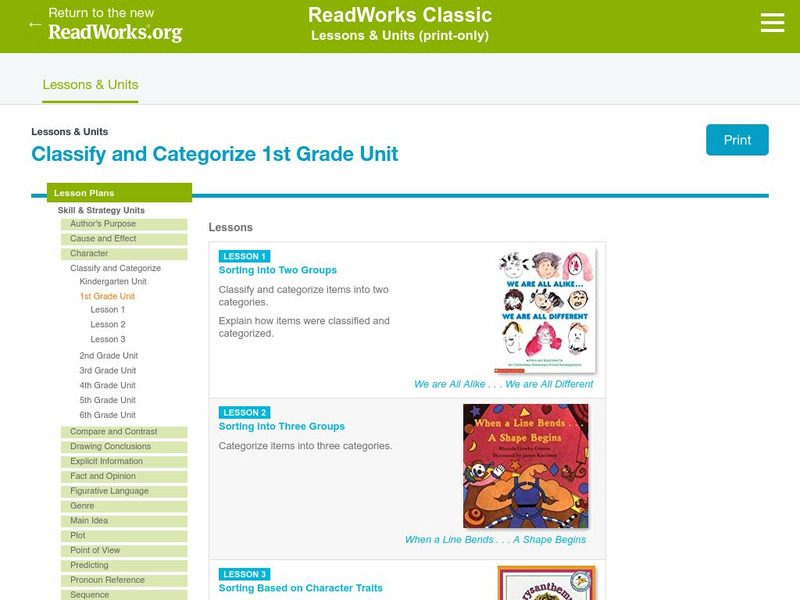
Read Works
Read Works: Classify and Categorize 1st Grade Unit
[Free Registration/Login Required] A three-lesson unit on classifying and categorizing through which students learn how to sort items into two and three categories and explain how each group is classified. Finally, students categorize...