Hi, what do you want to do?






Curated OER
What Do You See? What Do You Think?
Students review the implications of the printing of the Gutenberg Bible. Using a page from the Bible, they compare and contrast it with one that was handwritten. They use the internet to discover Gutenberg's model and marketing strategy...

Curated OER
Social Studies: People in the Rocks
Students discover characteristics of Native Americans as depicted in their rock art. By examining the rocks from the Human Figures Photo Gallery, they make inferences about the activities and purposes of the people drawn on them.

Curated OER
Let's Clean the Beach!
Learners volunteer their time to clean a local park. They estimate the amount of debris they collect and make observations. They write a poem and draw an illustration about their experience.

Curated OER
Biomes
Eighth graders use the Internet to research biomes and how animals adapt. They describe habitat's features and factors that are unique to the biome they are researching. They also participate in activities.

Curated OER
Making Tough Decisions about the Energy We Use
Student examine ways we use and conserve energy. They discover the choices one makes concerning excessive energy use.

Curated OER
Atlatl Lessons Grades 4-12
Students examine motion and how to describe it qualitatively. In this investigative lesson students see how aboriginal people were environmentally responsible.

Curated OER
An Introduction To Sets
Students recognize the symbol for and demonstrate the rules of set.

Curated OER
Newton’s Laws of Motion
Eighth graders explore the three laws of motion. In this physics lesson, 8th graders observe teacher demonstration and explain what happened in terms of Newton's Laws. They complete worksheet at the end of the lesson.

Curated OER
Exploring Our Solar System #1
Students examine the different theories on how our solar system was formed. They discover the order of the nine planets. They also identify the surface features of each planet.

Curated OER
Marine Debris
Students will perform experiments to examine if debris will float, or blow in the wind. They discuss the effects of these characteristics on marine debris.

Curated OER
Which One Doesn't Belong?
Third graders identify words that are related with 80% accuracy. Given a list of four vocabulary words, 3rd graders identify specific relationships between three of the four words. They also identify which of the four words are not...

Curated OER
Checking County Numbers
Pupils use their county's information page to gather information about their community. Using the information, they create graphs from the tables provided and interpret the data. They write a paragraph showing their interpretation of the...

Curated OER
Blowing in the Wind
Students compare hurricanes and tornadoes. They write a paragraph explaining how to prepare for a storm. Students give an oral report. They use weather facts to practice math skills. Students record observations of a storm.

Other
National Center on Intensive Intervention: Identify and Sort Common Objects
This individual or small group activity helps teach the common core standard of sorting common objects into categories to gain a sense of the concepts the categories represent. Materials and detailed instructions are included.
Utah Education Network
Uen: Classifying Objects
Fourth graders practice using a type of classification system.
Read Works
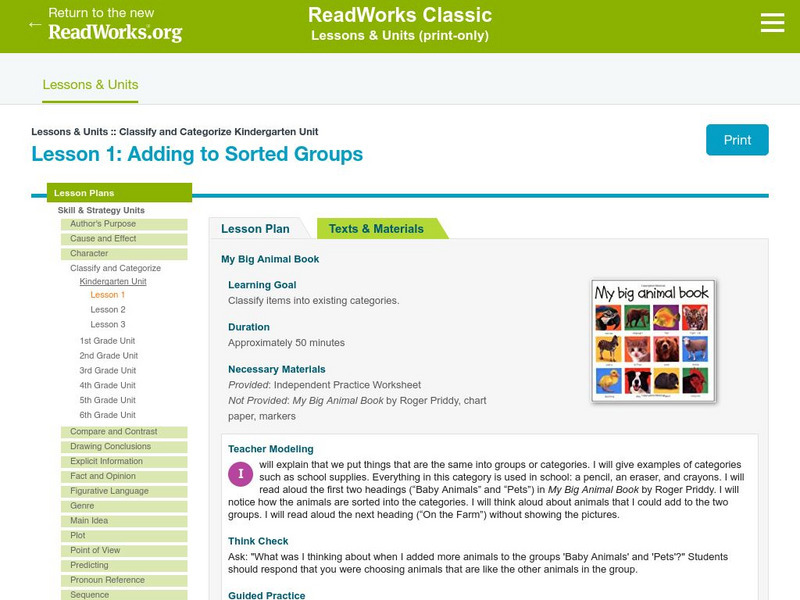
Read Works: Classify and Categorize Kindergarten Unit: Adding to Sorted Groups
[Free Registration/Login Required] A lesson using the book My Big Animal Book by Roger Priddy in which students learn to sort items into predetermined categories. Ideas for teaching, guided practice, and independent practice are...
Read Works
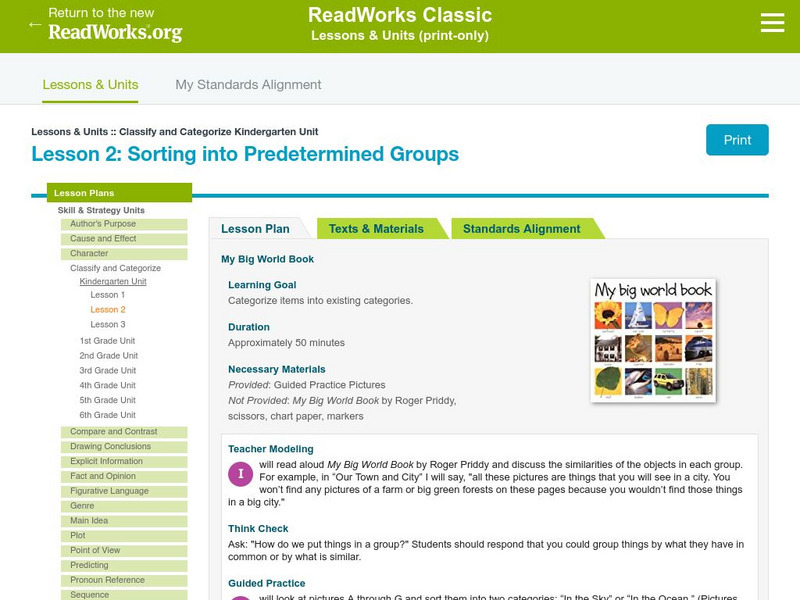
Read Works:classify/categorize Kindergarten Unit: Sorting to Predetermined Groups
[Free Registration/Login Required] A lesson using the book My Big World Book by Roger Priddy in which learners learn to sort items into predetermined categories. Ideas for teaching, guided practice, and independent practice are included....
Read Works
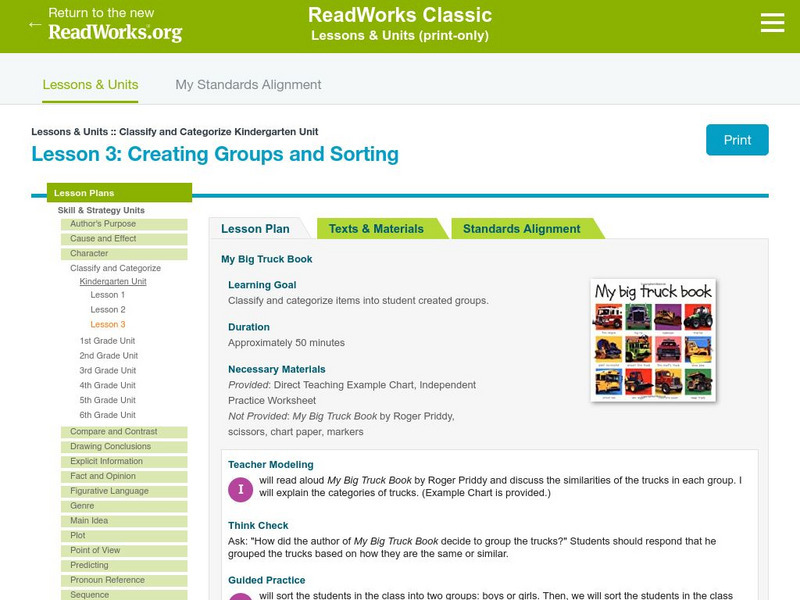
Read Works: Classify/categorize Kindergarten Unit: Creating Groups and Sorting
[Free Registration/Login Required] A lesson using the book My Big Truck Book by Roger Priddy in which young scholars learn to sort items into categories they create for themselves. Ideas for teaching, guided practice, and independent...

Alabama Learning Exchange
Alex: What's the Matter: A Sinker or Floater?
Students will explore matter that sinks or floats when submerged in water and that matter is categorized as either a sinker or a floater. Students will work actively in small, cooperative learning groups as well as gather in a whole...
Illustrative Mathematics
Illustrative Mathematics: Sort and Count Ii
The purpose of this task is for students to sort the same set of objects according to different attributes and to practice counting to tell the number of objects in a set. The teacher should accept any way the child wants to sort the...

ClassFlow
Class Flow: Air, Land, & Water
[Free Registration/Login Required] Students will be able to identify which category (air, land, or water) an object belongs to.
TeachEngineering
Teach Engineering: Touch and Discover
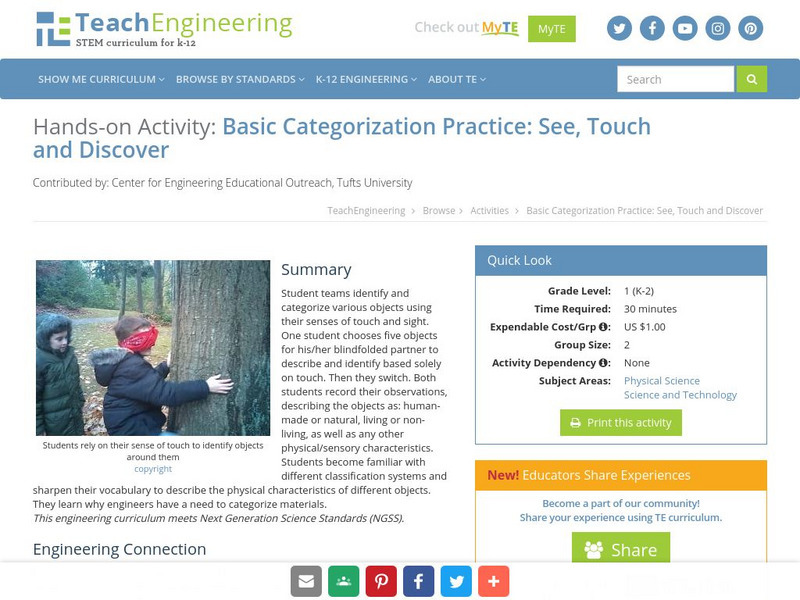
Students work in pairs or small groups to identify and categorize various objects. One student is blindfolded and the other student chooses five objects for their partner to identify. The blindfolded student has to describe and try to...
TeachEngineering
Teach Engineering: Earth Rocks!
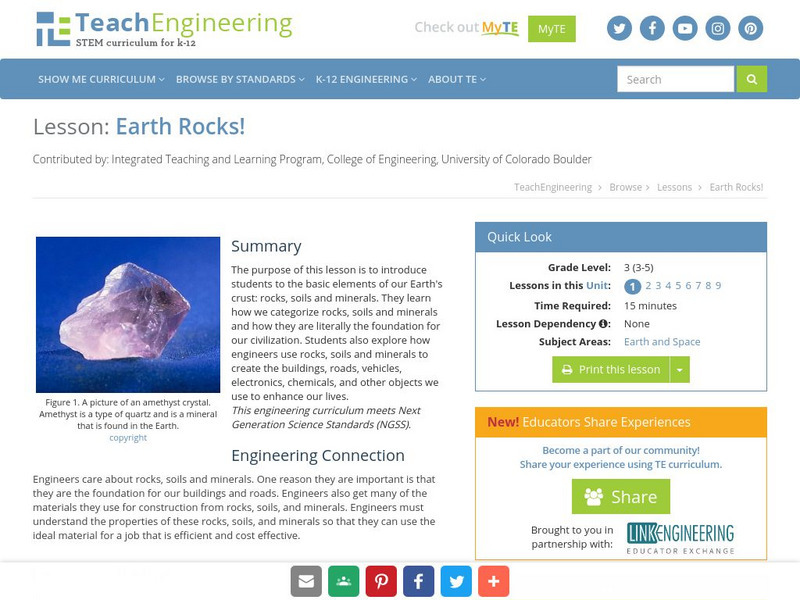
The purpose of this lesson is to introduce students to the basic elements of our Earth's crust: rocks, soils and minerals. They learn how we categorize rocks, soils and minerals and how they are literally the foundation for our...
PBS
Pbs Learning Media: Makers: Collection
The Maker Party, an initiative in which people around the world meet up, learn to make things, and share what they've made online. This collection is designed to support the Maker Party by providing a one-stop shop of STEM and digital...