Hi, what do you want to do?





Annenberg Foundation
Annenberg Learner: The Human Brain
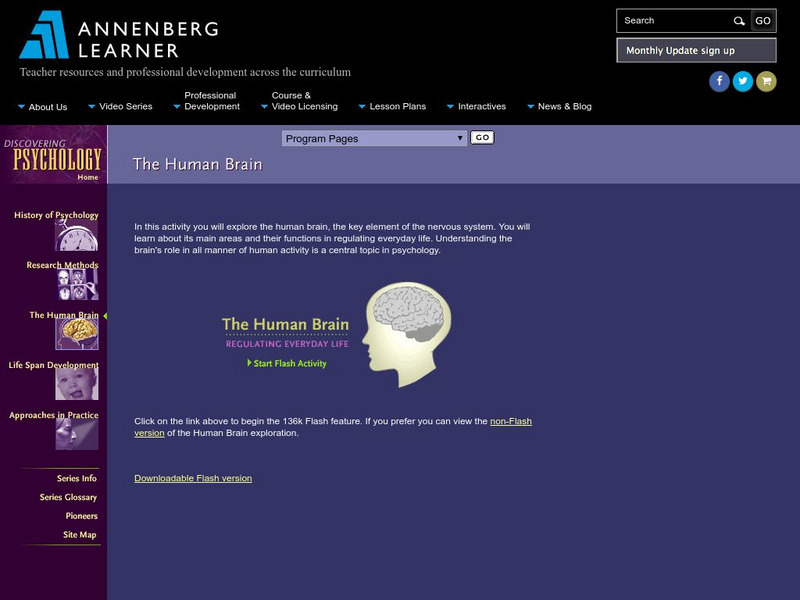
Explore the human brain, and the role it plays in the nervous system. Students learn about the three main parts of the brain and each of their functions.
Curated OER
Kids Health: The Brain Is the Boss
What weighs 3 pounds at maturity and is faster than any computer? If you don't know then use this site about the brain. Get great information and diagrams about the brain. Available in Spanish.

Other
Dana Sourcebook of Brain Science: It's Mindboggling!
Look through this online pamphlet to find brain exercises as well as explanations of how the brain works. Very complete and fun to read.
TeachEngineering
Teach Engineering: Brain Is a Computer
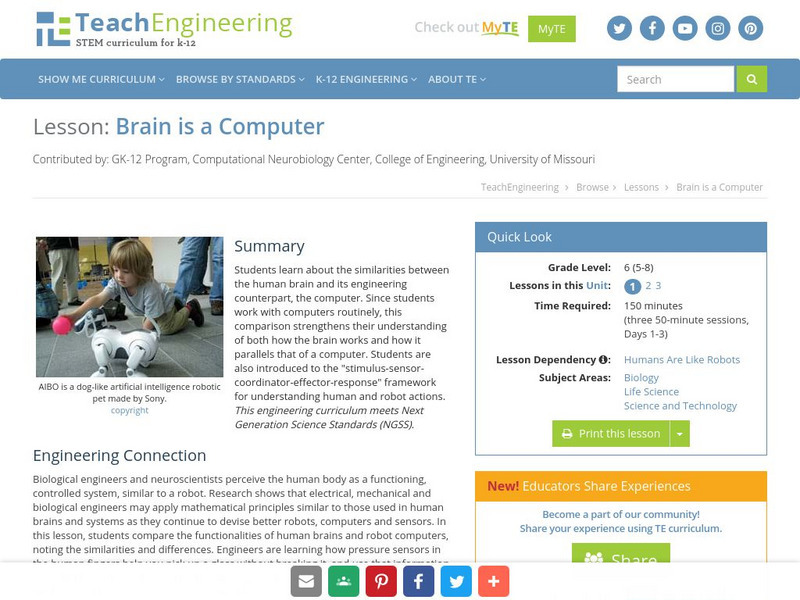
Students learn about the similarities between the human brain and its engineering counterpart, the computer. Since students work with computers routinely, this comparison strengthens their understanding of both how the brain works and...

Other
Brain Line: Brain Basics
Three roll-over diagrams of the brain highlight its parts. In accompanying display panes, learn about the functions that each highlighted part is responsible for and about problems that can occur if that part of the brain is damaged.
Harvard University
Harvard Medicine: The Whole Brain
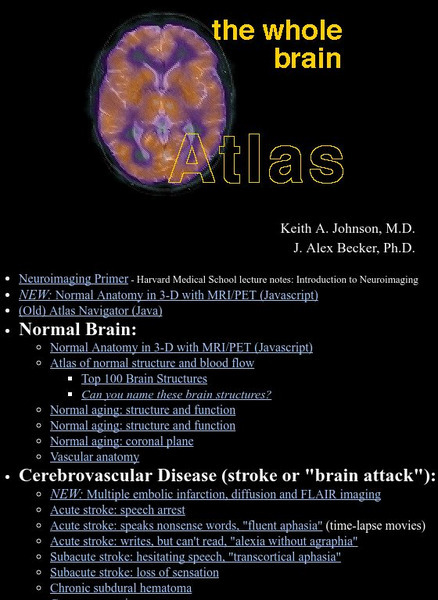
Detailed color images of the human brain, both normal and with various brain diseases, including Alzheimer's, Huntington's, multiple sclerosis, stroke, and AIDS dementia.
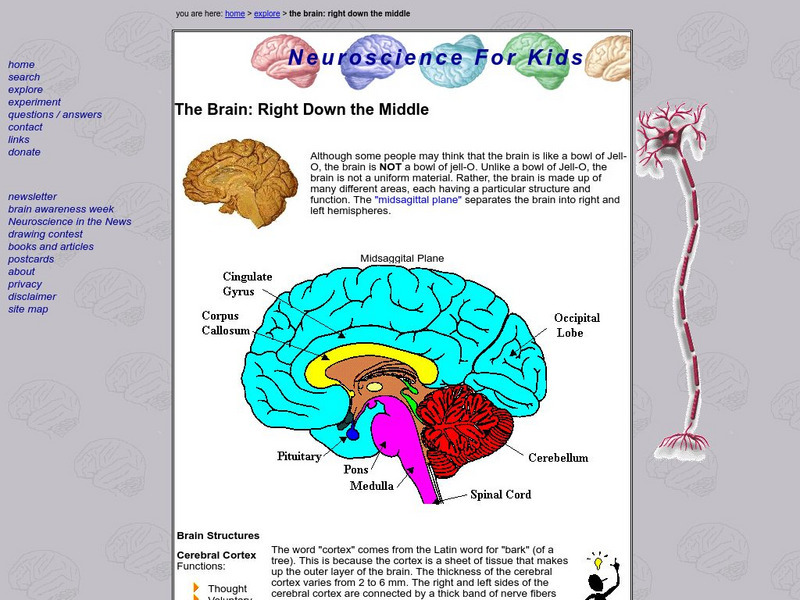
University of Washington
Univ. Of Washington: The Brain Right Down the Middle
From the University of Washington, this site goes into great detail in describing the brain.
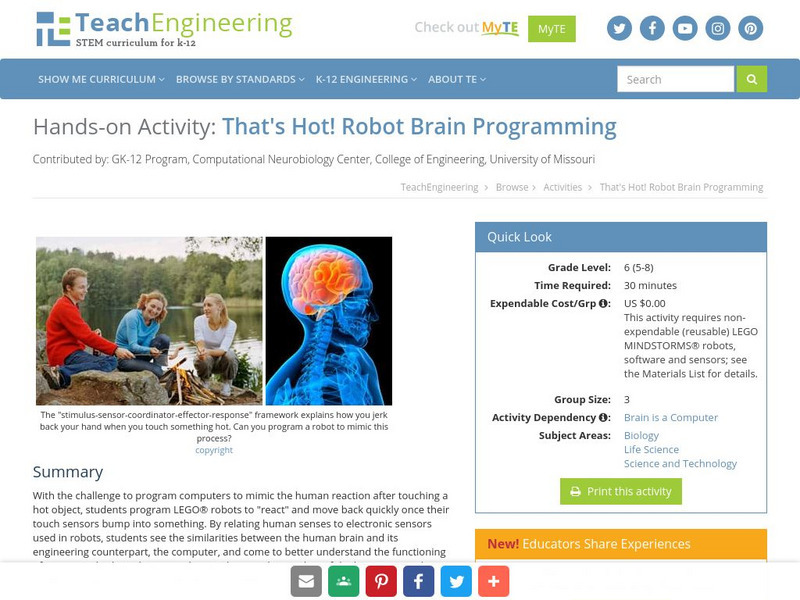
TeachEngineering
Teach Engineering: That's Hot! Robot Brain Programming
With the challenge to program computers to mimic the human reaction after touching a hot object, students program LEGO robots to "react" and move back quickly once their touch sensors bump into something. By relating human senses to...
Louisiana Department of Education
Louisiana Doe: Curriculum Hub: Ela Guidebooks: Application: Teenage Brain: Prepare for a Class Discussion
Review the academic conversation reference guide, the conversation stems, the class discussion norms, and the discussion question.
CK-12 Foundation
Ck 12: Life Science: Central Nervous System
[Free Registration/Login may be required to access all resource tools.] The central nervous system (CNS) is the largest part of the nervous system. It includes the brain and the spinal cord. The bony skull protects the brain. The spinal...

BBC
Bbc: Gcse Bitesize: How Does the Nervous System Help Us Respond? Ocr 21 C
This lesson focuses on the areas of the brain and the functions of each area. It includes a diagram of the brain with areas labeled, a table of the functions of the areas, and a link to a test.
Curated OER
Univ. Of Washington: The Brain Right Down the Middle
From the University of Washington, this site goes into great detail in describing the brain.
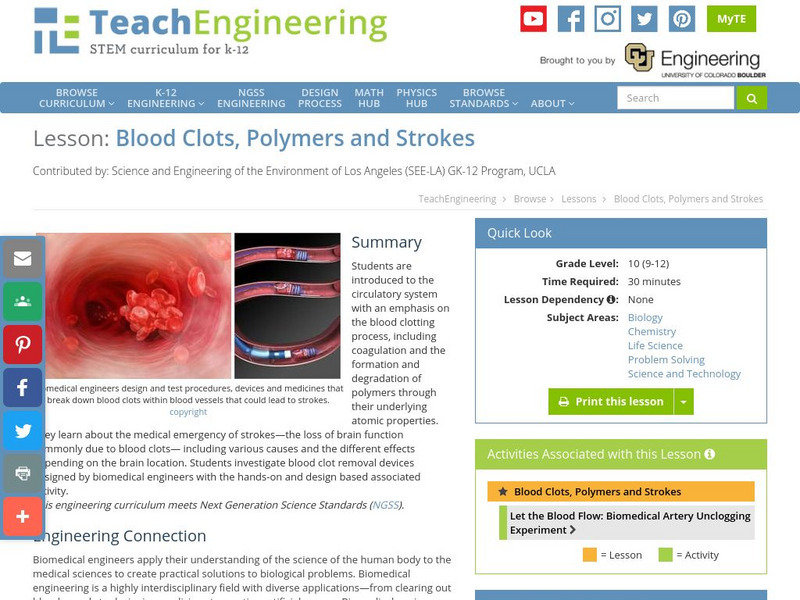
TeachEngineering
Teach Engineering: Blood Clots, Polymers and Strokes
Students are introduced to the circulatory system with an emphasis on the blood clotting process, including coagulation and the formation and degradation of polymers through their underlying atomic properties. They learn about the...
TeachEngineering
Teach Engineering: Hearing: How Do Our Ears Work?
Students learn about the anatomy of the ear and how the ears work as a sound sensor. Ear anatomy parts and structures are explained in detail, as well as how sound is transmitted mechanically and then electrically through them to the...
TeachEngineering
Teach Engineering: Sound From Left or Right?
Why do humans have two ears? How do the properties of sound help with directional hearing? Students learn about directional hearing and how our brains determine the direction of sounds by the difference in time between arrival of sound...
TeachEngineering
Teach Engineering: It's a Connected World: The Beauty of Network Science
Students learn about complex networks and how to use graphs to represent them. They also learn that graph theory is a useful part of mathematics for studying complex networks in diverse applications of science and engineering, including...
TeachEngineering
Teach Engineering: Our Bodies Have Computers and Sensors
Students learn about the human body's system components, specifically its sensory systems, nervous system and brain, while comparing them to robot system components, such as sensors and computers. The unit's life sciences-to-engineering...
TeachEngineering
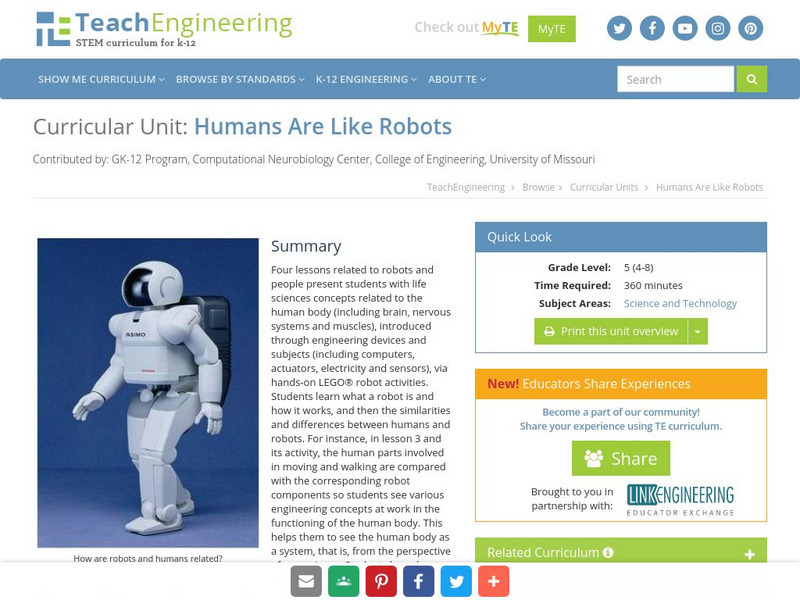
Teach Engineering: Humans Are Like Robots
Four lessons related to robots and people present students with life sciences concepts related to the human body (including brain, nervous systems and muscles), introduced through engineering devices and subjects (including computers,...
TeachEngineering
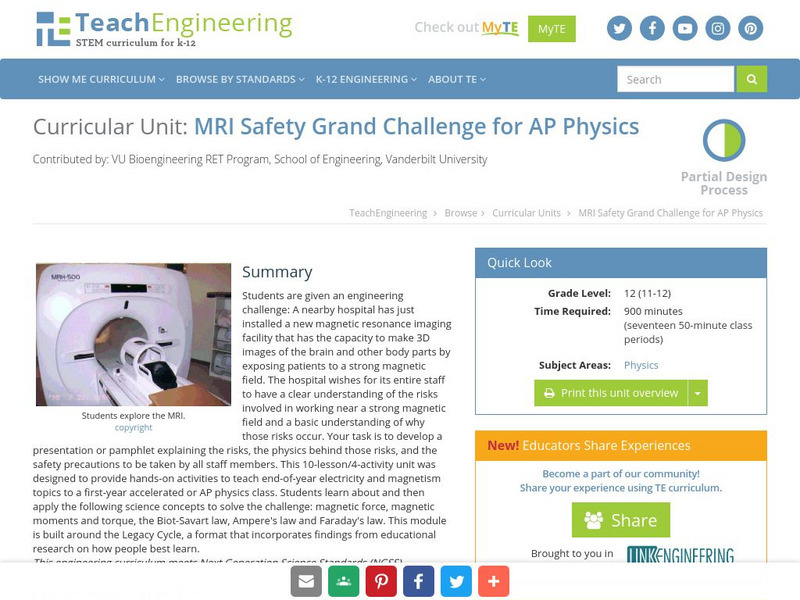
Teach Engineering: Mri Safety Grand Challenge
This module was written for a first year accelerated or AP physics class. It is intended to provide hands on activities to teach end of the year electricity and magnetism topics including the magnetic force, magnetic moments and torque,...
TeachEngineering
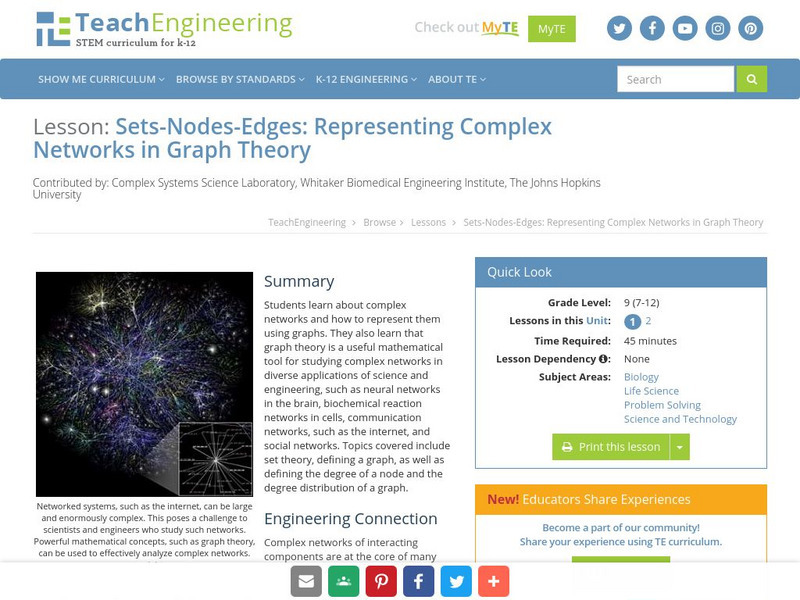
Teach Engineering: Complex Networks and Graphs
Students learn about complex networks and how to represent them using graphs. They also learn that graph theory is a useful mathematical tool for studying complex networks in diverse applications of science and engineering, such as...
TeachEngineering
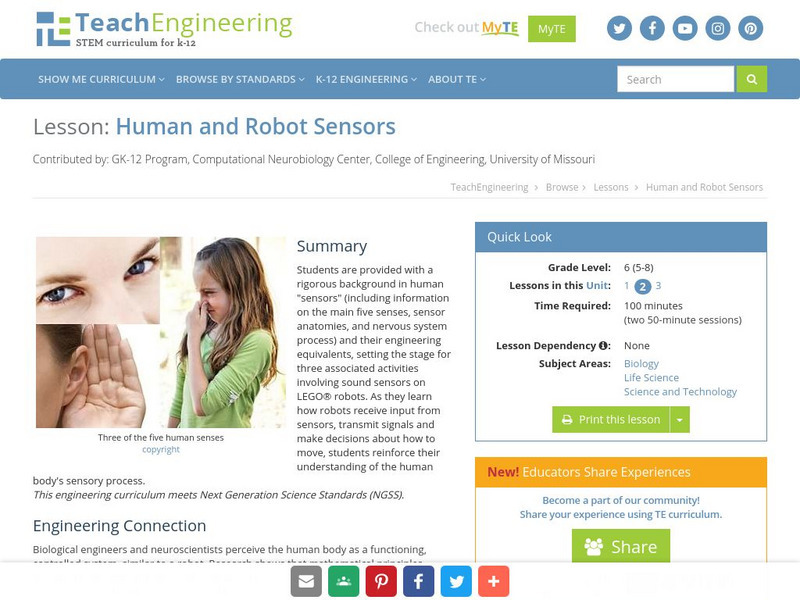
Teach Engineering: Human and Robot Sensors
Students are provided with a rigorous background in human "sensors" (including information on the main five senses, sensor anatomies, and nervous system process) and their engineering equivalents, setting the stage for three associated...
TeachEngineering
Teach Engineering: Building the Neuron
In this activity, students design and build neuron models based on observations made while viewing neurons through a microscope.
TeachEngineering
Teach Engineering: Control Using Sound
Students gain a deeper understanding of how sound sensors work through a hands-on design challenge involving LEGO MINDSTORMS NXT taskbots and sound sensors.
TeachEngineering
Teach Engineering: Don't Bump Into Me!
Students' understanding of how robotic ultrasonic sensors work is reinforced in a design challenge involving LEGO MINDSTORMS NXT robots and ultrasonic sensors.