Hi, what do you want to do?





Texas Instruments
Texas Instruments: The Bouncing Ball
In this activity, students will graph the height of a ball versus time after it is dropped from some height. They will then examine one ball bounce and investigate the parameters that effect the shape of the graph. They will also explore...
TeachEngineering
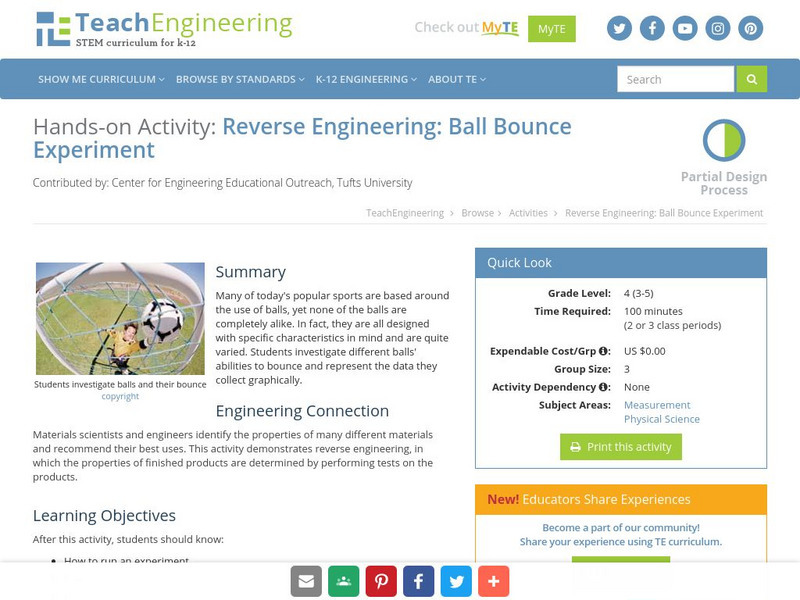
Teach Engineering: Ball Bounce Experiment
Many of today's popular sports are based around the use of a ball, yet none are completely alike. In fact they are all designed with specific characteristics in mind. Students will investigate different balls' abilities to bounce and...
Texas Instruments
Texas Instruments: The Golf Ball Challenge
In this activity, students will measure the bounce heights of golf balls dropped from a height. They examine the geometric sequence in the successive bounce heights and determine the constant or common ratio and the rate of decay of the...
Texas Instruments
Texas Instruments: Bounce Back
In this activity, students will explore the rebound height of a ball and develop a function that will model the rebound heights for a particular bounce. The model can then be used to predict the height of the ball for any bounce.
Texas Instruments
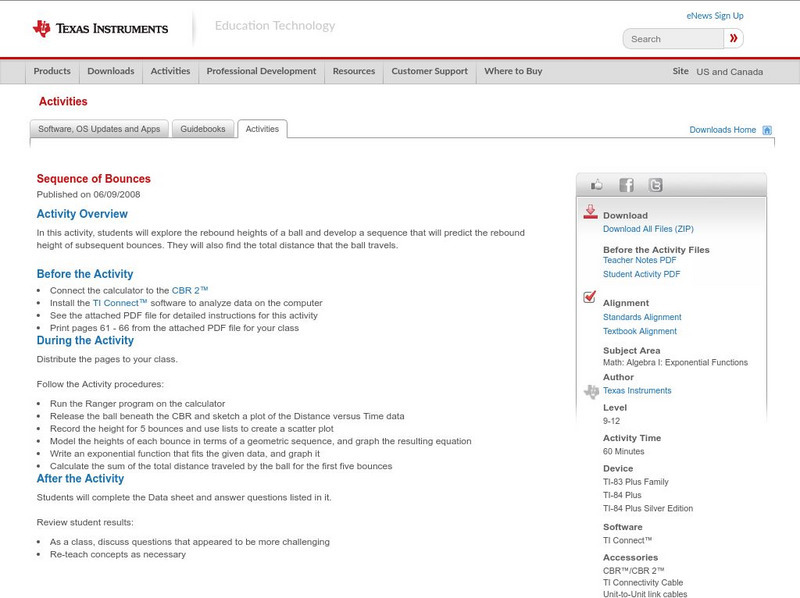
Texas Instruments: Sequence of Bounces
In this activity, students will explore the rebound heights of a ball and develop a sequence that will predict the rebound height of subsequent bounces. They will also find the total distance that the ball travels.
Texas Instruments
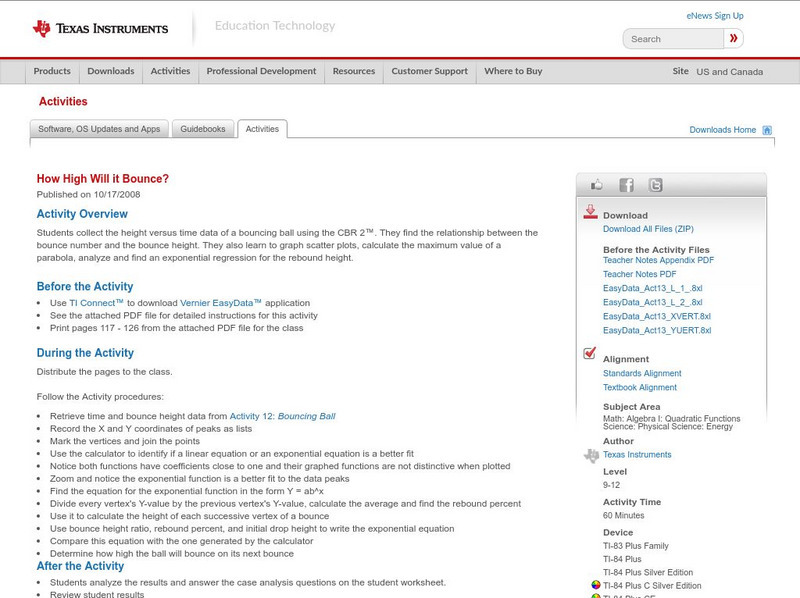
Texas Instruments: How High Will It Bounce?
In this activity, students collect the height versus time data of a bouncing ball using the CBR 2. They find the relationship between the bounce number and the bounce height. They learn to graph scatter plots, calculate the maximum value...
Texas Instruments
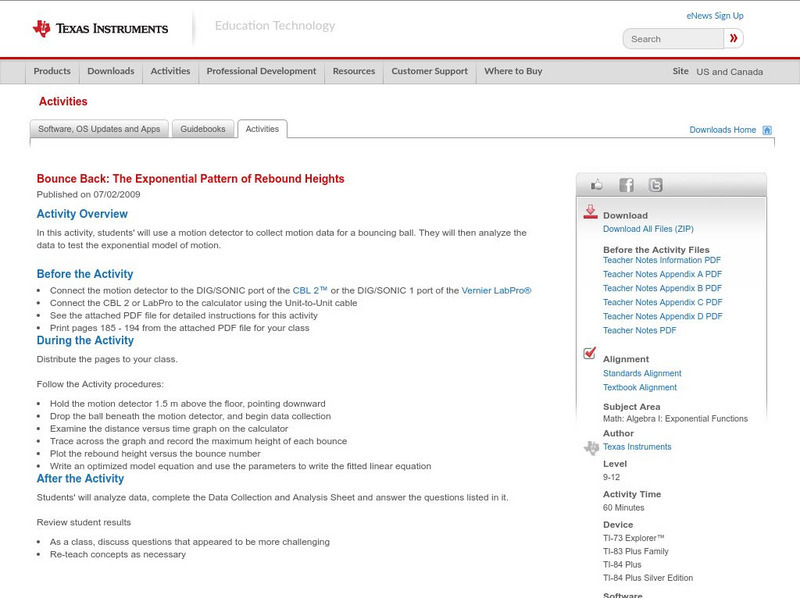
Texas Instruments: Bounce Back: The Exponential Pattern of Rebound Heights
In this activity, students' will use a motion detector to collect motion data for a bouncing ball. They will then analyze the data to test the exponential model of motion.
Texas Instruments
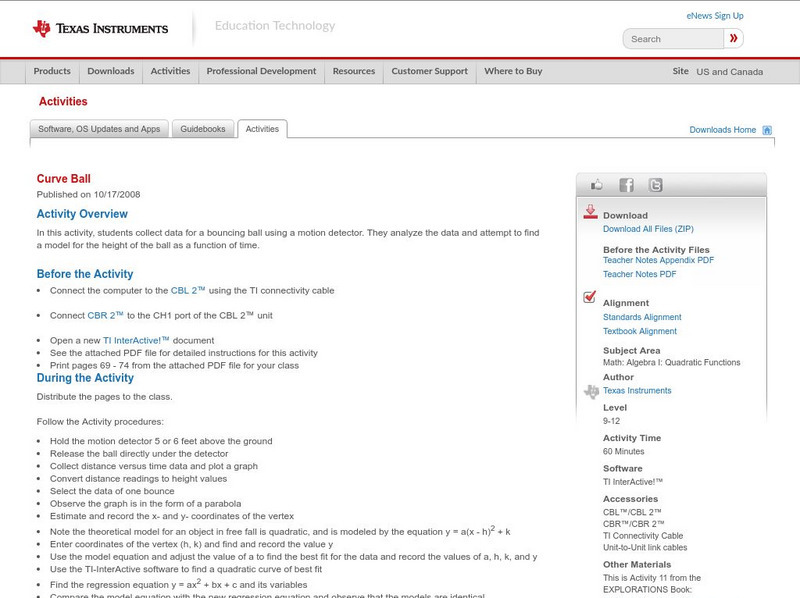
Texas Instruments: Curve Ball
In this activity, students collect data for a bouncing ball using a motion detector. They analyze the data and attempt to find a model for the height of the ball as a function of time.
Texas Instruments
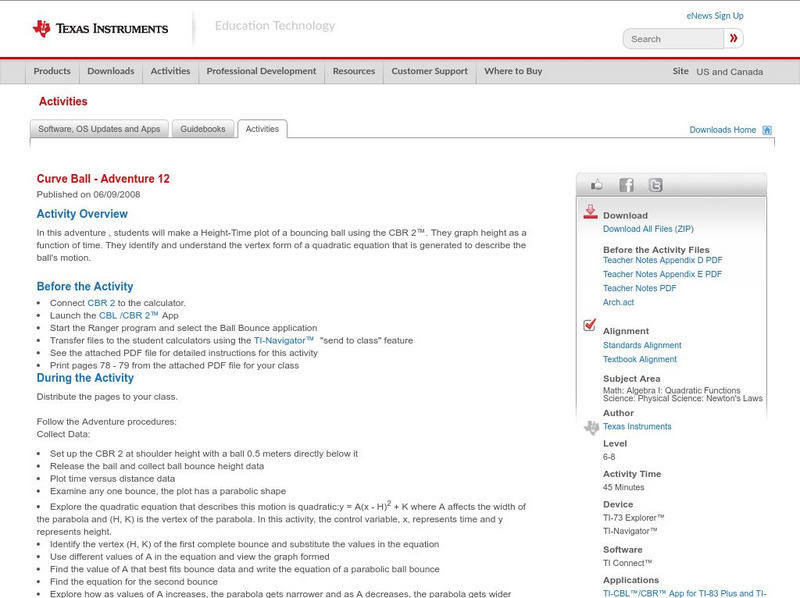
Texas Instruments: Curve Ball Adventure 12
In this adventure , students will make a Height-Time plot of a bouncing ball using the CBR 2. They graph height as a function of time. They identify and understand the vertex form of a quadratic equation that is generated to describe the...
Texas Instruments
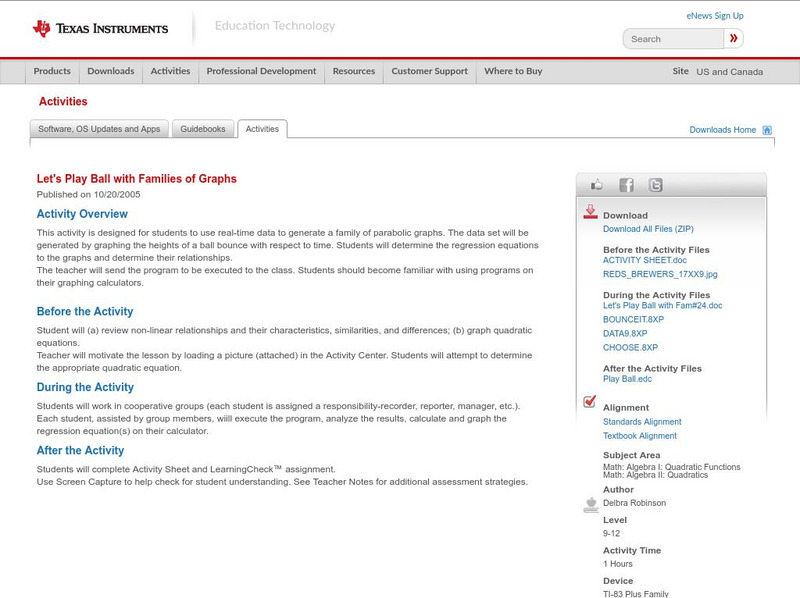
Texas Instruments: Let's Play Ball With Families of Graphs
This activity is designed for students to use real-time data to generate a family of parabolic graphs. The data set will be generated by graphing the heights of a ball bounce with respect to time. Students will determine the regression...

Colorado State University
Little Shop of Physics: The Amazing Physics of Everyday Objects
Try out these experiments you can do with items you might already have around the house: "Two Ball Bounce," "Cartesian Diver," "Straw Flute," "Bernoulli Ball," and others. Two experiments, "Imploding Pop Can" and "Balloon in a Bottle,"...

Science Buddies
Science Buddies: Follow the Bouncing Ball: A Web Animation Project
This project is a fun way to try your hand at programming and expand your knowledge of web design. You will learn how to create some simple animations, and perform tests and make measurements to help you create more realistic-looking...
TeachEngineering
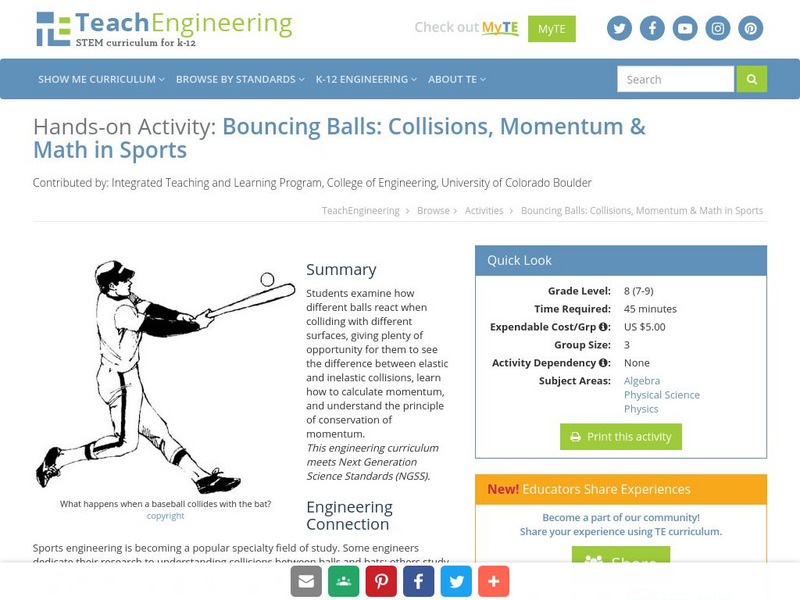
Teach Engineering: Bouncing Balls
Students examine how different balls react when colliding with different surfaces, giving plenty of opportunity for them to see the difference between elastic and inelastic collisions, learn how to calculate momentum, and understand the...
TeachEngineering
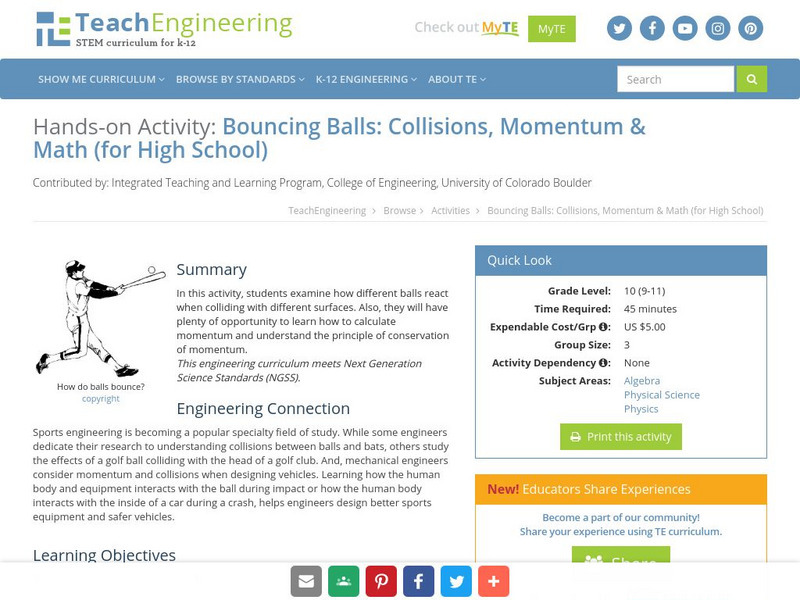
Teach Engineering: Bouncing Balls (For High School)
In this activity, students examine how different balls react when colliding with different surfaces. Also, they will have plenty of opportunity to learn how to calculate momentum and understand the principle of conservation of momentum.

PBS
Pbs Teachers: Daredevil Ball Jump Ii Experiment
Make alterations in the variables of the original ZOOM Daredevil Ball Jump activity by heating or cooling the balls in the experiment. Predict how the balls' bounces will be affected by hot and cold, test the predictions and record the...

Other
Siemens Science Day: Earth Science: Bounce
Students measure effects of elasticity by dropping rubber balls, graphing the height of the bounces, and making conclusions about the causes and effects of the bounces.

Khan Academy
Khan Academy: Squash and Stretch Animation With Bezier Curves
In this practice exercise students use the program below to create an animation of a bouncing ball. See if you can get the ball to squash as it hits the ground and stretch as it bounces back.

Khan Academy
Khan Academy: Straight Ahead Animation (Practice)
Try to make an animation of a bouncing ball by positioning the ball in each frame.

Khan Academy
Khan Academy: Save Your Animation
Make and save your own animation! Use the program below to build your animation. Now you can move the ball anywhere as well as rotate it. Use the x and y avars to position the ball. Use the s avar to control the stretch and squash, and...

Khan Academy
Khan Academy: Hands on Activity: Animating Luxo Jr.
Begin your career as an animator now! This lesson is a series of hand-drawn challenges which will introduce some basic animation principles and get you thinking about the physics of motion.
Physics Aviary
Physics Aviary: Energy Loss Lab
This lab is designed to have students investigate the amount of energy lost by a ball when it bounces. Students will change the starting height of the ball and see how this affects the amount of energy lost and the percent of the...

Khan Academy
Khan Academy: Linear Interpolation
In this 7-problem quiz/practice, calculate the position of a point using linear interpolation.
Physics Aviary
Physics Aviary: Guided Energy Loss Lab
This guided lab is designed to have students investigate the amount of energy lost by a ball when it bounces. This guided activity is meant to be used as a pre-lab for students who will do this lab live. Students will get a certificate...

American Association of Physics Teachers
Com Padre Digital Library: Open Source Physics: Galton Board Model
Simulate the binomial distribution of a Galton board as a ball is dropped into the device. Investigate the probability of the ball going to the right or to the left with each bounce off a peg.