Hi, what do you want to do?






Curated OER
Liquids of Different Densities
Students compare the densities of different liquids. In this liquids lesson plan, students compare color, viscosity, weight, volume, and graph their findings.

Curated OER
Build Your Own Submarine
Students construct their own submarine following a certain procedure. In this physics lesson, students calculate the density of objects using a mathematical formula. They explain why some object floats in water while some do not.

Curated OER
Float My Boat
Fourth graders, in groups, experiment with density and the displacement of water by creating and designing their own boats and seeing which boat holds the most centimeter cubes without sinking..

Curated OER
Float Your Boat
Students design an experiment to find density using Archimedes' Principle. In this physics lesson, students calculate density using mass and volume. They share their findings in class.

Cornell University
Buoyancy
Swimmers know to float by turning their bodies horizontally rather than vertically, but why does that make a difference? In an interesting activity, scholars explore buoyancy and the properties of air and water. They test cups to see...

Curated OER
Float Your Boat
Students investigate buoyancy, displacement and density. In this flotation lesson students study the Archimedes' Principle, analyze data and draw conclusions.

Curated OER
Clay Boats
Seventh graders are given the opportunity to use model-building as a way to help comprehend the forces and phenomena at work in the world around them. They use both successful and unsuccessful models to make inferences, refine...

Discovery Education
Sonar & Echolocation
A well-designed, comprehensive, and attractive slide show supports direct instruction on how sonar and echolocation work. Contained within the slides are links to interactive websites and instructions for using apps on a mobile device to...

Curated OER
Floaters and Sinkers
Fifth graders define density as the amount of mass per volume a material contains, compare the densities of several types of materials, especially those that sink in water compared to those that float. They use two different methods to...

Curated OER
I've Got That Sinking Feeling
Students design a simple boat and predict how much weight it can carry. They should also discover why objects float or sink and how this can be determined experimentally. A great lesson on buoyancy!

Curated OER
What Does It Matter?
Students define matter, the chemical properties of matter, and the physical properties of matter. They name physical and chemical properties of matter (by classifying using a Tree Map). Students determine the mass, volume, and density of...

Curated OER
What Does It Matter?
Students match definitions with vocabulary words and learn basic facts about matter. Then, they see how to determine the physical characteristics of matter. They determine the mass, volume, and density of objects using appropriate tools...

Curated OER
The Impact of Invention
Students explore the impact of invention. In this invention lesson, students examine how inventions are on going and affect all aspects of life in both good and bad ways. Students will research the history of invention, become an...
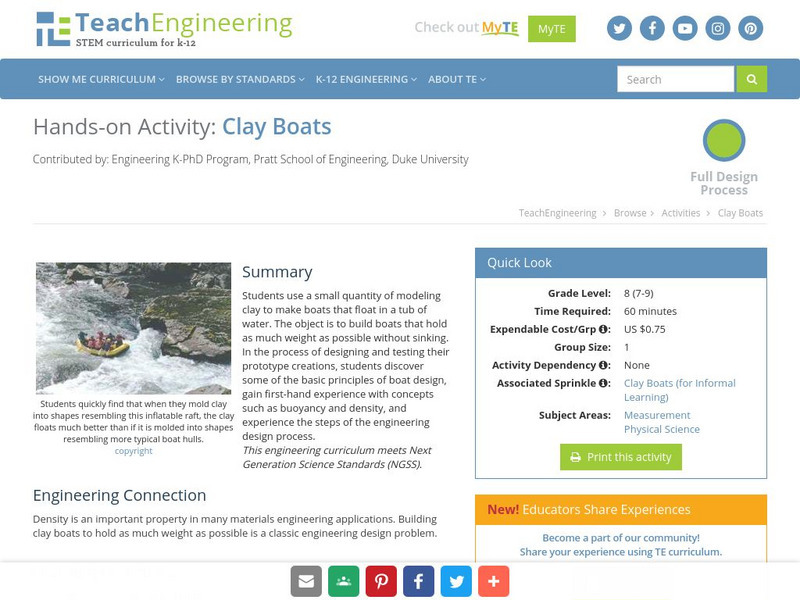
TeachEngineering
Teach Engineering: Clay Boats
Each student uses a small quantity of modeling clay to make a boat that will float in a tub of water. The object is to build a boat that will hold as much weight as possible without sinking. In the process of designing and testing their...
TeachEngineering
Teach Engineering: Taking the Boat to Manaus
In this activity, the students will apply the concepts they learned regarding mass, volume and density in the previous activities to design a boat.

TeachEngineering
Teach Engineering: What Floats Your Boat?
Young scholars use modeling clay, a material that is denser than water and thus ordinarily sinks in water, to discover the principle of buoyancy. They begin by designing and building boats out of clay that will float in water, and then...
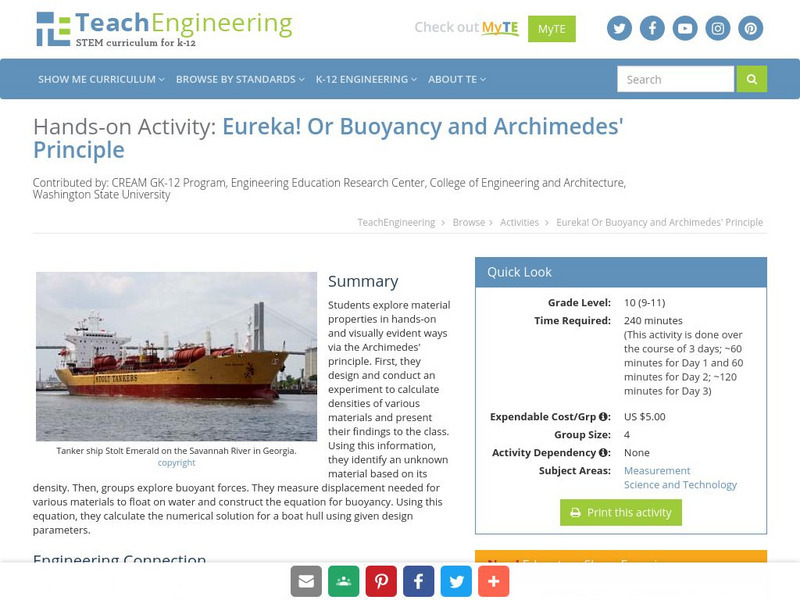
TeachEngineering
Teach Engineering: Eureka! Or Buoyancy and Archimedes' Principle
Students explore material properties in hands-on and visually evident ways via the Archimedes' principle. First, they design and conduct an experiment to calculate densities of various materials and present their findings to the class....