Hi, what do you want to do?






Curated OER
Pascal's Patterned Triangle
Fifth graders receive a brief history of Pascal's triangle. As a class the students construct the first few rows of the triangle. The students are then split into groups where they finish a worksheet identifying the total value of each...

Curated OER
Pascal's Triangle
In this Pascal's triangle instructional activity, students view Pascal's triangle and complete short answer questions about each row of the triangle. Students complete 6 questions.

Curated OER
Pascal's Triangle
In this math worksheet, students find the multiples of five that end in 0 or 5. Then they shade the numbers within Pascal's Triangle.

Curated OER
Pascal's Triangle
In this algebra activity, 11th graders solve binomials and trinomials using Pascal's Triangle theorem. They are able to factor out any amount of higher power without having to factor all the way. There are 3 problems.

Curated OER
Math History Can Help Students Overcome Learning Difficulties
Negative numbers and mathematical notation are better understood by examining how they have been handled throughout history.

Curated OER
Exploring Special Lines
Students compare and order numbers. In this geometry lesson, students write equations for inequalities. They differentiate and apply concepts of triangular properties to solve problems.

Curated OER
Eye Spy a Pattern
Fifth graders examine how to see patterns by showing how things work together. They identify, analyze and determine a rule for predicting and extending numberical patterns involving operations of whole numbers, decimals and fractions.

Curated OER
Richard's Dice
Young scholars problem solve logic problems. They complete a worksheet using dice as a manipulative. They decide on a problem solving strategy, solve the problem, and write up the solution.

Curated OER
Who Would Have Figured?
Students investigate what happens when a coin is tossed a few times versus many times. They analyze, in groups, the data from tossing coins, and the Law of Large Numbers.
University of California
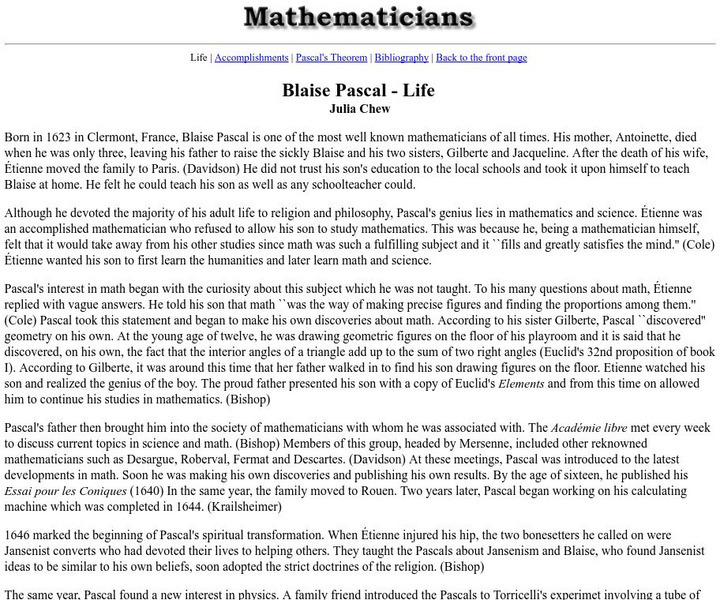
University of California Berkeley: Blaise Pascal
This site from the University of California, Berkeley provides a biography on the life of Blaise Pascal, including extensive information on his accomplishments.
Rice University
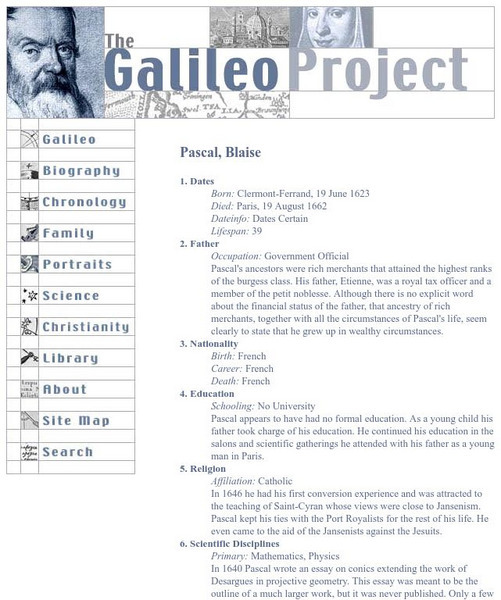
Galileo Project: Blaise Pascal
This site from The Galileo Project of Rice University provides information on ten fields of biographical data which are compiled regarding Blaise Pascal, including dates (birth/death), father (occupation/wealth), nationality, education,...
Wolfram Research
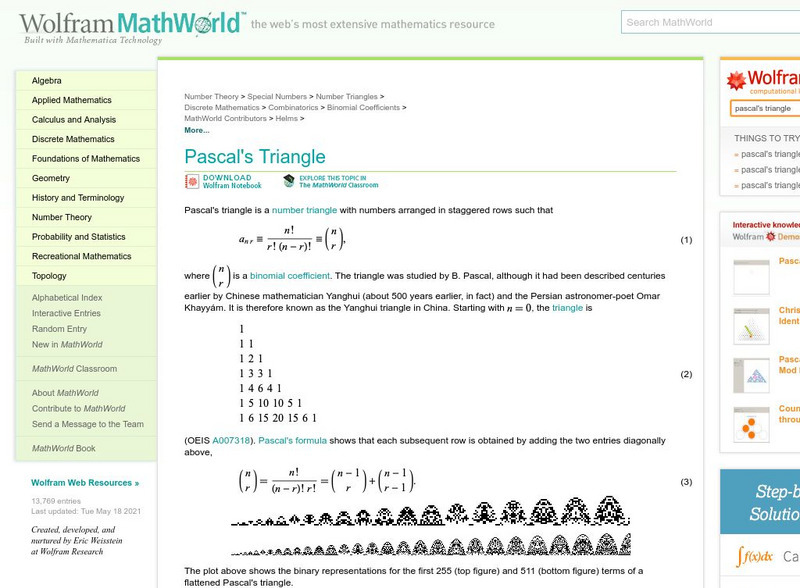
Wolfram Math World: Pascal's Triangle
This site from MathWorld provides great information on Pascal's Triangle. Links are provided throughout for additional information, along with several helpful charts and formulas. This is a good site to check out on the subject.

Instituto Latinoamericano de la Comunicacion Educativa
Red Escolar: El Triangulo De Pascal
In Spanish. Find out about the life of Blaise Pascal who discovered the famous Pascal triangle. Use their interactive activities to learn how to fill out the Pascal triangle.
Mathigon
Mathigon: Probability and Discrete Math: Introduction
This is an introduction to the study of probability. It tells the story of two of the greatest mathematicians, Blaise Pascal and Pierre de Fermat, who used coin tosses of heads or tails to determine who paid the bill. It led to the...
University of South Florida
Educational Technology Clearinghouse: Lit2 Go: History of Mathematics
Short selections from W. W. Rouse Ball's "A Short Account of the History of Mathematics," most of which are biographies that focus on the mathematician's work. The text can be read online or downloaded by individual chapters in MP3 or...
Oswego City School District
Regents Exam Prep Center: Binomial Theorem
Students learn about the binomial theorem. The tutorial includes class notes, calculator tips, examples, and practice problems with solutions. The teacher resource investigates the origins of the binomial theorem.
University of Houston
University of Houston: Lesson Plan: Famous Mathematicians
This lesson plan is aimed at 7th and 8th grade middle schoolers and involves researching famous mathematicians and the import of their contributions.