Hi, what do you want to do?






Curated OER
Not Just a Bag of Beans
Students determine the types of natural selection and variation that exists in a population, using beans.

Curated OER
Evolution Lab
High schoolers examine the pattern of natural variation in a society. They examine Darwin's theory of evolution and analyze data. They use computer programs to graphically display the variation in organisms.

Curated OER
Mammals: Mammals and Their Ways
Students study the difference between innate and learned behaviors. They observe the adaptations and behaviors of mammals in this series of lessons.

Curated OER
Transcription and Translation Lab Activity
Students investigate DNA strands. They study the sequence to determine if it is DNA or RNA and write the mRNA nucleotide sequence. After stringing the beads together to create the mRNA sequence they translate it into an amino acid...

Alabama Learning Exchange
Botany Scavenger Hunt Where's the Ginkgo?
Learners use a science journal to log plants that are native to Alabama. In this plant lesson plan, learners identify characteristics, describe environments, and classify the plants that they find.

Curated OER
Who Owns Rights to Pharmacogenetic Information?
Students develop an understanding of the rationale of ownership over scientific information. They research commercial applications of DNA sequences. They analyze how to evaluate medical ethics issues.

Curated OER
Superbugs and Antibiotic Resistance
Students complete experiments on antibiotics and antimicrobials. In groups, they explain how antibiotics affect the evolution of microorganisms. They test various types of bacteria to discover how much resistance they have to antibiotics.

Curated OER
The Birds and the Bees, and the Flowers and the Trees
High schoolers examine the roles in which animals play in the pollination of plants. They recognize that flowers have male and female sexes. Students describe cross pollination and propose reasons for cross pollination through narration...

Curated OER
What is the Relationship Between DNA and Cancer?
High schoolers examine the structure and functions of DNA. They discover the effects radon has on one's DNA and how it leads to cancer. They discuss why DNA is so important to us.

National Health Museum
Access Excellence: Molecular Biology/primate Phylogeny
This lesson plan involves comparison of amino acids to create a phylogenetic tree of primates. Students will also use other species information to draw conclusions about evolutionary relationships.
University of Washington
Genome Sciences Education Outreach: Sickle Cell Anemia [Pdf]
Students will use a Sickle Cell Anemia case study to learn about allele frequencies, genetics, and molecular biology.
Indiana University
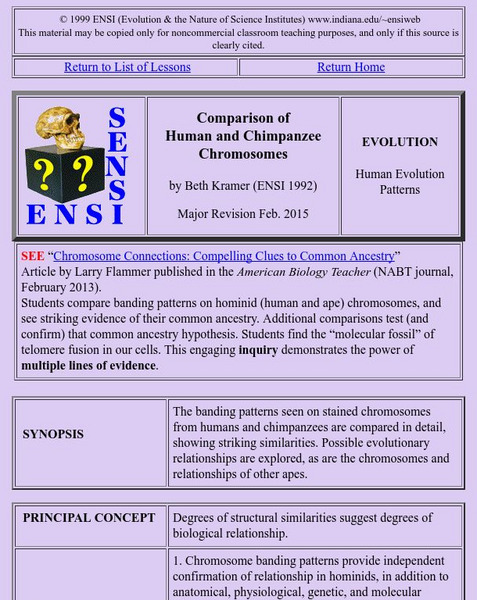
Ensi: Comparison of Human: Chimpanzee Chromosomes Lesson
This is a great lesson plan that combines Karoytypes and evolution. Students will recognize that the chromosomes of chimpanzees and humans are remarkably similar, then correlate that to their evolutionary relationship.
National Health Museum
Access Excellence: Making a Phylogenetic Tree Lesson Plan
Constructing phylogenetic trees may be a daunting task for students, but this lesson plan is a simulation of what molecular biologists must do to determine relationships. This plan is for students who have a good grasp of DNA structure...
National Health Museum
Nhm: Amino Acid Sequences Show Evolution
This lesson plan focuses on differences in the amino acid sequence of hemoglobin and myoglobin proteins. They use the number of differences to create a phylogenetic tree.
National Health Museum
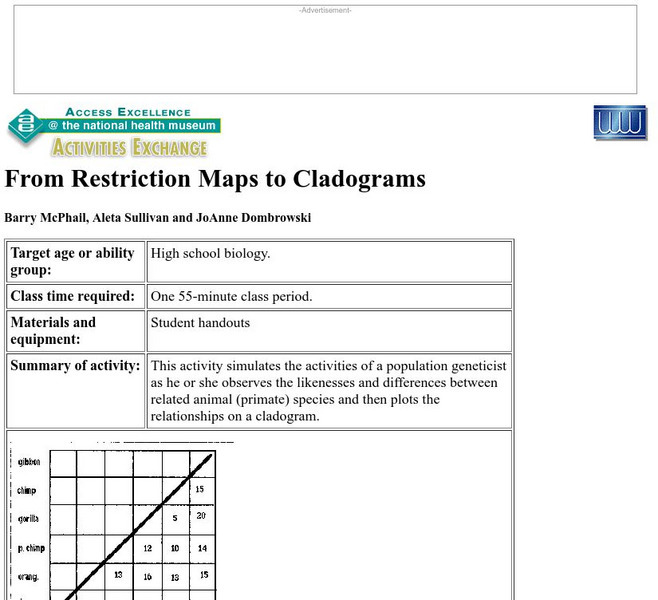
Nhm: Restriction Maps to Cladograms Lesson
This lesson plan requires young scholars to analyze DNA restriction maps to determine the differences in the sequence for several primates and humans. They then use the information to create a cladogram.