Hi, what do you want to do?





Vision Learning
Visionlearning: Biological Molecules: Fats and Proteins
An explanation of the importance of fats and proteins in the human diet. Examples of chemical structures of various fats and proteins are used.
Vision Learning
Visionlearning: Biological Molecules: Lipids
Lipids are defined. Chemical structures are used to demonstrate that fats and oils store energy.

National Institutes of Health
Ncbi: The Molecular Biology of the Cell: The Chemical Components of a Cell
Advanced chapter of the book "The Molecular Biology of the Cell" describes and provides illustrations of our most current understanding of the chemical makeup of cells and their components. Explains in detail how electron activity keeps...
Khan Academy
Khan Academy: Biology: Chemistry of Life: Chemical Bonds
Review over covalent, hydrogen, and ionic bonding in this article. Learn how molecules are held together by chemical bonds.

Ducksters
Ducksters: Biology for Kids: Carbohydrates
Kids learn about the carbohydrates in the science of biology. These organic molecules make up starches and sugars which provide energy for plants and animals.
Vision Learning
Visionlearning: Biology: Dna Ii: The Structure of Dna
Instructional module focusing on the physical structure of DNA. Discussion incorporates the description of the nucleotides, base pairs, and the double helix shape of a DNA molecule. Site also includes an interactive practice quiz and...
University of Arizona
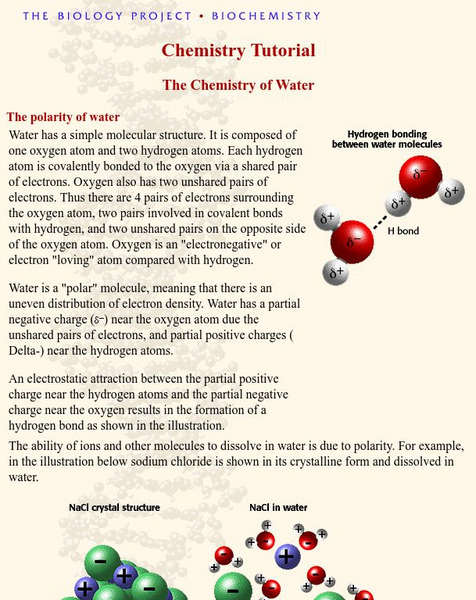
Ua: Chemistry Tutorial
This general tutorial begins with an explanation of the polarity of the water molecule and the effects this polarity has on the properties of water. Goes on to introduce organic molecules and has a thourough tutorial on the third page.
Khan Academy
Khan Academy: Active Transport
Learn about gradients of molecules that exist across cell membranes, how they can help or hinder transport, and how active transport mechanisms allow molecules to move against their gradients.

Khan Academy
Khan Academy: The Calvin Cycle
Learn about the three stages of the Calvin Cycle reactions: carbon fixation, reduction, and regeneration of the starting molecule. See how the products of the light reactions, ATP and NADPH, are used to fix carbon into sugars in this cycle.

Khan Academy
Khan Academy: Connections Between Cellular Respiration and Other Pathways
Resource examines how non-glucose molecules such as carbohydrates, proteins, and lipids enter the cellular respiration pathway. Also, looks at the use of cellular respiration intermediates for biosynthesis.