Hi, what do you want to do?






National Institute of Open Schooling
The Liquid State
Due to surface tension, dew — a liquid, is spherical in shape. Learners explore the properties of liquids in activity seven in this series of 36. Beginning with its basic properties such as boiling point and moving through to surface...

Curated OER
Rules for Balancing REDOX Equations: (Half-Reaction Method)
In this chemistry worksheet, students read the instructions of how to work with the following: acidic and basic solutions, total and net ionic equations, and how to relate these to each other.

National Institute of Open Schooling
Hydrogen and s-Block Elements
Lesson 19 in the series of 36 analyzes the element hydrogen and the s-block elements. Through readings, answering questions, and discussion, learners write about and explain their occurrence, physical and chemical properties, and...

National Institute of Open Schooling
Ionic Equilibrium
Scientific studies show the older we get, the more acidic we become. The activity extensively teaches high schoolers about acids and bases. By the end of the 14th installment of 36, they can define and explain three concepts of...
NASA
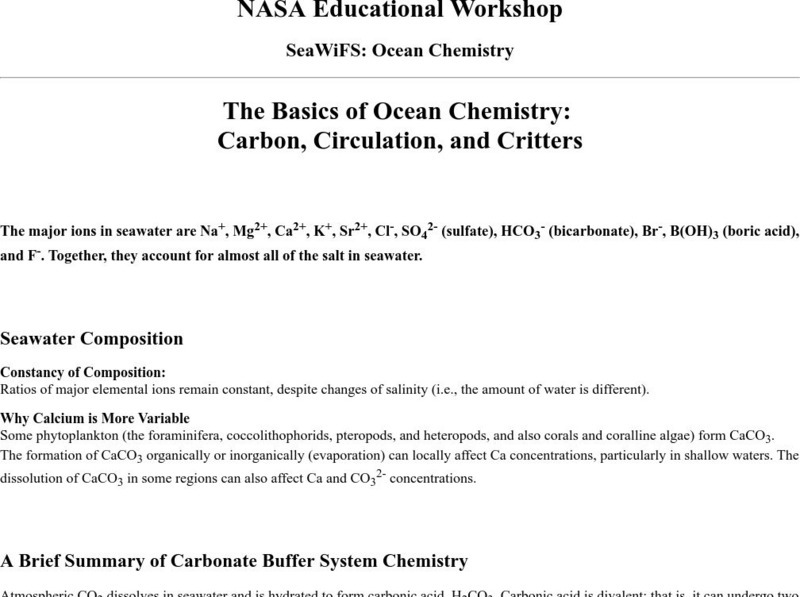
Nasa: The Basics of Ocean Chemistry: Carbon, Circulation, and Critters
An explanation of ocean chemistry, supported by illustrations, for example, of the global carbon cycle in the 1980s and the annual carbon dioxide flux. The concentration of nutrients in the ocean is discussed for its impact on marine...
eSchool Today
E School Today: Your Cool Basics on Ocean Acidification
Looks at ocean acidification, what causes it, the impact of it, and possible ways to reduce it.