Hi, what do you want to do?






Curated OER
Mathematics: Budgeting
Young scholars develop a month long budget. They use problem solving skills to adjust their budgets for unforeseen expenses. They use checks to pay mock bills.

Khan Academy
Khan Academy: Lesson Summary: Banking and the Expansion of the Money Supply
This lesson summary from Khan Academy is intended for students who are taking the AP Macroeconomics course. In this lesson summary will review key terms and calculations related to fractional reserve banking, required reserves, excess...
![Federal Reserve Bank of New York: Econ Explorers Journal [Pdf] Lesson Plan](https://static.lp.lexp.cloud/images/attachment_defaults/resource/large/FPO-knovation.png "Federal Reserve Bank of New York: Econ Explorers Journal [Pdf] Lesson Plan")
Other
Federal Reserve Bank of New York: Econ Explorers Journal [Pdf]
In this collection of activity activities, students will complete an "Econ Explorers Journal" to help them learn how economics is involved in their neighborhood, the books they read, in earning a living, at their banks, in their homes,...
iCivics
I Civics: Banks, Credit & the Economy
This lesson focuses on the relationship between money, banks, and lending in our economy.
Council for Economic Education
Econ Ed Link: Banks & Credit Unions (Part I)
Young scholars learn about banks and credit unions, identifying similarities and differences between the two types of financial institution. They also evaluate a local bank and credit union to determine which one would be better suited...
University of Nebraska Omaha
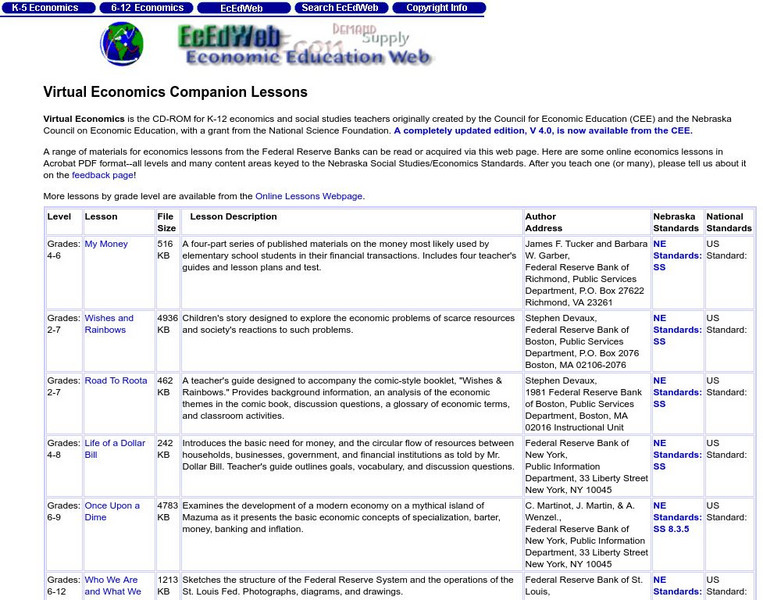
Ec Ed Web: Virtual Economics Web Companion
The Virtual Economics Web Companion for K-12 economics and social studies teachers was created by the National Council on Economic Education. A wide variety of educational materials and lesson plans can be accessed through this site....
PBS
Pbs Teachers: Electric Money Teaching Guides (History of Money Resources)
Five teaching guides containing interdisciplinary lessons that can be used to explore the characteristics of money; how credit, debit, and smart cards work; financial markets and transactions; and similar topics. Designed as complements...
Federal Reserve Bank
Federal Reserve Bank of St. Louis: Less Than Zero [Pdf]
This lesson accompanies a story by Stuart J. Murphy called Less Than Zero and teaches students about how to manage their money by saving it and setting goals for themselves.
Council for Economic Education
Econ Ed Link: You Can Bank on This! (Part 1)
This is the first of four lessons on banking for elementary students. This lesson provides the students with information on banking; it also allows them to try out some procedures for thinking about money and banking. There is a link to...
Crayola
Crayola: Money in the Bank
Young bankers and storekeepers practice counting money and making change. They keep their money in this recycled-box bank.
PBS
Pbs: Your Life, Your Money: Educators & Families: Picking a Bank
Learn how to select a bank through comparing and contrasting bank options.
Council for Economic Education
Econ Ed Link: The Story of Jack and the Bank Stalk
Fairy tales have always been used to give lessons about life. The story of Jack and the Bean Stalk is a good lesson about the importance of knowing about money and banks. The story of Jack asks the question, "What is money?"
Federal Reserve Bank
Federal Reserve Bank of Atlanta: Building Block Barter Lesson
Lesson plan for 3 - 5 graders about the advantages of using money instead of bartering.
Council for Economic Education
Econ Ed Link: Agent Pincher: P Is for Penny or Where Did Money Come From?
What if we woke up tomorrow and found that there were no more pennies? Or what if we found that money had disappeared altogether -- not only from our pockets but from banks, stores and all the other places where we would expect to find...
Council for Economic Education
Econ Ed Link: Multipliers and the Mystery of the Magic Money
Students learn about the purpose of the reserve requirement, how money is "created" in the economy through fractional reserves, and how the Federal Reserve uses the reserve requirement and loans to correct economic instability.

University of Missouri
University of Missouri: Wise Pockets: Berenstain Bears' Trouble With Money
Using a Berenstain Bears' book, students are introduced to concepts such as spending, goods, services, income, saving, and interest. Lesson is detailed and has good activities. Includes questions about the story that teach students about...
Council for Economic Education
Econ Ed Link: It's a Not So Wonderful Life
In this instructional activity students learn about banks and banking. The study the fractional reserve system, and the role the Fed plays in the money creation process.
Better Lesson
Better Lesson: Loans and Savings
What are loans and how do they work? How do banks encourage people to save money? Students work on these questions in the context of the College Project.
Council for Economic Education
Econ Ed Link: Big Banks, Piggy Banks
When choosing a place to put their money, people consider how safe there money will be, how easy it is to access, and whether it will earn more money. Learners explore how well different savings places achieve these objectives. This...
Council for Economic Education
Econ Ed Link: Banking Is Interest Ing!
Banks are important to Americans. We use banks to save money and earn interest, or borrow money and pay interest. This lesson introduces the concepts of banking to children.
University of Missouri
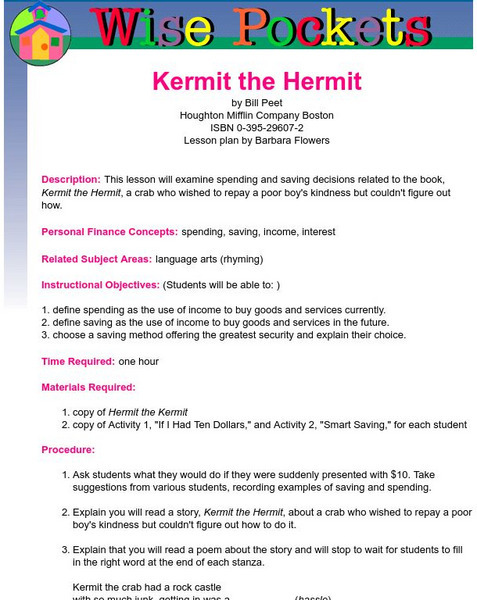
University of Missouri St. Louis:wise Pockets: Kermit the Hermit
This is an elementary level lesson that deals with spending, saving, income, and interest. Requires the book Kermit the Hermit by Bill Peet. Includes detailed lesson plan along with procedures and activities.
Discovery Education
Discovery Education: Money: Kids and Cash
This site provides a lesson about the dynamics of saving and borrowing with banks.
Illustrative Mathematics
Illustrative Mathematics: 6.rp Currency Exchange
Students use ratio and rate to answer this performance task: Joe was planning a business trip to Canada, so he went to the bank to exchange $200 U.S. dollars for Canadian dollars (at a rate of $1.02 CDN per $1 US). On the way home from...
Illustrative Mathematics
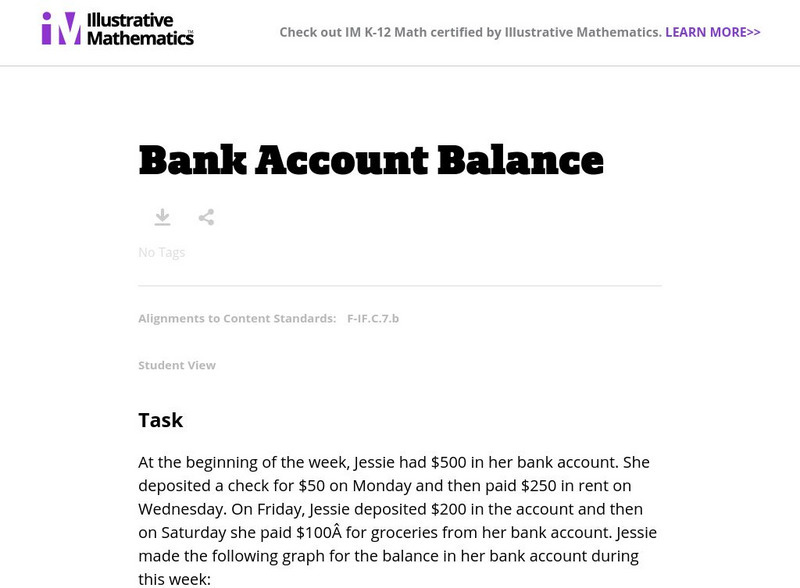
Illustrative Mathematics: F if Bank Account Balance
This task introduces the concept of a step function. It is about the changing balance in a bank account as money is deposited and removed. Aligns with HSF-IF.C.7.b.