Hi, what do you want to do?






Khan Academy
Khan Academy: The Mole and Avogadro's Number
An explanation the mole (named for molecule) and Avogadro's Number. One mole of a substance is equal to 6.022 times 10 to 23rd power units of that substance (such as atoms, molecules, or ions). The number 6.022 time 10 to 23rd power is...
Chiral Publishing
Chiral Publishing: An Introduction to Chemistry: Relating Mass to Number of Particles: Audio Book
This slide and audio book shows how to relate mass to a number of particles by using many formulas, examples, and real life scenarios. View the weighted average calculations, Avogadro's number, the atomic mass of carbon, and molar mass.

TED Talks
Ted: Ted Ed: How Big Is a Mole? (Not the Animal, the Other One.)
Video describes how moles are used in chemistry and how their size is measured. [4:33] Followed by a short quiz and a list of additional resources to explore.
Other
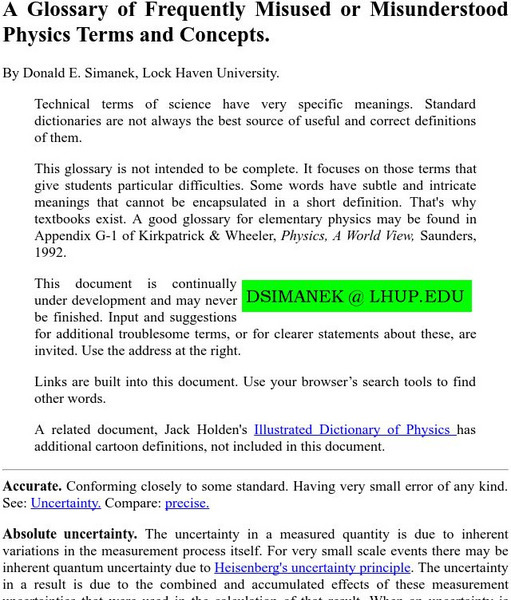
Lock Haven: Glossary of Frequently Misused or Misunderstood Physics Terms
A page, written by Donald E. Simanek of Lock Haven University discusses misused and misunderstood physics terms and concepts. It reminds us that Avogadro's number is a constant, and should be treated as such.
Sophia Learning
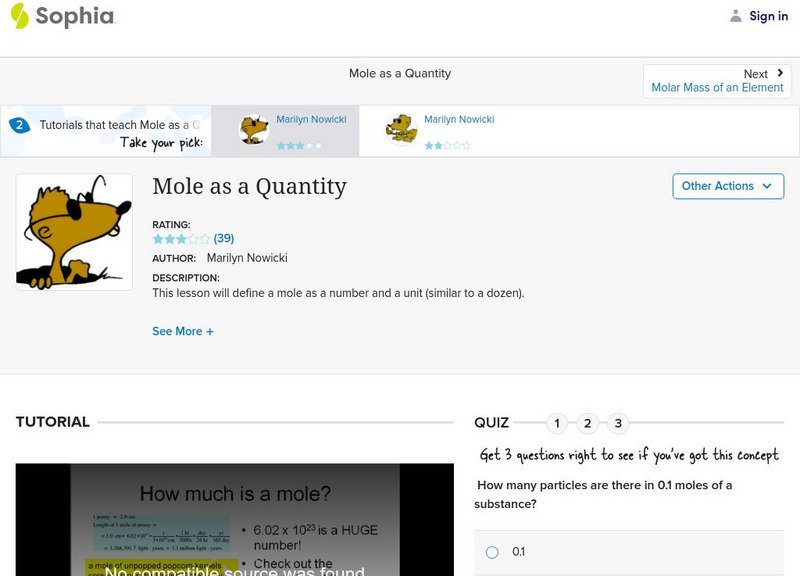
Sophia: Mole as a Quantity
Learn how to define a mole as a number, and estimate the size of a mole of some common objects. [3:18]
CK-12 Foundation
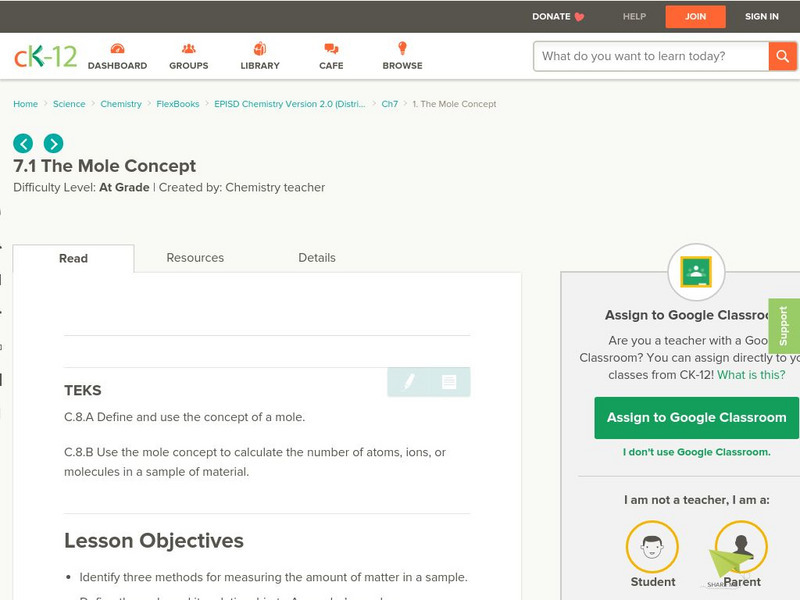
Ck 12: The Mole Concept
[Free Registration/Login may be required to access all resource tools.] In the following online tutorial students will identify three methods for measuring the amount of matter in a sample. They will define the mole and its relationship...

Chiral Publishing
Chiral Publishing: An Introduction to Chemistry: Avogadro's Law: Volume Number of Particles
Animation depicting Avogadro's Law or how the volume of a gas is affected by the number of gas particles. See what happens to the volume of a gas when the pressure and temperature stay constant.
CK-12 Foundation
Ck 12: Chemistry Simulation: Mole Carnival
[Free Registration/Login Required] In the mole carnival, students count the number of atoms and particles in different objects found at the carnival. As students work to find the number of particles, they practice counting particles by...
CK-12 Foundation
Ck 12: Gas Properties
[Free Registration/Login may be required to access all resource tools.] The following online tutorial describes how a gas can be compressed and identifies three factors that affect gas pressure. Students will describe the effects...
Chemistry Collective
Chem Collective: Stoichiometry Tutorials: Dimensional Analysis
Watch a short tutorial showing the conversion between the amount of a substance expressed in number of molecules to the amount of a substance expressed in moles of molecules, and then try some dimensional analysis practice problems.
Cosmo Learning
Cosmo Learning: Junior Chemistry With Chemguy
A collection of video lectures to teach junior high students topics in chemistry. Lectures cover topics in understanding the periodic table, compounds, chemical bonding, Avogadro's number, balancing chemical equations, stoichiometry,...
Sophia Learning
Sophia: Mole as a Quantity: Lesson 2
This lesson will define a mole as a number and a unit (similar to a dozen). It is 2 of 2 in the series titled "Mole as a Quantity."
Georgia Department of Education
Ga Virtual Learning: Chemistry: Gas Laws
Through informational text, interactive practice problems, virtual simulations, and video clips, students learn about the gas laws.
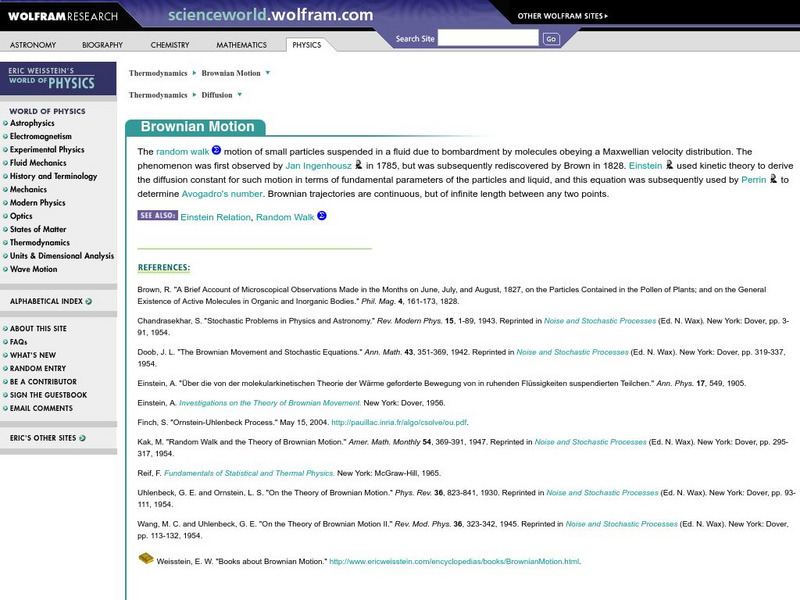
Wolfram Research
Wolfram Science World: Brownian Motion
This site from ScienceWorld gives a brief description of Brownian motion. It also goes on with a detailed series of formula derivations utilizing calculus. Links to related topics and definitions are given.

Sophia Learning
Sophia: Converting From Grams to Particles: Lesson 2
This lesson demonstrates how to convert from grams to particles (molecules, atoms, ion). It is 2 of 2 in the series titled "Converting from Grams to Particles."
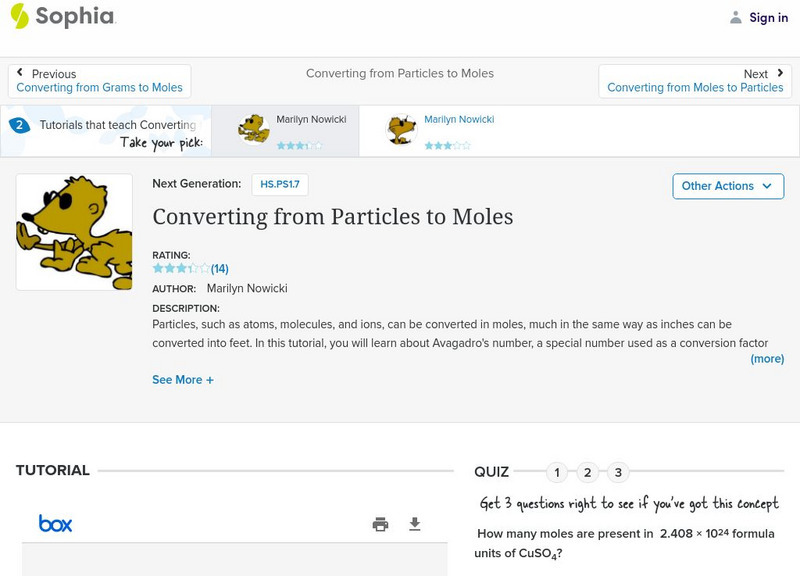
Sophia Learning
Sophia: Converting From Particles to Moles
A guided slide show presentation illustrating how to convert from particles to moles.
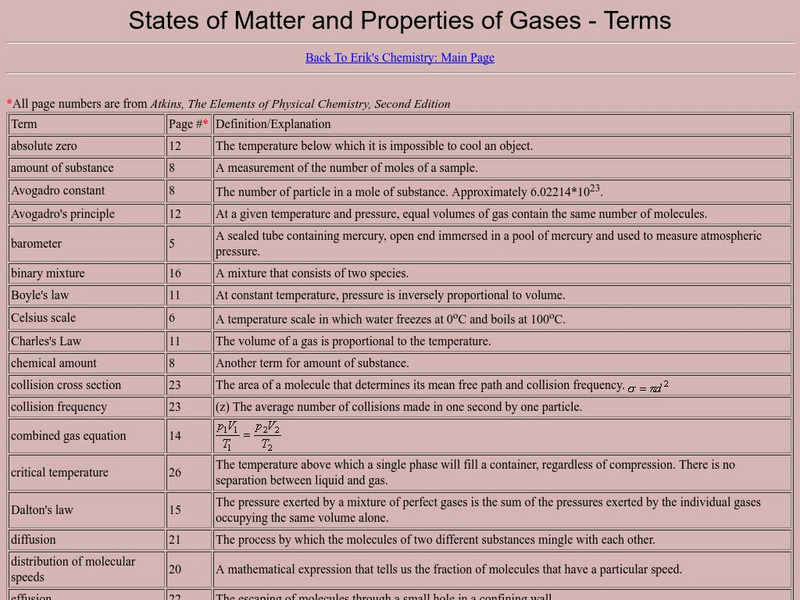
Other
States of Matter and Properties of Gases: Terms
A very complete list of terms that are important to the study of gases. This resource is a web archive.

Sophia Learning
Sophia: Converting From Moles to Particles: Lesson 2
This lesson demonstrates how to convert from moles to particles (molecules, atoms, ion). It is 2 of 2 in the series titled "Converting from Moles to Particles."