Hi, what do you want to do?






Curated OER
20/20 Vision
Young scholars determine their own eyesight and calculate what a good average eyesight value for the class would be. They examine how technology enhances eyesight and how engineers play an important role in the development of these...

Curated OER
20/20 Worksheet
In this eyesight worksheet, students figure out their vision in both eyes and the vision for their classmates. Students determine the average eyesight for their class. This worksheet has 5 fill in the blank, 3 short answer, and 1 graphic...

Curated OER
Bat Ecology
Students, through hands on games and activities, discover how bats live and how bats benefit ecosystems. They play a game designed to show them how echolocation works and another to show how mother bats locate their young through their...

Global Oneness Project
Witnessing Icebergs
Camille Seaman's photoessay, "Witnessing Icebergs" documents just a tip of the problem of climate change through images of icebergs in both the Arctic and Antarctic polar regions. After viewing the haunting images, viewers respond...

Curated OER
The Ocean Floor
Practice reading comprehension by approaching oceanography through 2 pages of informational text. The text compares the ocean floor to the Grand Canyon to gives students perspective, and gives a brief coverage of the earth's crust and...

Curated OER
How Many Stars are in the Sky?
In this star count worksheet, students solve three problems using a given polynomial and its logarithm to determine the number of stars in a given area.

Curated OER
Meteor, Meteoroid, Meteorite: What's the Difference?
Learners explore the difference between a meteor, meteorite and meteoroid. In this space science lesson plan, students first read information about these space bodies. Learners make Comet Cookies and use them to model a meteor shower...

Curated OER
Explorit's Tree Quiz
In this online interactive tree quiz worksheet, students respond to 6 questions. Students may check their answers for accuracy.
TeachEngineering
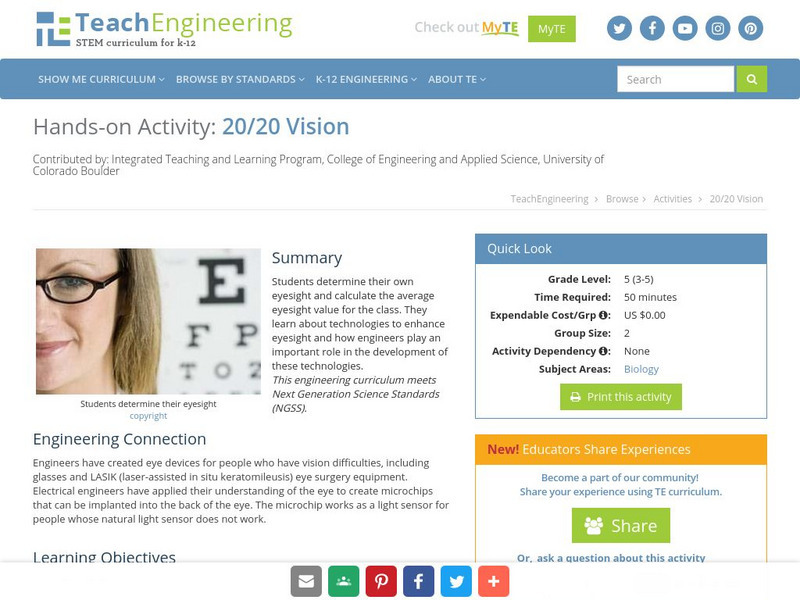
Teach Engineering: 20/20 Vision
In this activity, students determine their own eyesight and calculate what a good average eyesight value for the class would be. Students learn about technologies to enhance eyesight and how engineers play an important role in the...
TeachEngineering
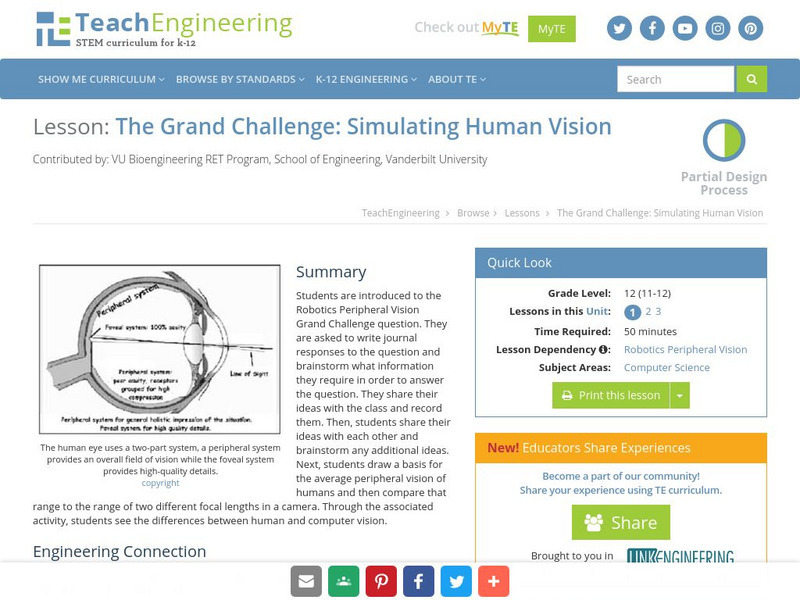
Teach Engineering: The Grand Challenge: Simulating Human Vision
Students are introduced to the Robotics Peripheral Vision Grand Challenge question. They are asked to write journal responses to the question and brainstorm what information they require to answer the question. Their ideas are shared...

PBS
Pbs Nature Critter Guide: Porcupine
This PBS Critter Guide site tells you how many quills the average porcupine has as well as other facts about this creature's natural history in text and pictures.
TeachEngineering
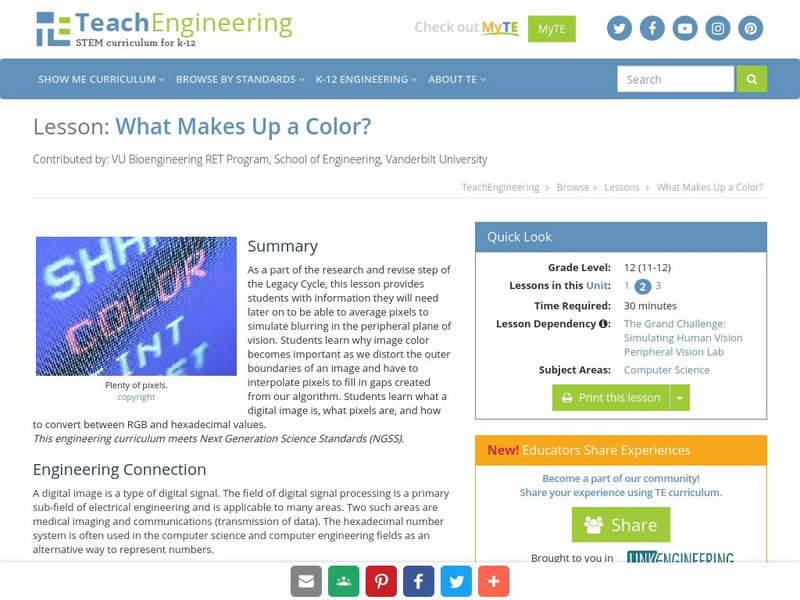
Teach Engineering: What Makes Up a Color?
As a part of the research and revise step of the Legacy Cycle, this lesson plan provides students with information they will need later on to be able to average pixels to simulate blurring in the peripheral plane of vision. Students...