Hi, what do you want to do?






Curated OER
Language Arts: Creating Original Fiction
Fourth graders create fictional stories and demonstrate the use of various writing techniques. After selecting their main ideas, they find appropriate graphics to use as illustrations. In groups, 4th graders apply Hyperstudio in...

Curated OER
Sunscapes
Students share their observations of the Sun, then analyze images collected by NASA's Solar and Heliospheric Observatory. They create exhibitions for presentations.

Curated OER
Show Some Backbone and Teach Invertebrates
Fifth graders identify two similarities and two differences between two phyla, assign fictitious invertebrate to its phylum and explain why it belongs in that grouping, and construct member of given phylum and explain why it should be...

Curated OER
Do You See What I See?
Students hypothesize the role of rocks, soil, and water by observing a terrarium and create a model to explore the water cycle. This is part of a five station set up.

Curated OER
If a Picture's Worth a Thousand Words...
Students examine the debate between the preservation of and access to historical artifacts. They explore the notion of ownership and commodification of historical artifacts and come up with a plan for compromise.

Curated OER
Tasmanian Time Travel
Sixth graders perform research using the Internet about the Tasmanian Devil. The project can be presented in a variety of ways. The use of computer software is important for students to know, specifically Hyperstudio.

Curated OER
Class Field Trip Itinerary
Students create fictional field trips for their class. In this field trip itinerary activity, students create an itinerary of a typical day of a student and plan a class field trip related to one of their current courses.

Texas Education Agency
Texas Gateway: Make Inferences in Informational/expository Text
[Accessible by TX Educators. Free Registration/Login Required] In this lesson, you will be taking a look at how authors of informational texts, such as expository texts, organize their writing and the effects that organization can have...
Tom Richey
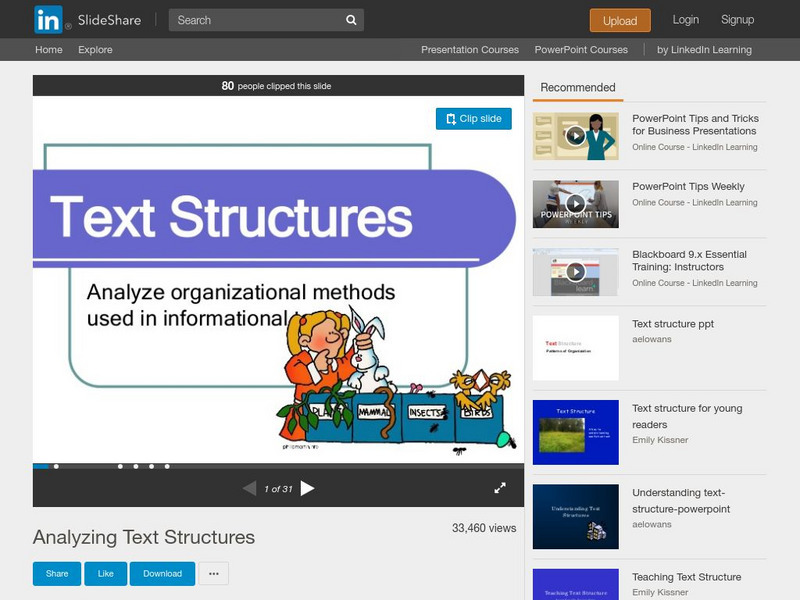
Slide Share: Text Structures: Analyze Organizational Methods
This slideshow focuses on text structures for informational texts including how the author's purpose helps determine the organizational pattern to use and how the reader can use clues to identify the text structure used. Five...
Better Lesson
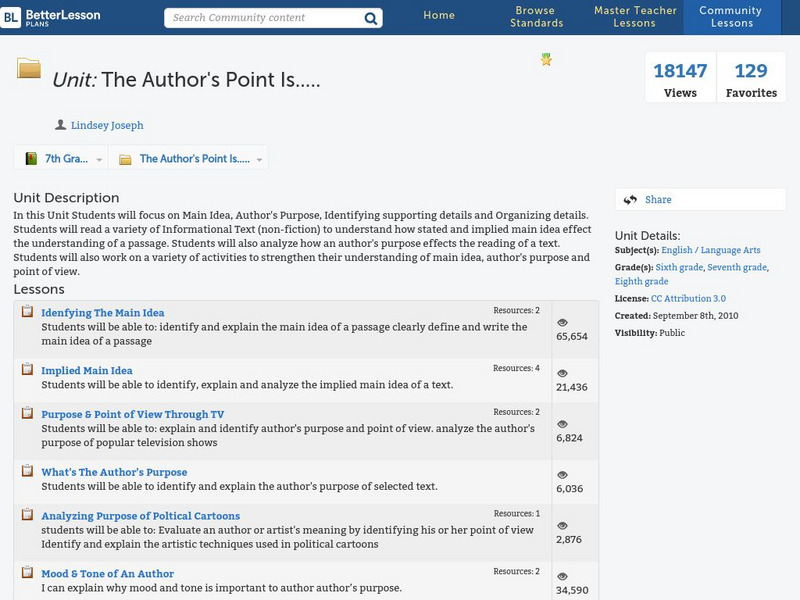
Better Lesson: Unit: The Author's Point Is
Students will focus on Main Idea, Author's Purpose, Identifying supporting details and Organizing details. Students will read a variety of Informational Text (non-fiction) to understand how stated and implied main idea effect the...

E Reading Worksheets
E Reading Worksheets: Text Structure Worksheet 8: Smart Phones
This is a PDF worksheet that provides six reading passages related to smart phones to help your students master text structure (patterns of organization) in informational text. RI.9-10.3 author unfolds
Other
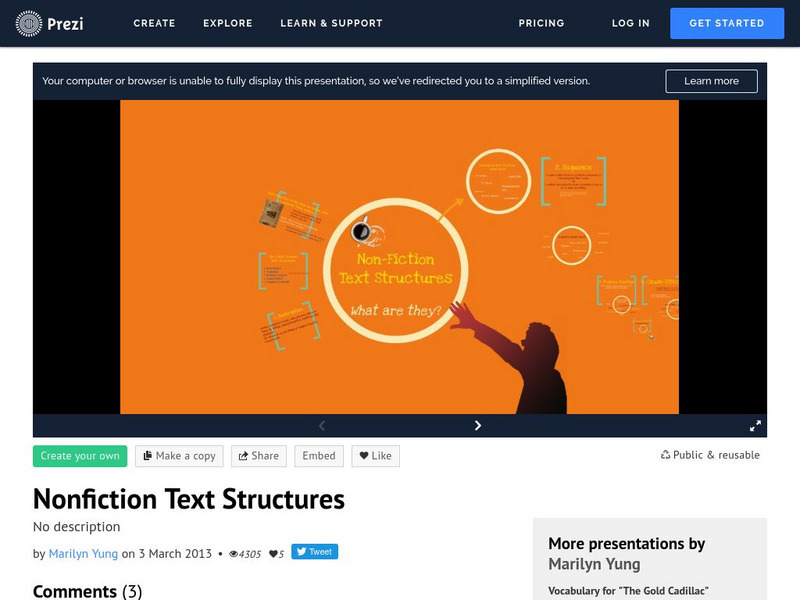
Prezi: Nonfiction Text Structures
Slideshow examines the five most common text structures used by authors to organize nonfiction writing.
Scholastic
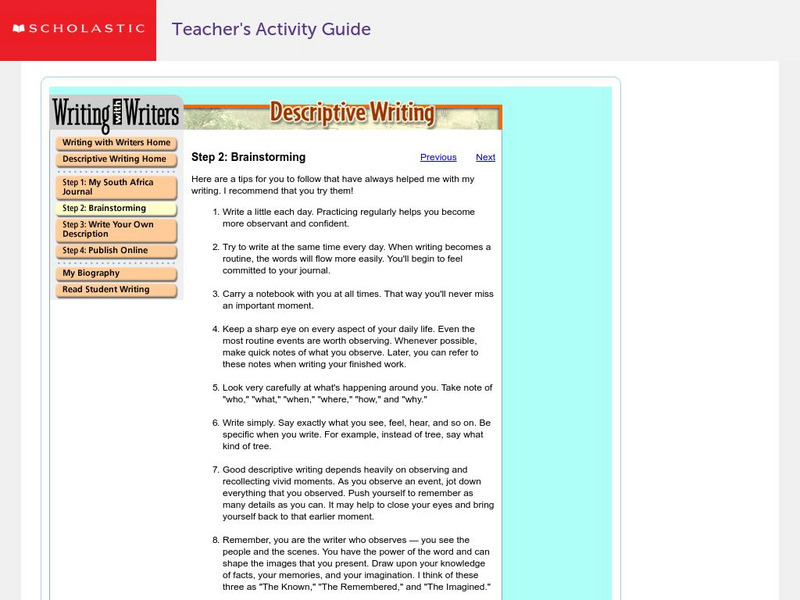
Scholastic: Writing With Writers: Descriptive Writing
Need help with doing a descriptive paper or personal narrative? Need a writing lesson plan? Meet Virginia Hamilton and follow her step-by-step guide to writing. When done, you are eligible for a certificate signed by this author.
Polk Brothers Foundation Center for Urban Education at DePaul University
De Paul University: Center for Urban Education: How Does Writer Organize Nonfiction Text?[pdf]
This poster contains writing craft questions for students to ask when reading nonfiction. This graphic organizer is a copyrighted material that may be used for educational purposes.
Capital Community College Foundation
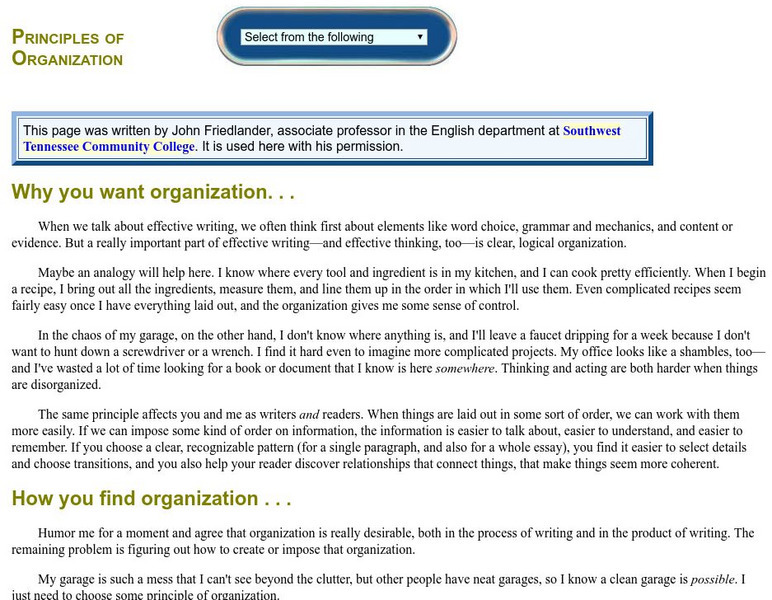
Guide to Grammar and Writing: Principles of Organization
In writing and reading organization is the key to a reader's understanding. A great site for those of you who are looking for some further explanation of organization in writing. There is instruction, an example text, and specific...
Other
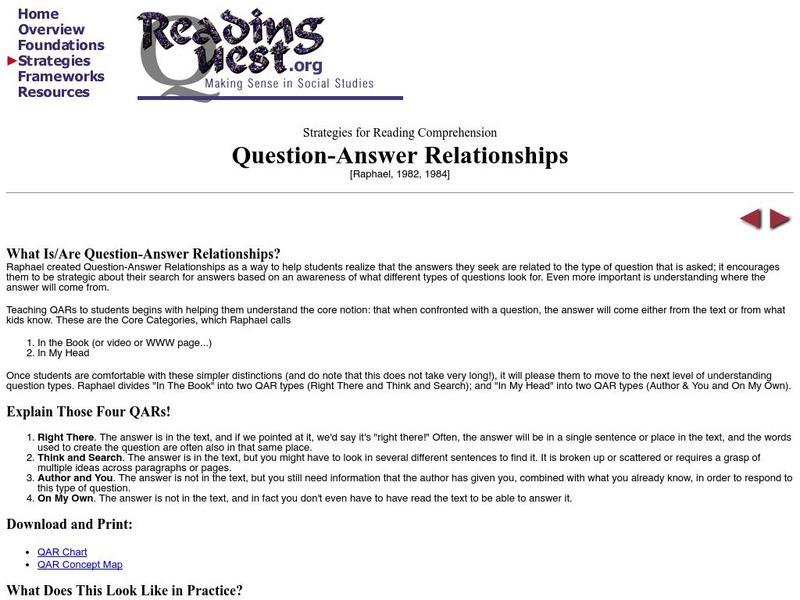
Reading Comprehension: Question Answer Relationships
If you need help working with your students on questioning a text or if you are working on higher-level questioning skills, this is a simple and helpful site. Printable resources available from site.
ReadWriteThink
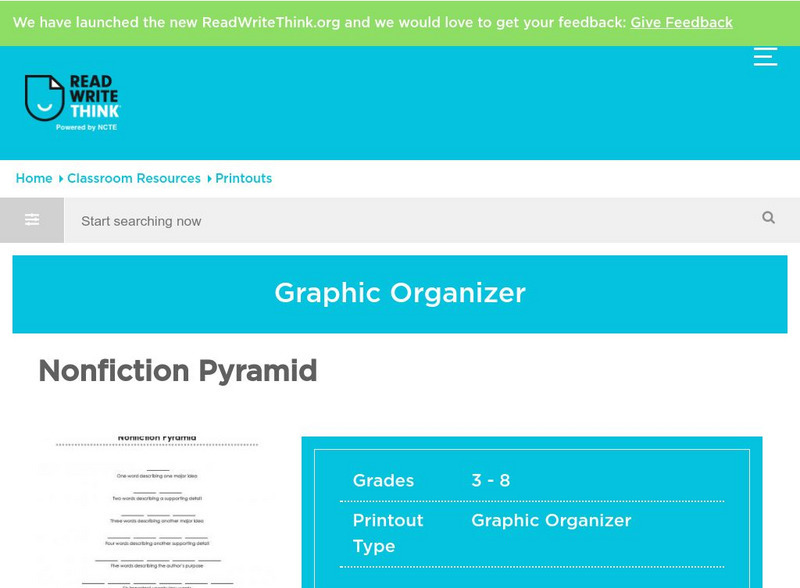
Read Write Think: Nonfiction Pyramid
A printable pyramid for use with nonfiction texts while students identify the main ideas and supporting details within a text. Students also determine author's purpose and key vocabulary words. Directions on how to use this type of...
ReadWriteThink
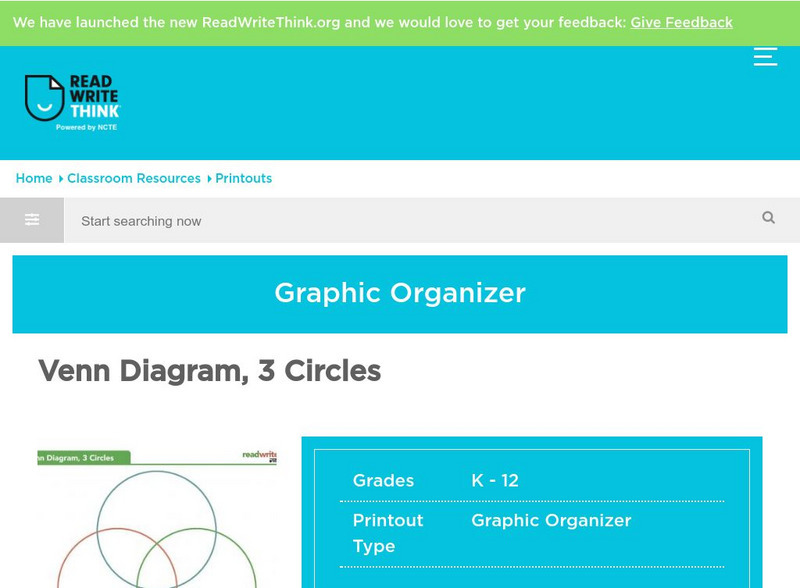
Read Write Think: Venn Diagram, 3 Circles
A printable Venn Diagram with three circles to use when comparing and contrasting three things or topics. Directions on how to use this graphic organizer as well as lists of teaching ideas and related resources are also provided.