Hi, what do you want to do?






Bozeman Science
ATP: Adenosine Triphosphate
Paul Andersen explains the structure, function and importance of adenosine triphosphate (ATP). He begins by describing the specific structure of the molecule and its three main parts: adenine, ribose sugar, and phosphate groups. He...
Amoeba Sisters
What is ATP?
Table of Contents: 00:00 Intro 0:40 Some Examples of ATP Uses in Cell Processes 1:14 What is ATP? 1:52 How do we get ATP? 3:05 How does ATP work? Note: We received an excellent comment in an older video (about cellular respiration) that...
Crash Course
ATP & Respiration: Crash Course Biology
In which Hank does some push ups for science and describes the "economy" of cellular respiration and the various processes whereby our bodies create energy in the form of ATP.
Bozeman Science
Coupled Reactions
Paul Andersen explains the importance role of coupled reactions in biology. He starts by explaining how the power of a river can be harnessed by a water mill to grind grains. He describes the importance of ATP and how it is used within...
Bozeman Science
Gibbs Free Energy
Paul Andersen attempts to explain Gibbs Free Energy. He begins by using three spontaneous reactions to explain how a change in enthalpy, entropy and temperature can affect the free energy of a system. He then applies this concept to...
Curated Video
Cellular Respiration - Energy in a Cell
In this lecture, I talk about Cellular respiration, which consists of Glycolysis, the Krebs Cycle and the Electron Transport Chain.
I deal with how Glucose is broken down and how ATP is made. Since energy is important for all...
I deal with how Glucose is broken down and how ATP is made. Since energy is important for all...
Ancient Lights Media
Photosynthesis: The Light-Dependent Reactions
Plant Physiology and Chemistry Set: 2. This clip provides an in-depth look at the details of the light-dependent Biochemical reactions of photosynthesis,
Catalyst University
Steps of Excitation-Contraction Coupling in Skeletal Muscle [Whole Video
In this video, we discuss all steps of excitation-contraction coupling in skeletal muscle from events on the motor neuron axon all the way through cross-bridge cycling between actin and myosin.
Catalyst University
Excitation-Contraction Coupling in Skeletal Muscle [Part 2/2]
Part 2 of 2 of excitation-contraction coupling | In this video, we discuss excitation-contraction coupling from opening of calcium channels in the sarcoplasmic reticulum (SR) all the way through cross-bridge cycling between actin and...
Curated Video
How Creatine REALLY Works - The Biology Behind It
Have you ever wondered what creatine is and how it works, then this video is for you. I'll explain the biology behind creatine in the context of how muscle contraction happens. Enjoy!

Curated OER
ATP: Adenosine Triphosphate
Here is accessible, understandable information about ADP and ATP. By explaining how ATP is hydrolyzed, Sal Khan is able to demonstrate how energy is released into a cell.

Bozeman Science
Adenosine Triphosphate
In this second video, viewers learn the structure of ATP, then watch how our bodies use ATP to provide us with the energy we need at the cellular level. At the end, they learn how all organisms in life, even from the...

Bozeman Science
The Importance of Oxygen
Wow, the human body is complex! The video explores the importance of oxygen, beginning with exploring why it is needed in combustion and then moving into an organism's need for oxygen. Learners see how glucose, when combined with oxygen,...

Khan Academy
Secondary Active Transport in the Nephron, Renal System Physiology, NCLEX-RN
The details of nephron structure and the importance of renal tubules in osmosis, reabsorption, and secretion of solutes, and the related concentration of the final filtrate.
Khan Academy
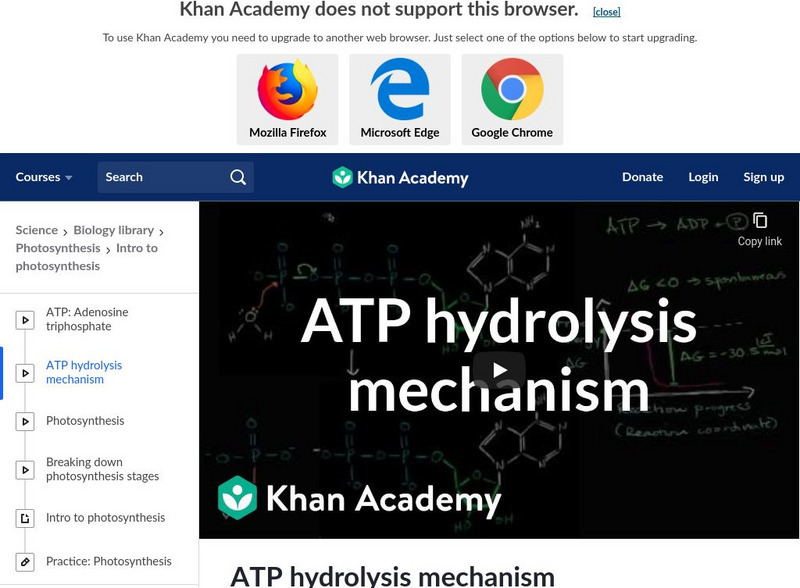
Khan Academy: Atp Hydrolysis Mechanism
Video lecture takes a look at how energy is released when ATP is converted to ADP and phosphate. [4:26]

Khan Academy
Khan Academy: Biology: Energy and Enzymes: Atp Hydrolysis Mechanism
A video describing how energy is released by ATP changing to ADP. [4:26]

Bozeman Science
Bozeman Science: Atp: Adenosine Triphosphate
Paul Andersen explains the structure, function and importance of adenosine triphosphate (ATP). He begins by describing the specific structure of the molecule and its three main parts: adenine, ribose sugar, and phosphate groups. He...

Khan Academy
Khan Academy: Energy and Transport: Atp: Adenosine Triphosphate
Learn more about ATP: how it stores energy, and how that energy is released when it's converted to ADP and phosphate. [6:19]

Khan Academy
Khan Academy: Uniporters, Symporters and Antiporters
Uniporters, symporters, and antiporters are proteins that are used in the transport of substances across a cell membrane. This video describes how each of these works in the transport process. [7:13]

Khan Academy
Khan Academy: Atp: Adenosine Triphosphate
Learn more about ATP: how it stores energy, and how that energy is released when it's converted to ADP and phosphate. [6:18]

Khan Academy
Khan Academy: How Tropomyosin and Troponin Regulate Muscle Contraction
This video describes how calcium ion concentration dictates whether a muscle contracts or not. [9:22]
Bozeman Science
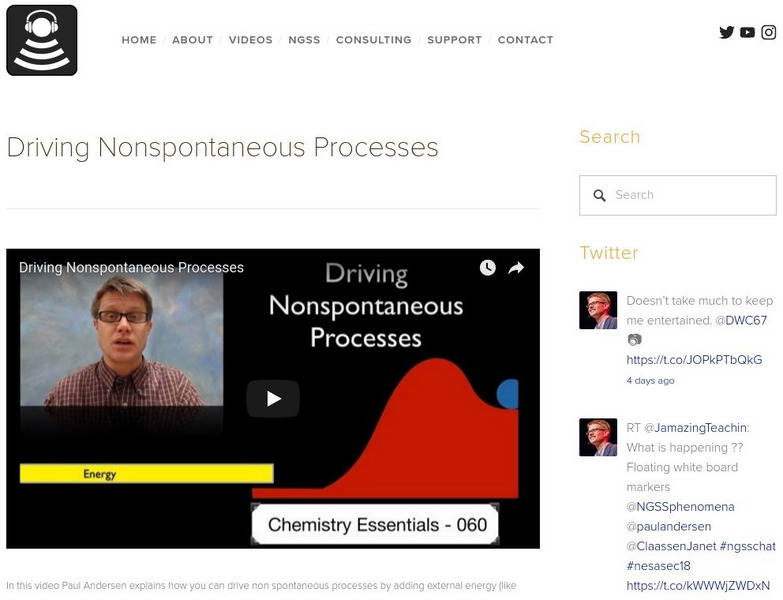
Bozeman Science: Driving Nonspontaneous Processes
In this video, Paul Andersen explains how you can drive nonspontaneous processes by adding external energy (like electricity or light) or by coupling it to a spontaneous process (like the conversion of ATP to ADP). Utilize the concept...