Hi, what do you want to do?





Wikimedia
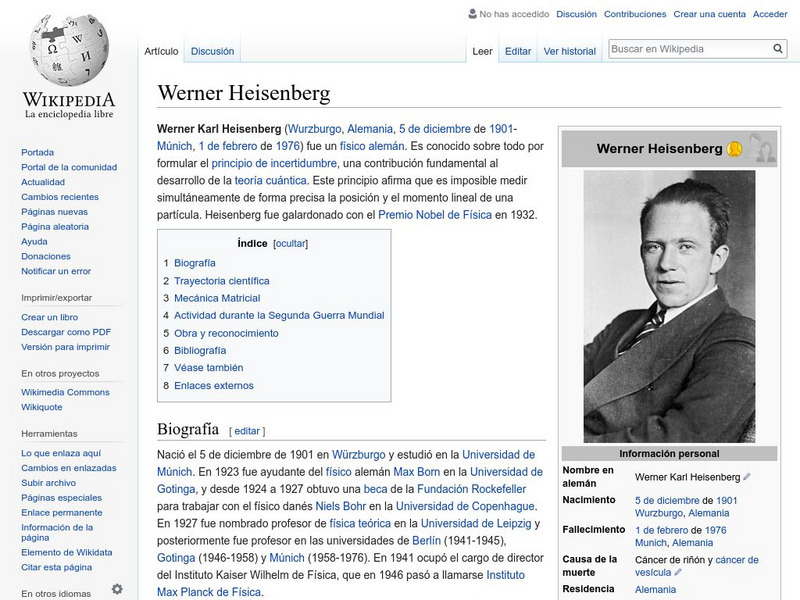
Wikipedia: Werner Heisenberg
In this Spanish-language entry, trace the life and accomplishments of Werner Heisenberg, the great physicist whose work with quantum mechanics resulted in earning the Nobel Prize.

University of St. Andrews (UK)
University of St. Andrews: Max Planck
This site is a mixture of a short biography and quotes on German physicist Max Planck.
CK-12 Foundation
Ck 12: Modern Atomic Theory
[Free Registration/Login may be required to access all resource tools.] Rutherford's model of the atom was better than earlier models. But it wasn't the last word. Danish physicist Niels Bohr created a more accurate and useful model....

PBS
Pbs: American Experience: The Trials of J. Robert Oppenheimer
J. Robert Oppenheimer is credited with the creation of the atomic bomb. But, "The country asked him to do something and he did it brilliantly, and they repaid him for the tremendous job he did by breaking him." This documentary traces...

Nobel Media AB
The Nobel Prize: The Nobel Prize in Physics 1938
At this site from The Nobel Foundation, read about the life and scientific discoveries of physicist Enrico Fermi (1901-1954), whose work with radiation and "discovery of nuclear reactions brought about by slow neutrons" earned him the...

University of St. Andrews (UK)
University of St. Andrews: Werner Heisenberg
German born Werner Heisenberg was a notable physicist who worked on numerous projects, including quantum theory.
Other
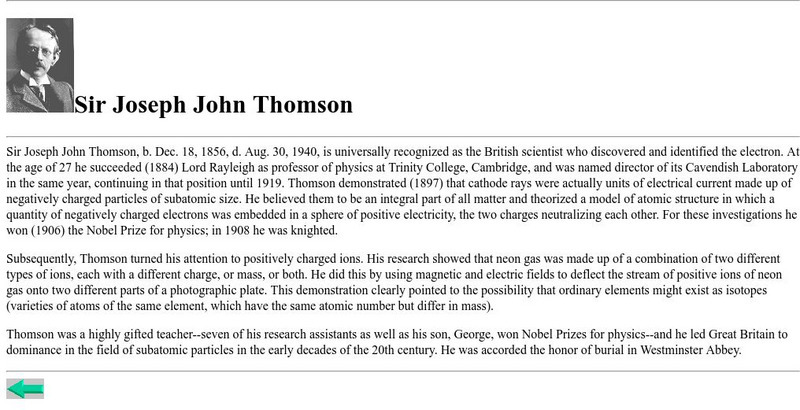
Sir Joseph John Thomson
Have you ever wondered who discovered the electron? The answer is Nobel Prize winning physicist Sir Joseph John Thomson.
National High Magnetic Field Laboratory
Magnet Academy: Joseph John Thomson
Joseph John Thomson, better known as J. J. Thomson, was a British physicist who first theorized and offered experimental evidence that the atom was a divisible entity rather than the basic unit of matter, as was widely believed at the...
Other
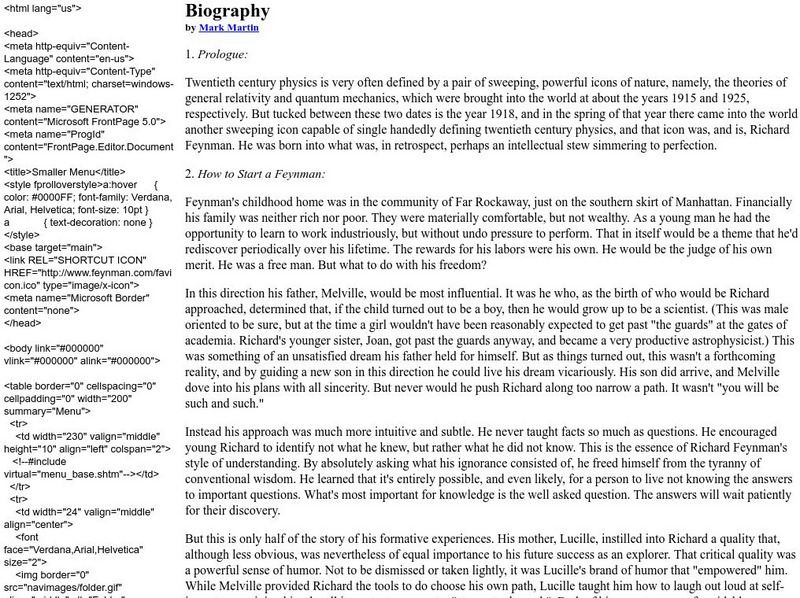
Biography of Richard Feynman
This biography of the physicist Richard Feynman surveys his contributions to the development of the atomic bomb as well as his work on quantum electrostatics.
National High Magnetic Field Laboratory
Magnet Academy: Isidor Isaac Rabi
Isidor Isaac Rabi won the Nobel Prize in Physics in 1944 for his development of a technique for measuring the magnetic characteristics of atomic nuclei. Rabi's technique was based on the resonance principle first described by Irish...
National High Magnetic Field Laboratory
Magnet Academy: Gerd Binnig
Gerd Binnig co-developed the scanning tunneling microscope (STM) with Heinrich Rohrer. The STM allowed scientists entry into the atomic world in a new way and was a major advance in the field of nanotechnology. For their achievement,...
National High Magnetic Field Laboratory
Magnet Academy: Paul Dirac
Paul Adrien Maurice Dirac was an outstanding twentieth century theoretical physicist whose work was fundamental to the development of quantum mechanics and quantum electrodynamics. He was awarded the Nobel Prize for Physics jointly with...

BBC
Bbc Mundo: El Ano Magico De Einstein
A special feature on Einstein from the BBC, in Spanish. Follow Einstein's life, including his role in the development of the atomic bomb; learn about the impact and practical applications of his work; or watch a speech he gave in 1950...
Wikimedia
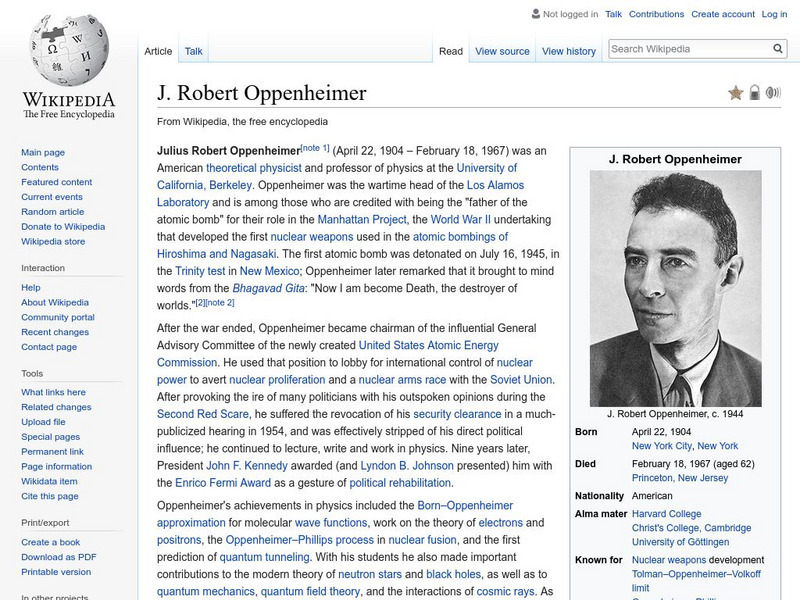
Wikipedia: J. Robert Oppenheimer
This biography from the encyclopedia Wikipedia of physicist Robert Oppenheimer discusses his education, his creation of the atomic bomb, and later, his opposition to the use of the bomb.
National High Magnetic Field Laboratory
Magnet Academy: Timeline of Electricity and Magnetism: 1940 1959
Defense-related research leads to the computer, the world enters the atomic age and TV conquers America.

Famous Scientists
Famous Scientists: Abdul Qadeer Khan
Learn about the Pakistani nuclear physicist who was the founder of the uranium enrichment program for Pakistan's atomic bomb project.

Wikimedia
Wikipedia: Max Planck
Discover the life and accomplishments of the great German scientist Max Planck. This site also provides links to sites explaining theories and scientific terms that are associated with Planck.
Nobel Media AB
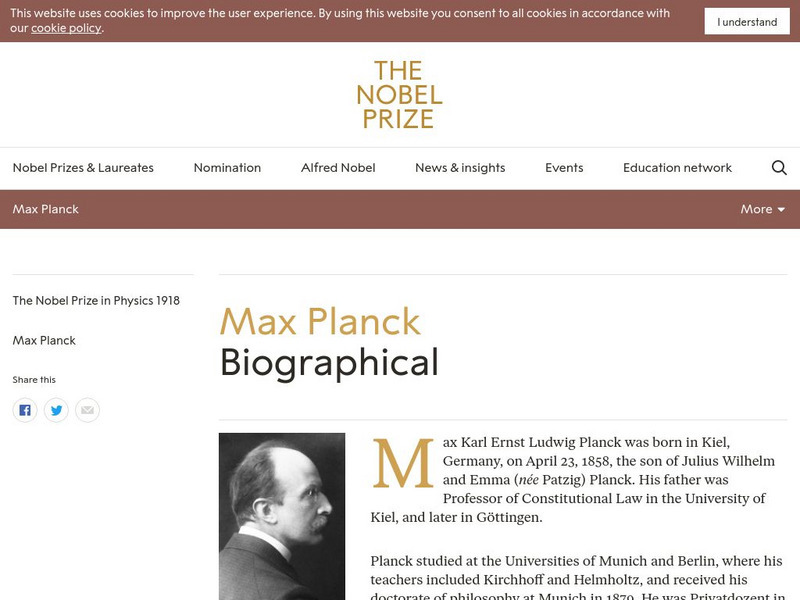
The Nobel Prize: Max Planck Biographical
A biography of Max Planck, covering his research interests and contributions to science, as well as more personal information about his family and life.
My Hero Project
My Hero: Madame Curie
Use this site to learn about Marie Curie's scientific discoveries in radiation, which resulted in the creation of both modern cancer treatments and the atomic bomb.
Mocomi & Anibrain Digital Technologies
Mocomi: Albert Einstein Biography
Useful biographical information, inventions, and interesting facts about German-born physicist, Albert Einstein, known for developing the theory of relativity.
PBS
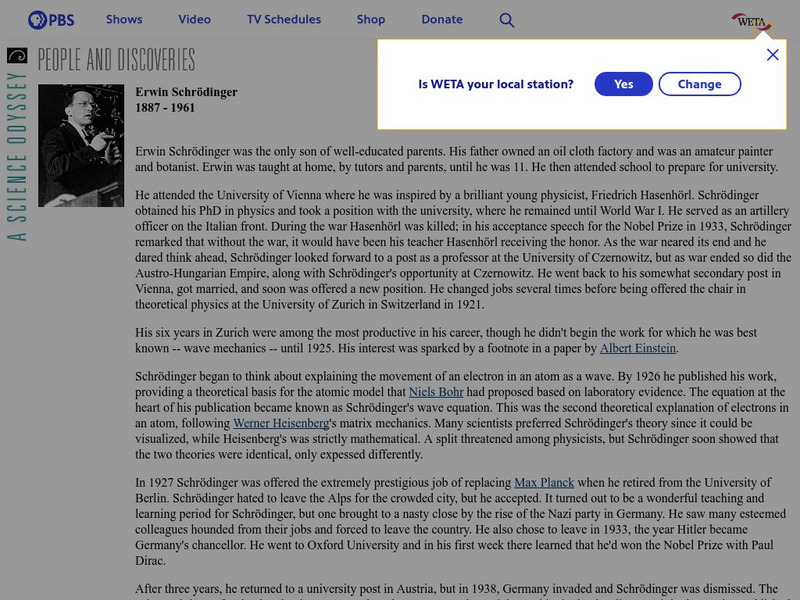
Pbs: People and Discoveries
At this PBS site there is a biography of the Austrian physicist Erwin Schrodinger who lived from 1887 until 1961.
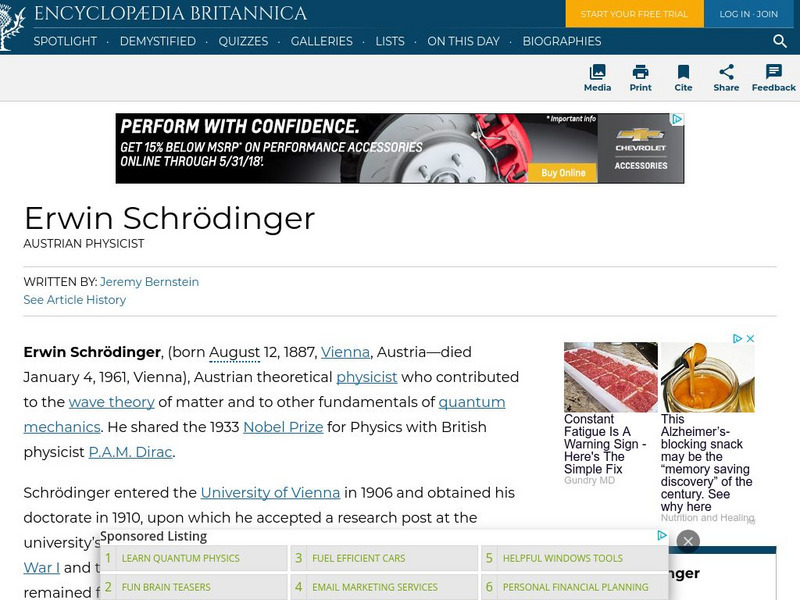
Encyclopedia Britannica
Encyclopedia Britannica: Erwin Schrodinger
This site gives brief biographical information about Austrian physicist, Erwin Schrodinger.

National High Magnetic Field Laboratory
Magnet Academy: Low Temperature Physics
Why do physicists want to study things at temperatures so cold atomic motion almost comes to a halt? And how do they create such frigid environments, anyway? Read on for the what, how and why of low temperature physics.
National High Magnetic Field Laboratory
Magnet Academy: Edward Purcell
Edward Mills Purcell was an American physicist who received half of the 1952 Nobel Prize for Physics for his development of a new method of ascertaining the magnetic properties of atomic nuclei. Known as nuclear magnetic resonance...