Hi, what do you want to do?






NASA
Nasa: Astronomy Picture of the Day: A Milestone Quasar
An image of a typical quasar and a star. An explanation written by a professional astronomer is included. There are also many embedded links within the text to related topics.
NASA
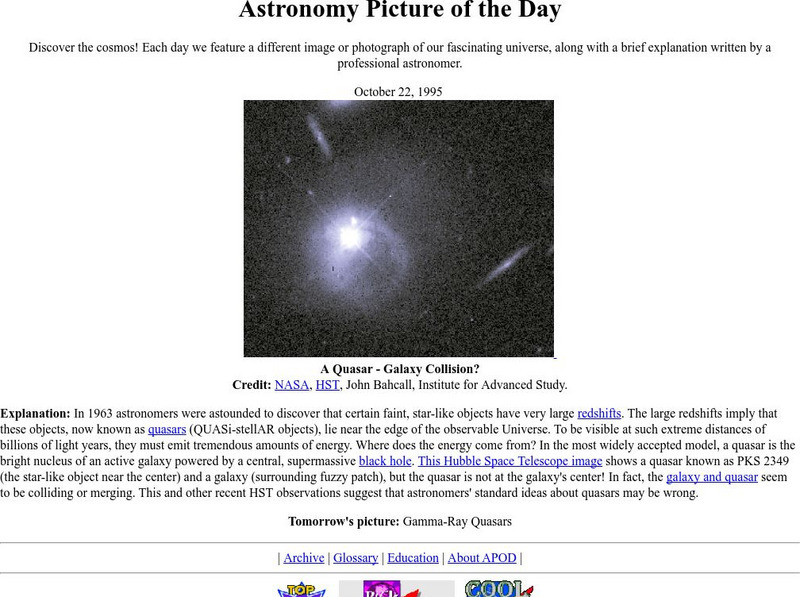
Astronomy Picture of the Day: Quasar Galaxy Collision
An image of a quasar. The large redshifts imply that quasars lie near the edge of the observable universe and must emit tremendous amounts of energy. There are also many embedded links to related topics.
NASA
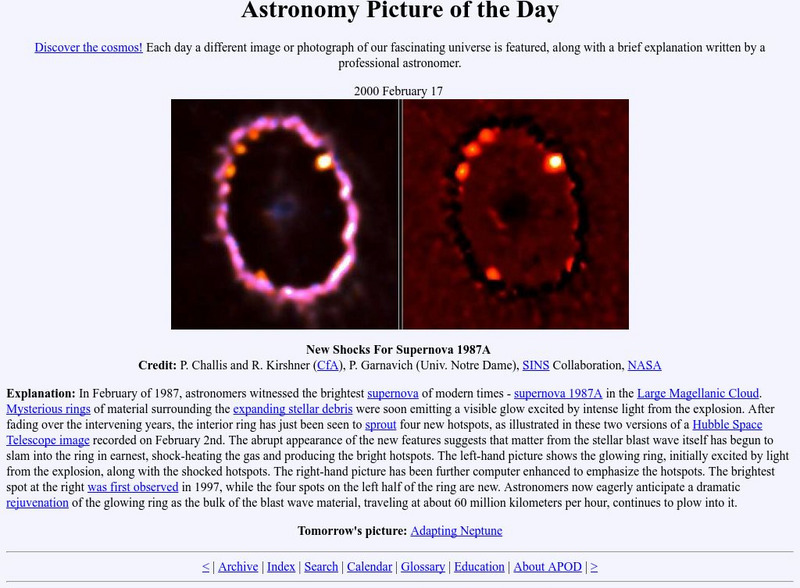
Astronomy Picture of the Day: Supernova 1987 A
Details of the brightest supernova of modern times - supernova 1987A in the Large Magellanic Cloud. There are many links for additional information.
Khan Academy
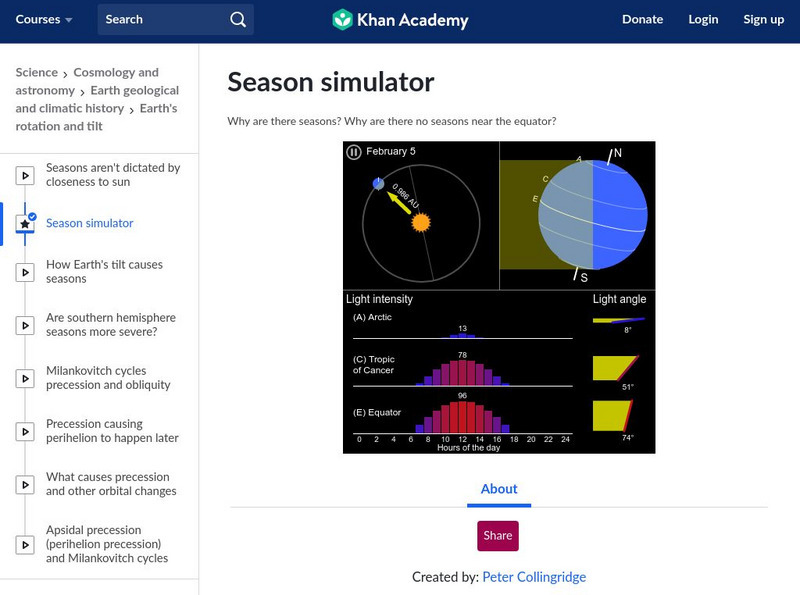
Khan Academy: Cosmology and Astronomy: Season Simulator
This season simulator takes Earth through an entire year cycle allowing the viewer to observe the tilt of the Earth and the intensity of the sunlight.

NASA
Nasa: Astronomy Picture of the Day: Crab Nebula and Geminga in Gamma Rays
Explains that pulsars would be the brightest objects in the sky if we could see gamma-rays.
NASA
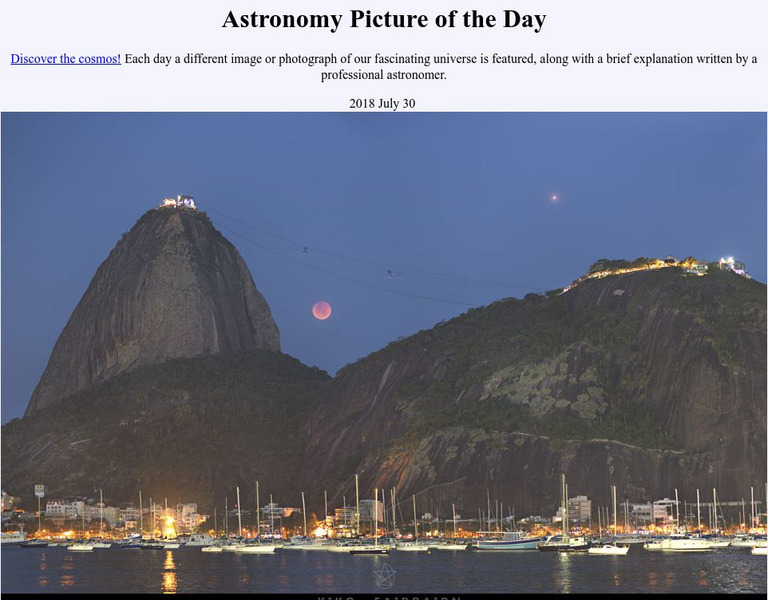
Nasa: Astronomy Picture of the Day:
A different image is featured each day along with descriptive narrative. NASA offers different and sometimes unexpected views of our Earth and the universe.
NASA
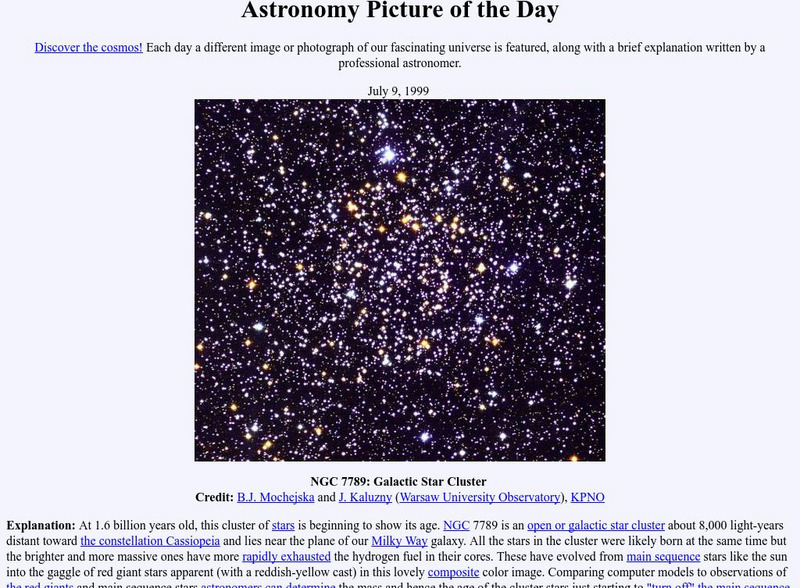
Nasa: Astronomy Picture of the Day: Giant Stars
Image of a group of red giant stars are seen in an image from the edge of the plane of the Milky Way. The evolution of these stars is explained. Many embedded links contained in the text to related topics.
NASA
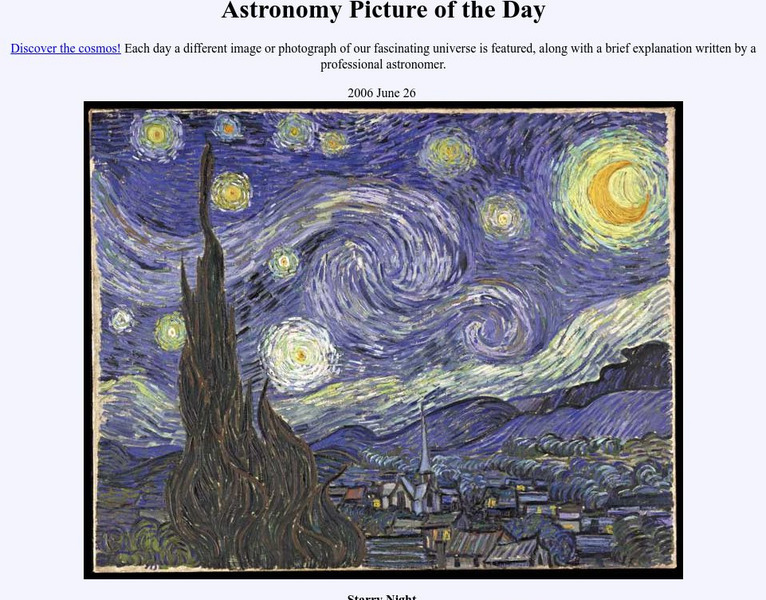
Nasa: Astronomy Picture of the Day: "The Starry Night" by Vincent Van Gogh
Discover why the scientists at NASA awarded Van Gogh's famous painting of the night sky, "The Starry Night," a spot on its astronomy-picture-of-the-day site.

NASA
Nasa: Astronomy Picture of the Day: Gamma Ray Quasar
A photograph and description of quasar 3C279 viewed in gamma-rays. It was unexpectedly discovered and was one of the brightest objects in the gamma-ray sky until it suddenly faded.
NASA
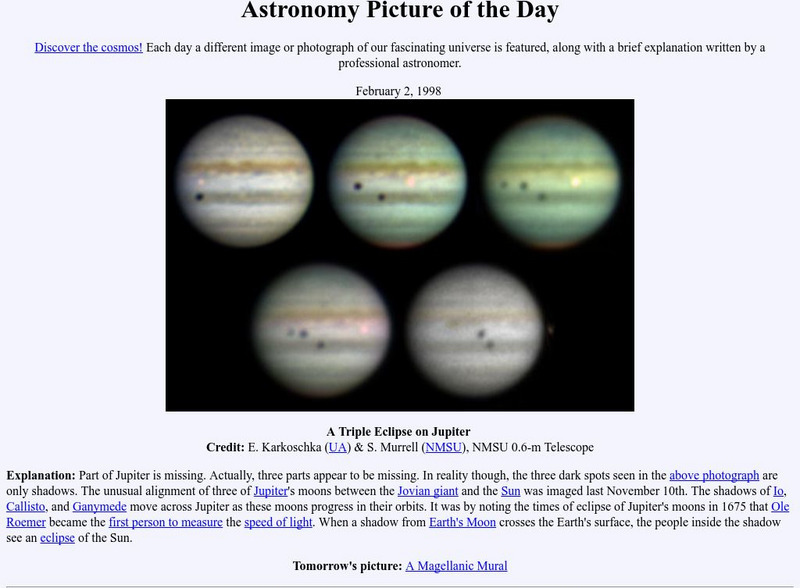
Nasa: Astronomy Picture of the Day: Jupiter
A triple eclipse crossing the face of Jupiter on 2 Feb 98. This set of five images captures the passage of the shadows of Io, Callisto, and Ganymede across the face of Jupiter.
NASA
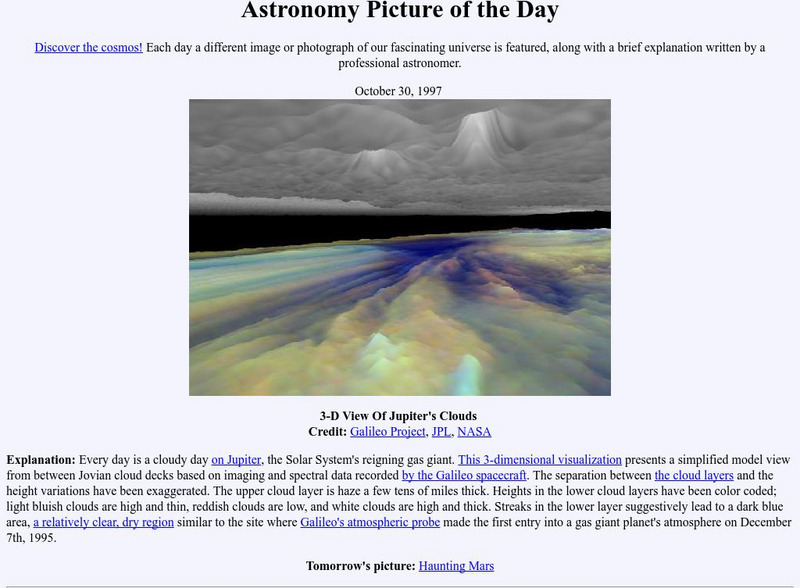
Nasa: Astronomy Picture of the Day: Jupiter's Clouds 3 D
Every day is a cloudy day on Jupiter, the Solar System's reigning gas giant. This 3-dimensional visualization presents a simplified model view from between Jovian cloud decks based on imaging and spectral data recorded by the Galileo...

NASA
Nasa: Astronomy Picture of the Day: Jupiter's Great Red Spot
This collage of images by the Hubble Space Telescope captured the changes in Jupiter's Great Red Spot over a period of several years.
NASA
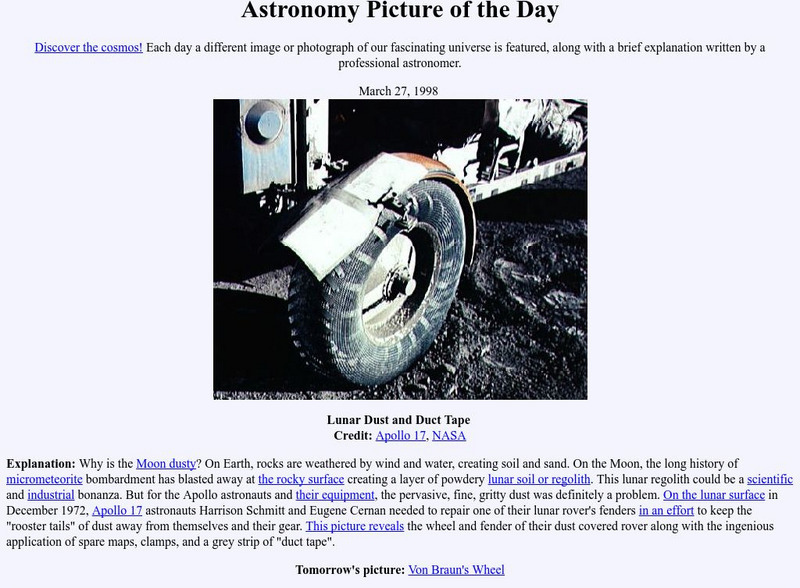
Nasa: Astronomy Picture of the Day: Lunar Dust and Duct Tape
Dust, a common and usually minor problem on Earth, presented a major challenge for the Apollo astronauts on the Moon. Here's an interesting solution created by the Apollo 17 crew.

Other
Geo 154 Astronomy : Retrograde Motion
A detailed explanation of retrograde motion with three different explanations and movies to accompany them. Additional links are available for more research.
NASA
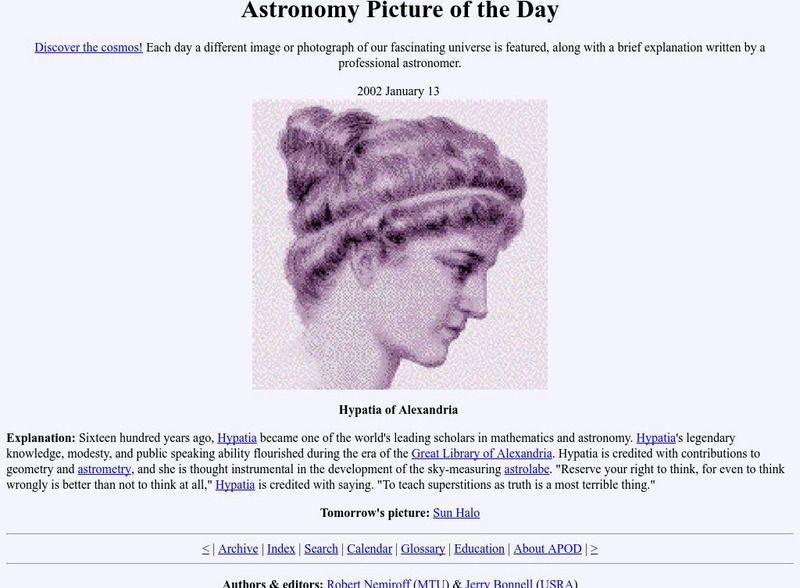
Nasa: Astronomy Picture of the Day: Hypatia
Learn more about Hypatia when you check out this resource. This site features a picture and a brief synopsis of this famous scientist.
Other
Introduction to Astronomy: The Motion of the Moon
This site provides a moving diagram of a Lunar eclipse, showing Earth's umbra and penumbra and the appearance of the Moon as it passes through these shadow regions.
NASA
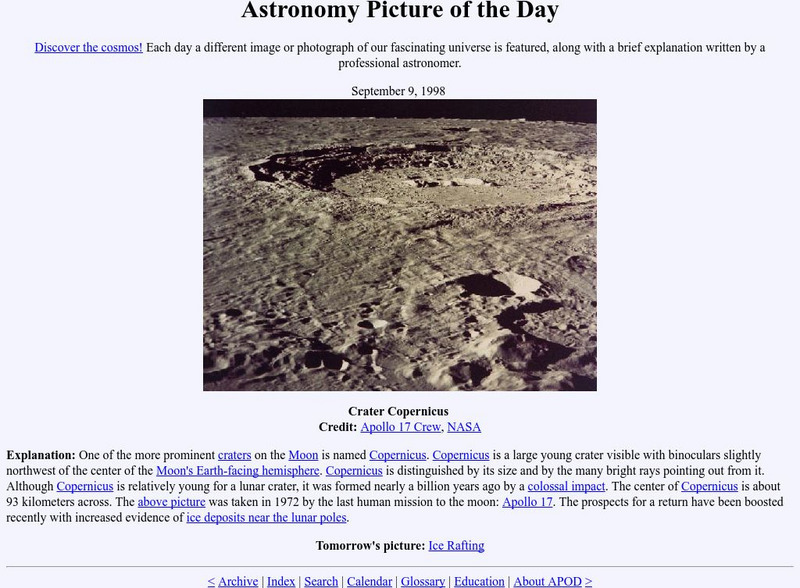
Nasa: Astronomy Picture of the Day: Crater Copernicus
This Astronomy Picture of the Day is of Crater Copernicus, taken by the Apollo 17 crew in 1972.
NASA
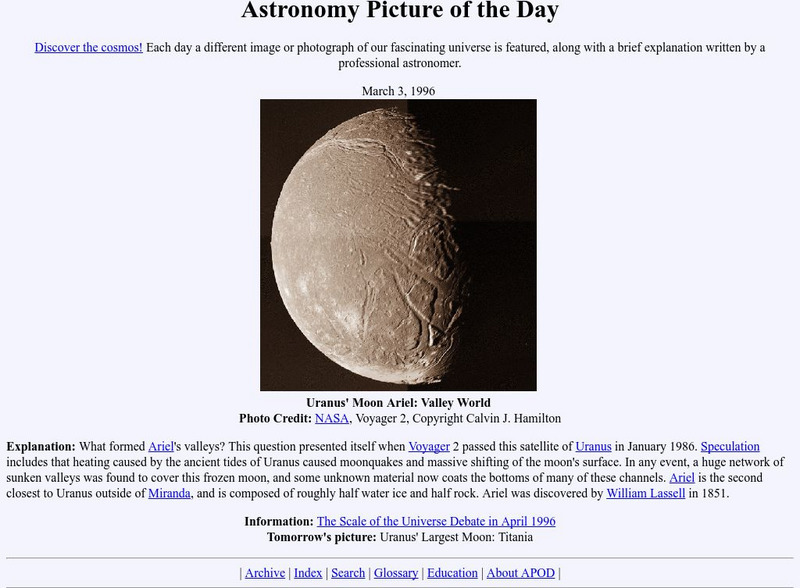
Nasa: Astronomy Picture of the Day: Uranus's Moon Ariel
Provides a brief overview of Ariel, one of Uranus's moons. Details how its deep valleys were formed. A NASA astronomy picture of the day.
NASA
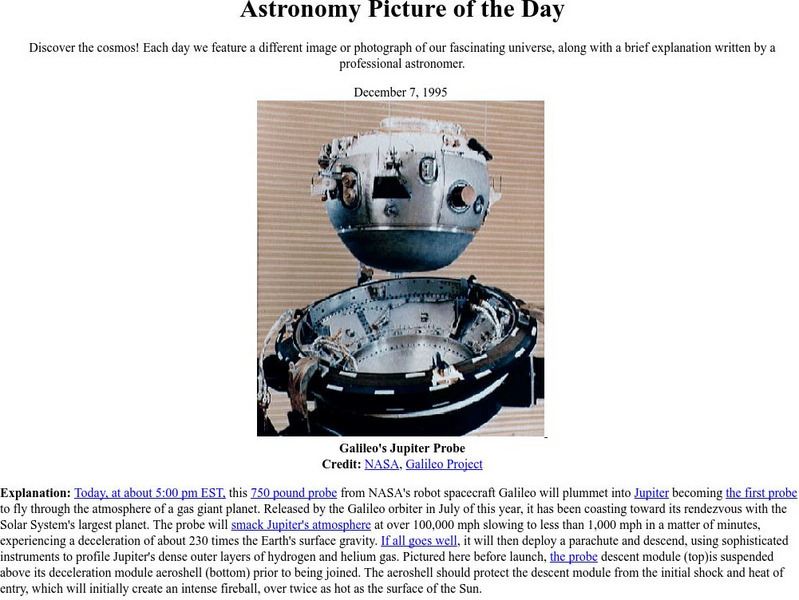
Nasa: Astronomy Picture of the Day:galileo Probe
This image, taken before Galileo left Earth in 1989, was chosen for December 7, 1995, the day that the probe entered Jupiter's Atmosphere.

Cornell University
Cornell University: Astronomy: The Phases of the Moon
This site from Cornell University provides great information on the different phases of the moon. As the Moon moves in its orbit around the Sun, our view of the side illuminated by the Sun changes. Furthermore, the rising and setting...
Wolfram Research
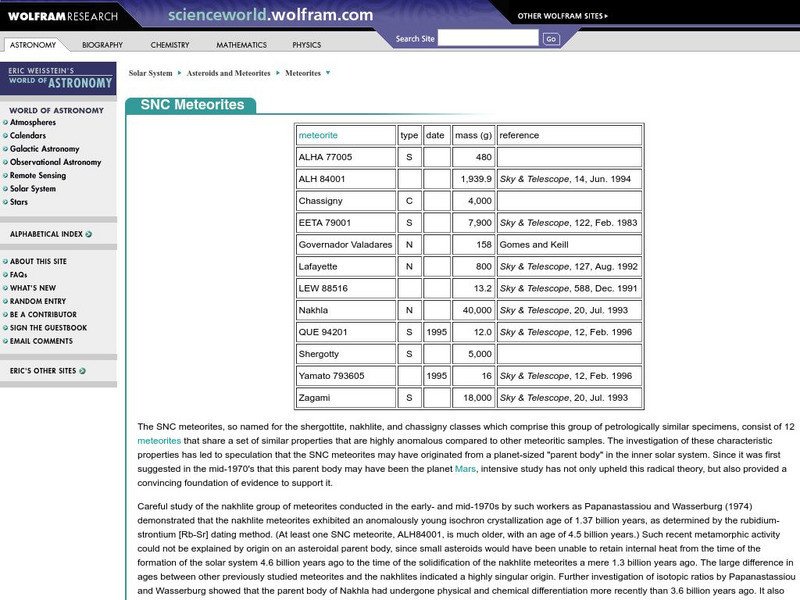
Wolfram Science World: Science World of Astronomy: Snc Meteorites
View a chart displaying various kinds of meteorites collected on earth and read a technical article describing the manner in which they are studied. Provides a link to more information about the planet Mars and the role it plays in the...
Cornell University
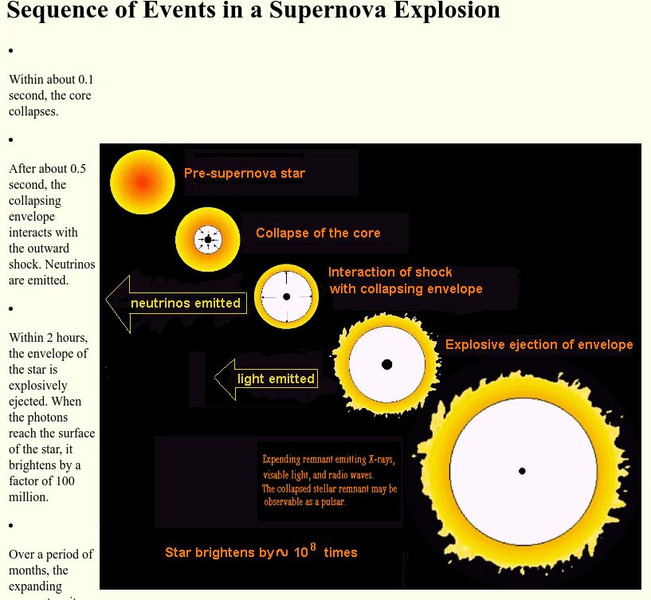
Cornell University: Astronomy: Sequence of Events in a Supernova Explosion
The complex sequence of events in a supernova explosion are explained and illustrated.
NASA
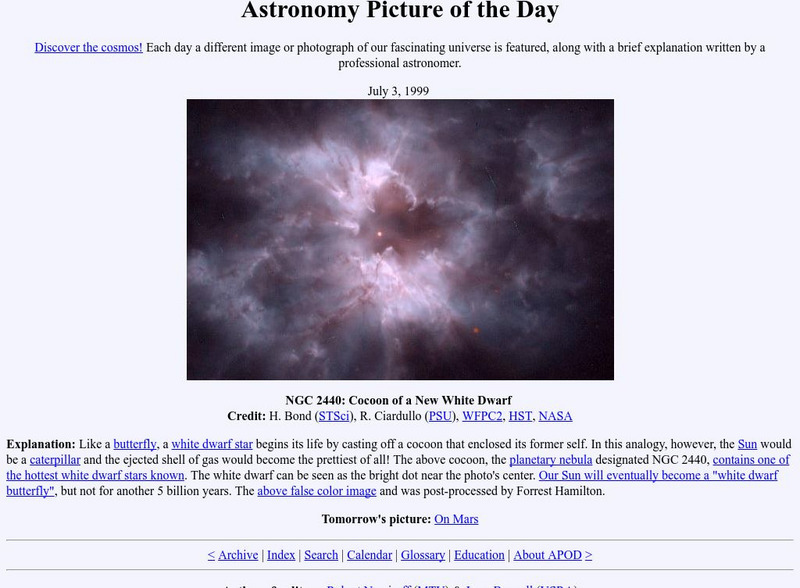
Nasa: Astronomy Picture of the Day: White Dwarf Cocoon
A white dwarf star begins its life by "casting off a cocoon (nebula)that enclosed its former self." There are many links within the text to related topics.

Curated OER
Web Gallery of Art: Astronomy
An image of "Astronomy", created by Laurent De La Hire in 1649 (Oil on canvas).
Other popular searches
- Astronomy and Space Science
- Astronomy Vocabulary
- Planets and Astronomy
- Astronomy Activity
- Science Astronomy
- Ancient Astronomy
- Astronomy Lesson Plans
- History of Astronomy
- Space Science Astronomy
- Space and Astronomy
- Astronomy Navigation
- Astronomy History