Hi, what do you want to do?






TeachEngineering
Teach Engineering: Laser Types and Uses
Through two classroom demos, students are introduced to the basic properties of lasers through various mediums. In the Making an Electric Pickle demonstration, students see how cellular tissue is able to conduct electricity, and how this...
TeachEngineering
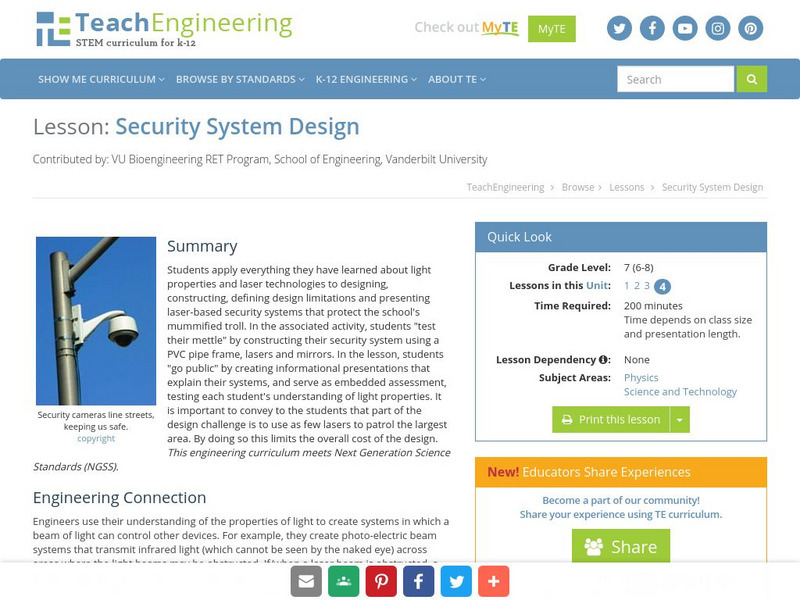
Teach Engineering: Security System Design
Middle schoolers apply everything they have learned about light properties and laser technologies to designing, constructing and presenting laser-based security systems that protect the school's mummified troll. In the associated...
TeachEngineering
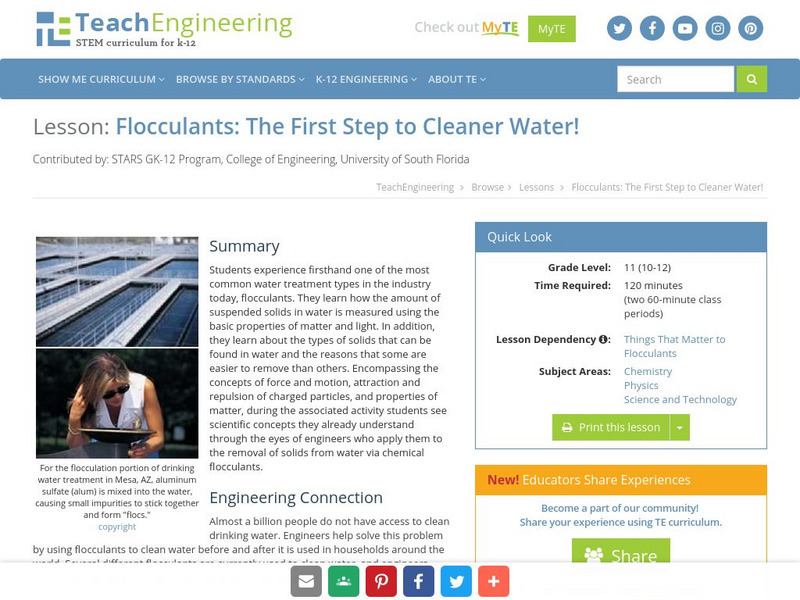
Teach Engineering: Flocculants: The First Step to Cleaner Water!
Students experience firsthand one of the most common water treatment types in the industry today, flocculants. They learn how the amount of suspended solids in water is measured using the basic properties of matter and light. In...
TeachEngineering
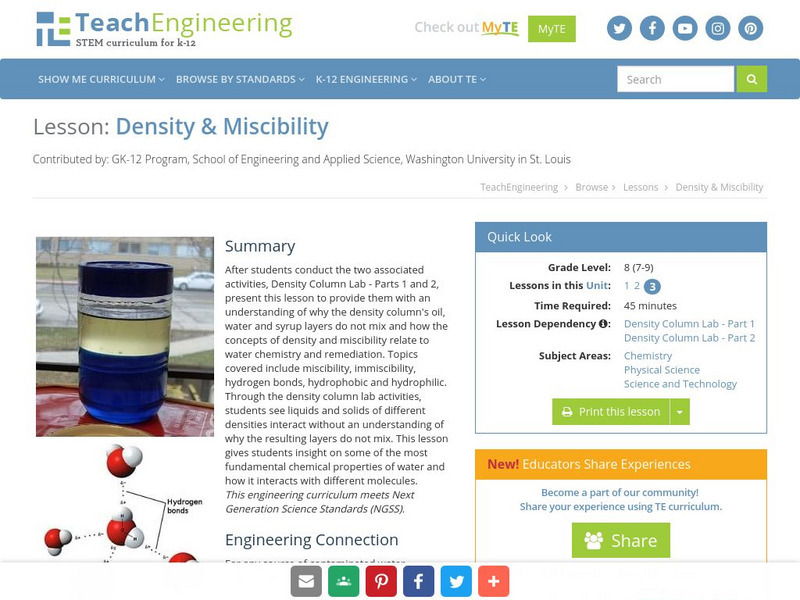
Teach Engineering: Density & Miscibility
After students conduct the two associated activities, Density Column Lab - Parts 1 and 2, present this lesson to provide them with an understanding of why the density column's oil, water and syrup layers do not mix and how the concepts...
TeachEngineering
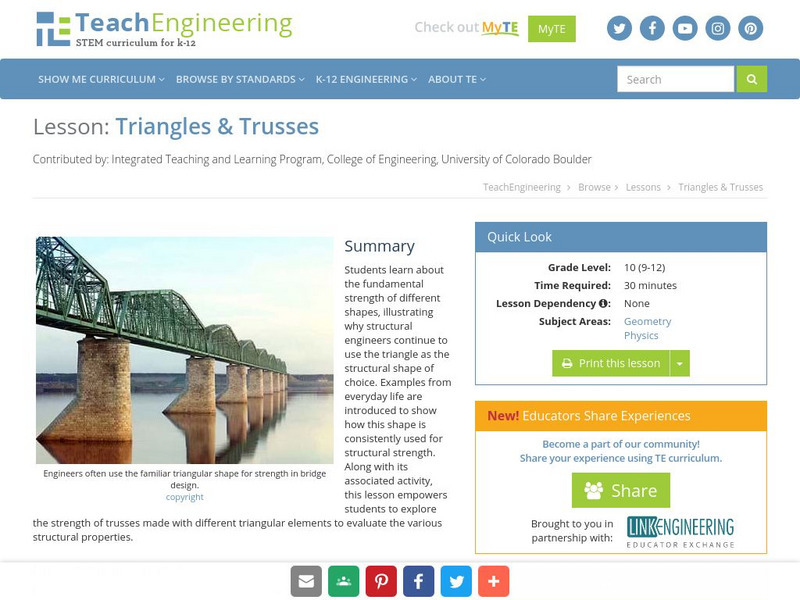
Teach Engineering: Triangles & Trusses
Students learn about the fundamental strength of different shapes, illustrating why structural engineers continue to use the triangle as the structural shape of choice. Examples from everyday life are introduced to show how this shape is...
TeachEngineering
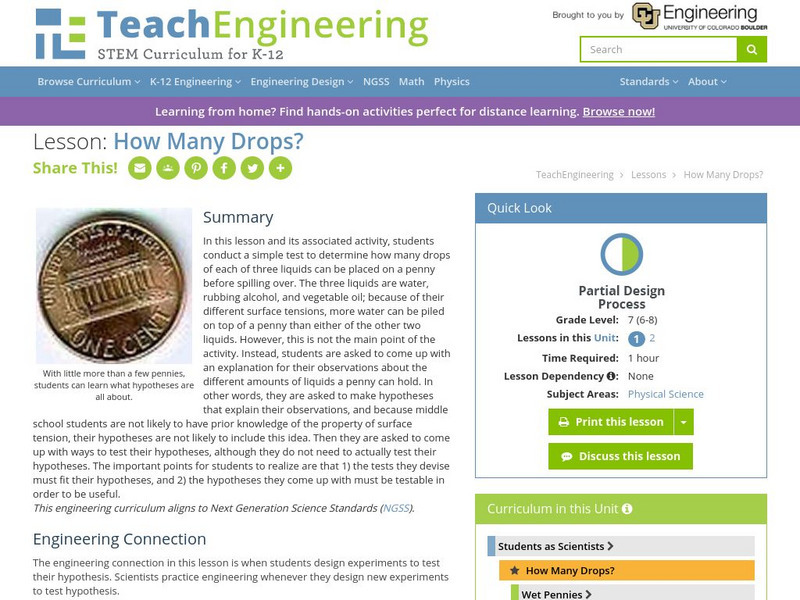
Teach Engineering: How Many Drops?
In this lesson and its associated activity, students conduct a simple test to determine how many drops of each of three liquids can be placed on a penny before spilling over. The three liquids are water, rubbing alcohol, and vegetable...
TeachEngineering
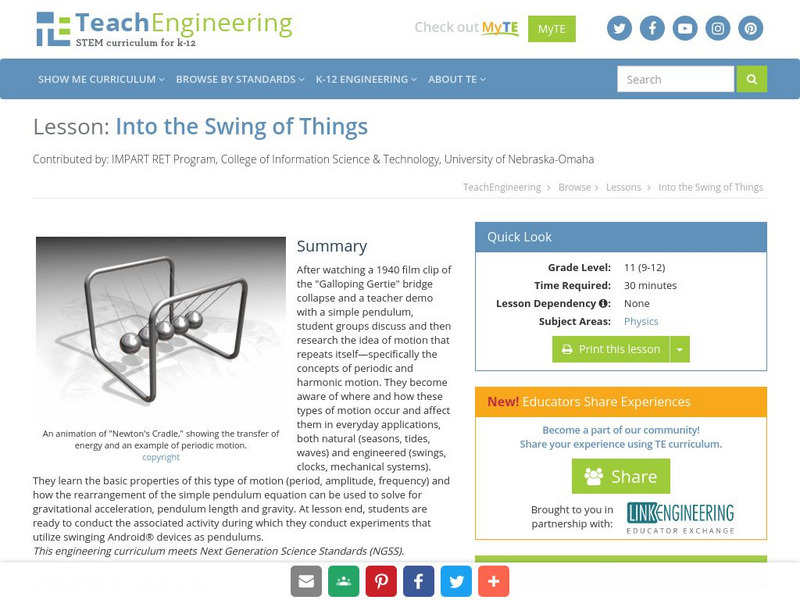
Teach Engineering: Into the Swing of Things
Students learn the basic properties of periodic and harmonic motion, and how the rearrangement of the simple pendulum equation can be used to solve for gravitational acceleration, pendulum length, and gravity. At lesson end, students are...
TeachEngineering
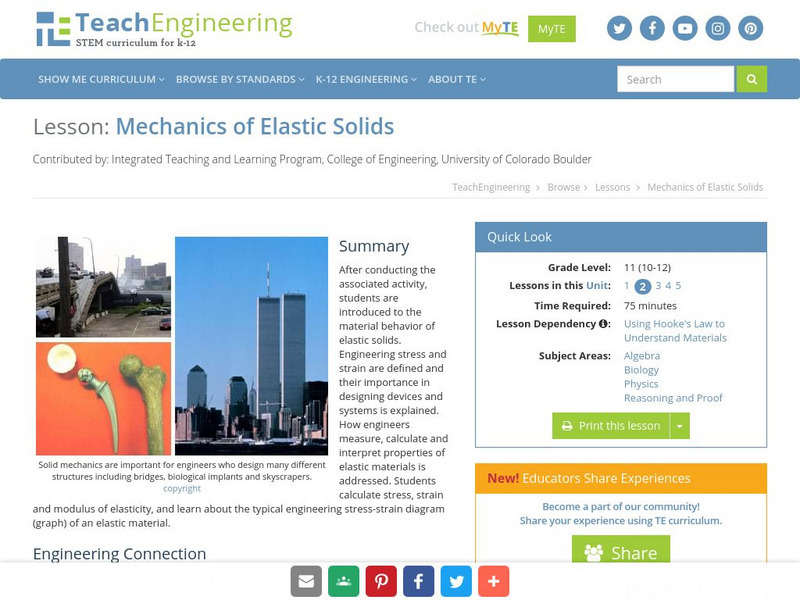
Teach Engineering: Mechanics of Elastic Solids
After conducting the associated activity, learners are introduced to the material behavior of elastic solids. Engineering stress and strain are defined and their importance in designing devices and systems is explained. How engineers...

McREL International
Mc Rel: Whelmer #10 Learning Activity: Singing Rod
An easy to do activity that investigates the simple observable properties of sound waves. The activity is presented in lesson plan format that meets NSES standards.
McREL International
Mc Rel: Whelmer #12 Learning Activity: Bernoulli Cans
An easy to do activity that investigates Bernoulli's principle. The activity is presented in lesson plan format that meets NSES standards.
TeachEngineering
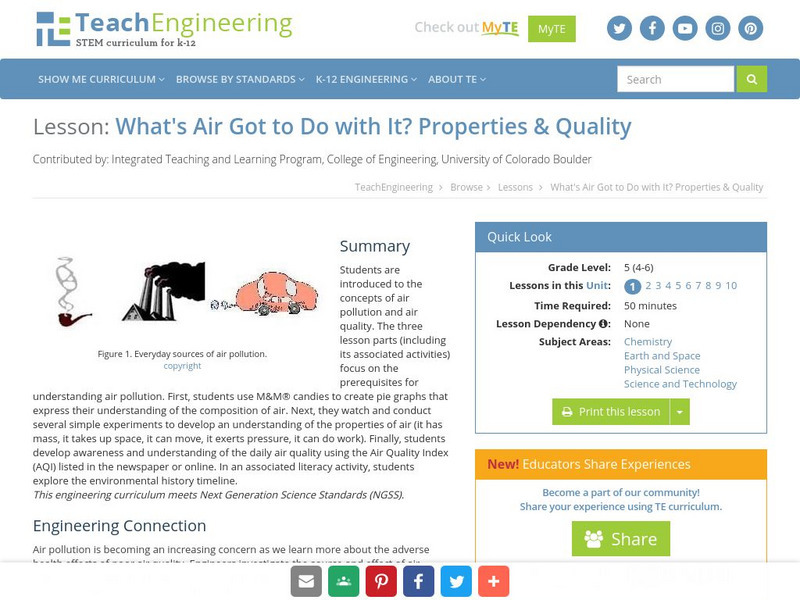
Teach Engineering: What's Air Got to Do With It?
Students are introduced to the concepts of air pollution and air quality. The three lesson plan parts focus on the prerequisites for understanding air pollution. First, students use M&Ms to create a pie graph that expresses their...

CK-12 Foundation
Ck 12: Statistics: Density Curve of the Normal Distribution
[Free Registration/Login may be required to access all resource tools.] This Concept expands upon the previous by discussing further the normal distribution and the probabilities associated with it by looking at the normal density curve.
TeachEngineering
Teach Engineering: Students as Scientists
This curricular unit contains two lessons that let students actually do the work of scientists as they design their own experiments to answer questions they generate. In the first lesson and its associated activity, students conduct a...
TeachEngineering
Teach Engineering: Waves Go Public!
Students apply everything they have learned over the course of the associated lessons about waves, light properties, the electromagnetic spectrum, and the structure of the eye, by designing devices that can aid color blind people in...
TeachEngineering
Teach Engineering: Using Hooke's Law to Understand Materials
Students explore the response of springs to forces as a way to begin to understand elastic solid behavior. They gain experience in data collection, spring constant calculation, and comparison and interpretation of graphs and material...
TeachEngineering
Teach Engineering: Surface Tension
Surface tension accounts for many of the interesting properties we associate with water. By learning about surface tension and adhesive forces, students learn why liquid jets of water break into droplets rather than staying in a...
Other
Design Build: Exploring the Fundamental Requirements of Structural Design [Pdf]
In this lesson unit from the Science Teachers' Association of Ontario (STAO), students fold paper to explore the properties and shapes of materials that give structures their stability and strength. They record their ideas as they...

Alabama Learning Exchange
Alex: "Tan"
The Chinese character mark formerly known as "Tan" is the first of two lessons to introduce first grade students to geometry using tangrams. This lesson incorporates history, math, and language arts. In this lesson students will be able...
Texas Instruments
Texas Instruments: Numb3 Rs: A Group of Symmetries
Based off of the hit television show NUMB3RS, this lesson has students examine a set of transformations to determine if certain properties (such as associativity and closure) exist for equilateral triangles. Students create tables of...