Hi, what do you want to do?






Library of Congress
Loc: America's Story: Nineteenth Amendment
There was a time in the United States when voting was only for white men who owned property. This Library of Congress site tells you about the days when American women fought for their right to vote. Includes high quality historic images.
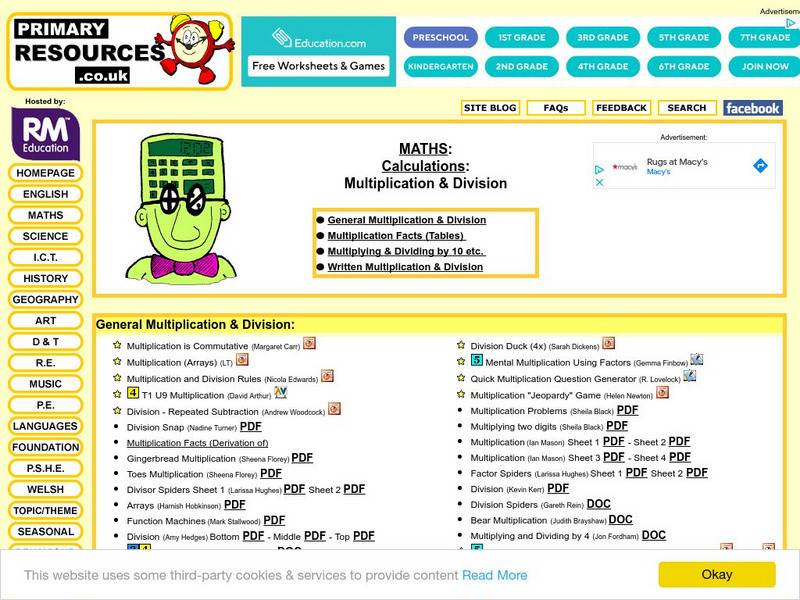
Primary Resources
Primary Resources: General Multiplication and Division
A huge collection of teacher resources in basic multiplication and division. Information on multiplication as repeated addition and division as repeated subtraction. Includes worksheets, games, PowerPoint presentations, smartboard...
E-learning for Kids
E Learning for Kids: Math: Fashion Store: Pattern and Function
Molly organizes her clothes in a pattern using functions.

Other
Business Software Alliance: B4 U Copy: Know the Risks
A nonprofit trade association of software industry professionals defines the risks associated with the use of unlicensed software.
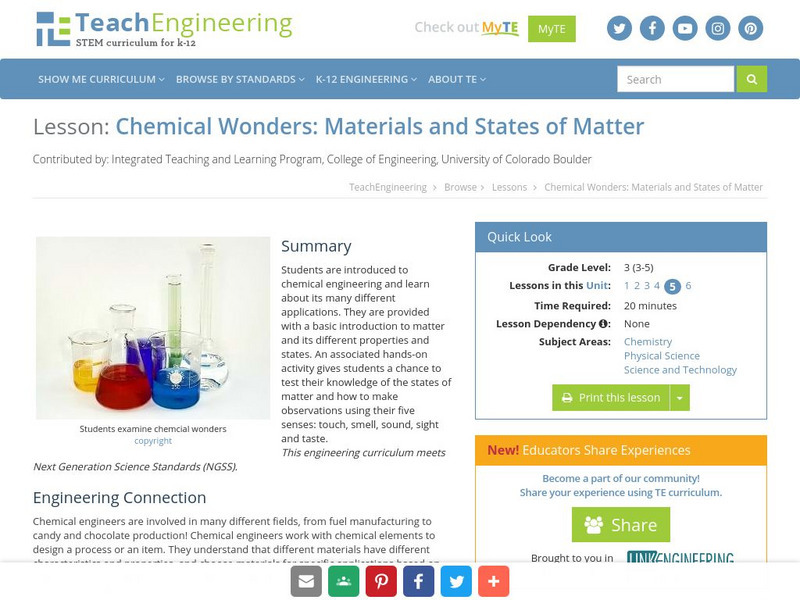
TeachEngineering
Teach Engineering: Chemical Wonders
Young scholars are introduced to chemical engineering and learn about its many different applications. They are provided with a basic introduction to matter and its different properties and states. An associated hands-on activity gives...
Other
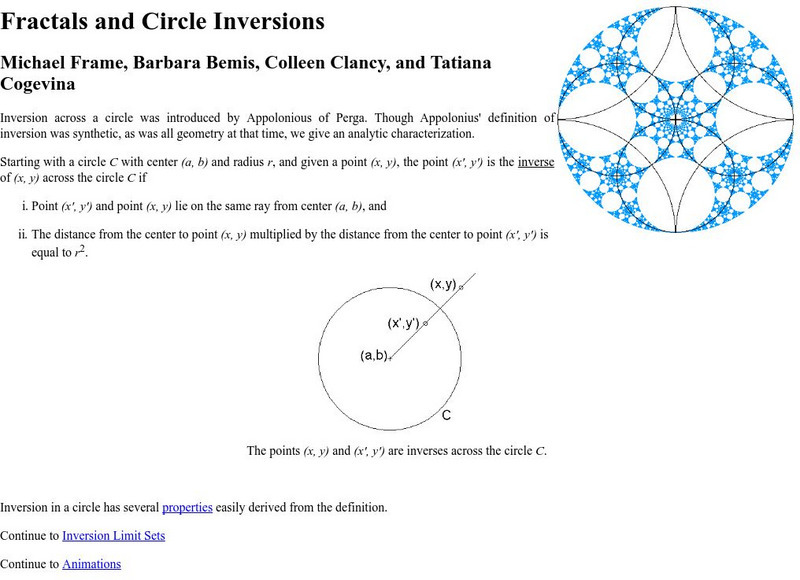
Research Pages: Circle Inversion Fractals
This site introduces the iteration of circle inversions and describes the associated properties.
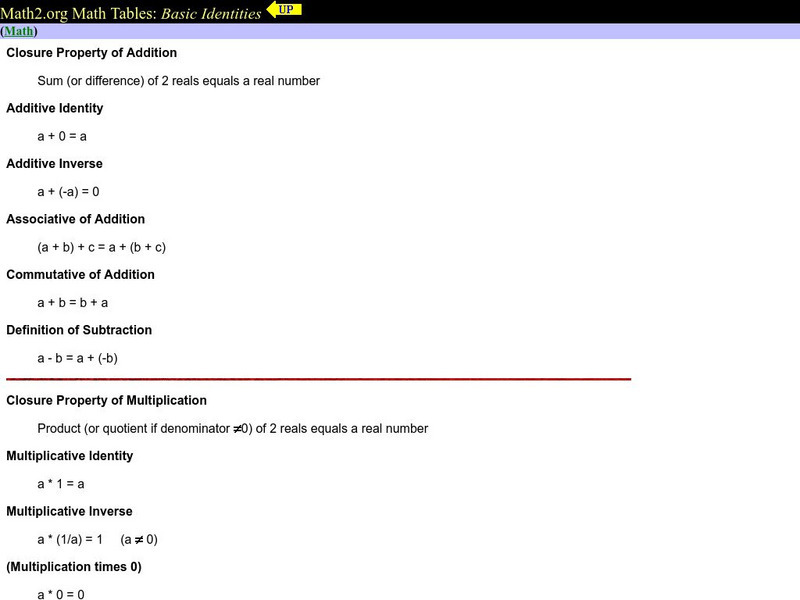
Math2
Math2.org: Basic Algebraic Identities
The basic identities and properties of addition and multiplication are listed. No explanation, simply the identities.
McREL International
Mc Rel: Whelmer #10 Learning Activity: Singing Rod
An easy to do activity that investigates the simple observable properties of sound waves. The activity is presented in lesson plan format that meets NSES standards.
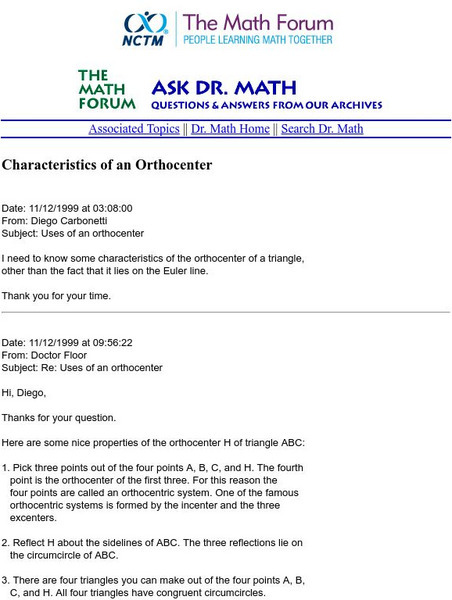
National Council of Teachers of Mathematics
The Math Forum: Ask Dr. Math: Characteristics of an Orthocenter
Here at The Math Forum, Dr. Math offers interesting properties of orthocenters. Links are provided at the bottom of the page for information on associated topics.
Illustrative Mathematics
Illustrative Mathematics: 6.ns Multiplication, Division and Place Value, Part 1
Sixth graders are presented with a completed multiplication equation and are asked to use it to find the answers to seven other equations. To do this, they must use their reasoning and estimation skills. Aligns with 6.NS.B.3.

Alabama Learning Exchange
Alex: Mix It Up!
By now, students have learned that fact families include both addition and subtraction facts. They have also learned that by reversing the order of the addends, they can form related addition facts with the same sum. The students will...
Louisiana Department of Education
Louisiana Doe: Louisiana Believes: Eureka Math Parent Guide: Multi Digit Multiplication and Division
A guide to support parents as they work with their students in multi-digit multiplication and division.

E-learning for Kids
E Learning for Kids: Math: School Bus: Missing Terms: Number Patterns
Students play a variety of learning games to explore number patterns by finding missing terms, using a calculator, and studying tables and a hundreds chart.
Other
Nearpod: Addition & Subtraction Within 20
In this lesson on addition and subtraction within 20, 1st graders learn how to solve addition and subtraction story problems by finding clue words. Adding three addends is also taught in this lesson.

CK-12 Foundation
Ck 12: Statistics: Density Curve of the Normal Distribution
[Free Registration/Login may be required to access all resource tools.] This Concept expands upon the previous by discussing further the normal distribution and the probabilities associated with it by looking at the normal density curve.

TeachEngineering
Teach Engineering: Laser Types and Uses
Through two classroom demos, students are introduced to the basic properties of lasers through various mediums. In the Making an Electric Pickle demonstration, students see how cellular tissue is able to conduct electricity, and how this...
TeachEngineering
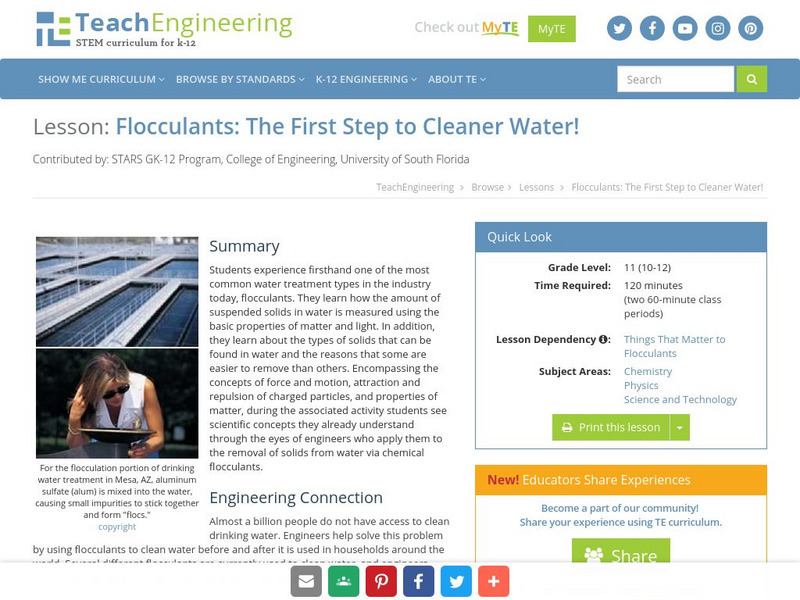
Teach Engineering: Flocculants: The First Step to Cleaner Water!
Students experience firsthand one of the most common water treatment types in the industry today, flocculants. They learn how the amount of suspended solids in water is measured using the basic properties of matter and light. In...
TeachEngineering
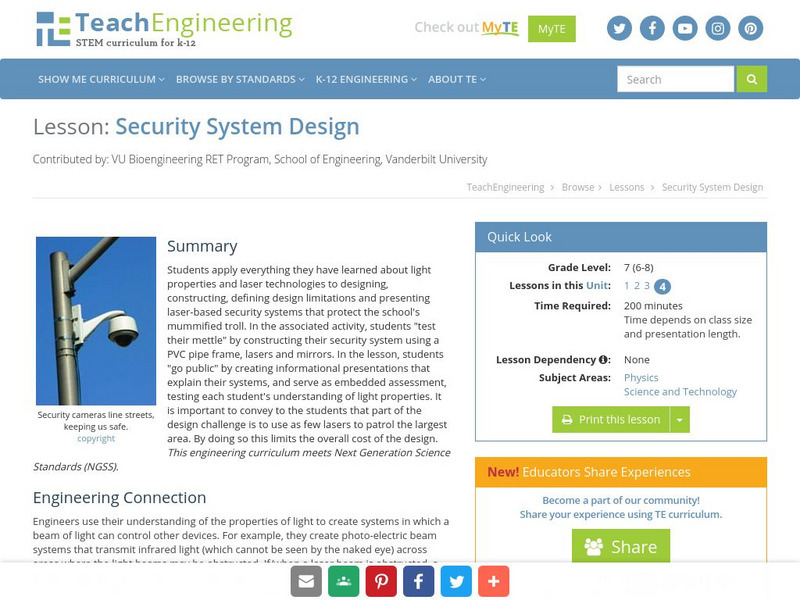
Teach Engineering: Security System Design
Students apply everything they have learned about light properties and laser technologies to designing, constructing and presenting laser-based security systems that protect the school's mummified troll. In the associated activity,...
US Navy
Office of Naval Research: Green Sea Turtle
This very thorough site examines the physical characteristics, adaptations and current research associated with the Green Sea Turtle. A quick quiz is also a part of this site.
TeachEngineering
Teach Engineering: Using Hooke's Law to Understand Materials
Students explore the response of springs to forces as a way to begin to understand elastic solid behavior. They gain experience in data collection, spring constant calculation, and comparison and interpretation of graphs and material...
TeachEngineering
Teach Engineering: Start Networking!
To get a better understanding of complex networks, students create their own, real social network example by interacting with their peers in the classroom and documenting the interactions. They represent the interaction data as a graph,...
TeachEngineering
Teach Engineering: Light Intensity Lab
Students complete this Beer's Law activity in class. Students examine the attenuation of various thicknesses of transparencies. From this activity, students will understand that different substances absorb light differently. This can...
TeachEngineering
Teach Engineering: To Heat or Not to Heat?
Students are introduced to various types of energy with a focus on thermal energy and types of heat transfer as they are challenged to design a better travel thermos that is cost efficient, aesthetically pleasing and meets the design...
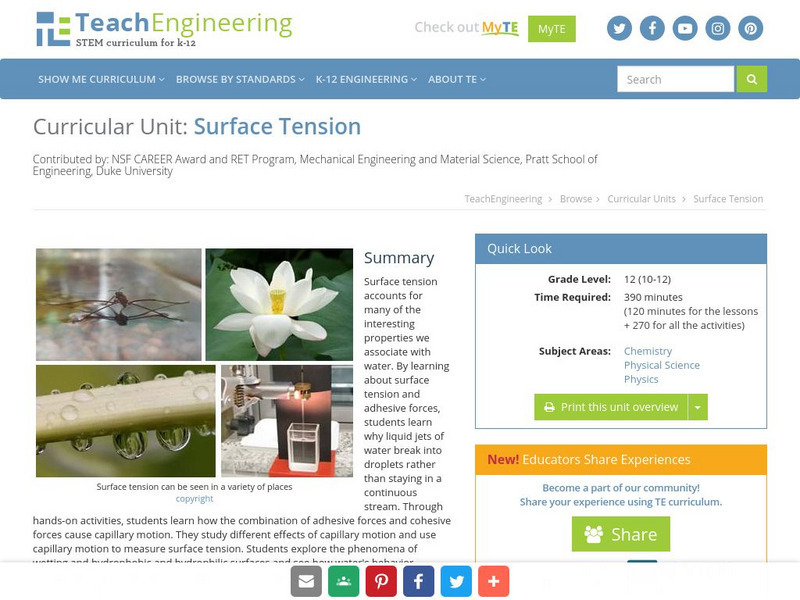
TeachEngineering
Teach Engineering: Surface Tension
Surface tension accounts for many of the interesting properties we associate with water. By learning about surface tension and adhesive forces, students learn why liquid jets of water break into droplets rather than staying in a...
Other popular searches
- Math Associative Property
- Associative Property of Math
- Associative Property in Math
- Associative Property Lessons
- Associative Property Addition