Hi, what do you want to do?






Science Buddies
Science Buddies: Ask an Expert Answers to Your Science Questions
This section of Science Buddies focuses on 'Ask an Expert'. Both teachers and students can go to find answers to science questions that they have been unable to find. Divided into grade levels with an archive of past questions. Free to...
Science Buddies
Science Buddies: Interpreting Area Data From Maps vs. Graphs
Graphical methods of data presentation are a key feature of scientific communication. This project asks the question, "What's the best way to compare the land area of states: a map or a bar graph?" You'll be measuring performance on two...
Science Buddies
Science Buddies: Bridges That Can Take a Shake!
Building a bridge in San Francisco has to take into account the possibilites of earthquakes. This Science Buddies science project asks that you use different virtual bridge designs to withstand virtual earthquakes. The Science Buddies...
Science Buddies
Science Buddies: The Effect of Bridge Design on Weight Bearing Capacity
This Science Buddies project asks that you identify different kinds of bridges, discover why they are built as they are, and then build three different bridges of your own out of balsa wood. See which one you think can bear the heaviest...
Science Buddies
Science Buddies: Predators and Prey: How Do Cats Respond to Bird Sound
A science fair project that ask whether cats respond to familiar bird sounds more readily that bird sounds in general. The Science Buddies project ideas are set up consistently beginning with an abstract, objective, and introduction,...

Science Buddies
Science Buddies: What Is Home Sweet Home to a Bug?
If you had to choose between having your favorite dessert, going to a movie, or spending the night at a friend's house, which would you choose? This project shows you how you can "ask" a sowbug (or pill bug) a similar question in order...
Science Buddies
Science Buddies: What Electric Bills Can Tell You About Energy Use
This project is a great way to "bring home" the concept of energy use. All you need to get started is a good-sized sample of monthly electric bills from households in your area. Building from this simple beginning, you can ask questions...
Washington State University
Washington State University: Ask Dr. Universe: How Are Magnets Made?
Website addresses curious questions about science in a letter format. Here, Dr. Universe is asked about magnets and how they are made and he attempts to explain in an easy to understand answer.
Washington State University
Washington State University: Ask Dr. Universe: Why Do Musicians Use Both Sides of Their Brains?
Website using a question-answer format in which Dr. Universe attempts to answer a curious question a student has about why musicians use both sides of their brains.
NASA
Nasa: Imagine the Universe: Ask an Astrophysicist
Here's the place to find support on a range of space-based astronomical topics. Check the main topics covered and the archived files, or send an email to the experts!

Science Struck
Science Struck: Interesting Philosophical Questions About Time
Discover some of the deep questions that scientists and philosophers ask about time and some of the ideas that emerge from each one.
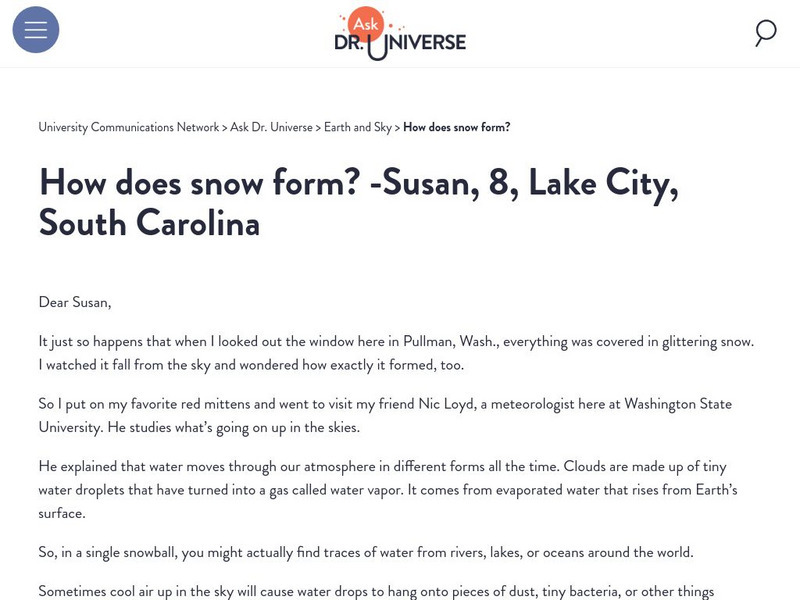
Washington State University
Washington State University: Ask Dr. Universe: How Does Snow Form?
In this "Ask Dr. Universe," an eight-year old's question about how snow is formed is answered. Find out what meteorologist, Nic Loyd, has to say about this science.
Discovery Education
Discovery Education: Science Fair Central: Validate Topic
A small collection of questions students should ask themselves as they think about the topics they want to explore in their science fair projects.

Alabama Learning Exchange
Alex: Air Is All Around You
In this science lesson students will be asked the question, "Does air take up space?" and "Does air have weight?" Students will conduct experiments that prove that air has mass, takes up space, and exerts pressure.
American Geosciences Institute
American Geosciences Institute: Earth Science Week: Be a Paleontologist!
Ask young scholars to think like private investigators working on a case where they answer this question: Where is paleontological evidence of past life likely to be discovered?
PBS
Pbs Learning Media: That's My Theory!
Become a game show contestant in this online activity from A Science Odyssey and ask a series of questions to a panel of mystery scientists, using the answers to determine which scientist is Einstein.