Hi, what do you want to do?






Curated OER
Sculpture Shapes
Students reconstruct an ancient Greek sculpture using various geometric forms and explore different geometric forms. They create an abstract human form out of geometric shapes and create other representations out of the same shapes.

Curated OER
Getting to Know All About You
Students learn each other's name and at the same time become familiar with the name of an endangered species. Without the student watching, their name and the name of an endangered species is placed on their back with tape. Students go...

Curated OER
Birds of Wisconsin
First graders explore the job done by ornithologists. They role play identifying the characteristics that make a bird a bird. They discuss what makes each bird species unique. Students are introduced to Wisconsin's most common and rare...

Curated OER
What Effect Does Climate Have on Wildlife?
Students explore the international scope of climate change. They identify variables that cause changes in the climate. Students examine how changes in climate affect the food chain.

Curated OER
The Desert Alphabet Book
Students explore world geography by researching a science book with their classmates. In this desert identification lesson, students utilize a U.S. map to locate the geographical locations of deserts. Students create an oral report based...

Curated OER
Opening Doors to Social Studies with Children's Literature: The Desert Alphabet Book
Young scholars explore the geography of the United States. In this social studies activity, students identify the major deserts on a map of the United States.

Curated OER
Spiders are Special
First graders recognize that spiders are important natural predators. They work in small groups with simple field guides to identify as many of their spiders as they can.

Curated OER
Nature's Recyclers
Students create environments to demonstrate how earthworms interact with their surroundings.
Read Works
Read Works: Classify and Categorize 3rd Grade Unit
[Free Registration/Login Required] A three-lesson plan unit on classifying and categorizing through which students learn how to categorize information to answer research questions and then to organization that information into an...
Read Works
Read Works: Classify and Categorize 4th Grade Unit
[Free Registration/Login Required] A three-lesson unit on classifying and categorizing through which students learn how to organize research into an outline, use text features to locate information, and write a research report. Lessons...
Read Works
Read Works: Animals Get Ready
[Free Registration/Login Required] Students read about how different types of animals prepare for winter. A question sheet is available to help students build skills in classifying and categorizing.

National Geographic
National Geographic: Sorting the Gulf Ecosystem
In this activity, students sort images of organisms into categories such as birds, reptiles, plants, invertebrates, etc. Next they examine the provided poster of the Gulf of Mexico ecosystem and categorize organisms they identify. A...
TESL Journal
Activities for Esl Students: Self Study Idiom Quizzes
Vast array of quizzes and self-study exercises based on idioms and idiomatic expressions, categorized in a variety of ways (beginning with A, B, etc., by keyword, or by association with other groupings). Great practice for the ELL/ESL...
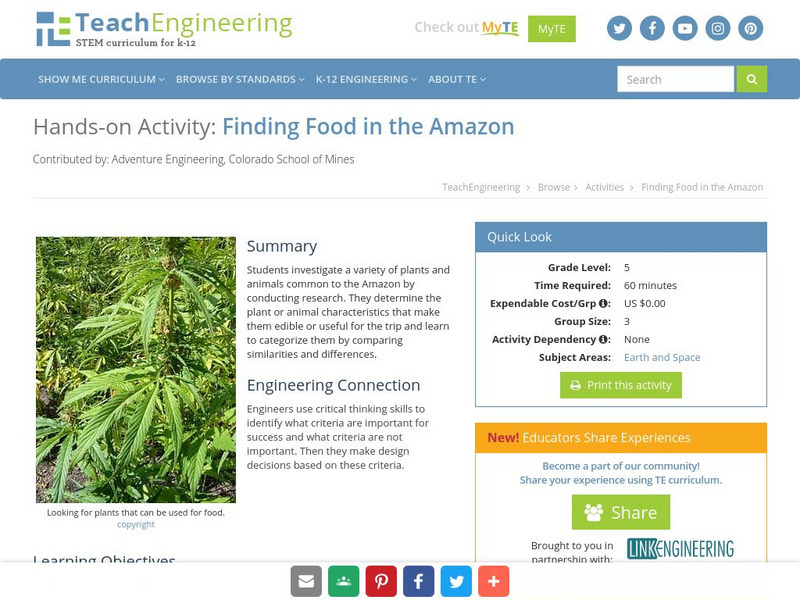
TeachEngineering
Teach Engineering: Finding Food in the Amazon
In this activity, the students will investigate a variety of plants and animals common to the Amazon through research. They will determine the plant or animal characteristics that make them edible or useful for the trip and learn to...
Canadian Museum of Nature
Canadian Museum of Nature: Natural History Notebooks
This site from the Canadian Museum of Nature, a natural history museum, provides short information blurbs and fun facts on over 240 different common animals categorized by type (mammals, fish, reptiles, invertebrates, amphibians,...
Science Education Resource Center at Carleton College
Serc: Pondering the Pond
After a trip to the pond, students will be able to name plants, animals, birds, and insects found at the pond. They will be able to categorize them and sort them into groups.