Hi, what do you want to do?





Smithsonian Institution
National Museum of Natural History: American Mammals: Desert Kangaroo Rat
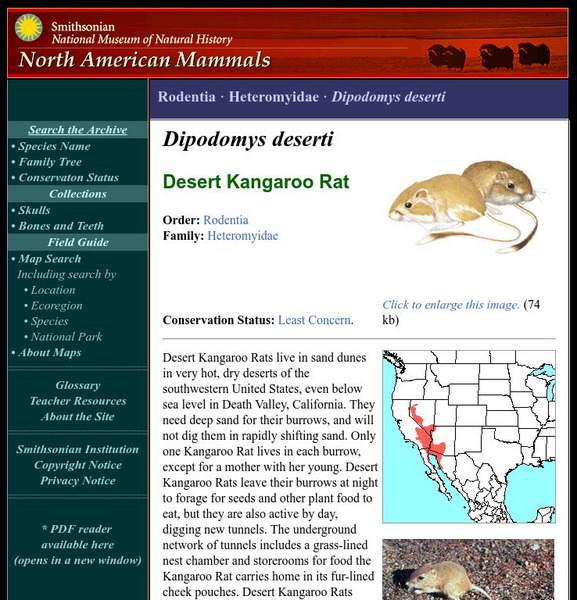
Desert Kangaroo Rats live in sand dunes in very hot, dry deserts of the southwestern United States, even below sea level in Death Valley, California. They need deep sand for their burrows, and will not dig them in rapidly shifting sand....
Smithsonian Institution
National Museum of Natural History: American Mammals: Dwarf Sperm Whale
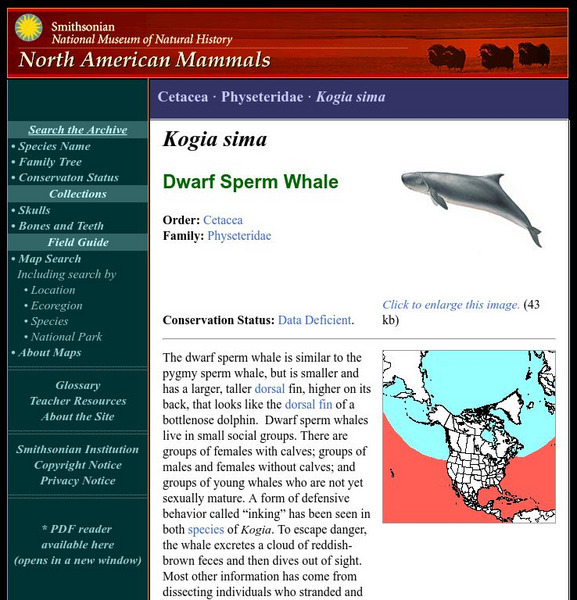
The dwarf sperm whale is similar to the pygmy sperm whale, but is smaller and has a larger, taller dorsal fin, higher on its back, that looks like the dorsal fin of a bottlenose dolphin. Dwarf sperm whales live in small social groups....
Smithsonian Institution
National Museum of Natural History: American Mammals: Fraser's Dolphin
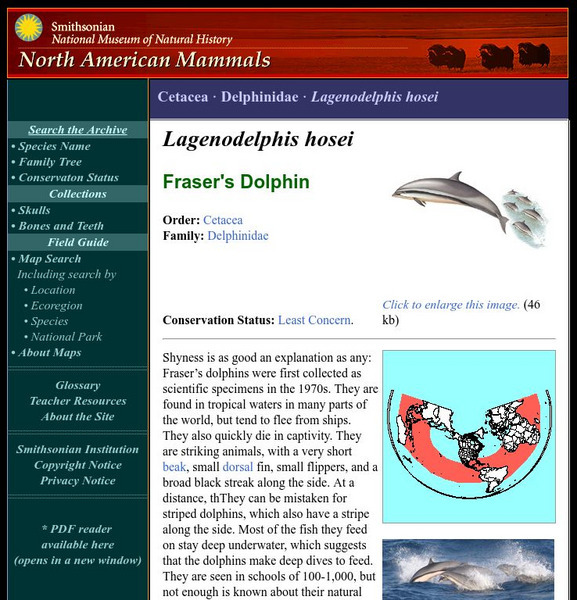
Shyness is as good an explanation as any: Fraser's dolphins were first collected as scientific specimens in the 1970s. They are found in tropical waters in many parts of the world but tend to flee from ships. Learn more about the...
Smithsonian Institution
National Museum of Natural History: American Mammals: Gervais's Beaked Whale
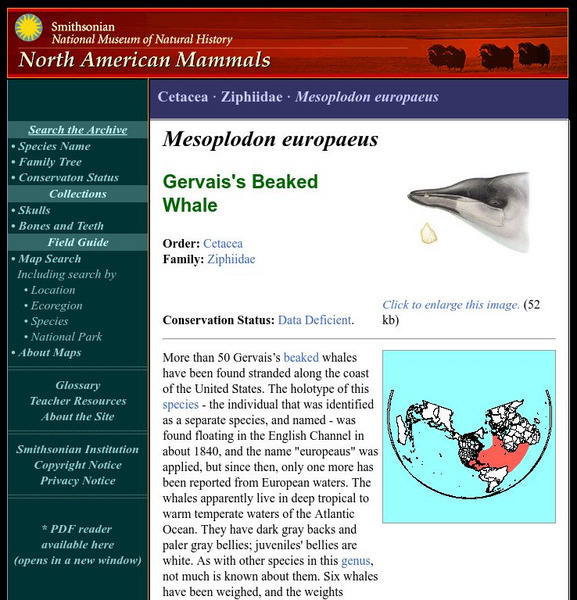
More than 50 Gervais's beaked whales have been found stranded along the coast of the United States. The holotype of this species - the individual that was identified as a separate species, and named - was found floating in the English...
Smithsonian Institution
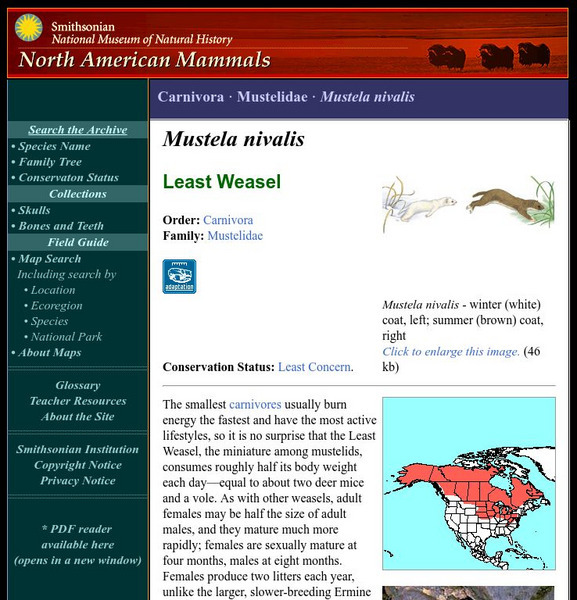
National Museum of Natural History: American Mammals: Least Weasel
The smallest carnivores usually burn energy the fastest and have the most active lifestyles, so it is no surprise that the Least Weasel, the miniature among mustelids, consumes roughly half its body weight each day, equal to about two...
Smithsonian Institution
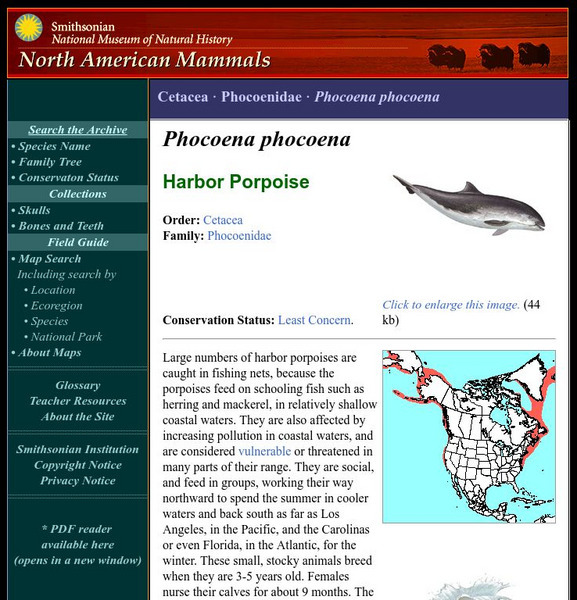
National Museum of Natural History: American Mammals: Harbor Porpoise
Large numbers of harbor porpoises are caught in fishing nets, because the porpoises feed on schooling fish such as herring and mackerel, in relatively shallow coastal waters. They are also affected by increasing pollution in coastal...
Smithsonian Institution
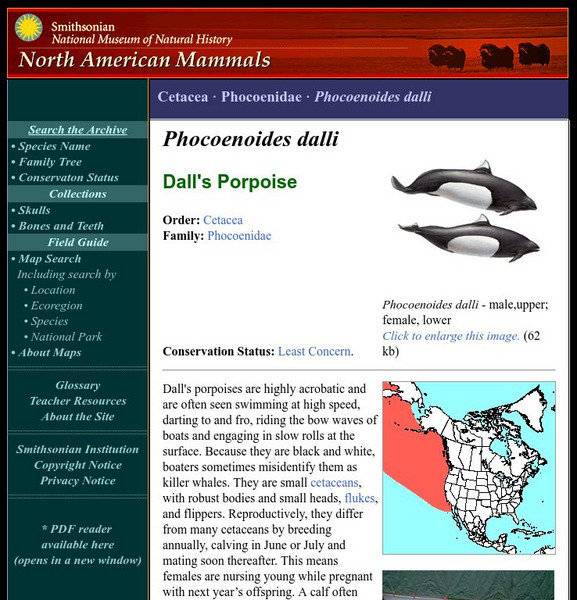
National Museum of Natural History: American Mammals: Dall's Porpoise
Dall's porpoises are highly acrobatic and are often seen swimming at high speed, darting to and fro, riding the bow waves of boats and engaging in slow rolls at the surface. Because they are black and white, boaters sometimes misidentify...
Smithsonian Institution
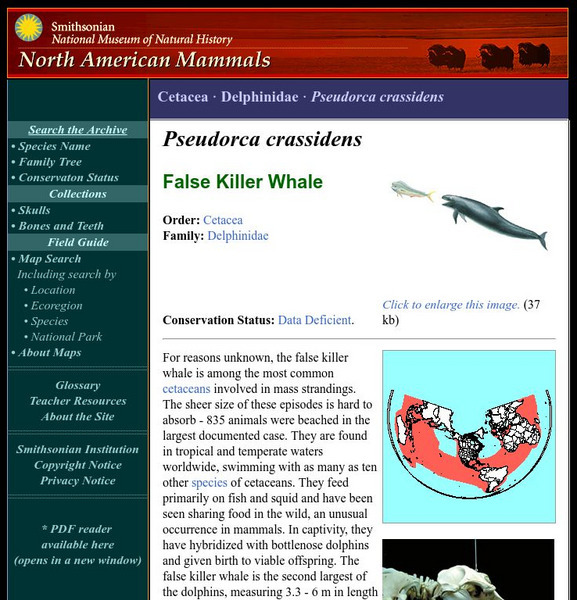
National Museum of Natural History: American Mammals: False Killer Whale
For reasons unknown, the false killer whale is among the most common cetaceans involved in mass strandings. The sheer size of these episodes is hard to absorb - 835 animals were beached in the largest documented case. Learn more about...
Smithsonian Institution
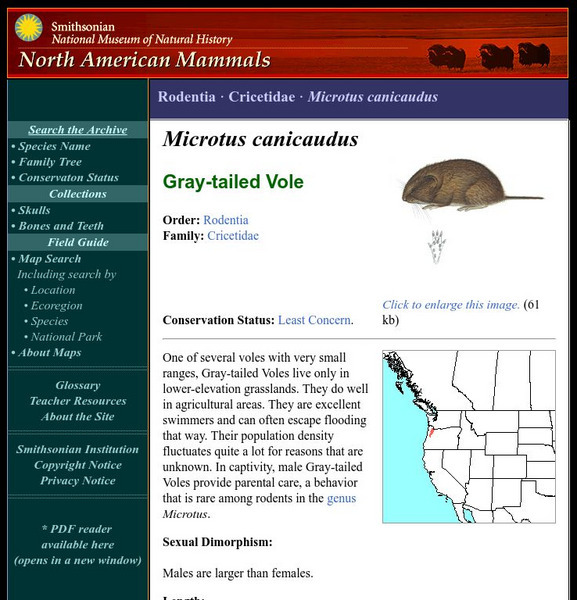
National Museum of Natural History: American Mammals: Gray Tailed Vole
One of several voles with very small ranges, Gray-tailed Voles live only in lower-elevation grasslands. They do well in agricultural areas. Learn more about the Microtus canicaudus, more commonly known as a Gray-tailed Vole, in this...

Smithsonian Institution
National Museum of Natural History: American Mammals: Insular Vole
There have been only scattered observations of the Insular Vole since 1885 because the two islands in the Bering Sea off the coast of Alaska where it lives are rather inaccessible. The Voles live in burrows dug in moist lowland areas, at...
Smithsonian Institution
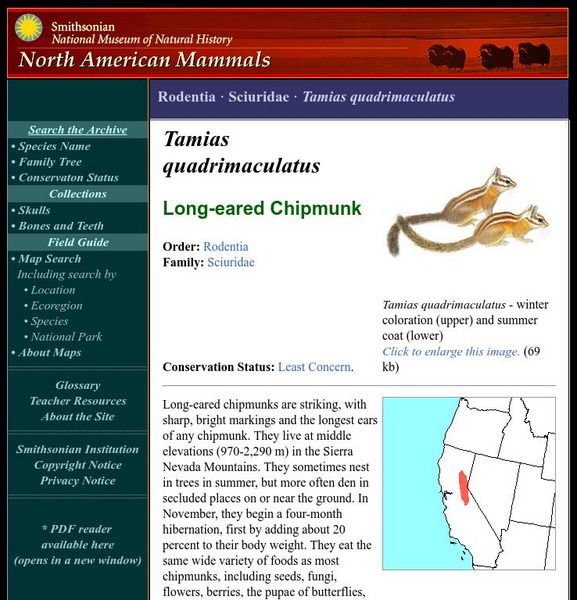
National Museum of Natural History: American Mammals: Long Eared Chipmunk
Long-eared chipmunks are striking, with sharp, bright markings and the longest ears of any chipmunk. They live at middle elevations (970-2,290 m) in the Sierra Nevada Mountains. Learn more about the Tamias quadrimaculatus, more commonly...
Smithsonian Institution
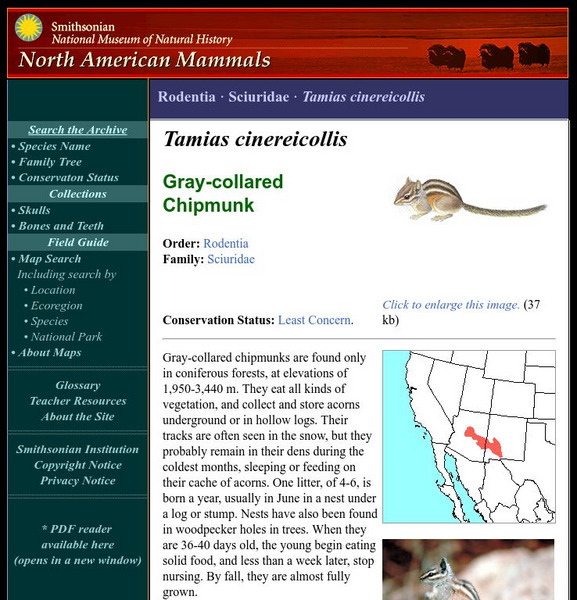
National Museum of Natural History: American Mammals: Gray Collared Chipmunk
Gray-collared chipmunks are found only in coniferous forests, at elevations of 1,950-3,440 m. They eat all kinds of vegetation and collect and store acorns underground or in hollow logs. Learn more about the Tamias cinereicollis, more...
Smithsonian Institution
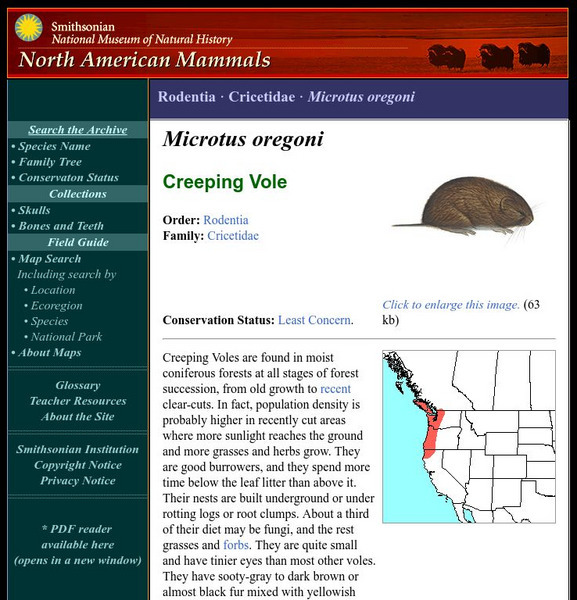
National Museum of Natural History: American Mammals: Creeping Vole
Creeping Voles are found in moist coniferous forests at all stages of forest succession, from old growth to recent clear-cuts. In fact, population density is probably higher in recently cut areas where more sunlight reaches the ground...
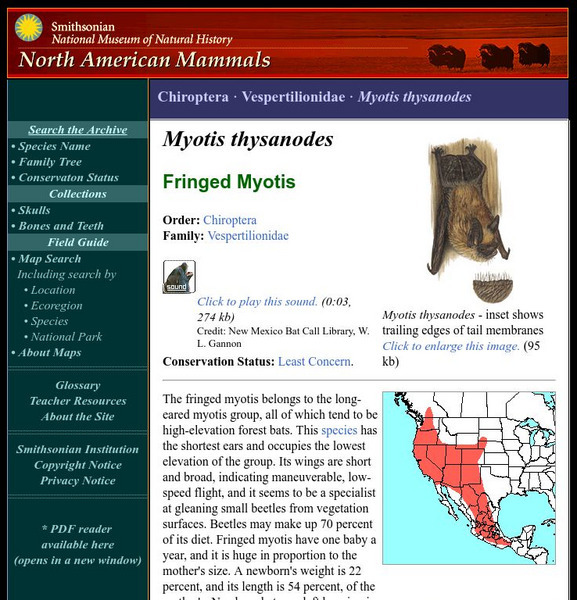
Smithsonian Institution
National Museum of Natural History: American Mammals: Fringed Myotis
The fringed myotis belongs to the long-eared myotis group, all of which tend to be high-elevation forest bats. This species has the shortest ears and occupies the lowest elevation of the group. Learn more about the Myotis thysanodes,...
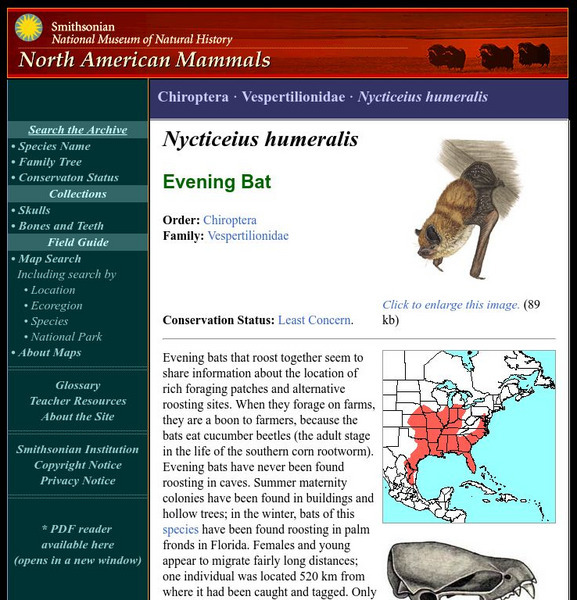
Smithsonian Institution
National Museum of Natural History: American Mammals: Evening Bat
Evening bats that roost together seem to share information about the location of rich foraging patches and alternative roosting sites. When they forage on farms, they are a boon to farmers, because the bats eat cucumber beetles (the...
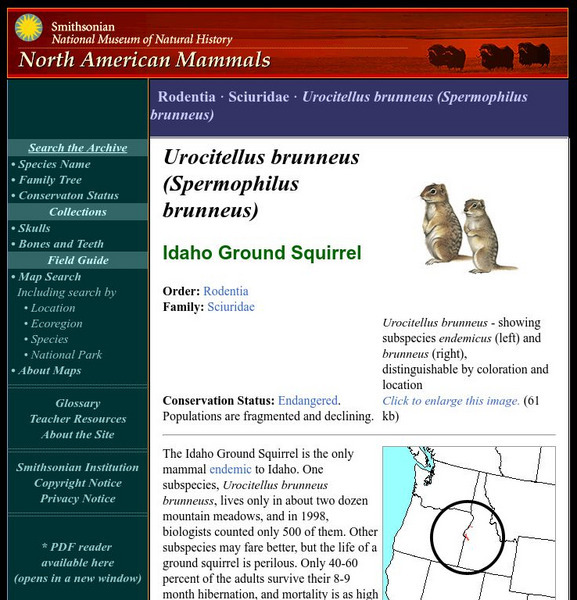
Smithsonian Institution
National Museum of Natural History: American Mammals: Idaho Ground Squirrel
The Idaho Ground Squirrel is the only mammal endemic to Idaho. One subspecies, Spermophilus brunneus brunneus, lives only in about two dozen mountain meadows, and in 1998, biologists counted only 500 of them. Learn more about the...
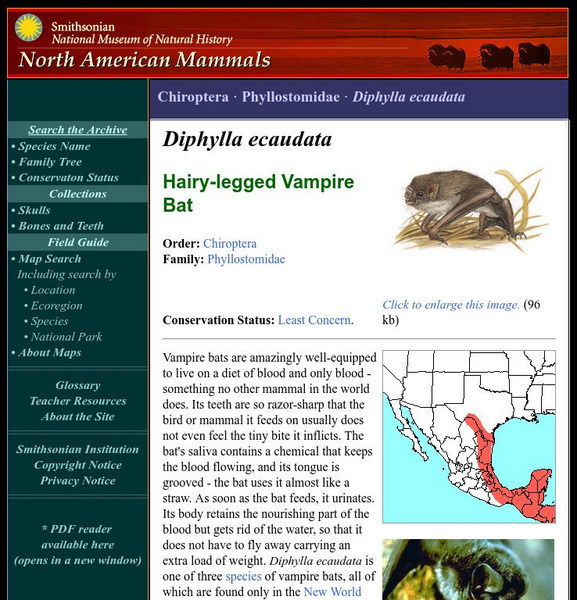
Smithsonian Institution
National Museum of Natural History: American Mammals: Hairy Legged Vampire Bat
Vampire bats are amazingly well-equipped to live on a diet of blood and only blood - something no other mammal in the world does. Its teeth are so razor-sharp that the bird or mammal it feeds on usually does not even feel the tiny bite...
Smithsonian Institution
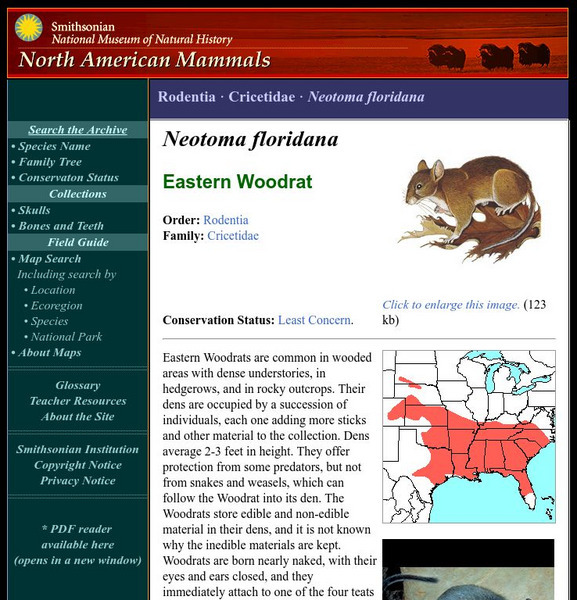
National Museum of Natural History: American Mammals: Eastern Woodrat
Eastern Woodrats are common in wooded areas with dense understories, in hedgerows, and in rocky outcrops. Their dens are occupied by a succession of individuals, each one adding more sticks and other material to the collection. Learn...
Smithsonian Institution
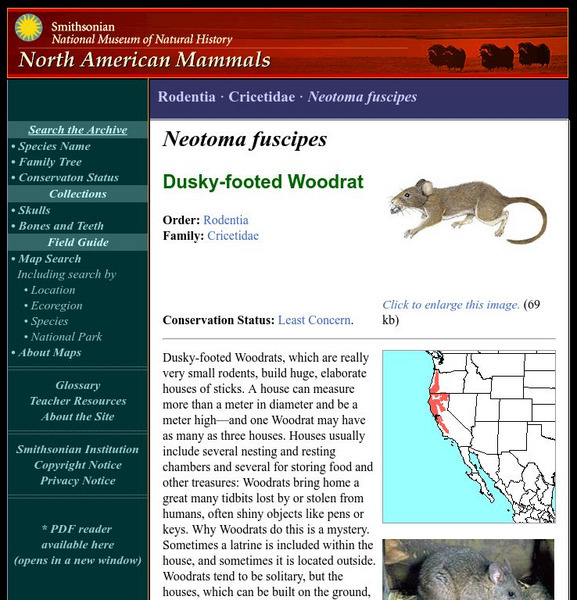
National Museum of Natural History: American Mammals: Dusky Footed Woodrat
Dusky-footed Woodrats, which are really very small rodents, build huge, elaborate houses of sticks. A house can measure more than a meter in diameter and be a meter high and one Woodrat may have as many as three houses. Learn more about...

Smithsonian Institution
National Museum of Natural History: American Mammals: Hispid Pocket Mouse
"Hispid" refers to the coarseness of this pocket mouse's fur. Hispid Pocket Mice are larger and more robust than other pocket mice in their range, and like the others, they are solitary except in the breeding season. Learn more about the...
Smithsonian Institution
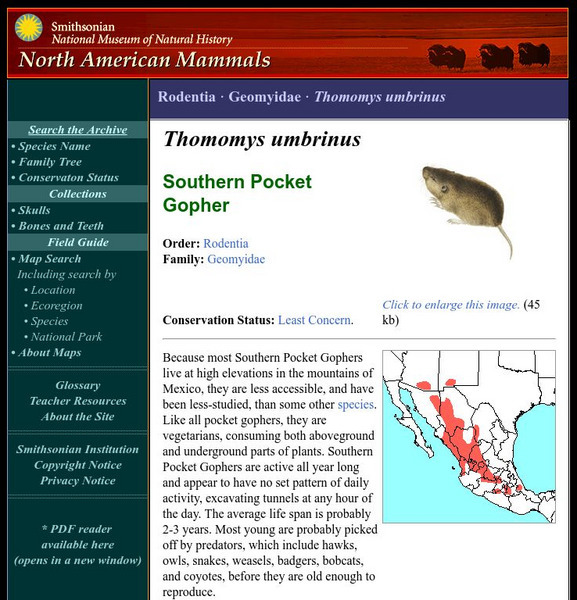
National Museum of Natural History: American Mammals: Southern Pocket Gopher
Because most Southern Pocket Gophers live at high elevations in the mountains of Mexico, they are less accessible, and have been less-studied, than some other species. Like all pocket gophers, they are vegetarians, consuming both...
Smithsonian Institution
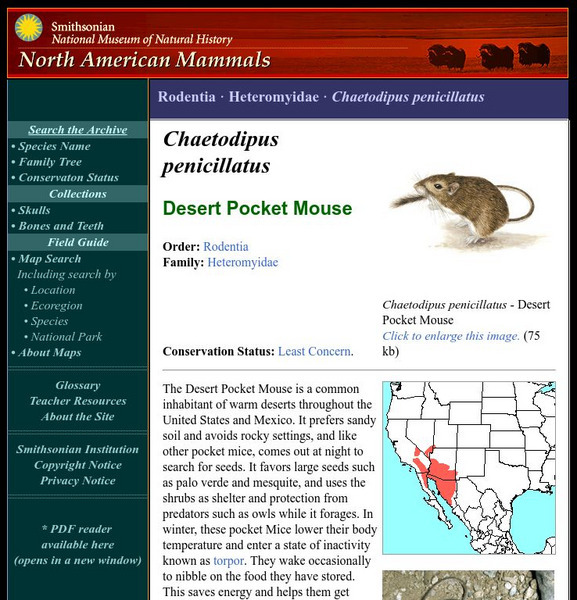
National Museum of Natural History: American Mammals: Desert Pocket Mouse
The Desert Pocket Mouse is a common inhabitant of warm deserts throughout the United States and Mexico. It prefers sandy soil and avoids rocky settings, and like other pocket mice, comes out at night to search for seeds. Learn more about...
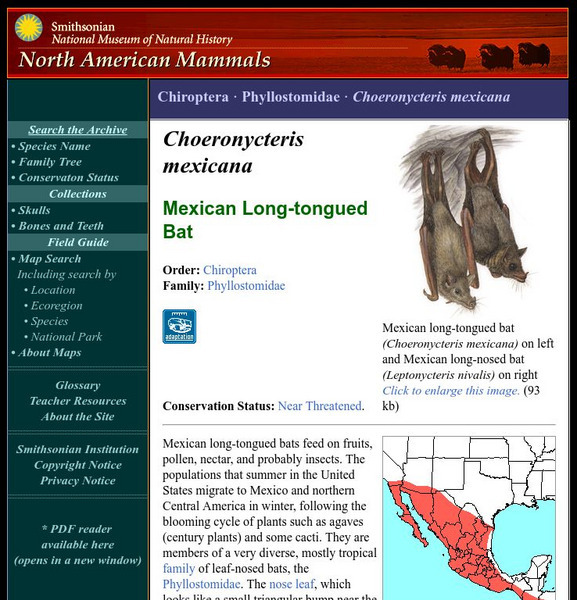
Smithsonian Institution
National Museum of Natural History: American Mammals: Mexican Long Tongued Bat
Mexican long-tongued bats feed on fruits, pollen, nectar, and probably insects. The populations that summer in the United States migrate to Mexico and northern Central America in winter, following the blooming cycle of plants such as...
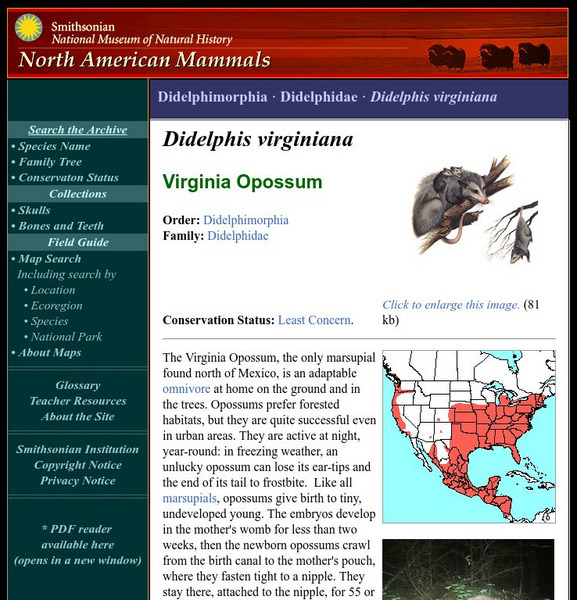
Smithsonian Institution
National Museum of Natural History: American Mammals: Virginia Opossum
The Virginia opossum, the only marsupial found north of Mexico, is an adaptable omnivore at home on the ground and in the trees. Opossums prefer forested habitats, but they are quite successful even in urban areas. Learn more about the...