Hi, what do you want to do?





Smithsonian Institution
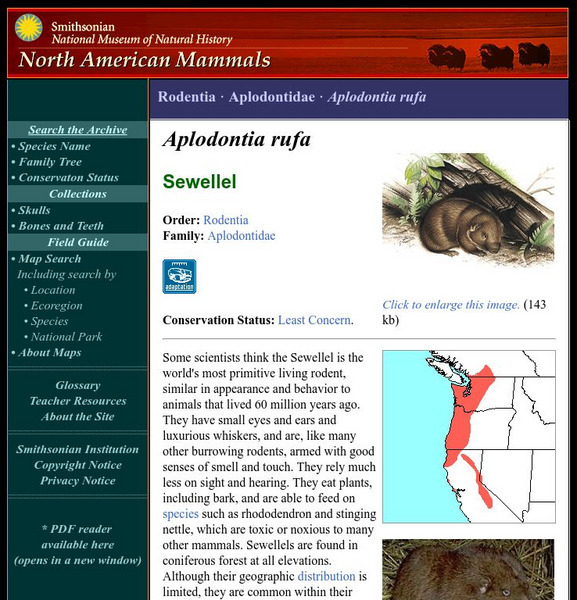
National Museum of Natural History: American Mammals: Mountain Beaver
Some scientists think the Mountain Beaver is the world's most primitive living rodent, similar in appearance and behavior to animals that lived 60 million years ago. They have small eyes and ears and luxurious whiskers, and are, like...
Smithsonian Institution
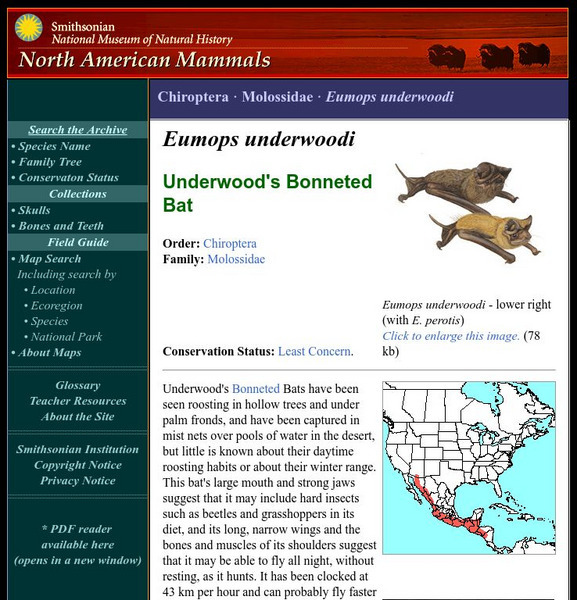
National Museum of Natural History: American Mammals: Underwood's Mastiff Bat
Underwood's mastiff bats have been seen roosting in hollow trees and under palm fronds, and have been captured in mist nets over pools of water in the desert, but little is known about their daytime roosting habits or about their winter...
Smithsonian Institution
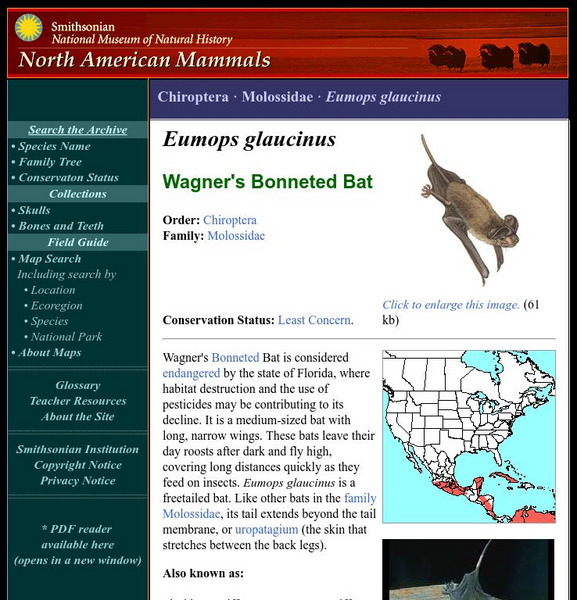
National Museum of Natural History: American Mammals: Wagner's Mastiff Bat
Wagner's mastiff bat is considered endangered by the state of Florida, where habitat destruction and the use of pesticides may be contributing to its decline. It is a medium-sized bat with long, narrow wings. Learn more about the Eumops...
Smithsonian Institution
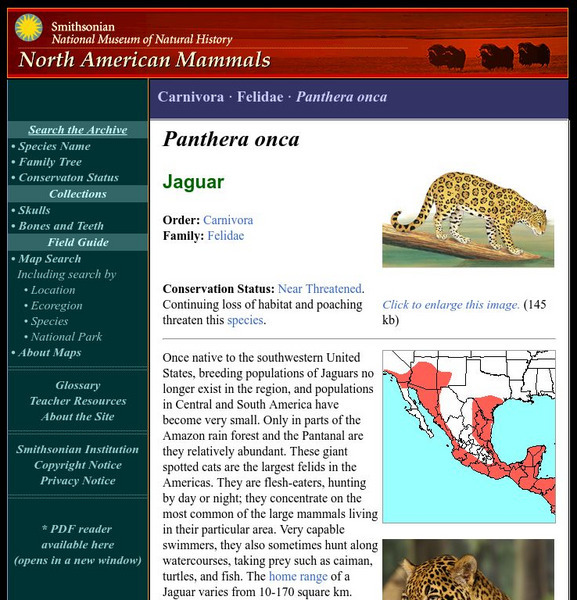
National Museum of Natural History: American Mammals: Jaguar
Once native to the southwestern United States, breeding populations of Jaguars no longer exist in the region, and populations in Central and South America have become very small. Only in parts of the Amazon rainforest and the Pantanal...
Smithsonian Institution
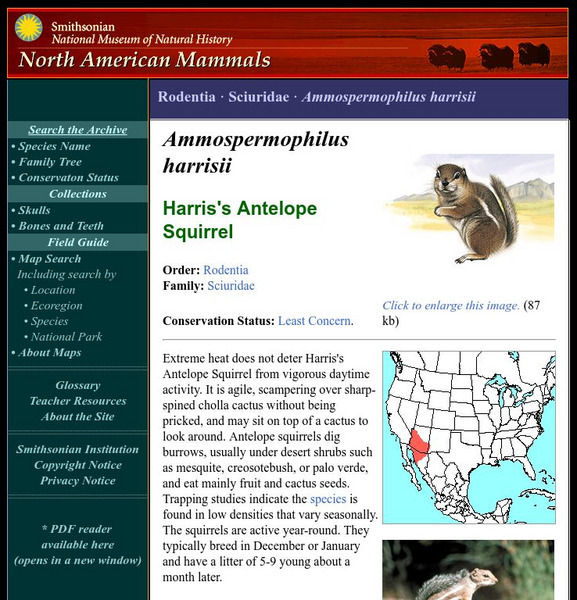
National Museum of Natural History: American Mammals: Harris's Antelope Squirrel
Extreme heat does not deter Harris's Antelope Squirrel from vigorous daytime activity. It is agile, scampering over sharp-spined cholla cactus without being pricked, and may sit on top of a cactus to look around. Learn more about the...
Smithsonian Institution
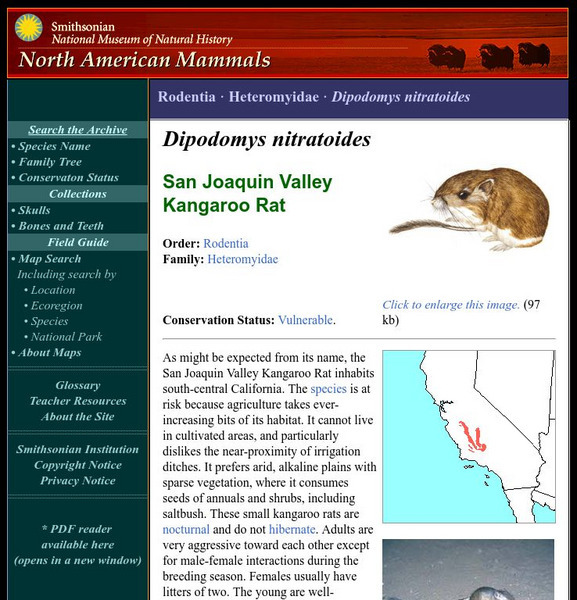
National Museum of Natural History: American Mammals: Fresno Kangaroo Rat
As might be expected from its name, the Fresno Kangaroo Rat inhabits south-central California. The species is at risk because agriculture takes ever-increasing bits of its habitat. Learn more about the Dipodomys nitratoides, more...
Smithsonian Institution
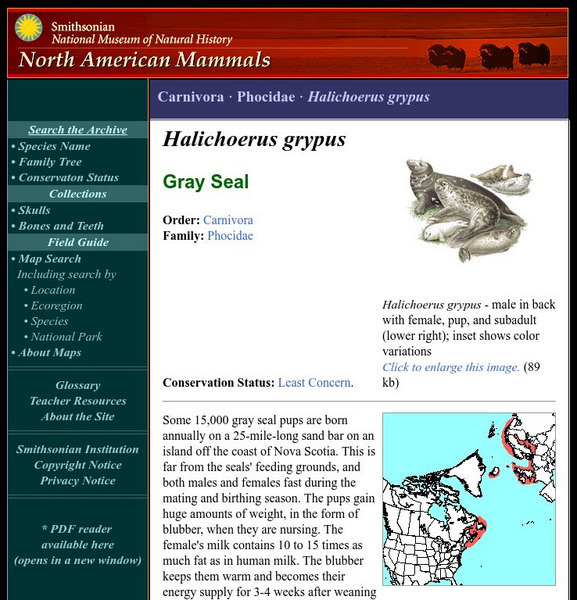
National Museum of Natural History: American Mammals: Gray Seal
Some 15,000 gray seal pups are born annually on a 25-mile-long sand bar on an island off the coast of Nova Scotia. This is far from the seals' feeding grounds, and both males and females fast during the mating and birthing season. Learn...
Smithsonian Institution
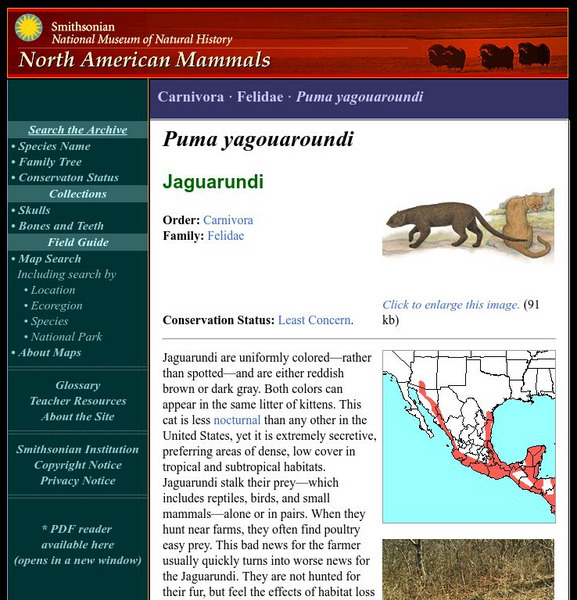
National Museum of Natural History: American Mammals: Jaguarundi
Jaguarundi are uniformly colored, rather than spotted, and are either reddish brown or dark gray. Both colors can appear in the same litter of kittens. Learn more about the Puma yaguarondi (Herpailurus yaguarondi), more commonly known as...
Smithsonian Institution
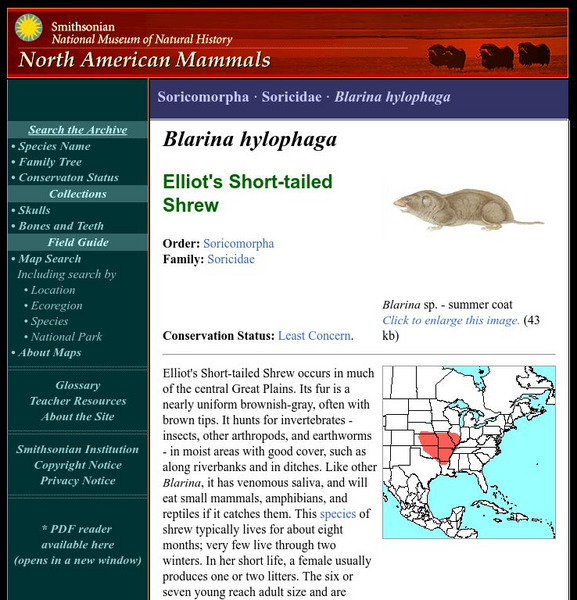
National Museum of Natural History: American Mammals: Elliot's Short Tailed Shrew
Elliot's Short-tailed Shrew occurs in much of the central Great Plains. Its fur is a nearly uniform brownish-gray, often with brown tips. Learn more about the Blarina hylophaga, more commonly known as Elliot's Short-tailed Shrew, in this...
Smithsonian Institution
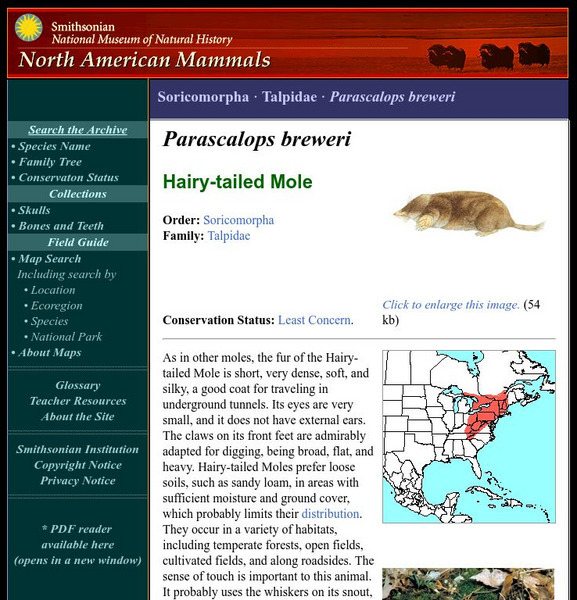
National Museum of Natural History: American Mammals: Hairy Tailed Mole
As in other moles, the fur of the Hairy-tailed Mole is short, very dense, soft, and silky, a good coat for traveling in underground tunnels. Its eyes are very small, and it does not have external ears. Learn more about the Parascalops...
Smithsonian Institution
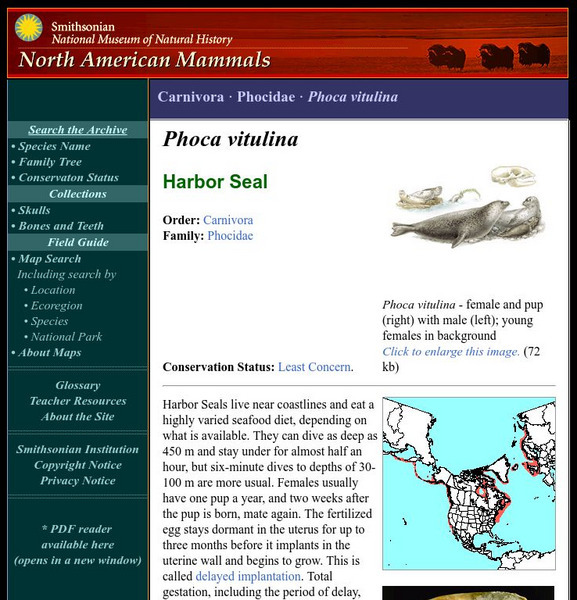
National Museum of Natural History: American Mammals: Harbor Seal
Harbor Seals live near coastlines and eat a highly varied seafood diet, depending on what is available. They can dive as deep as 450 m and stay under for almost half an hour, but six-minute dives to depths of 30-100 m are more usual....
Smithsonian Institution
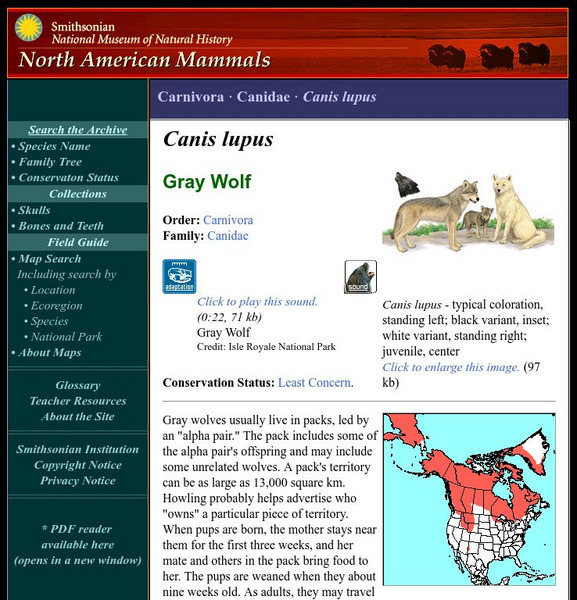
National Museum of Natural History: American Mammals: Gray Wolf
Gray wolves usually live in packs, led by an "alpha pair." The pack includes some of the alpha pair's offspring and may include some unrelated wolves. Learn more about the Canis lupus, more commonly known as a Gray Wolf, in this...
Smithsonian Institution
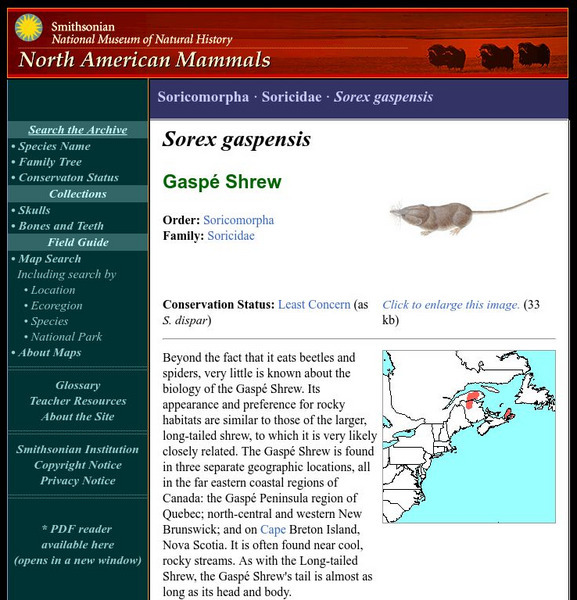
National Museum of Natural History: American Mammals: Gaspae' Shrew
Beyond the fact that it eats beetles and spiders, very little is known about the biology of the Gaspe Shrew. Its appearance and preference for rocky habitats are similar to those of the larger, long-tailed shrew, to which it is very...
Smithsonian Institution
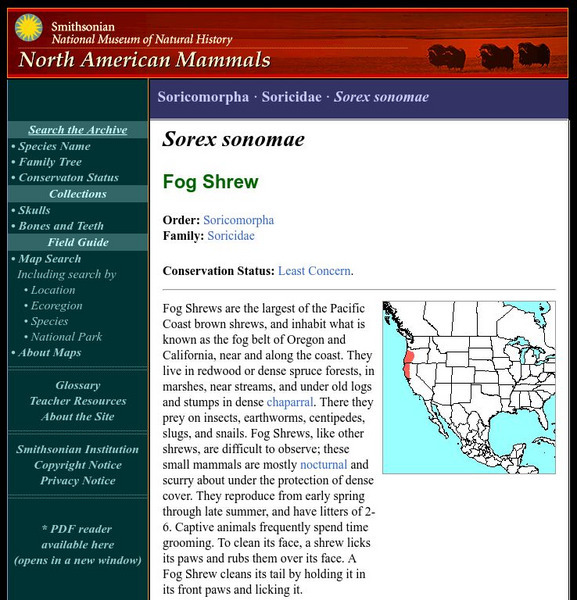
National Museum of Natural History: American Mammals: Fog Shrew
Fog Shrews are the largest of the Pacific Coast brown shrews, and inhabit what is known as the fog belt of Oregon and California, near and along the coast. They live in redwood or dense spruce forests, in marshes, near streams, and under...
Smithsonian Institution
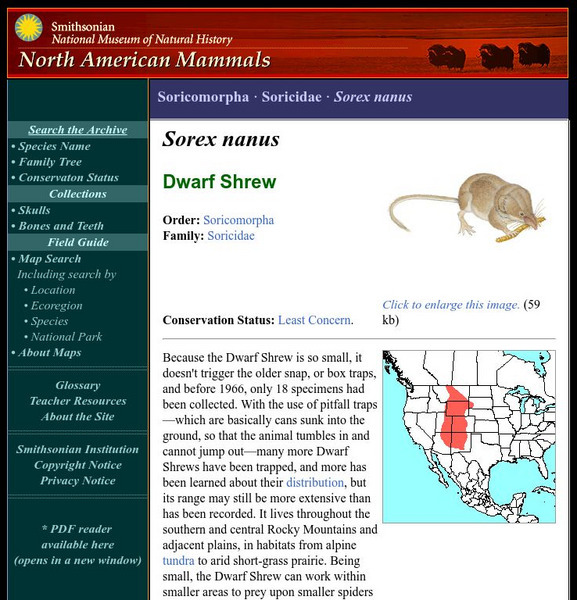
National Museum of Natural History: American Mammals: Dwarf Shrew
Because the Dwarf Shrew is so small, it doesn't trigger the older snap or box traps, and before 1966, only 18 specimens had been collected. With the use of pitfall traps, which are basically cans sunk into the ground so that the animal...
Smithsonian Institution
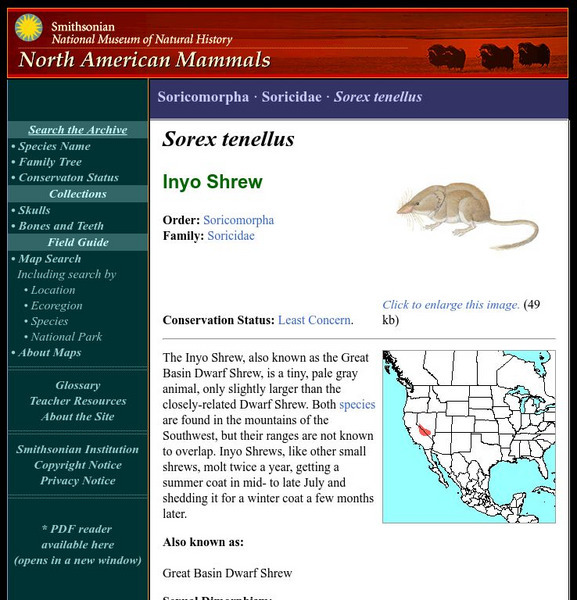
National Museum of Natural History: American Mammals: Inyo Shrew
The Inyo Shrew, also known as the Great Basin Dwarf Shrew, is a tiny, pale gray animal, only slightly larger than the closely-related Dwarf Shrew. Both species are found in the mountains of the Southwest, but their ranges are not known...
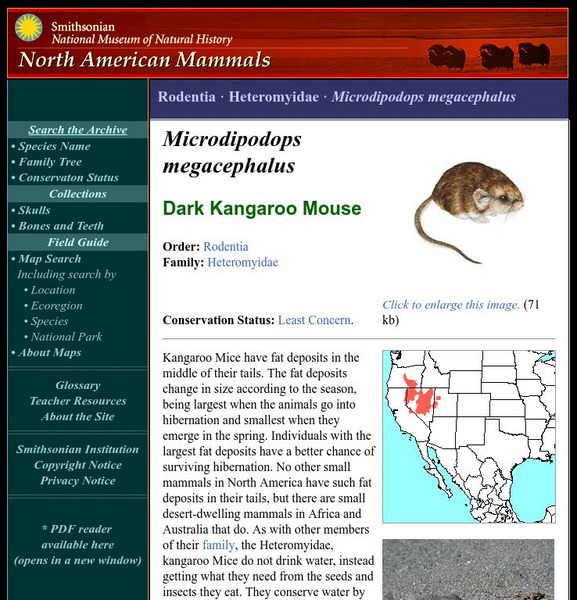
Smithsonian Institution
National Museum of Natural History: American Mammals: Dark Kangaroo Mouse
Kangaroo Mice have fat deposits in the middle of their tails. The fat deposits change in size according to the season, being largest when the animals go into hibernation and smallest when they emerge in the spring. Learn more about the...
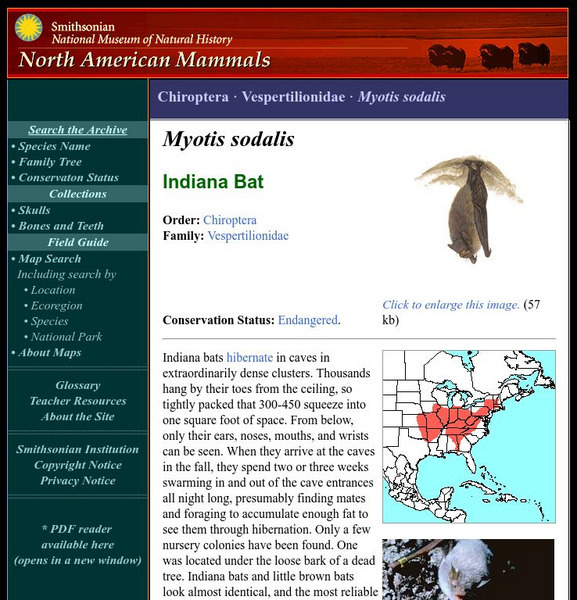
Smithsonian Institution
National Museum of Natural History: American Mammals: Indiana Bat
Indiana bats hibernate in caves in extraordinarily dense clusters. Thousands hang by their toes from the ceiling, so tightly packed that 300-450 squeeze into one square foot of space. Learn more about the Myotis sodalis, more commonly...
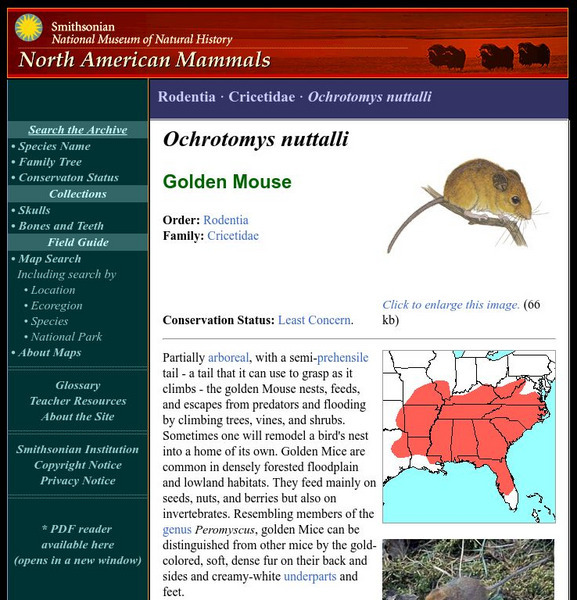
Smithsonian Institution
National Museum of Natural History: American Mammals: Golden Mouse
Partially arboreal, with a semi-prehensile tail - a tail that it can use to grasp as it climbs - the golden Mouse nests, feeds, and escapes from predators and flooding by climbing trees, vines, and shrubs. Sometimes one will remodel a...

Smithsonian Institution
National Museum of Natural History: American Mammals: Great Basin Pocket Mouse
The Great Basin Pocket Mouse is the largest member of the genus. It inhabits arid and semi-arid habitats in nearly the entire Great Basin region of western North America, particularly where sagebrush dominates the vegetation. Learn more...
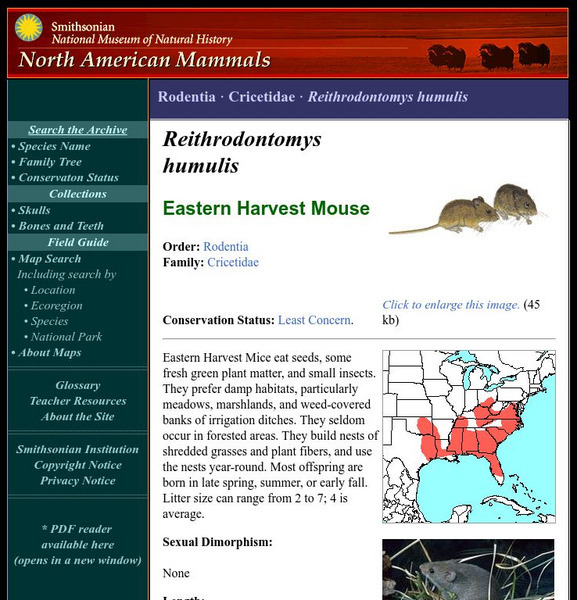
Smithsonian Institution
National Museum of Natural History: American Mammals: Eastern Harvest Mouse
Eastern Harvest Mice eat seeds, some fresh green plant matter, and small insects. They prefer damp habitats, particularly meadows, marshlands, and weed-covered banks of irrigation ditches. Learn more about the Reithrodontomys humulis,...
Smithsonian Institution
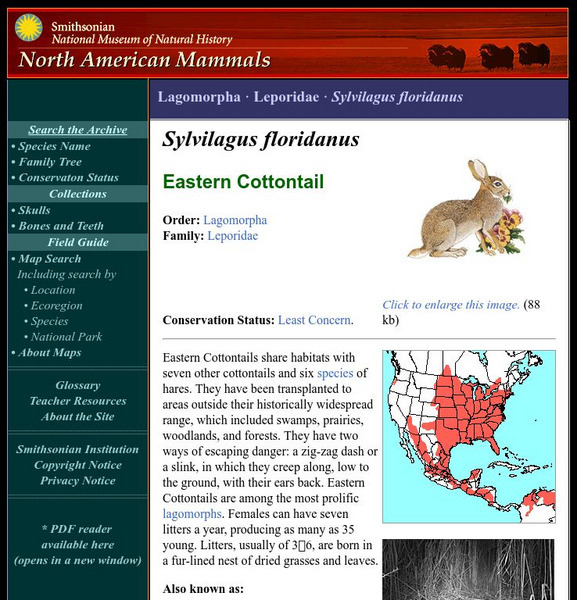
National Museum of Natural History: American Mammals: Eastern Cottontail
Eastern Cottontails share habitats with seven other cottontails and six species of hares. They have been transplanted to areas outside their historically widespread range, which included swamps, prairies, woodlands, and forests. Learn...
Smithsonian Institution
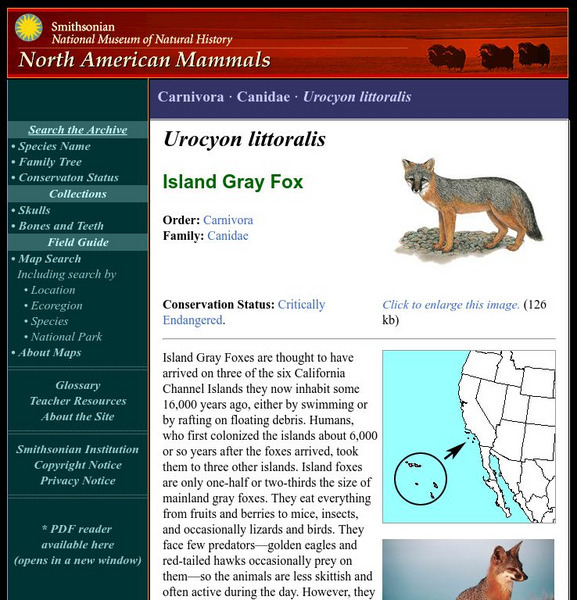
National Museum of Natural History: American Mammals: Island Gray Fox
Island gray foxes are thought to have arrived on three of the six California Channel Islands they now inhabit some 16,000 years ago, either by swimming or by rafting on floating debris. Humans, who first colonized the islands about 6,000...
Smithsonian Institution
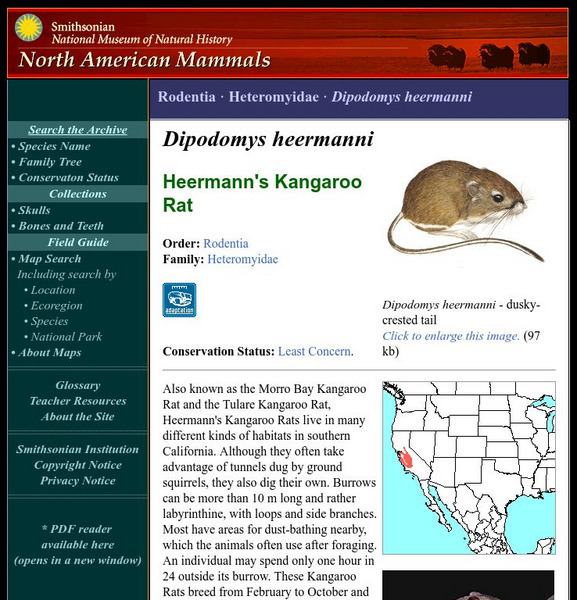
National Museum of Natural History: American Mammals: Heermann's Kangaroo Rat
Also known as the Morro Bay Kangaroo Rat and the Tulare Kangaroo Rat, Heermann's Kangaroo Rats live in many different kinds of habitats in southern California. Although they often take advantage of tunnels dug by ground squirrels, they...