Hi, what do you want to do?





Smithsonian Institution
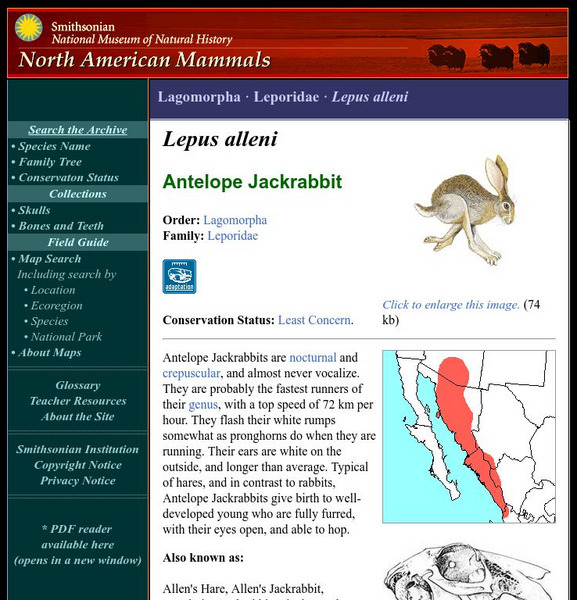
National Museum of Natural History: American Mammals: Antelope Jackrabbit
Antelope Jackrabbits are nocturnal and crepuscular, and almost never vocalize. They are probably the fastest runners of their genus, with a top speed of 72 km per hour. Learn more about the Lepus alleni, more commonly known as an...
Smithsonian Institution
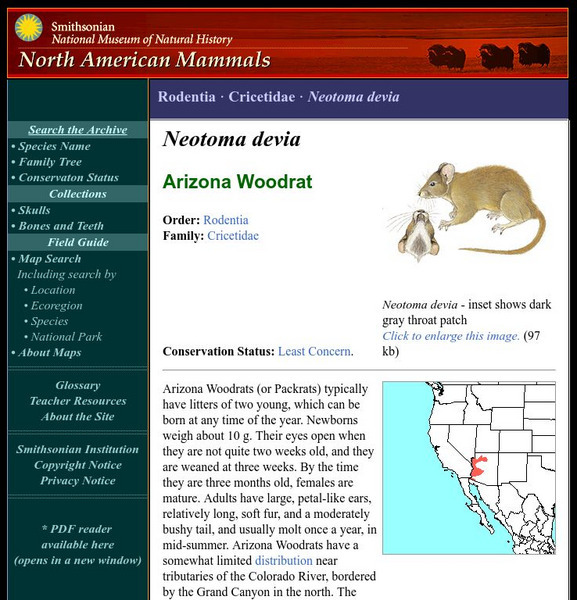
National Museum of Natural History: American Mammals: Arizona Woodrat
Arizona Woodrats (or Packrats) typically have litters of two young, which can be born at any time of the year. Newborns weigh about 10 g. Learn more about the Neotoma devia, more commonly known as an Arizona Woodrat, in this easy-to-read...
Smithsonian Institution
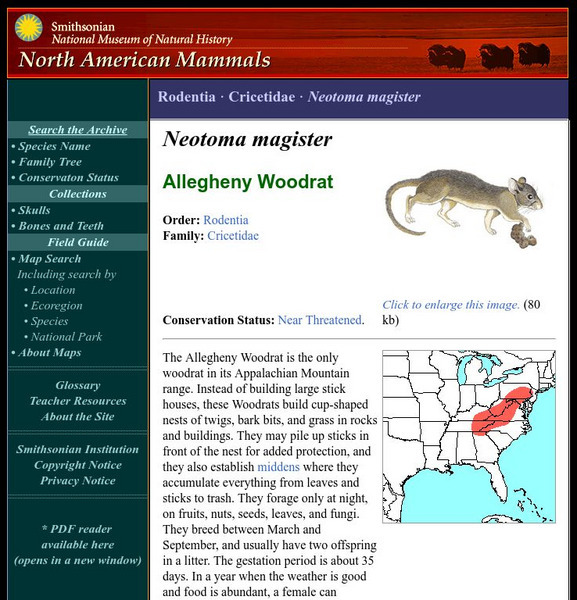
National Museum of Natural History: American Mammals: Allegheny Woodrat
The Allegheny Woodrat is the only woodrat in its Appalachian Mountain range. Instead of building large stick houses, these Woodrats build cup-shaped nests of twigs, bark bits, and grass in rocks and buildings. Learn more about the...
Smithsonian Institution
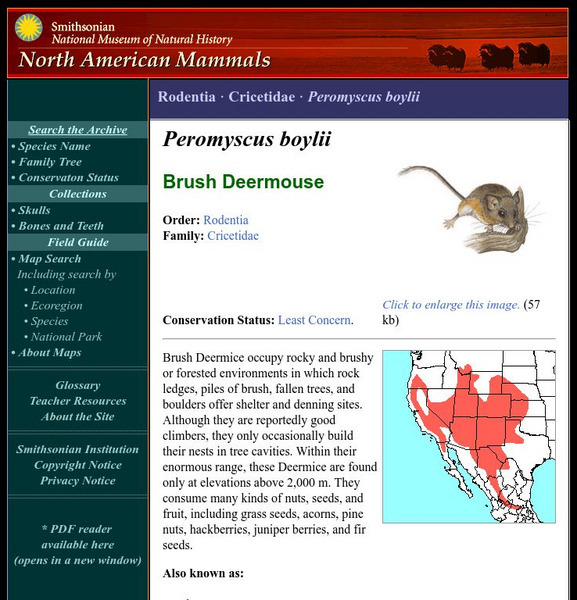
National Museum of Natural History: American Mammals: Brush Deermouse
Brush Deermice occupy rocky and brushy or forested environments in which rock ledges, piles of brush, fallen trees, and boulders offer shelter and denning sites. Although they are reportedly good climbers, they only occasionally build...
Smithsonian Institution
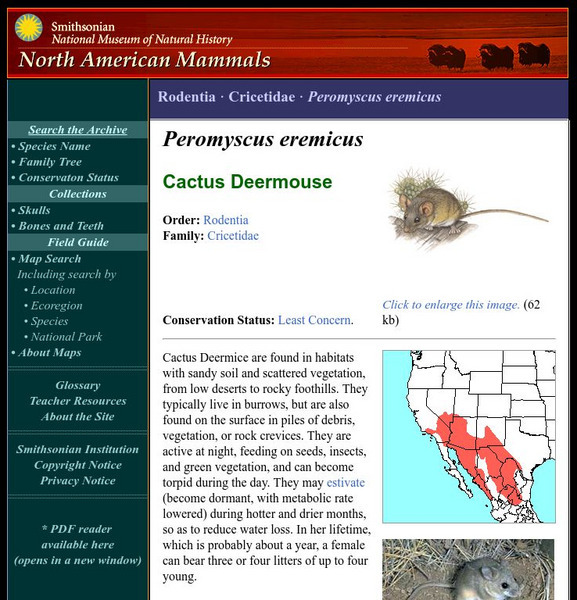
National Museum of Natural History: American Mammals: Cactus Deermouse
Cactus Deermice are found in habitats with sandy soil and scattered vegetation, from low deserts to rocky foothills. They typically live in burrows but are also found on the surface in piles of debris, vegetation, or rock crevices. Learn...
Smithsonian Institution
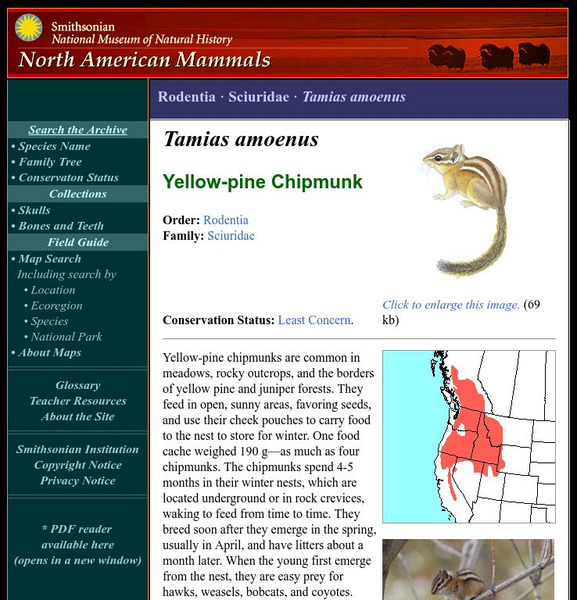
National Museum of Natural History: American Mammals: Yellow Pine Chipmunk
Yellow-pine chipmunks are common in meadows, rocky outcrops, and the borders of yellow pine and juniper forests. They feed in open, sunny areas, favoring seeds, and use their cheek pouches to carry food to the nest to store for winter....
Smithsonian Institution
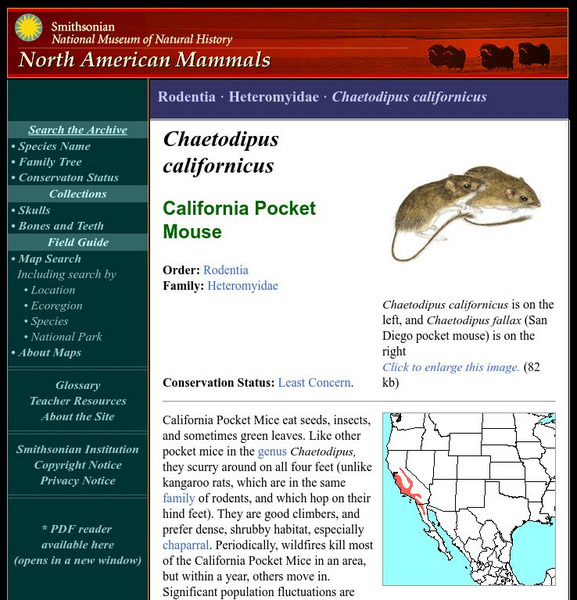
National Museum of Natural History: American Mammals: California Pocket Mouse
California Pocket Mice eat seeds, insects, and sometimes green leaves. Like other pocket mice in the genus Chaetodipus, they scurry around on all four feet (unlike kangaroo rats, which are in the same family of rodents, and which hop on...
Smithsonian Institution
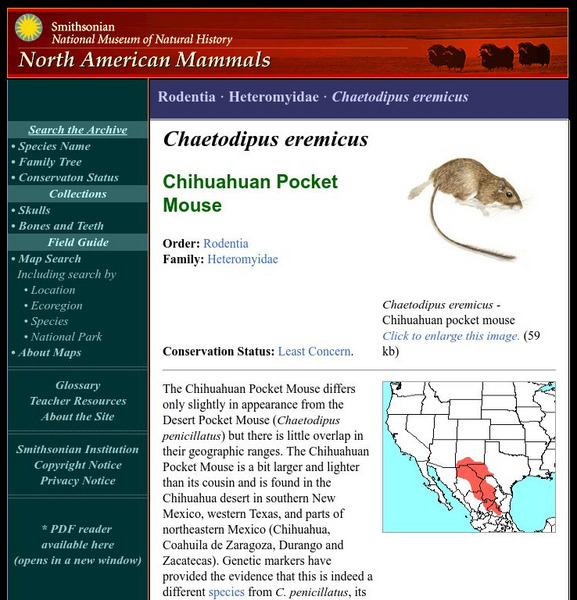
National Museum of Natural History: American Mammals: Chihuahuan Pocket Mouse
The Chihuahuan Pocket Mouse differs only slightly in appearance from the Desert Pocket Mouse (Chaetodipus penicillatus) but there is little overlap in their geographic ranges. The Chihuahuan Pocket Mouse is a bit larger and lighter than...
Smithsonian Institution
National Museum of Natural History: American Mammals: Collared Pika
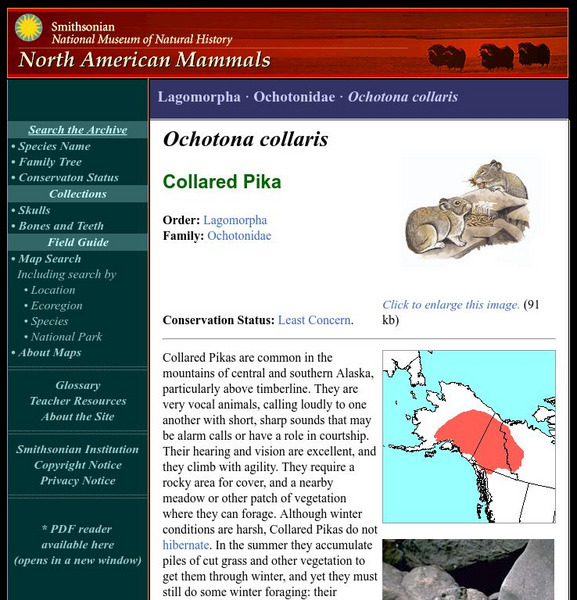
Collared Pikas are common in the mountains of central and southern Alaska, particularly above the timberline. They are very vocal animals, calling loudly to one another with short, sharp sounds that may be alarm calls or have a role in...
Smithsonian Institution
National Museum of Natural History: American Mammals: Arizona Gray Squirrel
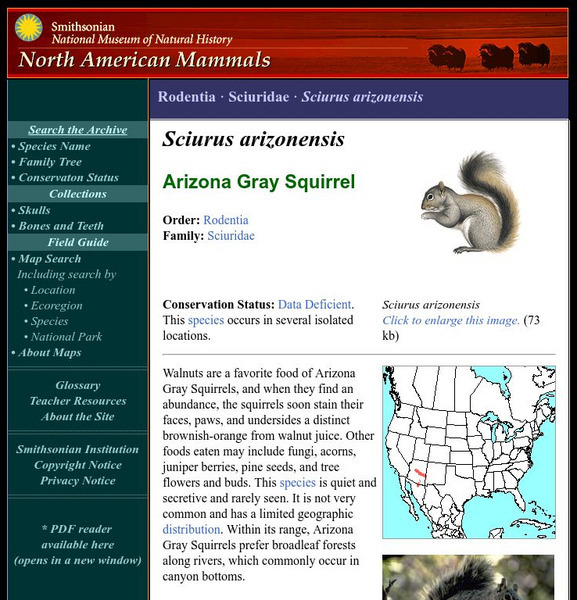
Walnuts are a favorite food of Arizona Gray Squirrels, and when they find an abundance, the squirrels soon stain their faces, paws, and undersides a distinct brownish-orange from walnut juice. Other foods eaten may include fungi, acorns,...
Smithsonian Institution
National Museum of Natural History: American Mammals: Big Eared Kangaroo Rat
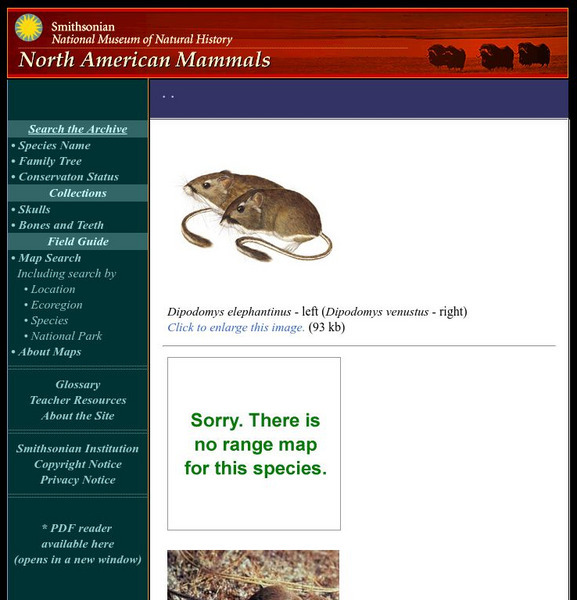
The Big-eared Kangaroo Rat has the longest ears of any kangaroo rat, and weighing in at about 85 g, is one of the largest Dipodomys species in California. It is dark cinnamon in color, with white underparts and brown ears. Learn more...
Smithsonian Institution
National Museum of Natural History: American Mammals: California Kangaroo Rat
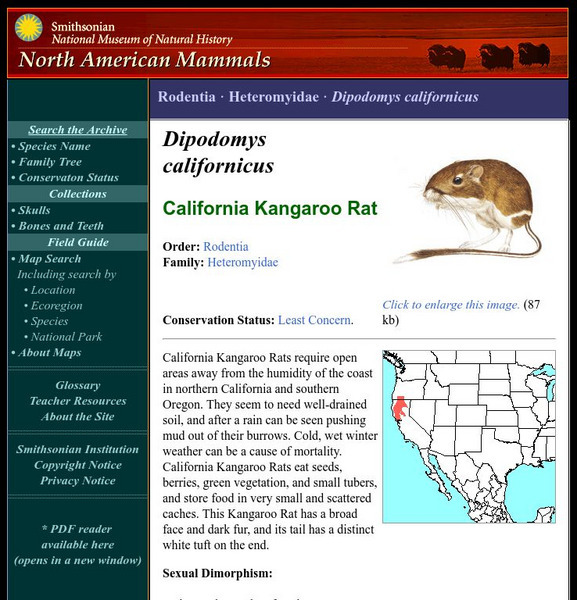
California Kangaroo Rats require open areas away from the humidity of the coast in northern California and southern Oregon. They seem to need well-drained soil, and after a rain can be seen pushing mud out of their burrows. Learn more...
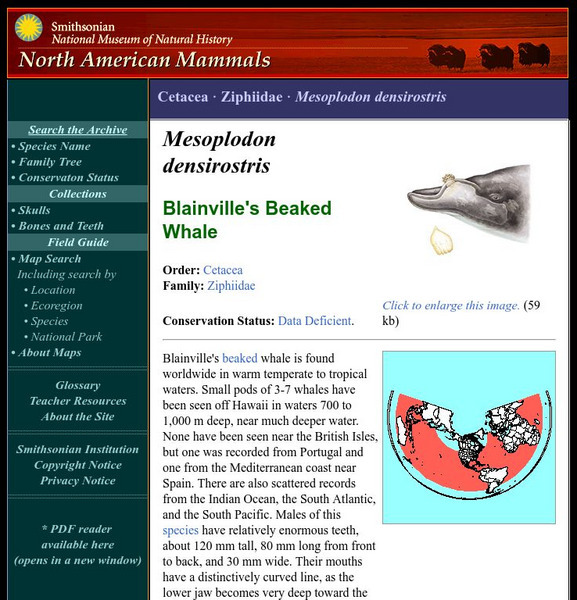
Smithsonian Institution
National Museum of Natural History: American Mammals: Blainville's Beaked Whale
Blainville's beaked whale is found worldwide in warm temperate to tropical waters. Small pods of 3-7 whales have been seen off Hawaii in waters 700 to 1,000 m deep, near much deeper water. Learn more about the Mesoplodon densirostris,...
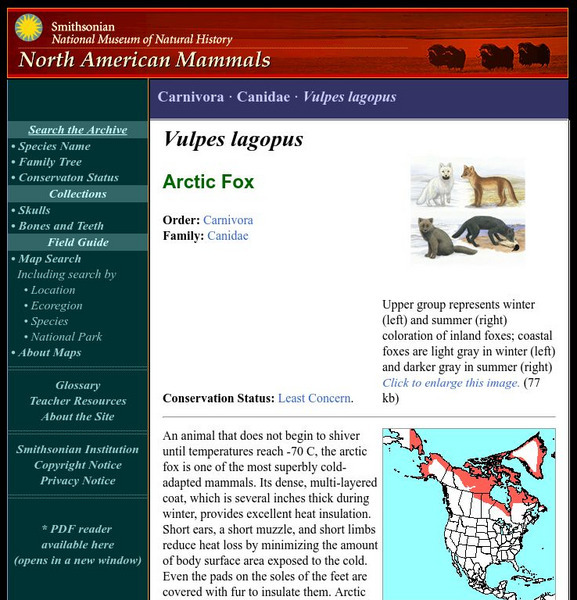
Smithsonian Institution
National Museum of Natural History: American Mammals: Arctic Fox
An animal that does not begin to shiver until temperatures reach -70 C, the arctic fox is one of the most superbly cold-adapted mammals. Its dense, multi-layered coat, which is several inches thick during winter, provides excellent heat...

Smithsonian Institution
National Museum of Natural History: American Mammals: Baird's Beaked Whale
Baird's beaked whale is the longest species of the Ziphiidae, which is a family of medium-sized whales. The name "beaked whale" comes from the way the long snout, or rostrum, tapers to a tip. Learn more about the Berardius bairdii, more...
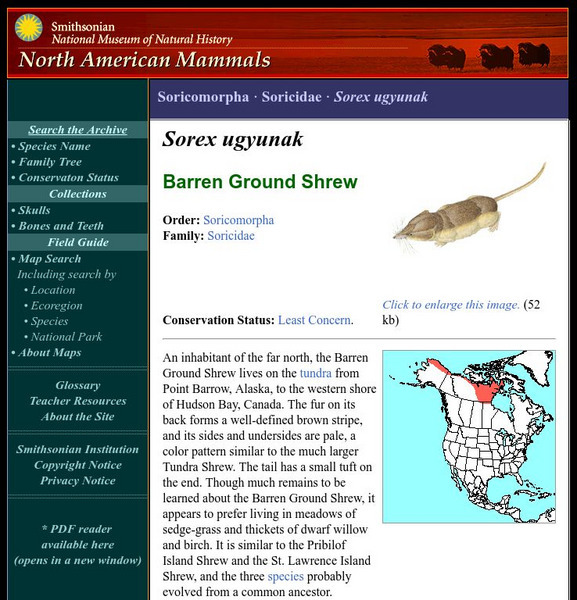
Smithsonian Institution
National Museum of Natural History: American Mammals: Barren Ground Shrew
An inhabitant of the far north, the Barren Ground Shrew lives on the tundra from Point Barrow, Alaska, to the western shore of Hudson Bay, Canada. The fur on its back forms a well-defined brown stripe, and its sides and undersides are...
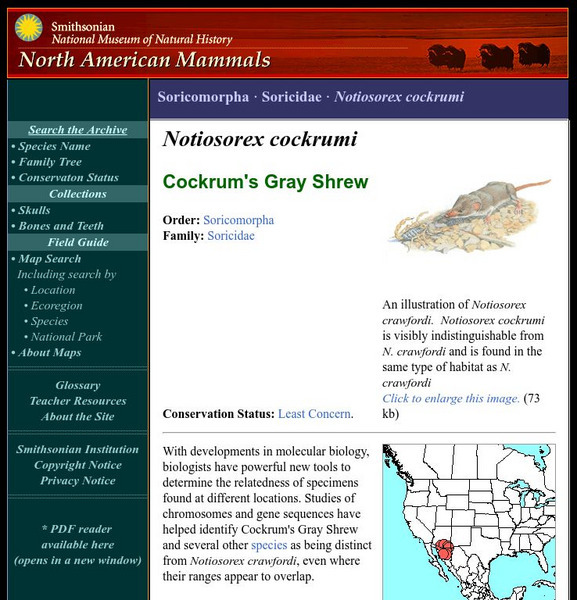
Smithsonian Institution
National Museum of Natural History: American Mammals: Cockrum's Gray Shrew
With developments in molecular biology, biologists have powerful new tools to determine the relatedness of specimens found at different locations. Studies of chromosomes and gene sequences have helped identify Cockrum's Gray Shrew and...
Smithsonian Institution
National Museum of Natural History: American Mammals: Brown Lemming
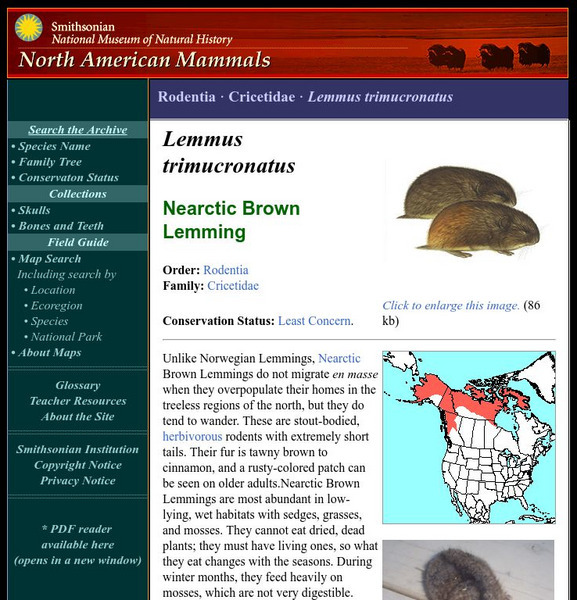
Unlike Norwegian Lemmings, Brown Lemmings do not migrate en masse when they overpopulate their homes in the treeless regions of the north, but they do tend to wander. These are stout-bodied, herbivorous rodents with extremely short...
Smithsonian Institution
National Museum of Natural History: American Mammals: Arctic Hare
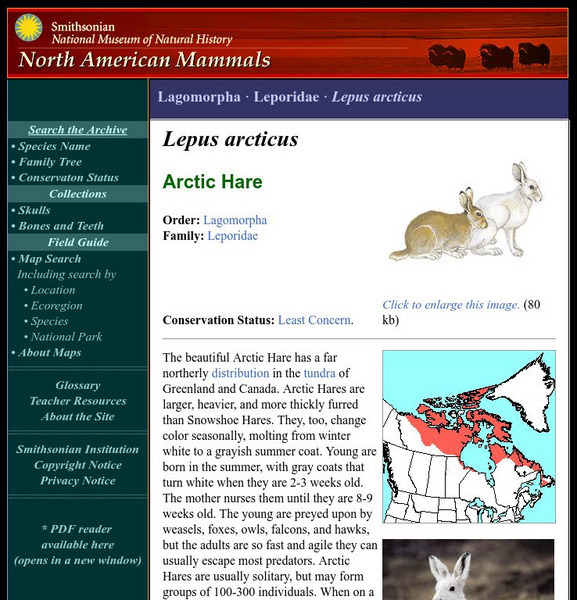
The beautiful Arctic Hare has a far northerly distribution in the tundra of Greenland and Canada. Arctic Hares are larger, heavier, and more thickly furred than Snowshoe Hares. Learn more about the Lepus arcticus, more commonly known as...
Smithsonian Institution
National Museum of Natural History: American Mammals: California Leaf Nosed Bat
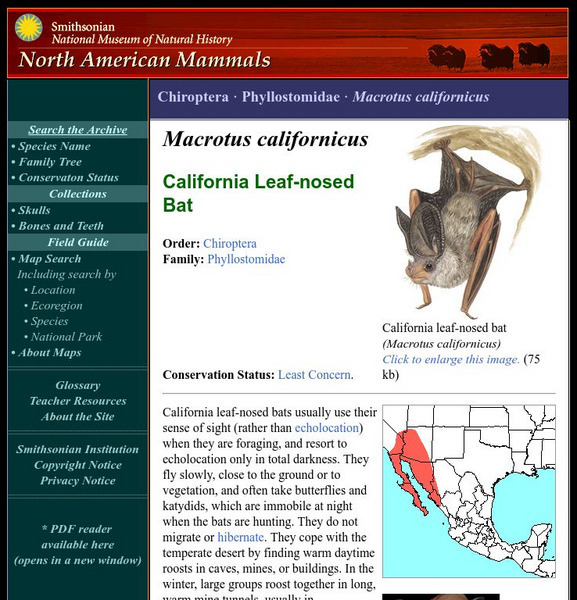
California leaf-nosed bats usually use their sense of sight (rather than echolocation) when they are foraging, and resort to echolocation only in total darkness. They fly slowly, close to the ground or to vegetation, and often take...
Smithsonian Institution
National Museum of Natural History: American Mammals: Bowhead Whale
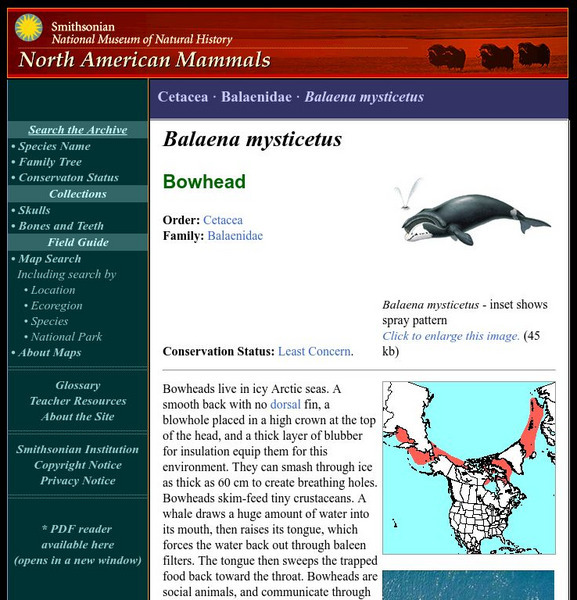
Bowheads live in icy Arctic seas. A smooth back with no dorsal fin, a blowhole placed in a high crown at the top of the head, and a thick layer of blubber for insulation equip them for this environment. Learn more about the Balaena...
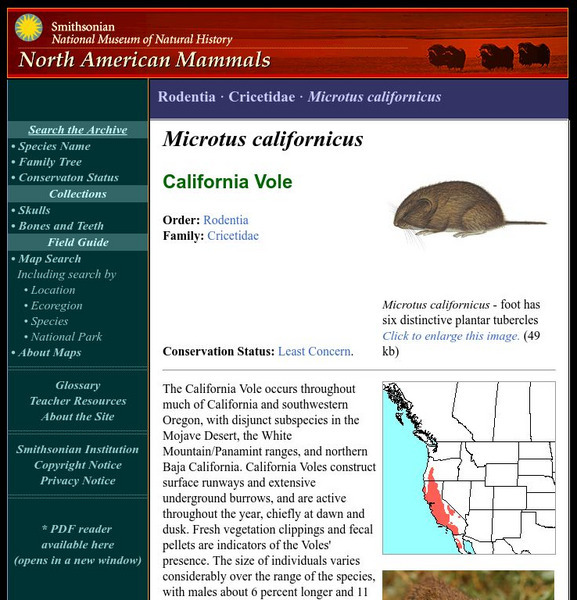
Smithsonian Institution
National Museum of Natural History: American Mammals: California Vole
The California Vole occurs throughout much of California and southwestern Oregon, with disjunct subspecies in the Mojave Desert, the White Mountain/Panamint ranges, and northern Baja California. California Voles construct surface runways...
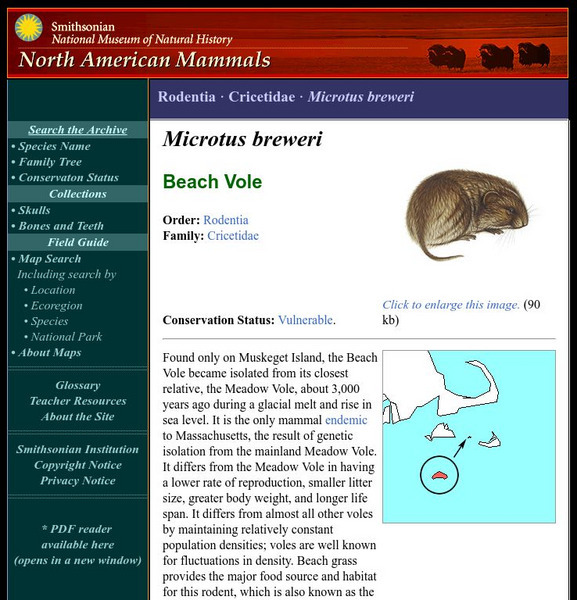
Smithsonian Institution
National Museum of Natural History: American Mammals: Beach Vole
Found only on Muskeget Island, the Beach Vole became isolated from its closest relative, the Meadow Vole, about 3,000 years ago during a glacial melt and rise in sea level. It is the only mammal endemic to Massachusetts, the result of...
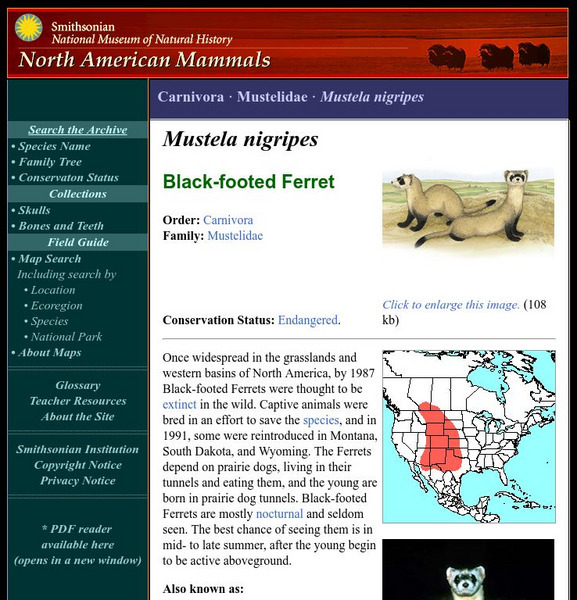
Smithsonian Institution
National Museum of Natural History: American Mammals: Black Footed Ferret
Once widespread in the grasslands and western basins of North America, by 1987 Black-footed Ferrets were thought to be extinct in the wild. Captive animals were bred in an effort to save the species, and in 1991, some were reintroduced...