Hi, what do you want to do?





Smithsonian Institution
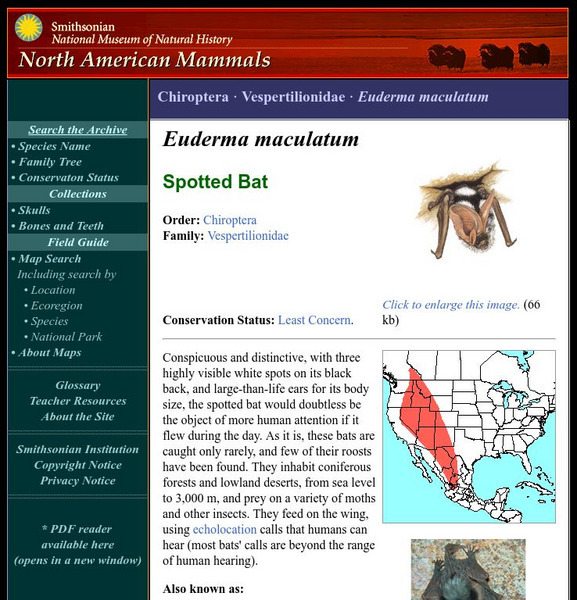
National Museum of Natural History: American Mammals: Spotted Bat
Conspicuous and distinctive, with three highly visible white spots on its black back, and larger-than-life ears for its body size, the spotted bat would doubtless be the object of more human attention if it flew during the day. As it is,...
Smithsonian Institution
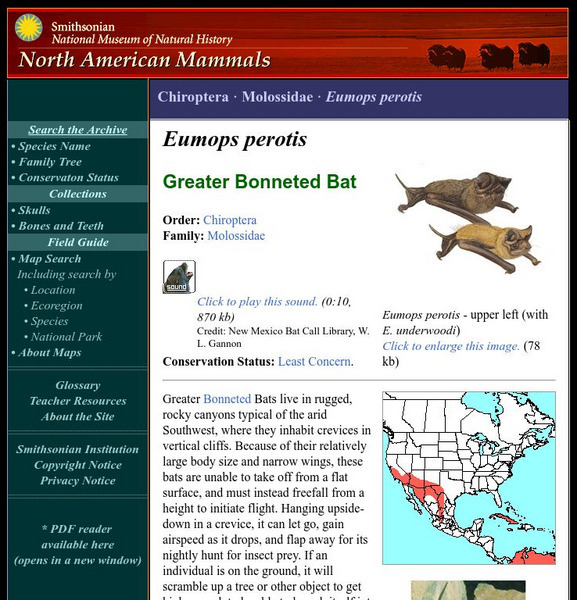
National Museum of Natural History: American Mammals: Greater Bonneted Bat
Greater Bonneted Bats live in rugged, rocky canyons typical of the arid Southwest, where they inhabit crevices in vertical cliffs. Because of their relatively large body size and narrow wings, these bats are unable to take off from a...
Smithsonian Institution
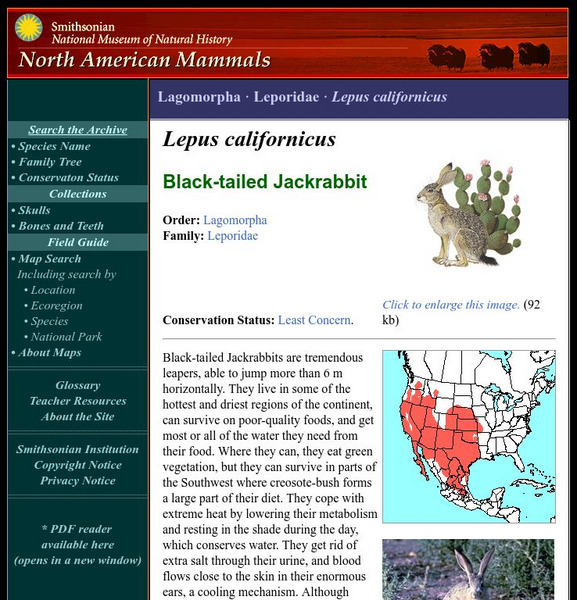
National Museum of Natural History: American Mammals: Black Tailed Jackrabbit
Black-tailed Jackrabbits are tremendous leapers, able to jump more than 6 m horizontally. They live in some of the hottest and driest regions of the continent, can survive on poor-quality foods, and get most or all of the water they need...
Smithsonian Institution
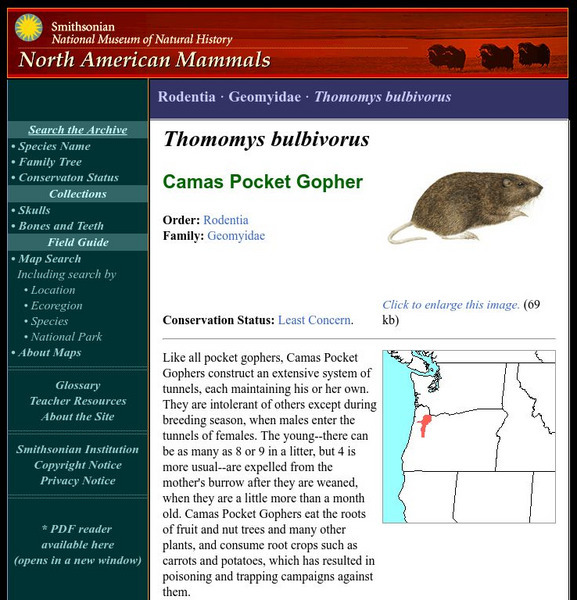
National Museum of Natural History: American Mammals: Camas Pocket Gopher
Like all pocket gophers, Camas Pocket Gophers construct an extensive system of tunnels, each maintaining his or her own. They are intolerant of others except during breeding season, when males enter the tunnels of females. Learn more...
Smithsonian Institution
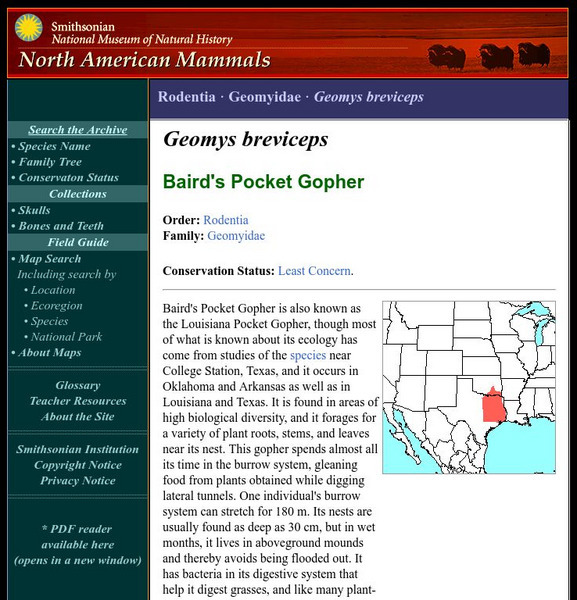
National Museum of Natural History: American Mammals: Baird's Pocket Gopher
Baird's Pocket Gopher is also known as the Louisiana Pocket Gopher, though most of what is known about its ecology has come from studies of the species near College Station, Texas, and it occurs in Oklahoma and Arkansas as well as in...
Smithsonian Institution
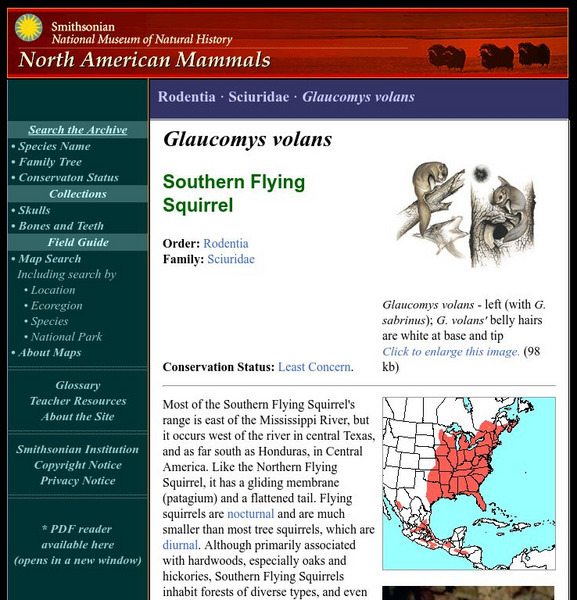
National Museum of Natural History: American Mammals: Southern Flying Squirrel
Most of the Southern Flying Squirrel's range is east of the Mississippi River, but it occurs west of the river in central Texas, and as far south as Honduras, in Central America. Like the Northern Flying Squirrel, it has a gliding...
Smithsonian Institution
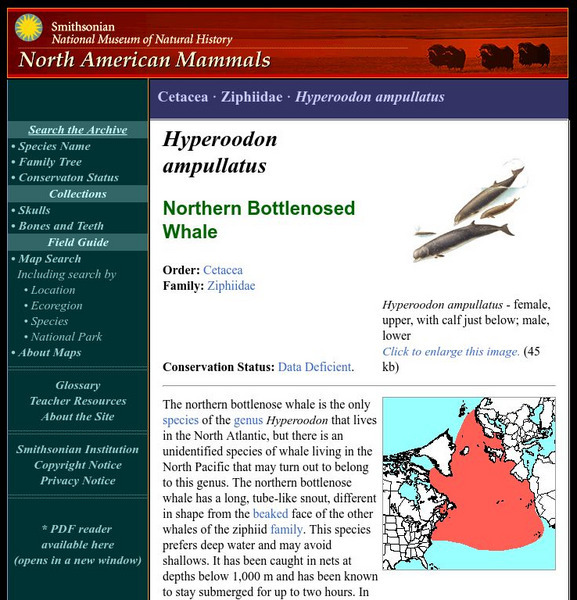
National Museum of Natural History: American Mammals: Northern Bottlenosed Whale
The northern bottlenose whale is the only species of the genus Hyperoodon that lives in the North Atlantic, but there is an unidentified species of whale living in the North Pacific that may turn out to belong to this genus. The northern...
Smithsonian Institution
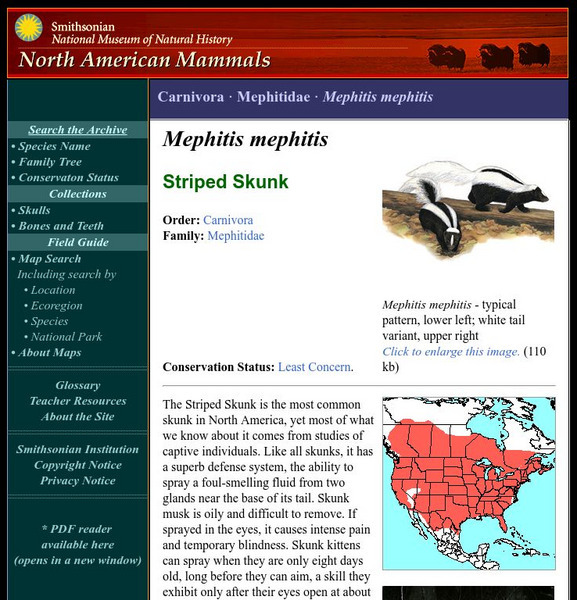
National Museum of Natural History: American Mammals: Striped Skunk
The Striped Skunk is the most common skunk in North America, yet most of what we know about it comes from studies of captive individuals. Like all skunks, it has a superb defense system, the ability to spray a foul-smelling fluid from...
Smithsonian Institution
National Museum of Natural History: American Mammals: Sowerby's Beaked Whale
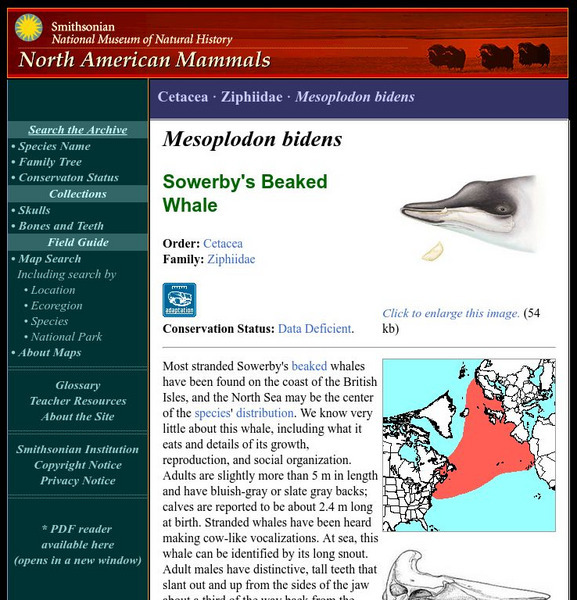
Most stranded Sowerby's beaked whales have been found on the coast of the British Isles, and the North Sea may be the center of the species' distribution. We know very little about this whale, including what it eats and details of its...
Smithsonian Institution
National Museum of Natural History: American Mammals: Northern Yellow Bat
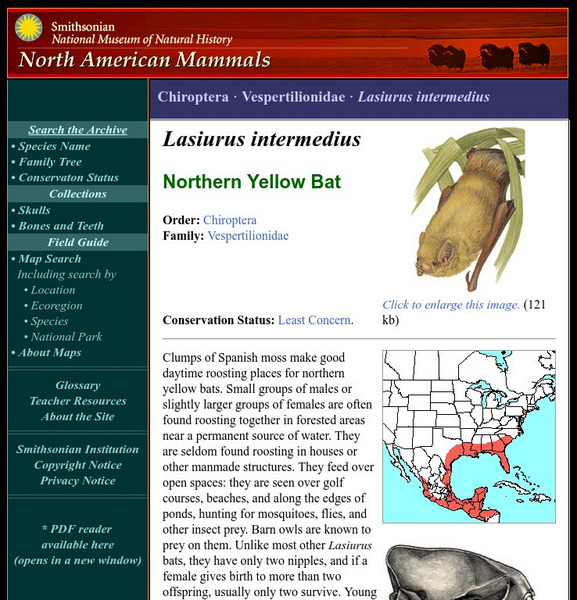
Clumps of Spanish moss make good daytime roosting places for northern yellow bats. Small groups of males or slightly larger groups of females are often found roosting together in forested areas near a permanent source of water. Learn...
Smithsonian Institution
National Museum of Natural History: American Mammals: White Throated Woodrat
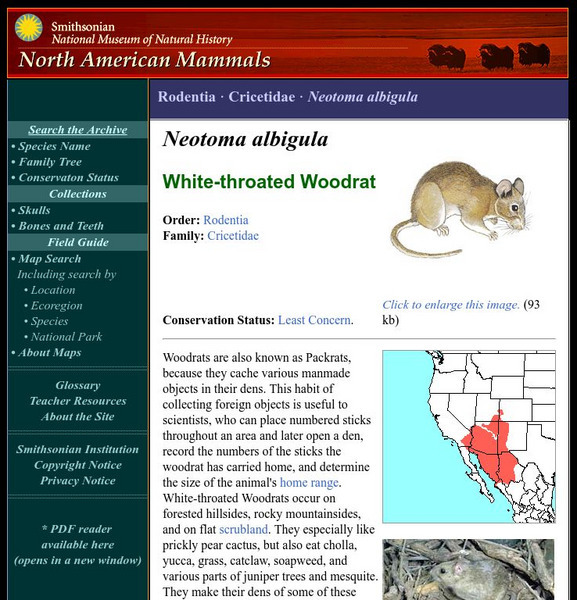
Woodrats are also known as Packrats, because they cache various manmade objects in their dens. This habit of collecting foreign objects is useful to scientists, who can place numbered sticks throughout an area and later open a den,...
Smithsonian Institution
National Museum of Natural History: American Mammals: Olive Backed Pocket Mouse
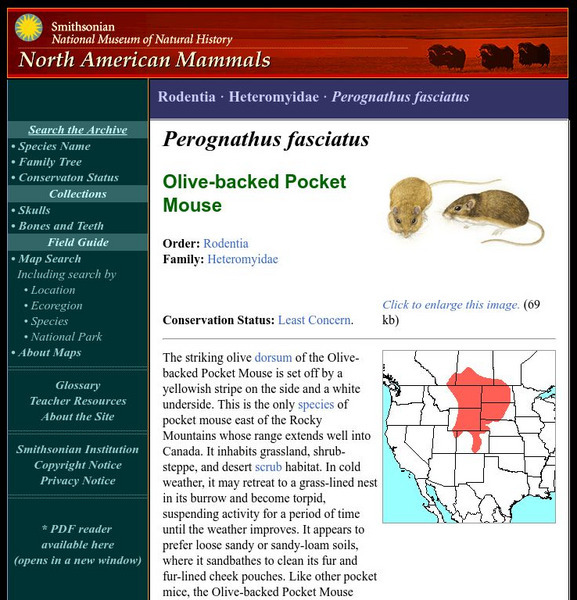
The striking olive dorsum of the Olive-backed Pocket Mouse is set off by a yellowish stripe on the side and a white underside. This is the only species of pocket mouse east of the Rocky Mountains whose range extends well into Canada....
Smithsonian Institution
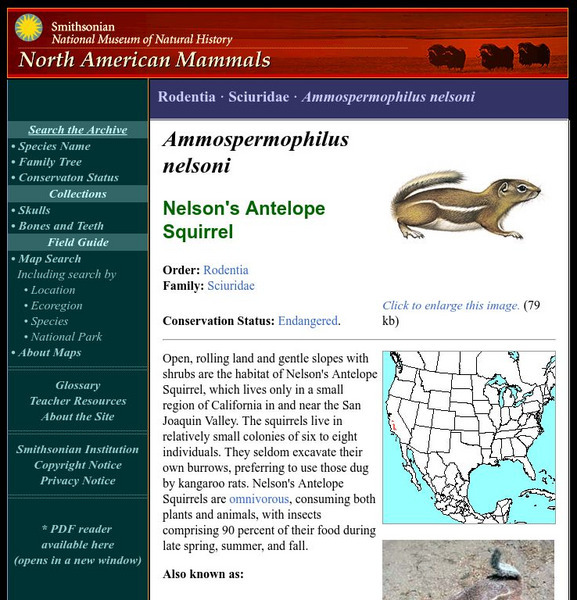
National Museum of Natural History: American Mammals: Nelson's Antelope Squirrel
Open, rolling land and gentle slopes with shrubs are the habitat of Nelson's Antelope Squirrel, which lives only in a small region of California in and near the San Joaquin Valley. The squirrels live in relatively small colonies of six...
Smithsonian Institution
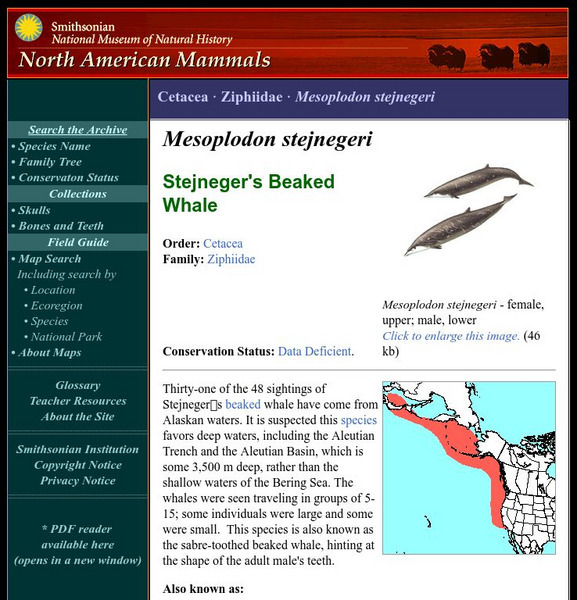
National Museum of Natural History: American Mammals: Stejneger's Beaked Whale
Thirty-one of the 48 sightings of Stejneger's beaked whale have come from Alaskan waters. It is suspected this species favors deep waters, including the Aleutian Trench and the Aleutian Basin, which is some 3,500 m deep, rather than the...
Smithsonian Institution
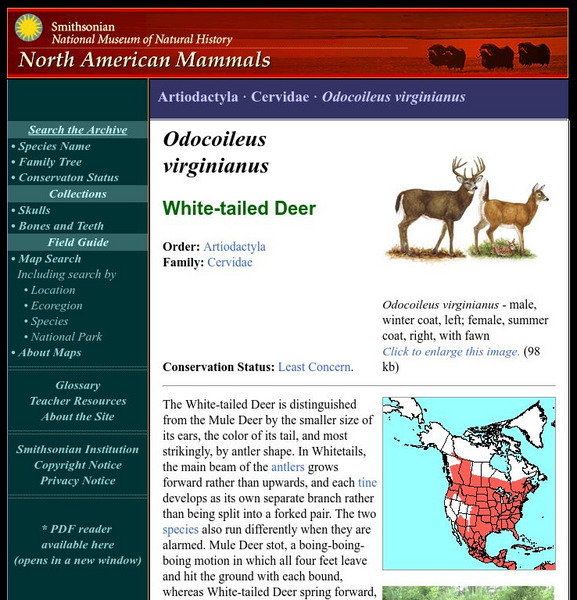
National Museum of Natural History: American Mammals: White Tailed Deer
The White-tailed Deer is distinguished from the Mule Deer by the smaller size of its ears, the color of its tail, and most strikingly, by antler shape. In Whitetails, the main beam of the antlers grows forward rather than upwards, and...
Smithsonian Institution
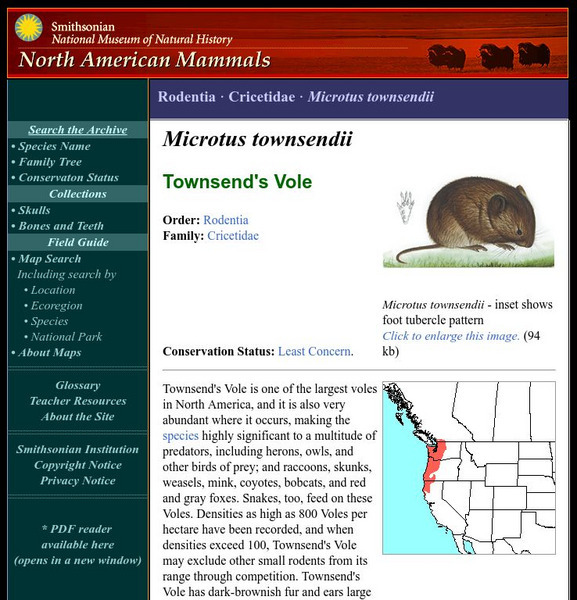
National Museum of Natural History: American Mammals: Townsend's Vole
Townsend's Vole is one of the largest voles in North America, and it is also very abundant where it occurs, making the species highly significant to a multitude of predators, including herons, owls, and other birds of prey; and raccoons,...
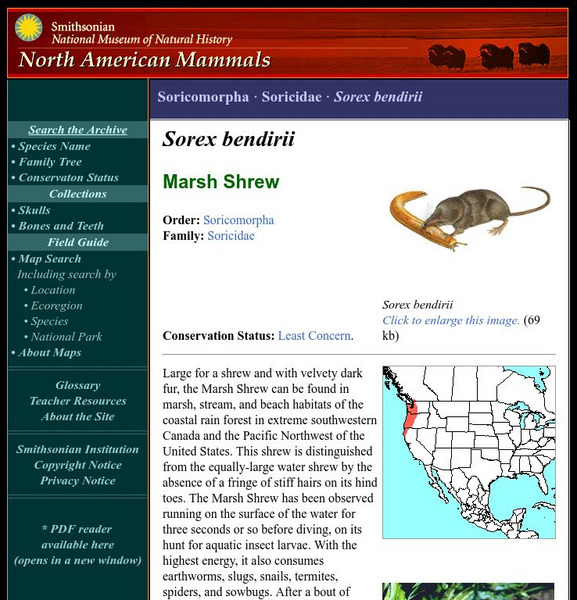
Smithsonian Institution
National Museum of Natural History: American Mammals: Marsh Shrew
Large for a shrew and with velvety dark fur, the Marsh Shrew can be found in marsh, stream, and beach habitats of the coastal rain forest in extreme southwestern Canada and the Pacific Northwest of the United States. This shrew is...
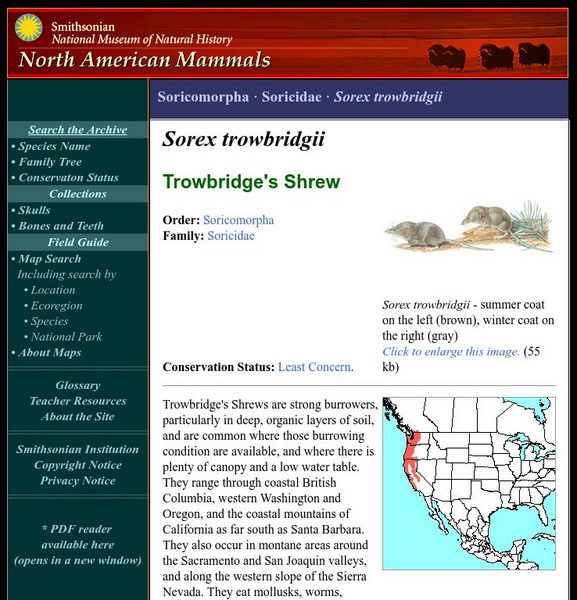
Smithsonian Institution
National Museum of Natural History: American Mammals: Trowbridge's Shrew
Trowbridge's Shrews are strong burrowers, particularly in deep, organic layers of soil, and are common where those burrowing condition are available, and where there is plenty of canopy and a low water table. They range through coastal...
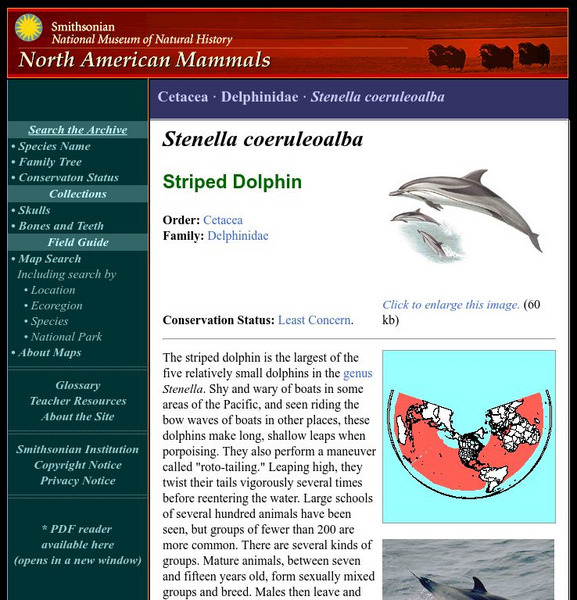
Smithsonian Institution
National Museum of Natural History: American Mammals: Striped Dolphin
The striped dolphin is the largest of the five relatively small dolphins in the genus Stenella. Shy and wary of boats in some areas of the Pacific, and seen riding the bow waves of boats in other places, these dolphins make long, shallow...
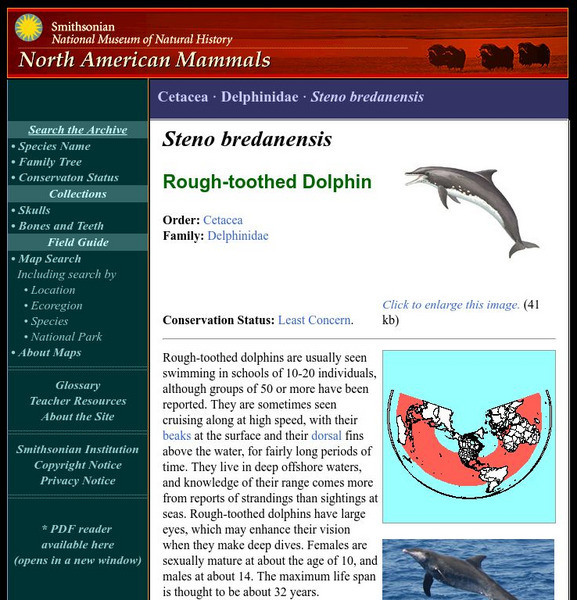
Smithsonian Institution
National Museum of Natural History: American Mammals: Rough Toothed Dolphin
Rough-toothed dolphins are usually seen swimming in schools of 10-20 individuals, although groups of 50 or more have been reported. They are sometimes seen cruising along at high speed, with their beaks at the surface and their dorsal...
Smithsonian Institution
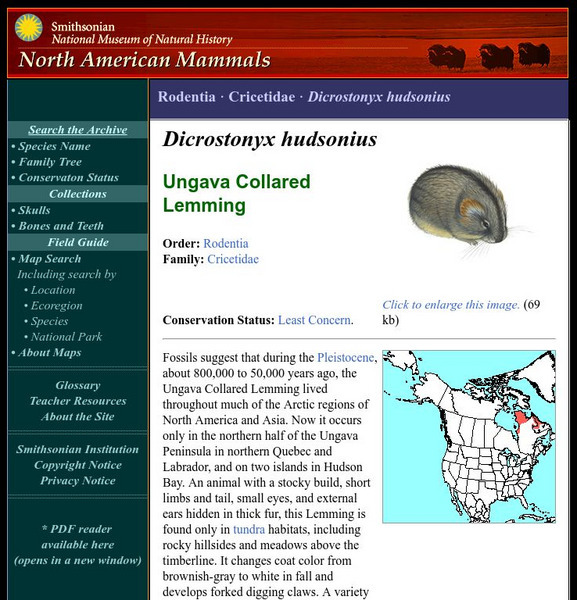
National Museum of Natural History: American Mammals: Ungava Collared Lemming
Fossils suggest that during the Pleistocene, about 800,000 to 50,000 years ago, the Ungava Collared Lemming lived throughout much of the Arctic regions of North America and Asia. Now it occurs only in the northern half of the Ungava...
Smithsonian Institution
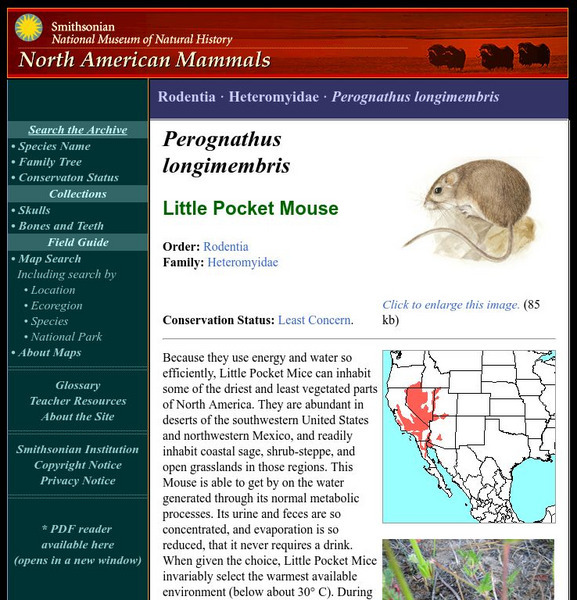
National Museum of Natural History: American Mammals: Little Pocket Mouse
Because they use energy and water so efficiently, Little Pocket Mice can inhabit some of the driest and least vegetated parts of North America. They are abundant in deserts of the southwestern United States and northwestern Mexico, and...
Smithsonian Institution
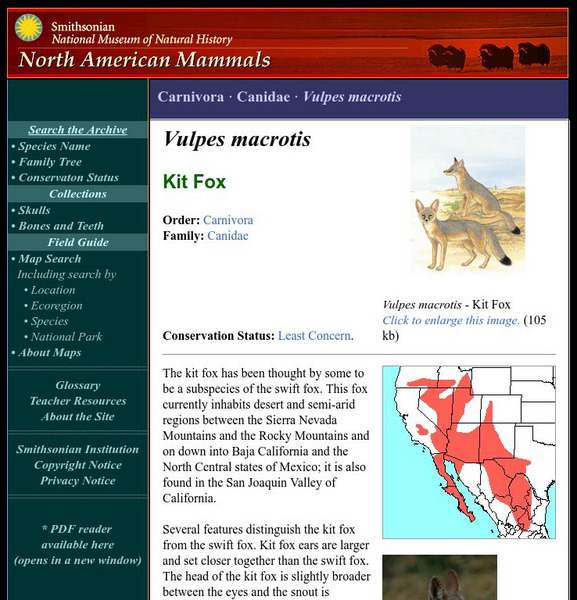
National Museum of Natural History: American Mammals: Kit Fox
The kit fox has been thought by some to be a subspecies of the swift fox. This fox currently inhabits desert and semi-arid regions between the Sierra Nevada Mountains and the Rocky Mountains and on down into Baja California and the North...
Smithsonian Institution
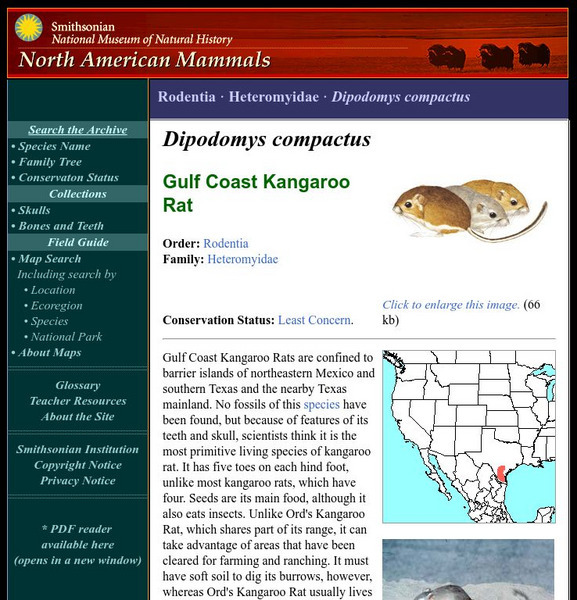
National Museum of Natural History: American Mammals: Gulf Coast Kangaroo Rat
Gulf Coast Kangaroo Rats are confined to barrier islands of northeastern Mexico and southern Texas and the nearby Texas mainland. No fossils of this species have been found, but because of features of its teeth and skull, scientists...