Hi, what do you want to do?






Smithsonian Institution
National Museum of Natural History: American Mammals: Chisel Toothed Kangaroo Rat
The Chisel-toothed Kangaroo Rat has chisel-shaped lower incisors, with which it strips the epidermis from the leaves of desert shadscale or saltbush, thereby reaching the palatable and water-rich interior of the leaf. This Kangaroo Rat...
Smithsonian Institution
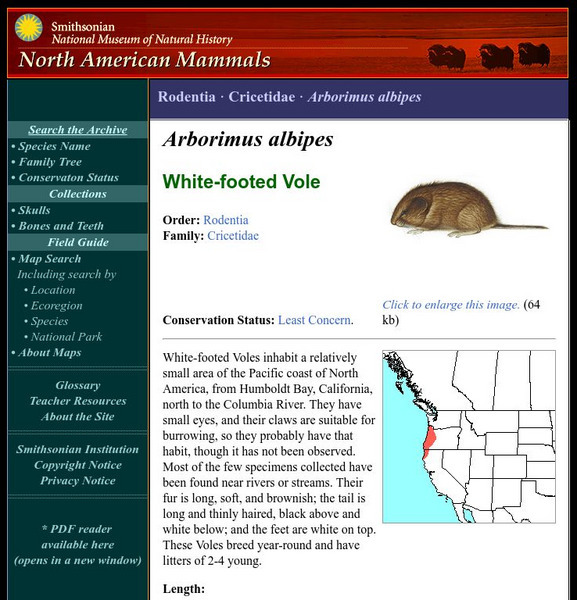
National Museum of Natural History: American Mammals: White Footed Vole
White-footed Voles inhabit a relatively small area of the Pacific coast of North America, from Humboldt Bay, California, north to the Columbia River. They have small eyes, and their claws are suitable for burrowing, so they probably have...
Smithsonian Institution
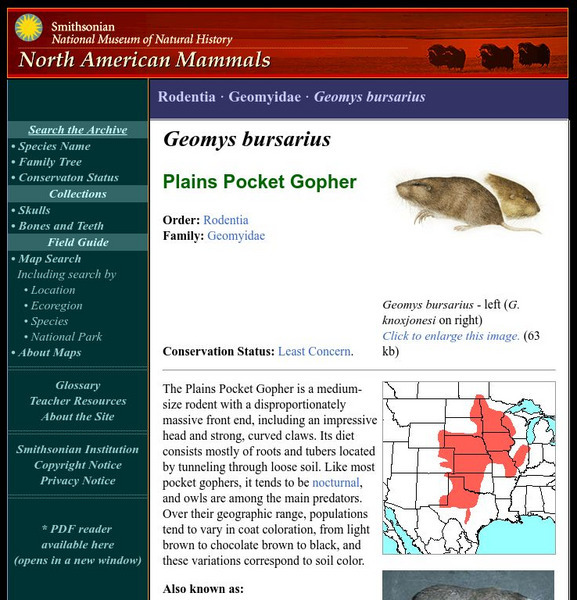
National Museum of Natural History: American Mammals: Plains Pocket Gopher
The Plains Pocket Gopher is a medium-size rodent with a disproportionately massive front end, including an impressive head and strong, curved claws. Its diet consists mostly of roots and tubers located by tunneling through loose soil....
Smithsonian Institution
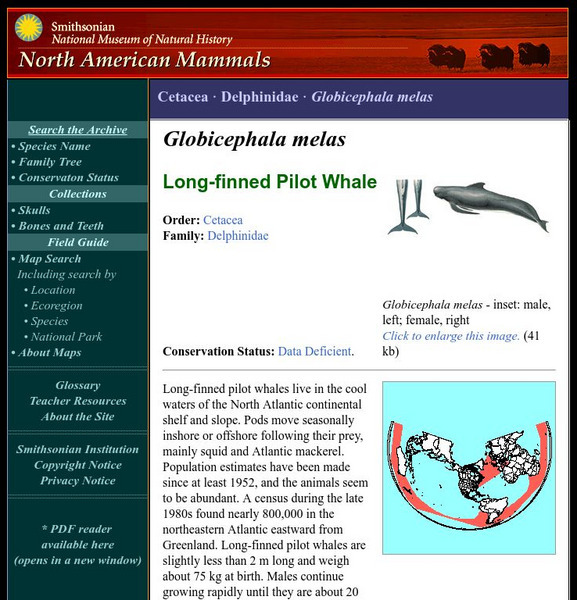
National Museum of Natural History: American Mammals: Long Finned Pilot Whale
Long-finned pilot whales live in the cool waters of the North Atlantic continental shelf and slope. Pods move seasonally inshore or offshore following their prey, mainly squid and Atlantic mackerel. Learn more about the Globicephala...
Smithsonian Institution
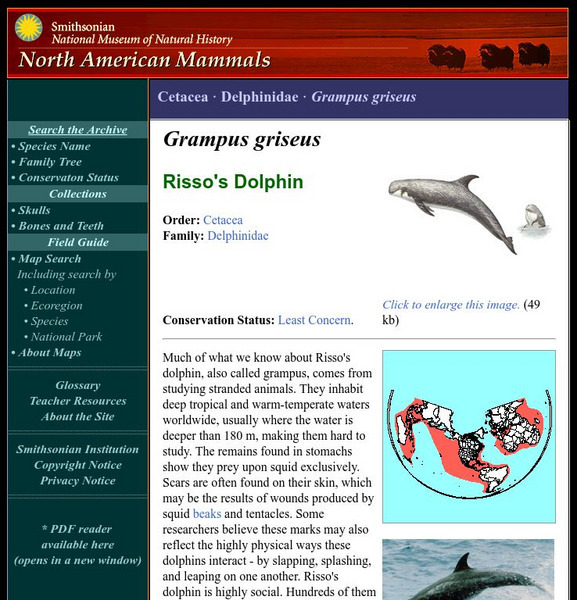
National Museum of Natural History: American Mammals: Risso's Dolphin
Much of what we know about Risso's dolphin, also called grampus, comes from studying stranded animals. They inhabit deep tropical and warm-temperate waters worldwide, usually where the water is deeper than 180 m, making them hard to...

Smithsonian Institution
National Museum of Natural History: American Mammals: Red Tree Vole
The home range of a Red Tree Vole may consist of just one tree, usually a large old Douglas-fir, where the vole builds its nest, eats the needles, and gets water by licking dew drops from the needles. Nests have been found more than 50 m...
Smithsonian Institution
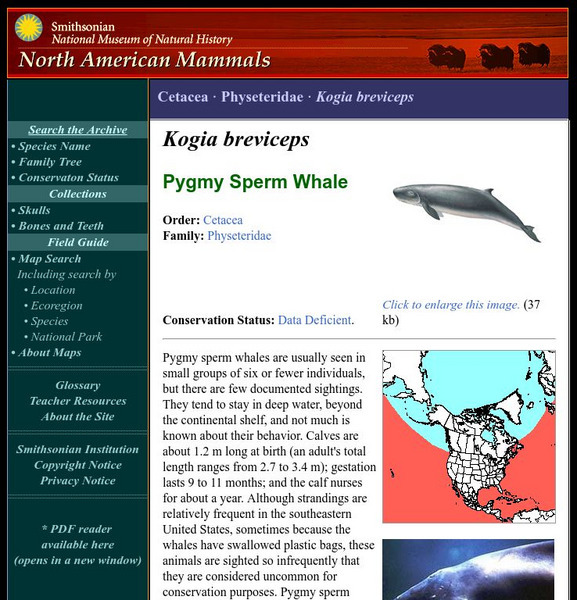
National Museum of Natural History: American Mammals: Pygmy Sperm Whale
Pygmy sperm whales are usually seen in small groups of six or fewer individuals, but there are few documented sightings. They tend to stay in deep water, beyond the continental shelf, and not much is known about their behavior. Learn...
Smithsonian Institution
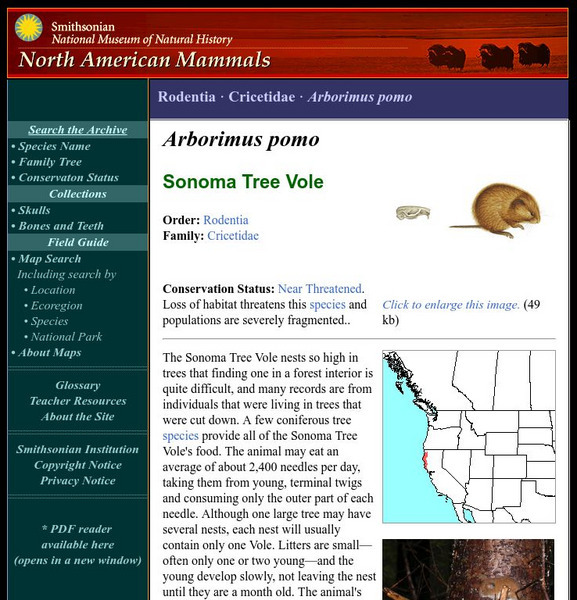
National Museum of Natural History: American Mammals: Sonoma Tree Vole
The Sonoma Tree Vole nests so high in trees that finding one in a forest interior is quite difficult, and many records are from individuals that were living in trees that were cut down. A few coniferous tree species provide all of the...
Smithsonian Institution
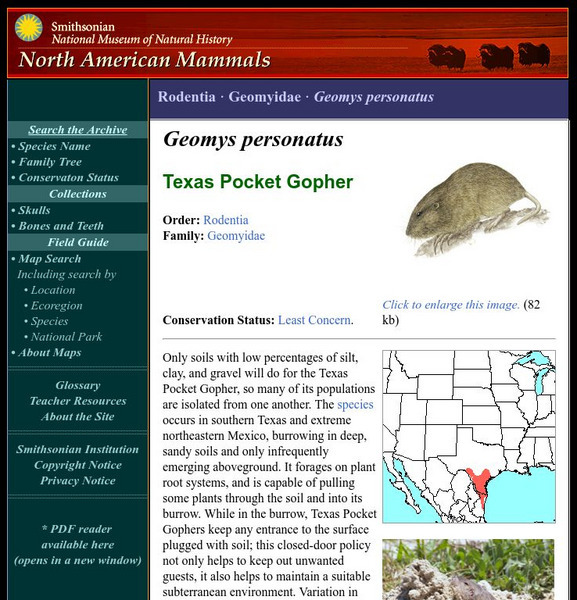
National Museum of Natural History: American Mammals: Texas Pocket Gopher
Only soils with low percentages of silt, clay, and gravel will do for the Texas Pocket Gopher, so many of its populations are isolated from one another. The species occurs in southern Texas and extreme northeastern Mexico, burrowing in...
Smithsonian Institution
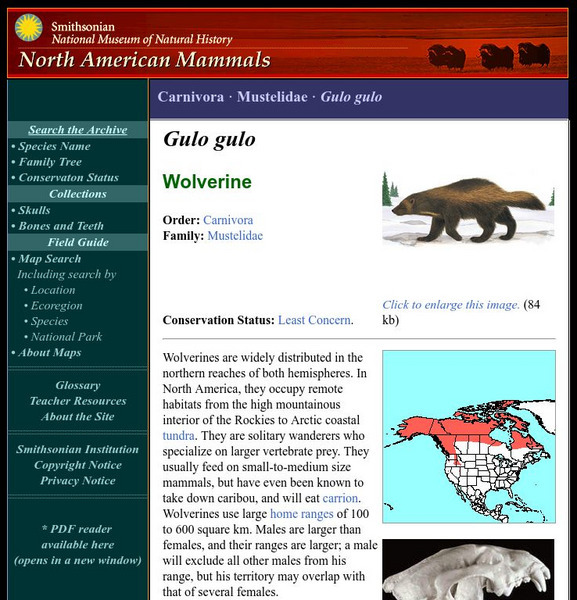
National Museum of Natural History: American Mammals: Wolverine
Wolverines are widely distributed in the northern reaches of both hemispheres. In North America, they occupy remote habitats from the high mountainous interior of the Rockies to Arctic coastal tundra. Learn more about the Gulo gulo, more...
Smithsonian Institution
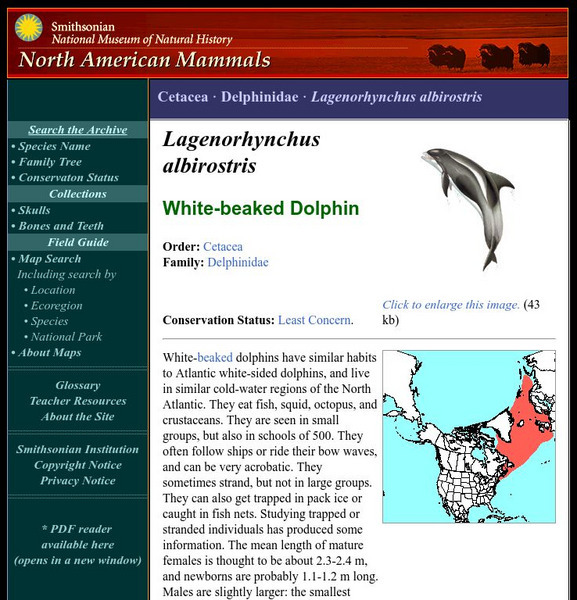
National Museum of Natural History: American Mammals: White Beaked Dolphin
White-beaked dolphins have similar habits to Atlantic white-sided dolphins and live in similar cold-water regions of the North Atlantic. They eat fish, squid, octopus, and crustaceans. Learn more about the Lagenorhynchus albirostris,...
Smithsonian Institution
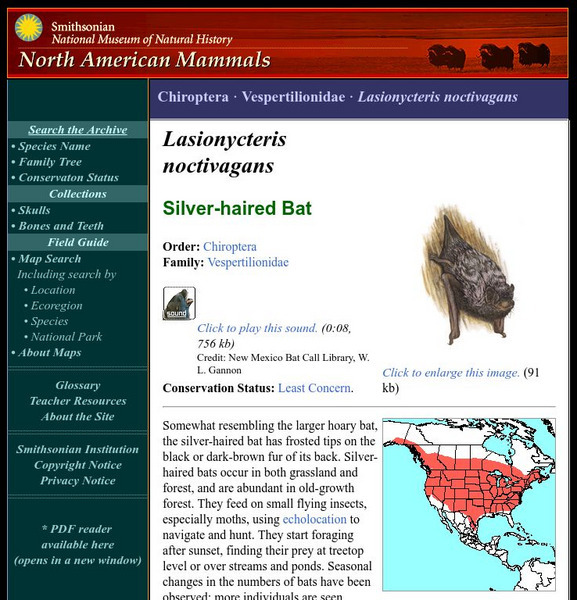
National Museum of Natural History: American Mammals: Silver Haired Bat
Somewhat resembling the larger hoary bat, the silver-haired bat has frosted tips on the black or dark-brown fur of its back. Silver-haired bats occur in both grassland and forest and are abundant in old-growth forest. Learn more about...
Smithsonian Institution
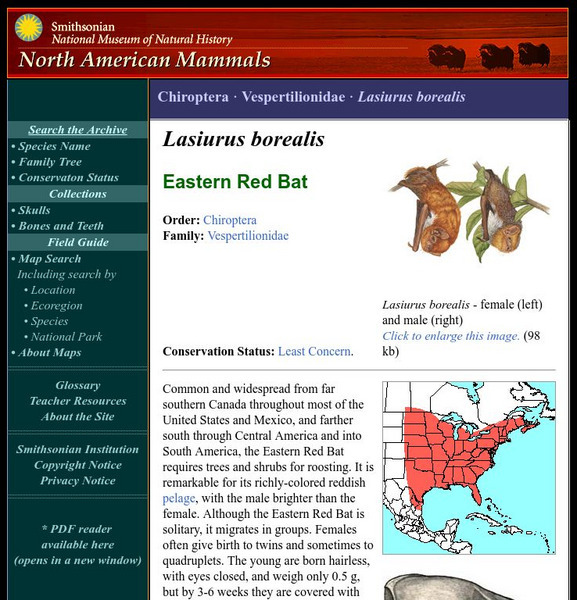
National Museum of Natural History: American Mammals: Eastern Red Bat
Common and widespread from far southern Canada throughout most of the United States and Mexico, and farther south through Central America and into South America, the Eastern Red Bat requires trees and shrubs for roosting. It is...
Smithsonian Institution
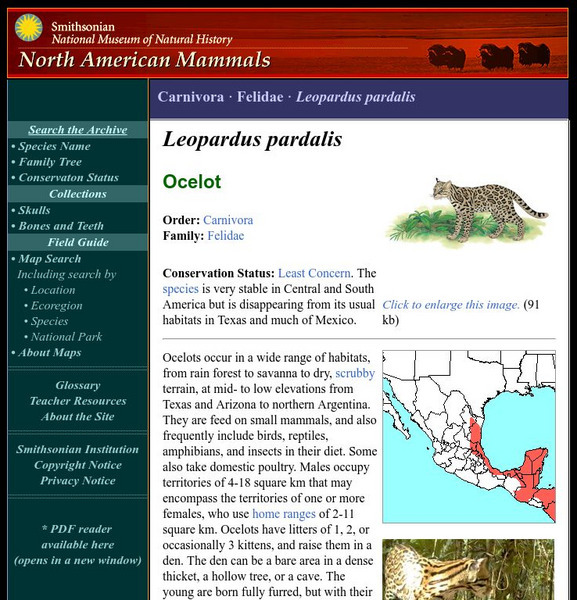
National Museum of Natural History: American Mammals: Ocelot
Ocelots occur in a wide range of habitats, from rainforest to savanna to dry, scrubby terrain, at mid- to low elevations from Texas and Arizona to northern Argentina. They are feed on small mammals, and also frequently include birds,...

Smithsonian Institution
National Museum of Natural History: American Mammals: Mexican Long Nosed Bat
The Mexican long-nosed bat feeds mainly on the nectar and pollen of agaves, and is found in Texas in June and July when the plants are in bloom there. Then it migrates southward into Mexico, where it lives in pine-oak forests and...

Smithsonian Institution
National Museum of Natural History: American Mammals: Lesser Long Nosed Bat
The lesser long-nosed bat is associated with arid grassland, scrub land, and tropical dry forest. Its daytime roosts include caves and abandoned mines, where upwards of 10,000 bats sometimes congregate. Learn more about the Leptonycteris...

Smithsonian Institution
National Museum of Natural History: American Mammals: White Tailed Jackrabbit
White-tailed Jackrabbits live at a remarkably broad range of elevations, from 40 m to 4,300 m, and where they are in competition with Black-tailed Jackrabbits, they tend to move toward higher elevations. They are slightly larger than...
Smithsonian Institution
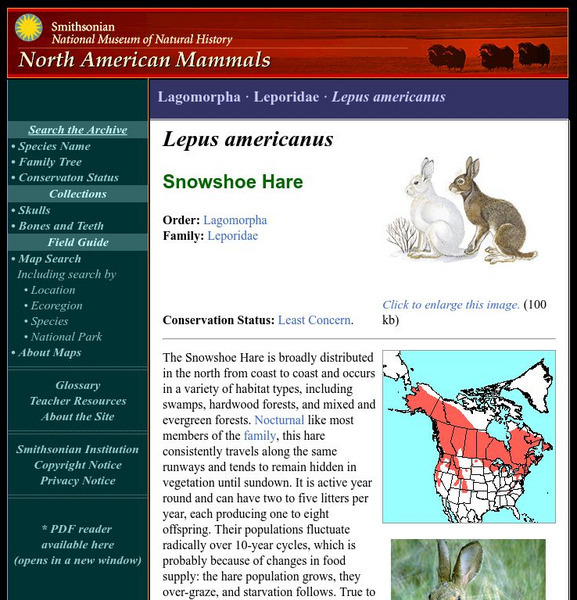
National Museum of Natural History: American Mammals: Snowshoe Hare
The Snowshoe Hare is broadly distributed in the north from coast to coast and occurs in a variety of habitat types, including swamps, hardwood forests, and mixed and evergreen forests. Nocturnal like most members of the family, this hare...

Smithsonian Institution
National Museum of Natural History: American Mammals: White Sided Jackrabbit
The White-sided Jackrabbit strongly prefers level ground to hills, and does not require shrubs for cover, but uses clumps or dense stands of grass instead. Grass also makes up more than 99 percent of its diet. Learn more about the Lepus...
Smithsonian Institution
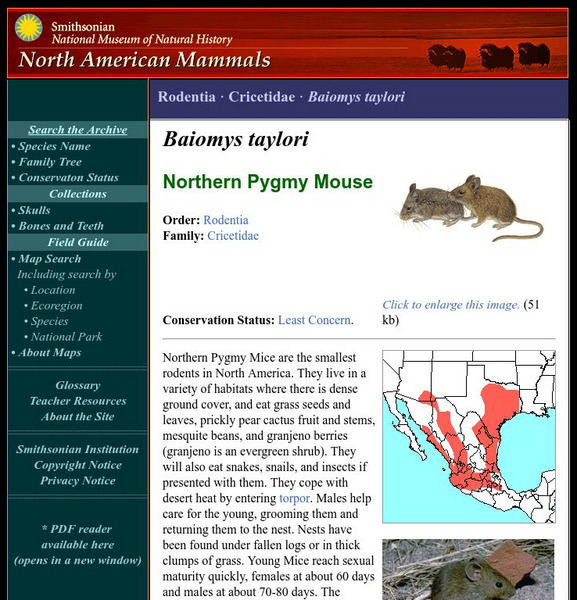
National Museum of Natural History: American Mammals: Northern Pygmy Mouse
Northern Pygmy Mice are the smallest rodents in North America. They live in a variety of habitats where there is dense ground cover and eat grass seeds and leaves, prickly pear cactus fruit and stems, mesquite beans, and granjeno berries...
Smithsonian Institution
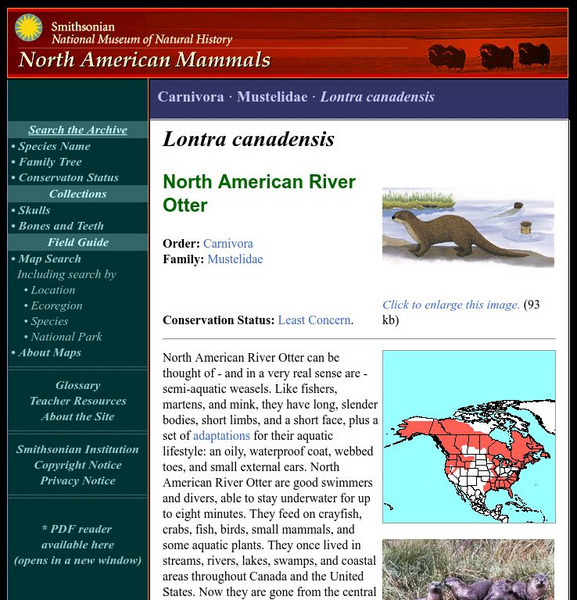
National Museum of Natural History: American Mammals: Northern River Otter
River Otters can be thought of - and in a very real sense are - semi-aquatic weasels. Like fishers, martens, and mink, they have long, slender bodies, short limbs, and a short face, plus a set of adaptations for their aquatic lifestyle:...
Smithsonian Institution
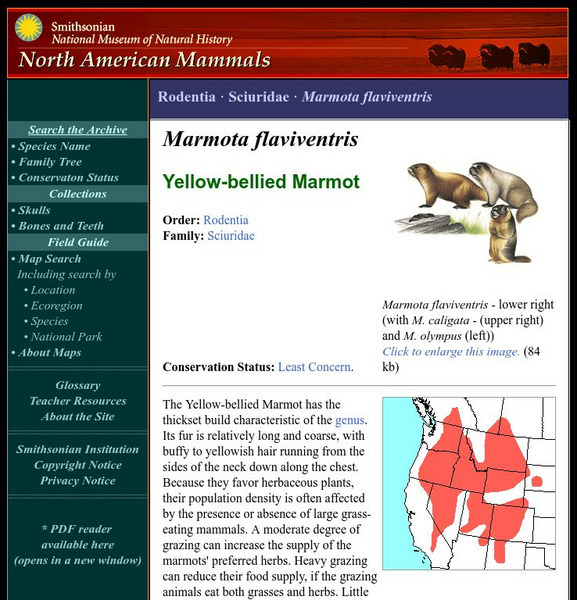
National Museum of Natural History: American Mammals: Yellow Bellied Marmot
The Yellow-bellied Marmot has the thickset build characteristic of the genus. Its fur is relatively long and coarse, with buffy to yellowish hair running from the sides of the neck down along the chest. Learn more about the Marmota...

Smithsonian Institution
National Museum of Natural History: American Mammals: Olympic Marmot
Olympic Marmots are highly social, living in groups made up of an adult male, one or more adult females, two-year-olds, yearlings, and young. Their diet consists of grasses and sedges, with flowering plants in season. Learn more about...

Smithsonian Institution
National Museum of Natural History: American Mammals: Woodland Jumping Mouse
Woodland Jumping Mice can make spectacular leaps of up to 4 m. They have large feet constructed from long foot and toe bones, and very long ankles, all of which help give them leverage when they push off. Learn more about the Napaeozapus...