Hi, what do you want to do?





Smithsonian Institution
National Museum of Natural History: North American Mammals
This concise site contains photos of North American mammals along with a map showing where they currently can be found. Includes links to other mammal sites.

Smithsonian Institution
National Museum of Natural History: Hall of Mammals: Black Bear
Brief overview of the black bear and accompanying photos demonstrate the physical adaptations that allow this animal to eat and survive in their habitat.
Smithsonian Institution
National Museum of Natural History: Hall of Mammals: Bison
Brief overview of the bison and accompanying photos demonstrate the physical adaptations that allow this animal to survive in its habitat.
Other
American Scientist: Author Interview: Neil De Grasse Tyson
Astrophysicist Neil deGrasse Tyson has made "Popularizing science a personal passion." Tyson's latest book, Origins, is the starting point here for a discussion of dark matter, intelligent life in our solar system, the possibility of...

Smithsonian Institution
National Museum of American History: History Explorer
This website, developed by the National Museum of American History, provides standards-based online resources for teaching and learning American history. An array of teacher lessons, activities, interactive media, and artifacts tag this...
Smithsonian Institution
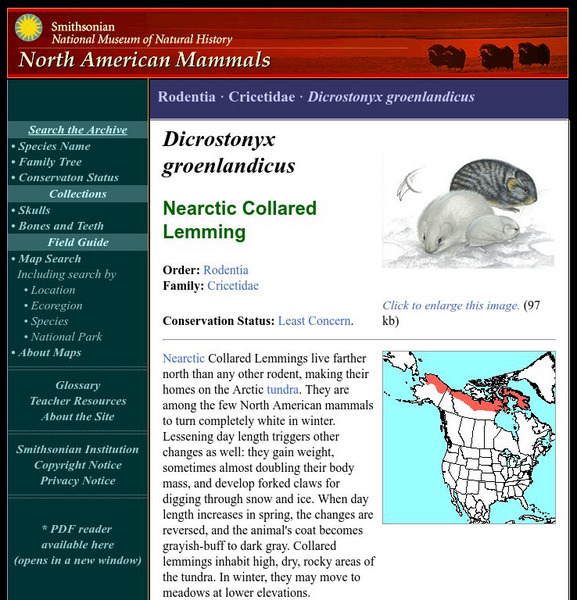
National Museum of Natural History: American Mammals: Northern Collared Lemming
Northern Collared Lemmings live farther north than any other rodent, making their homes on the Arctic tundra. They are among the few North American mammals to turn completely white in winter. Learn more about the Dicrostonyx...
Smithsonian Institution
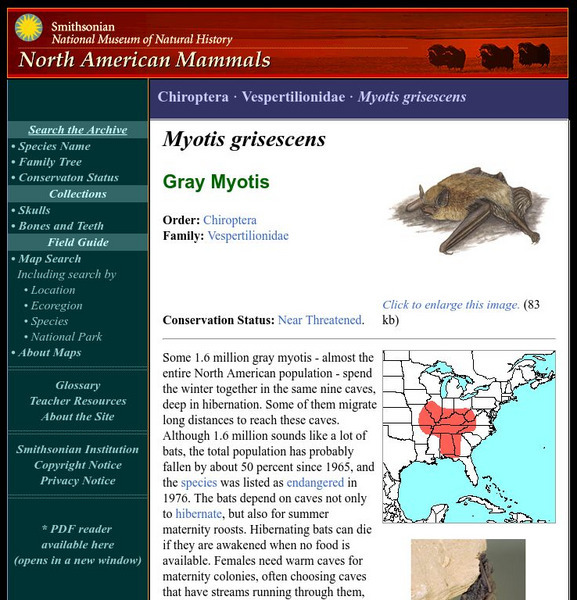
National Museum of Natural History: American Mammals: Gray Myotis
Some 1.6 million gray myotis - almost the entire North American population - spend the winter together in the same nine caves, deep in hibernation. Learn more about the Myotis grisescens, more commonly known as a Gray Myotis, in this...
Smithsonian Institution
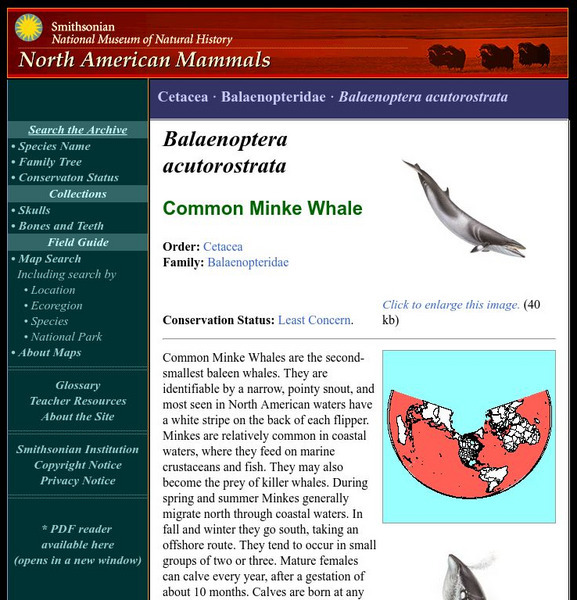
National Museum of Natural History: American Mammals: Common Minke Whale
Common Minke Whales are the second-smallest baleen whales. They are identifiable by a narrow, pointy snout, and most seen in North American waters have a white stripe on the back of each flipper. Learn more about the Balaenoptera...
Smithsonian Institution
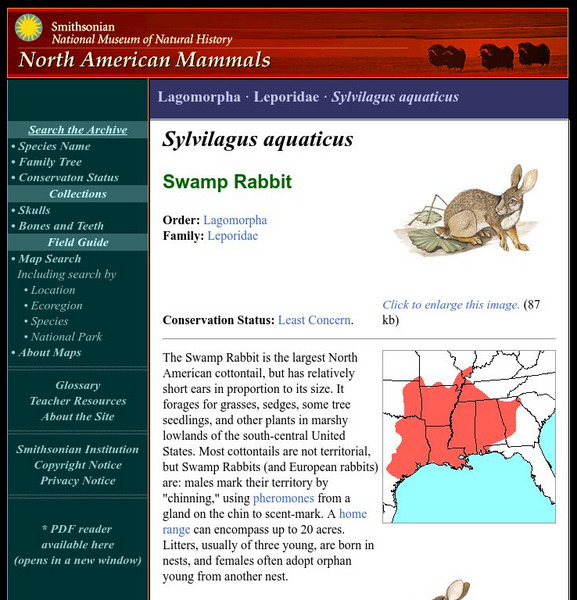
National Museum of Natural History: American Mammals: Swamp Rabbit
The Swamp Rabbit is the largest North American cottontail, but has relatively short ears in proportion to its size. It forages for grasses, sedges, some tree seedlings, and other plants in marshy lowlands of the south-central United...
Smithsonian Institution
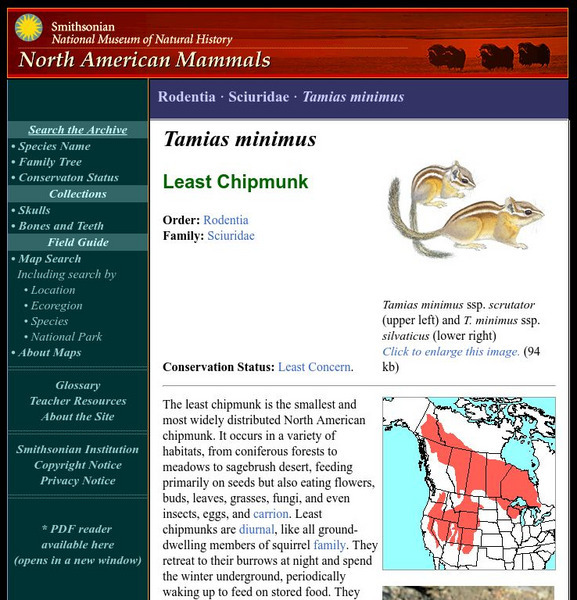
National Museum of Natural History: American Mammals: Least Chipmunk
The least chipmunk is the smallest and most widely distributed North American chipmunk. It occurs in a variety of habitats, from coniferous forests to meadows to sagebrush desert, feeding primarily on seeds but also eating flowers, buds,...

Smithsonian Institution
National Museum of Natural History: American Mammals: Eastern Small Footed Myotis
The eastern small-footed myotis is one of the smallest North American bats. It has a limited range, occurring only in eastern deciduous and coniferous forests. Learn more about the Myotis leibii, more commonly known as an Eastern...
Smithsonian Institution
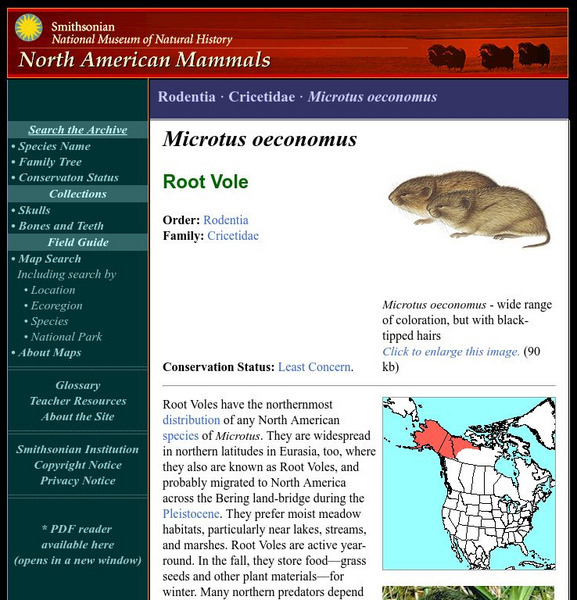
National Museum of Natural History: American Mammals: Tundra Vole
Tundra Voles have the northernmost distribution of any North American species of Microtus. They are widespread in northern latitudes in Eurasia, too, where they are known as Root Voles, and probably migrated to North America across the...
Smithsonian Institution
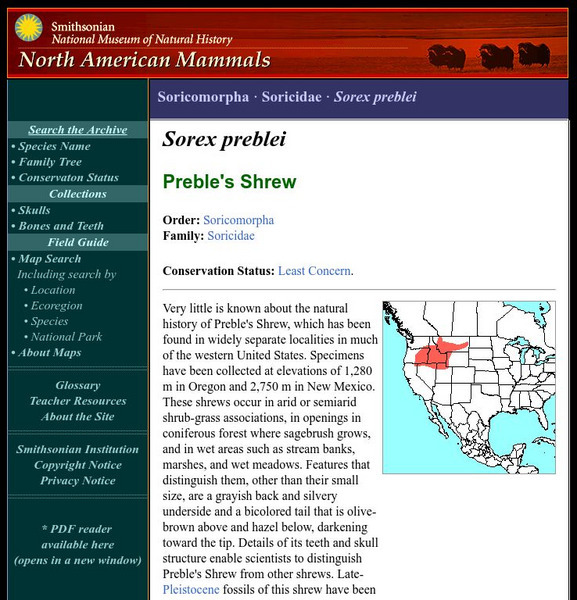
National Museum of Natural History: American Mammals: Preble's Shrew
Very little is known about the natural history of Preble's Shrew, which has been found in widely separate localities in much of the western United States. Specimens have been collected at elevations of 1,280 m in Oregon and 2,750 m in...
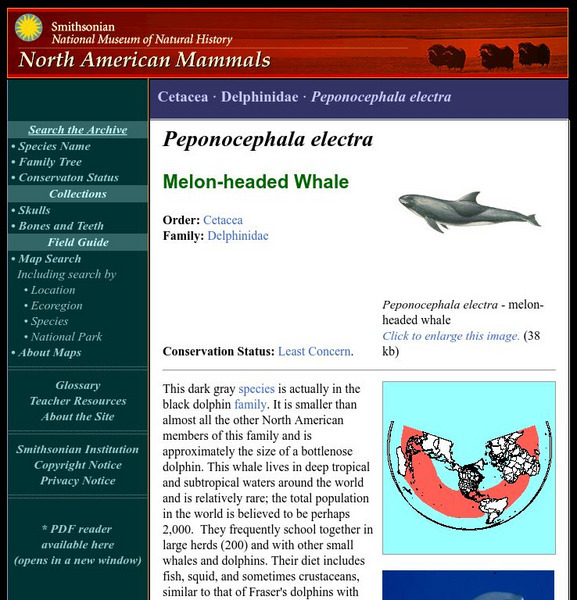
Smithsonian Institution
National Museum of Natural History: American Mammals: Melon Headed Whale
This dark gray species is actually in the black dolphin family. It is smaller than almost all the other North American members of this family and is approximately the size of a bottlenose dolphin. Learn more about the Peponocephala...
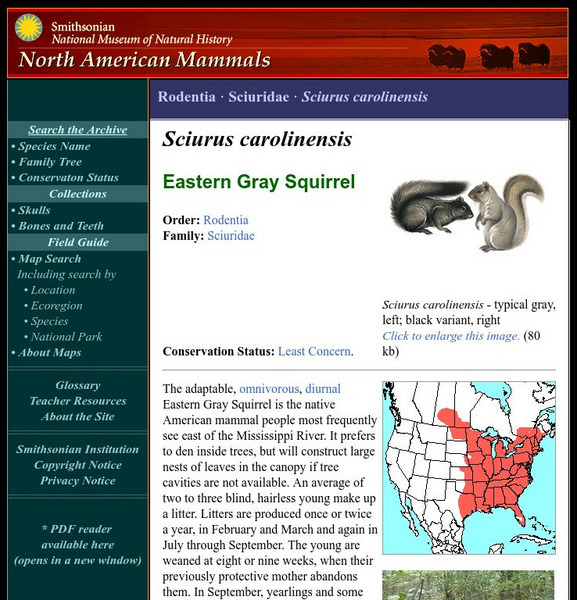
Smithsonian Institution
National Museum of Natural History: American Mammals: Eastern Gray Squirrel
The adaptable, omnivorous, diurnal Eastern Gray Squirrel is the native American mammal people most frequently see east of the Mississippi River. It prefers to den inside trees, but will construct large nests of leaves in the canopy if...
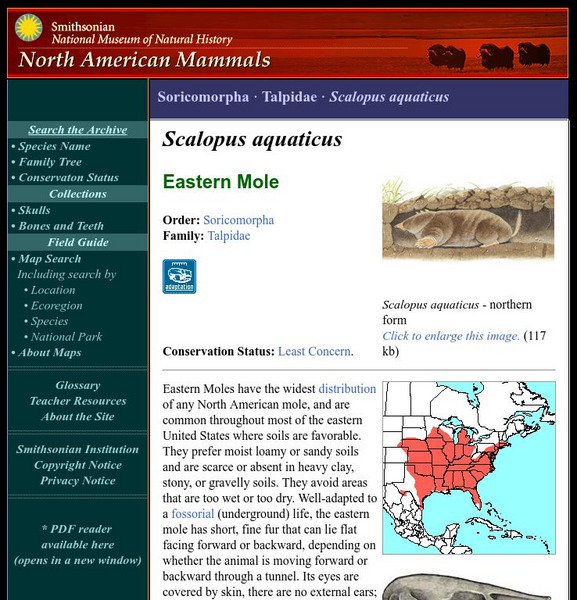
Smithsonian Institution
National Museum of Natural History: American Mammals: Eastern Mole
Eastern Moles have the widest distribution of any North American mole and are common throughout most of the eastern United States where soils are favorable. They prefer moist loamy or sandy soils and are scarce or absent in heavy clay,...
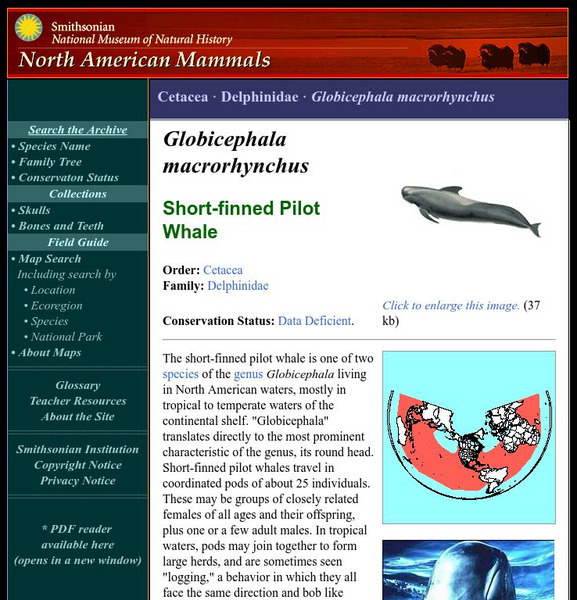
Smithsonian Institution
National Museum of Natural History: American Mammals: Short Finned Pilot Whale
The short-finned pilot whale is one of two species of the genus Globicephala living in North American waters, mostly in tropical to temperate waters of the continental shelf. "Globicephala" translates directly to the most prominent...
Smithsonian Institution
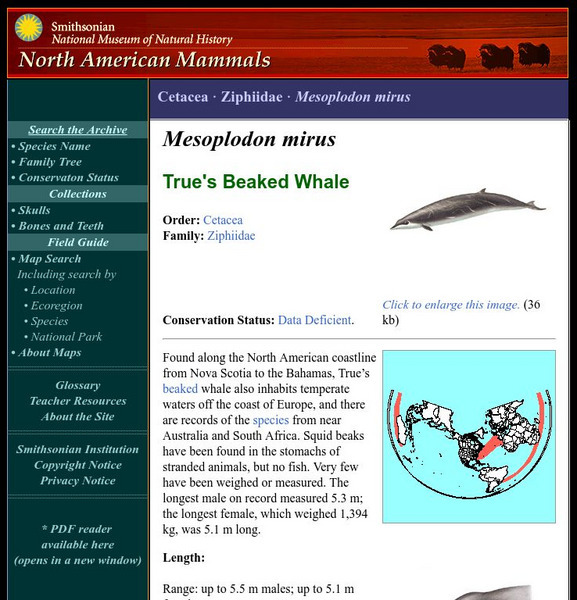
National Museum of Natural History: American Mammals: True's Beaked Whale
Found along the North American coastline from Nova Scotia to the Bahamas, True's beaked whale also inhabits temperate waters off the coast of Europe, and there are records of the species from near Australia and South Africa. Squid beaks...
Smithsonian Institution
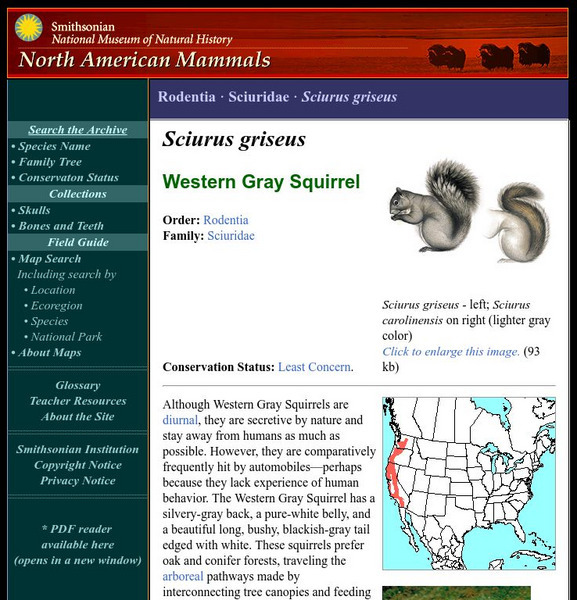
National Museum of Natural History: American Mammals: Western Gray Squirrel
Although Western Gray Squirrels are diurnal, they are secretive by nature and stay away from humans as much as possible. However, they are comparatively frequently hit by automobiles, perhaps because they lack experience of human...
Smithsonian Institution
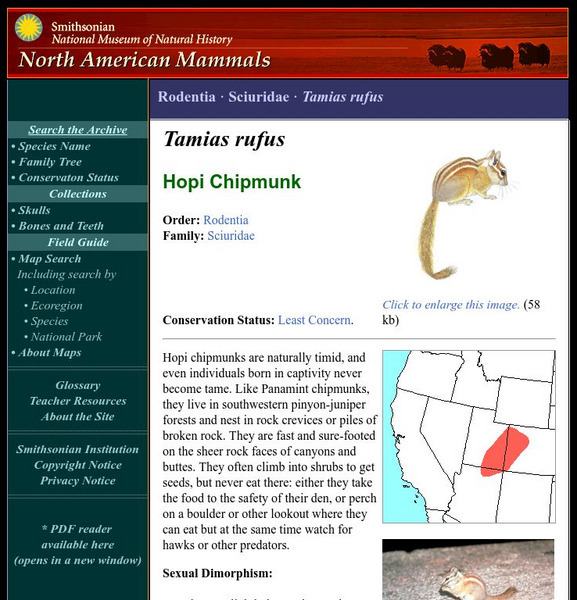
National Museum of Natural History: American Mammals: Hopi Chipmunk
Hopi chipmunks are naturally timid, and even individuals born in captivity never become tame. Like Panamint chipmunks, they live in southwestern pinyon-juniper forests and nest in rock crevices or piles of broken rock. Learn more about...
Smithsonian Institution
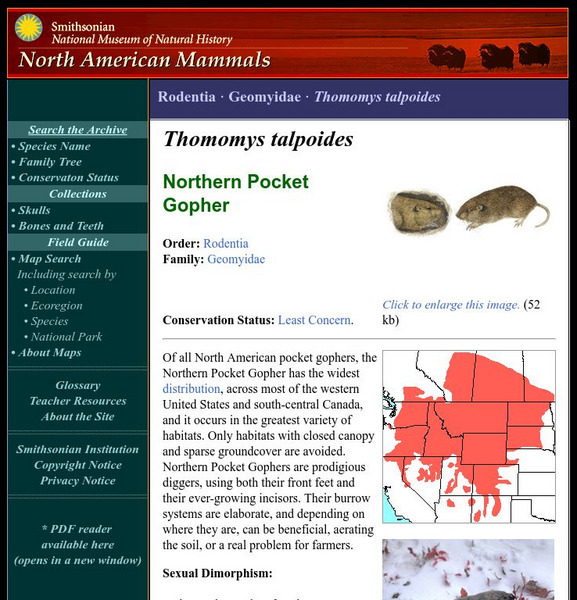
National Museum of Natural History: American Mammals: Northern Pocket Gopher
Of all North American pocket gophers, the Northern Pocket Gopher has the widest distribution, across most of the western United States and south-central Canada, and it occurs in the greatest variety of habitats. Only habitats with a...
Smithsonian Institution
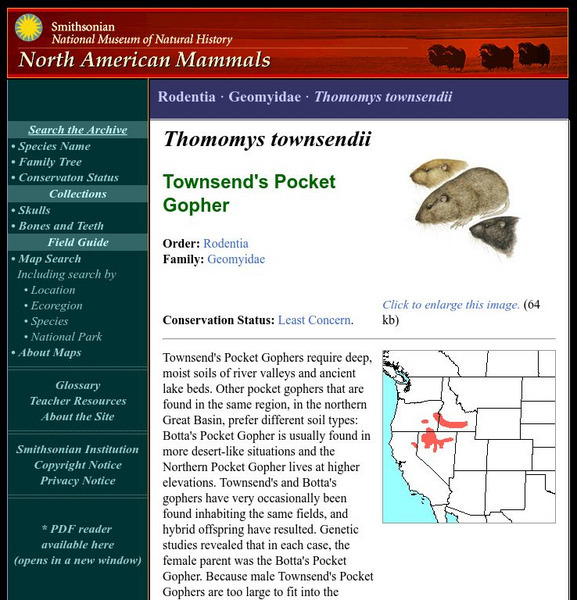
National Museum of Natural History: American Mammals: Townsend's Pocket Gopher
Townsend's Pocket Gophers require deep, moist soils of river valleys and ancient lake beds. Other pocket gophers that are found in the same region, in the northern Great Basin, prefer different soil types: Botta's Pocket Gopher is...
Smithsonian Institution
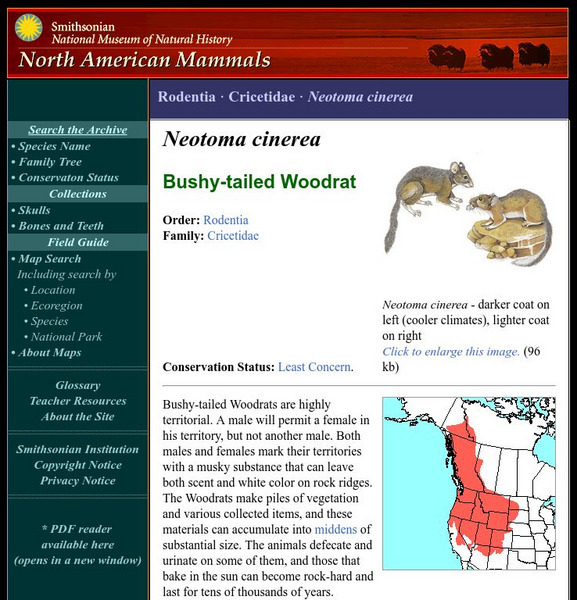
National Museum of Natural History: American Mammals: Bushy Tailed Woodrat
Bushy-tailed Woodrats are highly territorial. A male will permit a female in his territory, but not another male. Learn more about the Neotoma cinerea, more commonly known as a Bushy-tailed Woodrat, in this easy-to-read species overview...

Smithsonian Institution
National Museum of Natural History: American Mammals: Arizona Pocket Mouse
Like other heteromyid rodents, Arizona Pocket Mice are solitary creatures. They spend the day in underground burrows, emerging only at night. Learn more about the Perognathus amplus, more commonly known as an Arizona Pocket Mouse, in...