
Curated OER
How did Geography Affect the Economy of the Colonies
Eighth graders examine the impact of geography on a region. In this geography lesson, 8th graders study the themes of geography. Students write an open response to a question.

Curated OER
American Colonial Life in the Late 1700s: Distant Cousins
Young scholars explore daily life and its influences in the late 1700s for two families in different colonies- Delaware and Massachusetts by becoming historical detectives. After gathering information from artifacts to make inferences...

Curated OER
Kiskiack: Changing Architectural Landscape
Learners compare and contrast the changing Native and English colonial architectural landscape of the 17th and 18th centuries. Students research and evaluate how economic technology, and the environment reflected cultural changes in the...

Curated OER
American Immigration Past and Present
Young scholars simulate a Commission hearing in which the class attempt to arrive at an immigration policy; individual essays by each student; and, if time permits, individual or group projects based on some aspect of America's...

Curated OER
Salem's Maritime History: A History of our New Nation
Eighth graders examine the impact of Salem's maritime trade on America. Using primary source documents, they identify the use of expanding the number of products available and how it affected the economy. They write an essay discussing...

Curated OER
Good Brother, Bad Brother
Students are exposed to the writings of John Wilkes Booth. They discover that fanaticism is not just a modern phenomenon. They examine four periods in American history when treason was at issue.

Curated OER
Low-country Rice Planting and Cooking
Eighth graders compare the use of rice in the 1700s to the modern use of rice. For this lesson examining the importance of rice in US history, 8th graders learn about the role of rice in the early 1700s and compare the use of rice in...

Curated OER
Early America
Fifth graders, in groups, study the differences between the 13 Original Colonies, then explore the relationship between the Revolutionary War and the Civil War.

Curated OER
Tobacco Road
Learners use court records to learn that tobacco was used a source of currency in early Delaware history. Students choose something in their culture to use as currency instead of money.

Curated OER
Abenaki Indians: A Jigsaw Activity
Students work together to research the Abenaki Indians. They discover how the Native Americans lives where changed after contact with the Europeans. They compare and contrast the Indians and the Europeans and present their information to...

Curated OER
Civil War
Historical poetry is lyrical in form and rich with content. After examining the differences between the Northern and Southern states before and during the U.S. Civil War, learners complete a Venn diagram and create an illustration of the...

Curated OER
I Have No Money, Would You Take Wampum
Students engage in a discussion about their experiences with goods, services, and money. In this bartering activity, students read The Wampum Bird story and brainstorm their personal experiences with economics.

Curated OER
Globalization's Effects on Indonesian Women
Twelfth graders investiage the status of women in contemporary Indonesian society and the business strategies of companies located there. They create a Web page that explains the effects of globalization on Indonesian women and shows...

Curated OER
From Forest to Farm and Back Again
Students review and discuss a given set of questions regarding ecosystems. They analyze essays, maps and historical documents on timber harvesting and regeneration and then complete worksheets.
University of Groningen
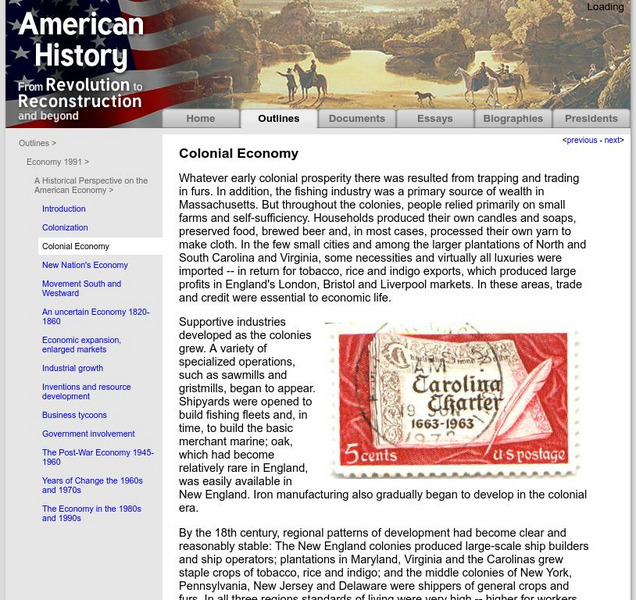
American History: Outlines: Colonial Economy
Whatever early colonial prosperity there was resulted from trapping and trading in furs. In addition, the fishing industry was a primary source of wealth in Massachusetts. But throughout the colonies, people relied primarily on small...
Henry J. Sage
Sage American History: Virginia: The London Company
Article on the development and practices of the London Company, including discussion on the economy and resources in 17th Century colonial America.
University of Groningen
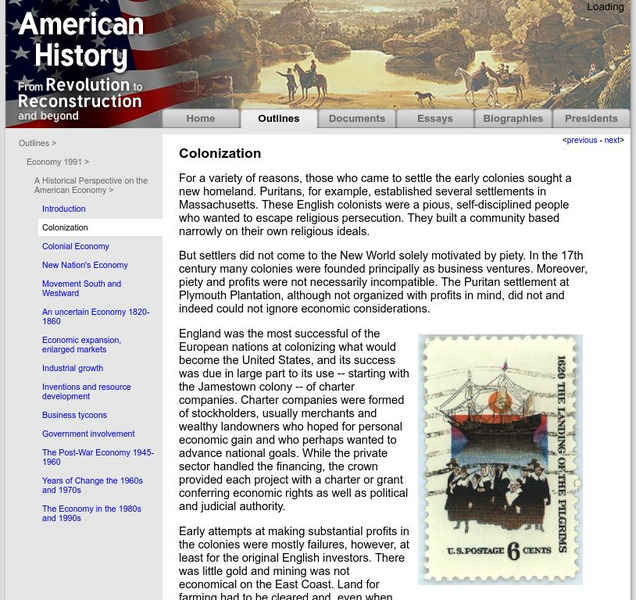
American History: Outlines: Colonization
For a variety of reasons, those who came to settle the early colonies sought a new homeland. Puritans, for example, established several settlements in Massachusetts. These English colonists were a pious, self-disciplined people who...
University of Groningen
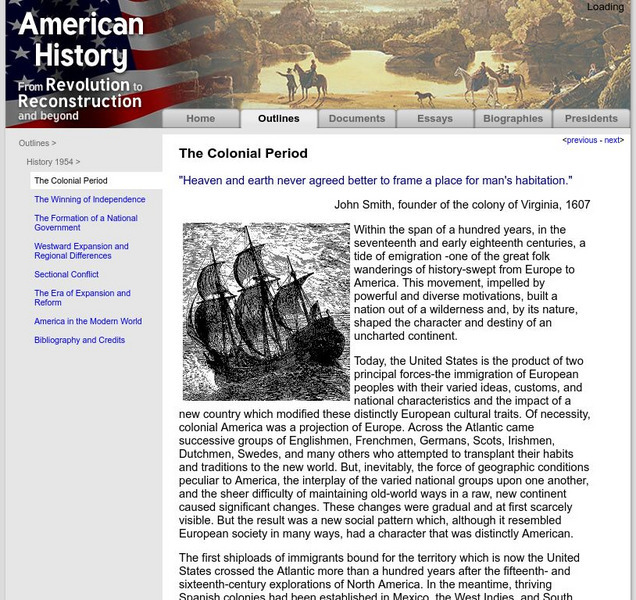
American History: Outlines: The Colonial Period
The early settlers to the New World began to map strategy for their own system of government. This site details that strategy and what kinds of events spawned the idea of representative government.
Internet History Sourcebooks Project
Fordham University: Modern History Sourcebook: American Independence
Part of Fordham University's Internet Modern History Sourcebook, this site gives historical background and extensive web resources on American Independence.
PBS
Wnet: Thirteen: Freedom: A History of the u.s. Independence Webisode 1
Webisode 1-Independence. The history of the United States is presented in a series of webisodes, within each are a number of segments.Included are links to lesson plans, teacher guides, resources, activities, and tools.

National Geographic
National Geographic: Society: A History of Trade in New York City
A lesson based on the New York City seal that explores the trading relationship between the Dutch and Native Americans in New Amsterdam.
Colonial Williamsburg Foundation
Colonial Williamsburg: Occupations and Trades of the 18th Century
A comprehensive list of the types and descriptions of occupations available in the 18th century. From the Colonial Williamsburg Foundation.
University of Groningen
American History: Outlines: Agriculture Rules the South
The essay describes the devlopment of the Southern colonies as agricultural centers and the cultural aspects associated with rural, agricultural life.
Internet History Sourcebooks Project
Fordham University: Modern History Sourcebook: Coffee Fazenda of Brazil 1911
The Modern History Sourcebook provides this great look at what life would be like on a coffee plantation during the early 20th century. It describes the houses, life on the plantation, colonists, and harvests.