
National First Ladies' Library
Eleanor Roosevelt and Hillary Clinton: Activist First Ladies
Students are divided into six smaller groups, with each group assigned to the task of exploring one of the aspects of the lives of both Eleanor Roosevelt and Hillary Clinton. They prepare a grid on which to record their findings and...

Curated OER
Abraham Lincoln and the U.S. Constitution
Students investigate President Abraham Lincoln's use of the U.S. Constitution and its importance to the Civil War. In this US history lesson, students read text about President Lincoln and the US Constitution. Students examine the...

Curated OER
NAFTA Trade Unit
Learners research the geography, economics and government of Canada and how that affects US/Canadian trade relations. In this NAFTA lesson, students play a game, read about Canadian history, and creat a graph.

Center For Civic Education
Center for Civic Education: Black History Month
A collection of six lessons for Grades 5 and up for Black History Month. The lesson plans explore the use of nonviolence in history, particularly with respect to the civil rights movement and African American history.
Louisiana Department of Education
Louisiana Doe: Louisiana Believes: Civics: Suffrage
Learners develop and express claims through discussions and writing which they examine how citizens can participate responsibly and effectively in American civic and political life to catalyze a successful democratic society.
Center For Civic Education
Center for Civic Education: How Does Government Secure Natural Rights?
This lesson introduces students to some basic ideas the Framers used in creating the kind of government they thought would best protect the natural rights of each individual and promote the good of all. At the end of the lesson, students...

Bill of Rights Institute
Bill of Rights Institute: Justice Thomas on National Identity
An examination of a speech Justice Clarence Thomas delivered in 2009 highlighting his thoughts on the Bill of Rights as well has his views on the importance of American civic responsibility.
Center For Civic Education
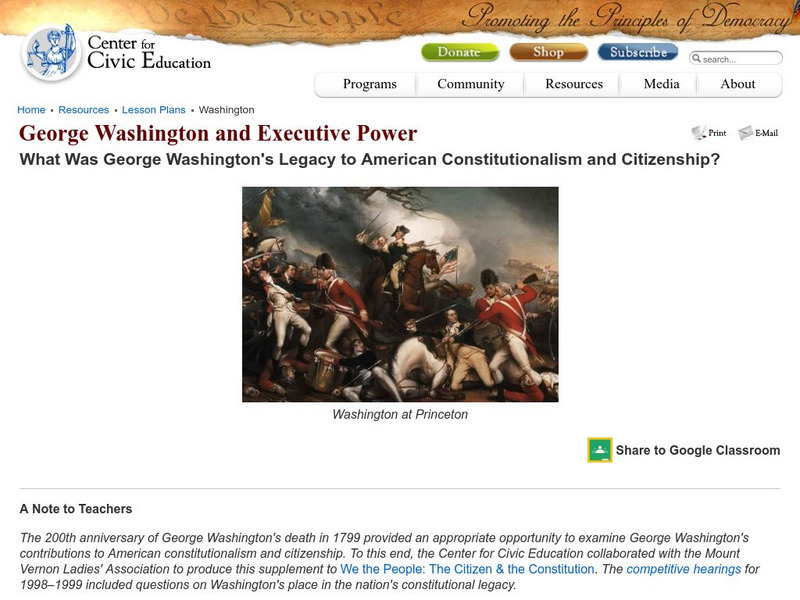
Center for Civic Education: George Washington and Executive Power
This lesson looks at the legacy of George Washington, perhaps the most influential leader in the creation of the American nation. Through his achievements as commander-in-chief during the Revolution, in support of the drafting and...
Center For Civic Education
Center for Civic Education: Teaching Presidential Elections [Zip]
Citizens, Not Spectators is a voter education program whose goal of the program is to increase the voting rate among young Americans by demystifying the voting process. The lessons familiarize students with the process and the duty of...
Center For Civic Education
Center for Civic Education: James Madison and Executive Power
This lesson examines the legacy of the "philosopher statesman," James Madison. Madison combined the intellectual knowledge and creativity of the scholar with the practical savvy of the politician, a man of strong principles who also...
iCivics
I Civics: Got Grievances?
Learn what economic, political, and social factors led to the writing of the Declaration of Independence and the American Revolution. In this lesson, students learn what caused the colonies to declare independence from Great Britain and...
iCivics
I Civics: Appellate Courts: Civic Action and Change
In this lesson, students examine civic action, the steps involved, and its various methods, including protests and petitions.
Center For Civic Education
Center for Civic Education: George Washington's Legacy to America
This lesson plan from the Center for Civic Education encourages both teachers and young scholars to learn more about George Washington's contribution to American Constitutionalism and Citizenship.
Center For Civic Education
Center for Civic Education: Why Do We Need a Government?
This lesson introduces students to some of the basic ideas which were of great importance to the Founders. They used these ideas when they developed the American government. Students will learn why they thought a government was needed in...
Organization for Community Networks
Academy Curricular Exchange: Civics Jeopardy
A thorough lesson plan that has students having fun while reviewing for their civics final exam.
iCivics
I Civics: Tribal Government
As sovereign nations, American Indian and Alaska Native tribes develop and manage their own governments. This lesson examines the varied structures and functions of tribal government as well as the relationship these nations have with...
iCivics
I Civics: Elk v. Wilkins (1884)
This mini-lesson examines the Supreme Court's ruling that the 14th Amendment's Citizenship Clause did not apply to American Indians born on Native reservations. Students analyze a primary document and discover how the lack of citizenship...
iCivics
I Civics: Rousseau Mini Lesson
Explore the ideas of Enlightenment thinker, Jean-Jacques Rousseau. His writings on natural and social freedom, the social contract, and democracy shaped the American system of government in a variety of ways.
iCivics
I Civics: Mexican Cession (1848)
Students explore the causes and effects of the Mexican-American war. They will learn about the land was obtained as a result, the Treaty of Guadalupe Hidalgo, the Gadsen Purchase of 1853, and the new international borders.
iCivics
I Civics: Lyng v. Northwest Indian Cemetery Protective Association (1988)
This mini-lesson examines the Supreme Court case that pitted the interests of government economic projects against the religious rights of American Indians. Young scholars learn about the religious protections of the First Amendment's...
PBS
Pbs Teachers: George Washington and Civic Virtue (Lesson Plan)
A lesson for gaining knowledge and insight into the founders' ideas of civic virtue - civic knowledge, self-restraint, self-assertion, and self-reliance. Includes an examination of an excerpt from a primary source document: George...
iCivics
I Civics: Jim Crow
Use primary documents and images to discover the ways state and local governments restricted the newly gained freedoms of African Americans after the Civil War. Compare, contrast, and analyze post-war legislation, court decisions...
iCivics
I Civics: Pga Tour, Inc. V. Martin (2001)
This mini-lesson plan explores the Supreme Court's decision that required the Professional Golf Association to accommodate competitors with disabilities in its tournaments. Learners learn about the Americans with Disabilities Act, the...
Center For Civic Education
Center for Civic Education: How Constitution Used to Organize the New Govt [Pdf]
This instructional activity describes how, using the guidelines provided in the Constitution, the First Congress in April 1789 named the new president and vice president, provided funding for the new government, organized the executive...
Other popular searches
- U.s. American Civics
- Us American Civics
- Chapter 1 American Civics
- Holt American Civics
- American Civics and Activism
- Chapter 2 American Civics
- Civics American Goverment