Hi, what do you want to do?





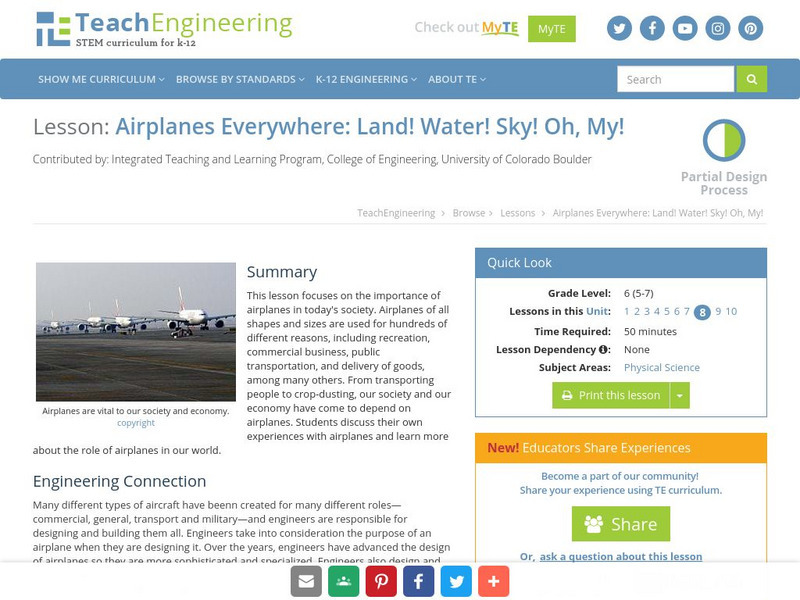
TeachEngineering
Teach Engineering: Land! Water! Sky! Oh My!
This lesson focuses on the importance of airplanes in today's society. Airplanes of all shapes and sizes are used for hundreds of different reasons, including recreation, commercial business, public transportation, and delivery of goods,...
PBS
Pbs Teachers: Supersonic Dream
Examine how fuel use affects the mass of different planes during flight. This lesson teaches students how to determine the per person fuel cost of a transatlantic flight for seven airplanes, and display the results on a bar graph. Three...
Center for Innovation in Engineering and Science Education, Stevens Institute of Technology
Ciese Navigational Vectors
For this project, students use real time data to learn how pilots navigate when they fly. Students go through a series of lessons on vectors, weather maps and flight tracking, then take a pilot's test where they apply what they have...
TeachEngineering
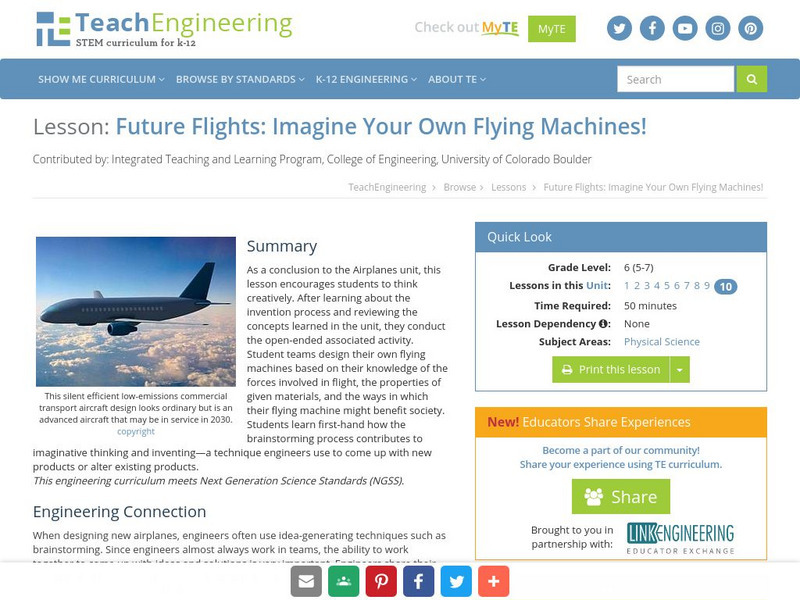
Teach Engineering: Future Flights!
This lesson plan is an exciting conclusion to the airplanes unit that encourages students to think creatively. After a review of the concepts learned, students will design their own flying machine based on their knowledge of the forces...
TeachEngineering
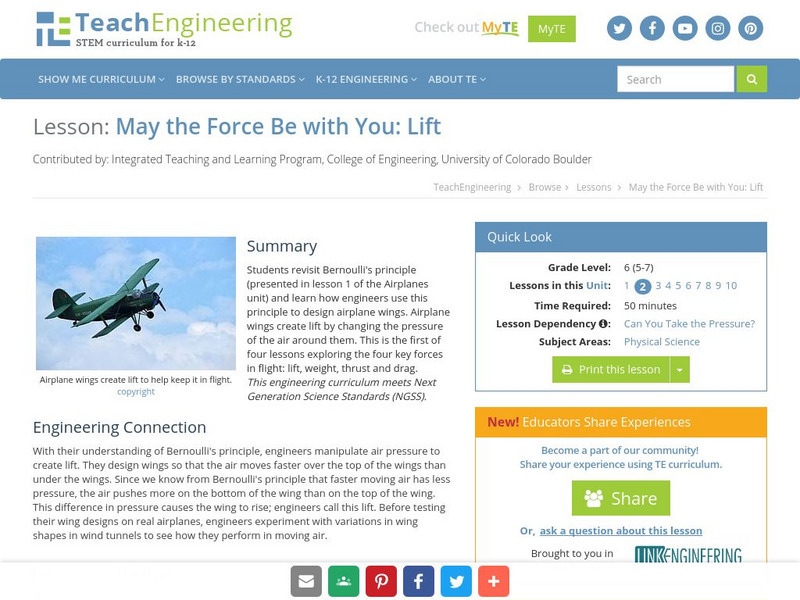
Teach Engineering: May the Force Be With You: Lift
Students revisit Bernoulli's Principle (Lesson 1 of the Airplanes unit) and learn how engineers use this principle to design airplane wings. Airplane wings create lift by changing the pressure of the air around it. This is the first of...
![Ontario Council for Technology Education: Transportation Design and Construction [Pdf] Lesson Plan](https://static.lp.lexp.cloud/images/attachment_defaults/resource/large/FPO-knovation.png "Ontario Council for Technology Education: Transportation Design and Construction [Pdf] Lesson Plan")
Other
Ontario Council for Technology Education: Transportation Design and Construction [Pdf]
In this project, students will develop knowledge and skills related to the construction of vehicle/craft systems. They will identify and describe the major systems and components of vehicles, aircraft, and/or watercraft such as body,...

Alabama Learning Exchange
Alex: Let's Calculate Flight!
Students will use stop watches to help understand elapsed time when they fly paper airplanes through the air. Students will then move on to using clocks. Students will work out elapsed time word problems using made up flight schedules.
Council for Economic Education
Econ Ed Link: Transportation: They Say We Had a Revolution (Part 1)
Advancements in transportation have played a key role in the growth of our nation. U.S.government policies have also had a considerable impact on the development of transport as we know it today. In this series of three lessons, the...
Council for Economic Education
Econ Ed Link: Transportation: They Say We Had a Revolution (Part 3)
Advancements in transportation have played a key role in the growth of our nation. U.S. government policies have also had a considerable impact on the development of transport as we know it today. In this series of three lessons, the...
Science and Mathematics Initiative for Learning Enhancement (SMILE)
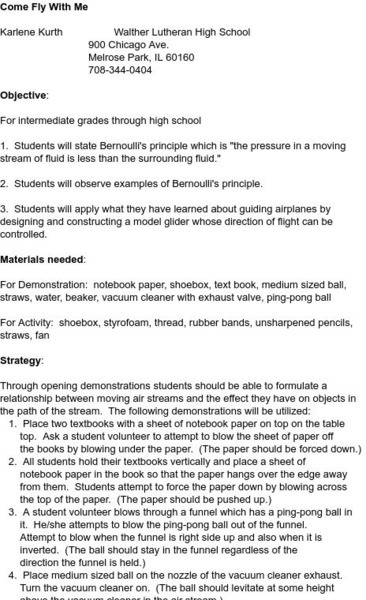
Smile: Lab Work: Come Fly With Me
This site by the Illinois Institute of Technology lets students use a vacuum cleaner hose, ping pong balls, straws and other materials to investigate the effect of moving air upon the surfaces which it hits. Principles are applied as...
TryEngineering
Try Engineering: Engineered Sports
Students work in teams to investigate how aerospace engineering relates to sports, especially golf ball design and the physics of bounce. They use this information to determine whether these aerospace principles can be applied to...