Hi, what do you want to do?






Curated OER
Thar She Blows!
Students identify the advantages and disadvantages of wind farms and turbines. They examine how weather conditions can affect their effectiveness and how engineers are trying to solve the problem. They discover how engineers use this...

Curated OER
By Bernoulli, Where's Gravity?
Students observe a 1/4 inch by 2 inch piece of paper that is held vertically downward under the bottom lip, noting that the paper is pulled down by gravity. They predict what happens to the paper if air is blown out. After air is blown,...

Curated OER
#22c Airplane flight #22d Airplane flight--How High? How Fast?
Students discuss the application of frames of reference to an airplane flying with a constant velocity v through the air.

Curated OER
Size Effects Problem Set
Pupils, after reading the Size Effects page from a NASA Web-based textbook, demonstrate an understanding of Size Effects by answering questions.

Curated OER
The Lift Equation Problem Set
Students, after reading the Lift Equation page from a NASA Web-based textbook, demonstrate an understanding of the lift equation by answering questions.

Curated OER
Using 3-D Models for Code Validation with FoilSim
Students use FoilSim to complete the activity to create tables of data sets comparing the lift values for a 3-D model of a symmetrical wing section to the values predicted by the FoilSim software.

Discovery Education
Discovery Education: Inventors and Inventions 2: Air and Space
After discussing important flying inventions, students explore technological design by making paper airplanes.
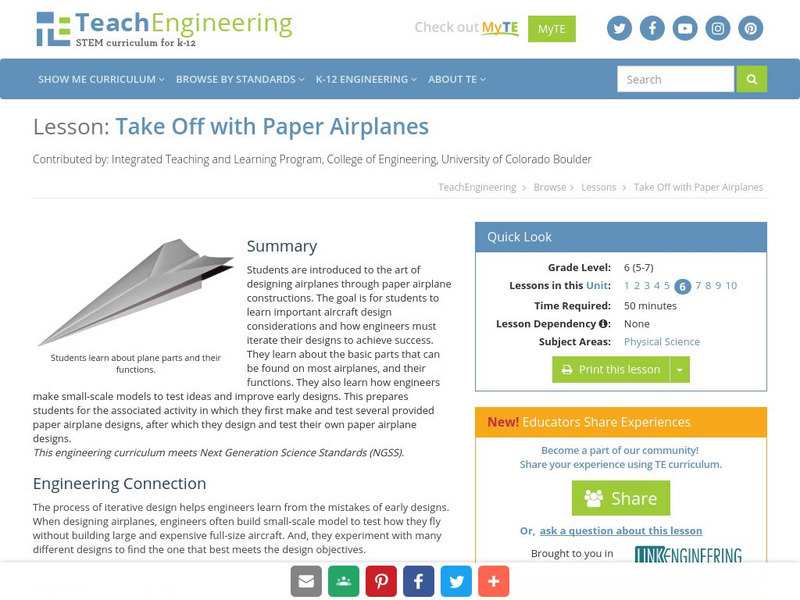
TeachEngineering
Teach Engineering: Take Off With Paper Airplanes
This lesson introduces learners to the art of designing an airplane through paper airplane constructions. The goal is that students will learn important aircraft design considerations and how engineers must iterate their designs to...

TeachEngineering
Teach Engineering: What Makes Airplanes Fly?
Students begin to explore the idea of a force. To further their understanding of drag, gravity and weight, they conduct activities that model the behavior of parachutes and helicopters. An associated literacy activity engages the class...
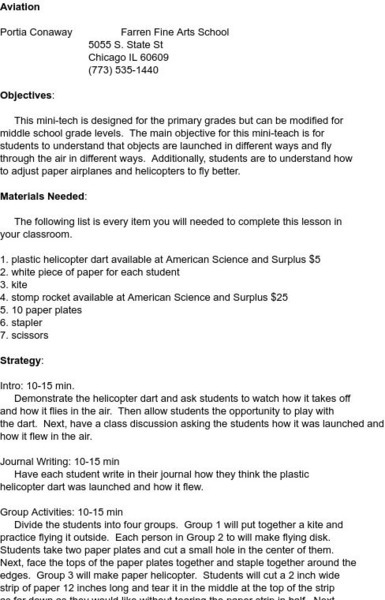
Science and Mathematics Initiative for Learning Enhancement (SMILE)
Smile: Lab Activity: Aviation
This site from the Illinois Institute of Technology provides a student lab activity in which the flight of a paper airplane is investigated and studied. Designed for primary grades, but easily adaptable for junior high students.

Smithsonian Institution
Smithsonian Learning Lab: How Things Fly: Activities for Teaching Flight
Through this series of three lessons, young scholars will gain an understanding of the basics of flight. They will learn about the four forces of flight and practice their observation skills through a number of fun experiments. In...
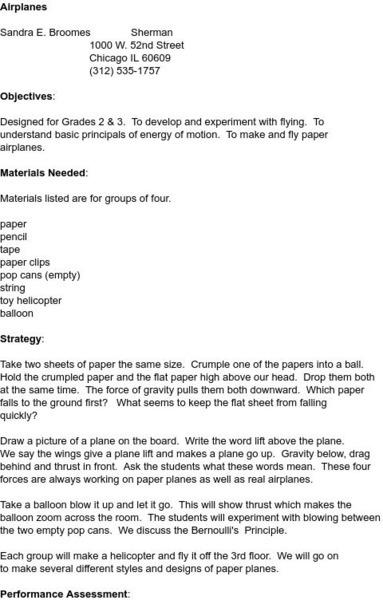
Science and Mathematics Initiative for Learning Enhancement (SMILE)
Smile: Airplanes (2 3)
This paper airplane lesson plan helps students learn about certain concepts like air resistance, motion, and aerodynamics.
TryEngineering
Try Engineering: Engineered Sports
Students work in teams to investigate how aerospace engineering relates to sports, especially golf ball design and the physics of bounce. They use this information to determine whether these aerospace principles can be applied to...
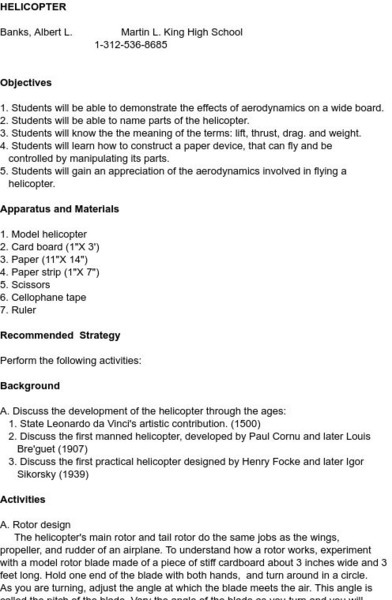
Science and Mathematics Initiative for Learning Enhancement (SMILE)
Smile: Lab Activity: Helicopter
The Illinois Institute of Technology lets students investigate the aerodynamics of a helicopter, focusing on the variables which effect the lift, thrust, drag, and weight. Students investigate the effects of aerodynamics on a wide board.
Science and Mathematics Initiative for Learning Enhancement (SMILE)
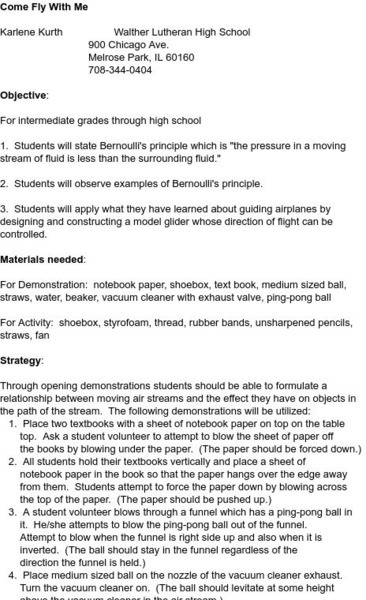
Smile: Lab Work: Come Fly With Me
This site by the Illinois Institute of Technology lets students use a vacuum cleaner hose, ping pong balls, straws and other materials to investigate the effect of moving air upon the surfaces which it hits. Principles are applied as...