Hi, what do you want to do?






Curated OER
Propellers, Forces and Energy
Pupils construct a model airplane, measure distance, and calculate velocity. In this creative lesson students work in groups to build a model and use it to calculate distances and velocity.

Curated OER
Maximum Flight Time
Learners, after reading an explanation from a NASA Web site, demonstrate an understanding of the text by applying it to questions involving Maximum Flight Time and Range under varying conditions.

Curated OER
#22c Airplane flight #22d Airplane flight--How High? How Fast?
Students discuss the application of frames of reference to an airplane flying with a constant velocity v through the air.

Curated OER
Airplane flight
Students learn the basic concepts about airplane flight. They learn the reason jetliner wings are swept back and why jet engines have replaced propellers in high-speed flight.

Curated OER
Out Of Sight Air; Weather
Fourth graders conduct an experiment to get them thinking about the invisibility of air, and to prove that air has weight.

Curated OER
Weightlessness
Young scholars predict the behavior of coffee in a cup while it is dropped during a demonstration. They relate their observations to the weightless conditions that astronauts experience in space and discuss the concept of free-fall.

Curated OER
Drag Problem Set
Students read an explanation from a NASA Web-based textbook and then demonstrate an understanding of the text by applying it to calculating drag of both full-sized and model gliders.

Curated OER
Gas Properities Definitions
Students, after reading the Web page Gas Properties Definitions, complete the activity to demonstrate an understanding of the properties of gases.

Curated OER
Propulsion Pop!
Students demonstrate an understanding of the text by completing a propulsion activity, charting the results, and answering questions that demonstrate an understanding of rocket propulsion.

Curated OER
Fuel and Air Relationships
Students use EngineSim and information found on the World Wide Web to complete the activity on the relationship between the atmosphere and jet fuel. They discover how much air is required to pass through a jet engine.

Curated OER
CHARTING A COURSE
Young scholars model how a gyroscope works with string, an old phonograph record and crayon.

Curated OER
Pilots, Drivers, and Captains
Students listen to the song, The Wheels on the Bus, then change the words for a boat.

Curated OER
Aeronautics - Propeller experiments - Experiment 5 - Level 1
Students participate in propeller experiments. They research the purpose of the propeller and its functions. Students create and experiment with blades and straws to produce a breeze.
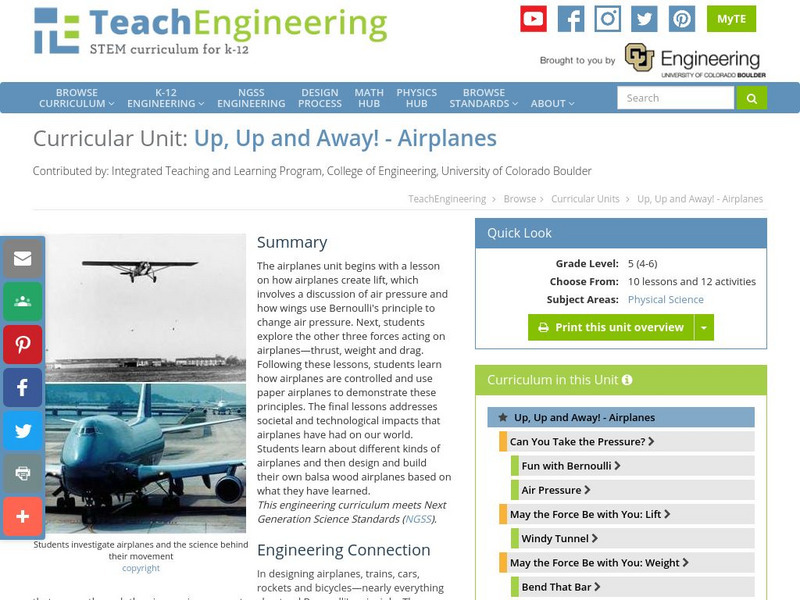
TeachEngineering
Teach Engineering: Up, Up and Away! Airplanes
The airplanes unit begins with a lesson on how airplanes create lift, which involves a discussion of air pressure and how wings use Bernoulli's Principle to change air pressure. Following the lessons on lift, students explore the other...
![Federal Aviation Administration: Anti Gravity Marble [Pdf] Activity](https://static.lp.lexp.cloud/images/attachment_defaults/resource/large/FPO-knovation.png "Federal Aviation Administration: Anti Gravity Marble [Pdf] Activity")
Other
Federal Aviation Administration: Anti Gravity Marble [Pdf]
This experiment examines Newton's Second Law of Motion. Learn how centrifugal and centripetal force help to keep a marble in a can when turned upside down.
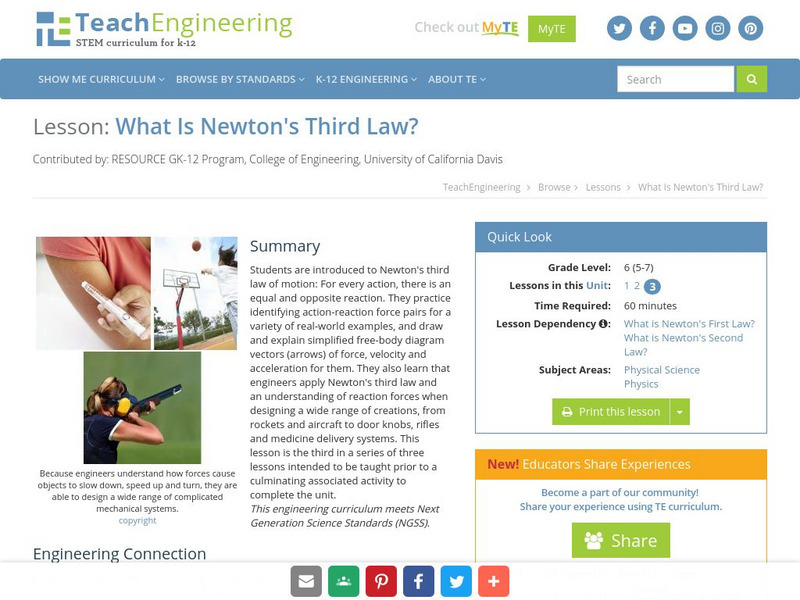
TeachEngineering
Teach Engineering: What Is Newton's Third Law?
Students are introduced to Newton's third law of motion, and then learn that engineers apply Newton's third law and an understanding of reaction forces when designing a wide range of creations, from rockets and aircraft to door knobs,...
Science and Mathematics Initiative for Learning Enhancement (SMILE)
Smile: Airplanes (2 3)
This paper airplane lesson plan helps students learn about certain concepts like air resistance, motion, and aerodynamics.

NASA
Nasa: Beginner's Guide to Aerodynamics
Includes exhaustive information and a wealth of activities pertaining to aerodynamics and the physics of flight.
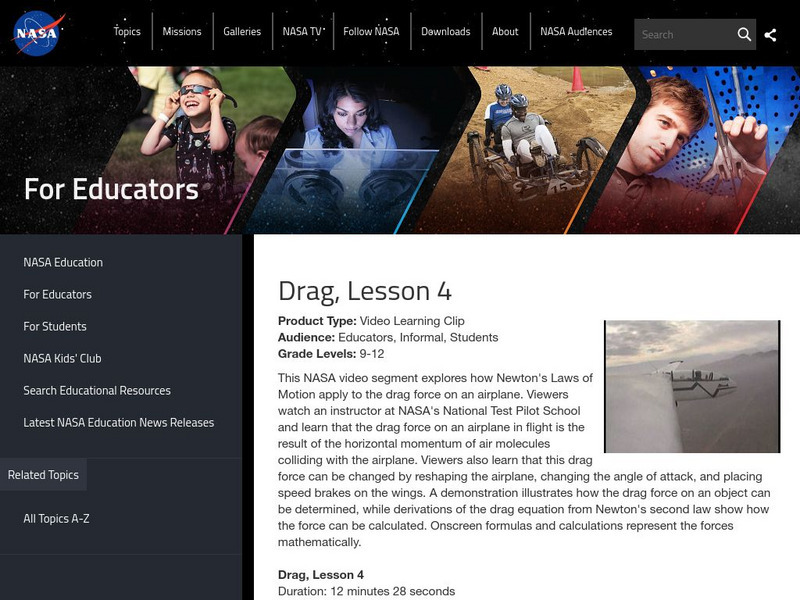
NASA
Nasa: Drag, Lesson 4
This video [12:28] shows how Newton's law of motion relates to the drag of an airplane. Watch as an instructor shows how the molecules colliding with the airplane create drag.
Science Buddies
Science Buddies: Rocking the Boat
Become an engineer for a day and discover the best way to keep from rocking the boat in this engineering science fair project. When a ship rocks back and forth, it can make people seasick, but also it makes it dangerous for jets to land...
PBS
Pbs: Nova: Top Gun Over Moscow
An online exhibit investigating the sensations experienced by a cockpit pilot in a Russian aircraft. Focuses on G-forces and apparent weightlessness.
American Association of Physics Teachers
Com Padre Digital Library: Open Source Physics: Two Dimensional Air Drop Model
How do Red Cross pilots manage to drop loads of supplies from airplanes on a specific target? This simulation will illustrate this example of projectile motion.
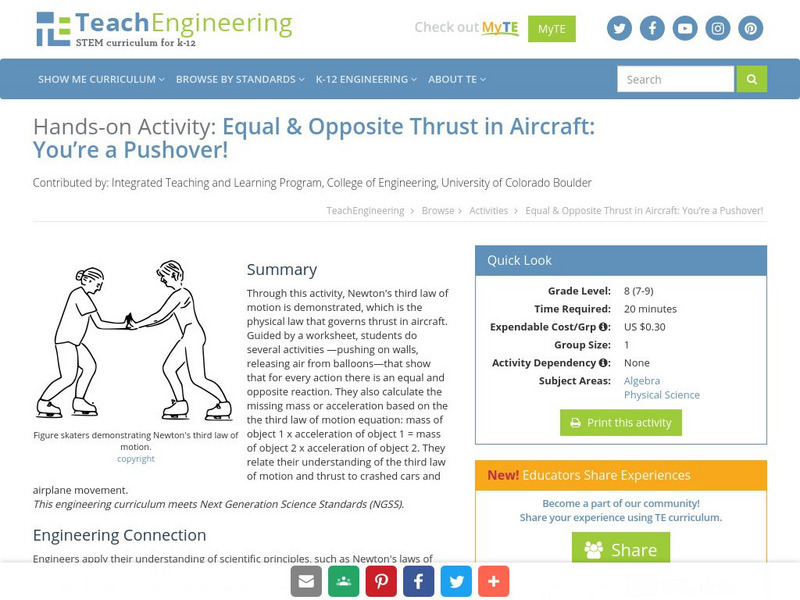
TeachEngineering
Teach Engineering: You're a Pushover!
The purpose of this activity is to demonstrate Newton's 3rd Law of Motion, which is the physical law that governs thrust in aircraft. The students will do several activities that show that for every action there is an equal and opposite...
TeachEngineering
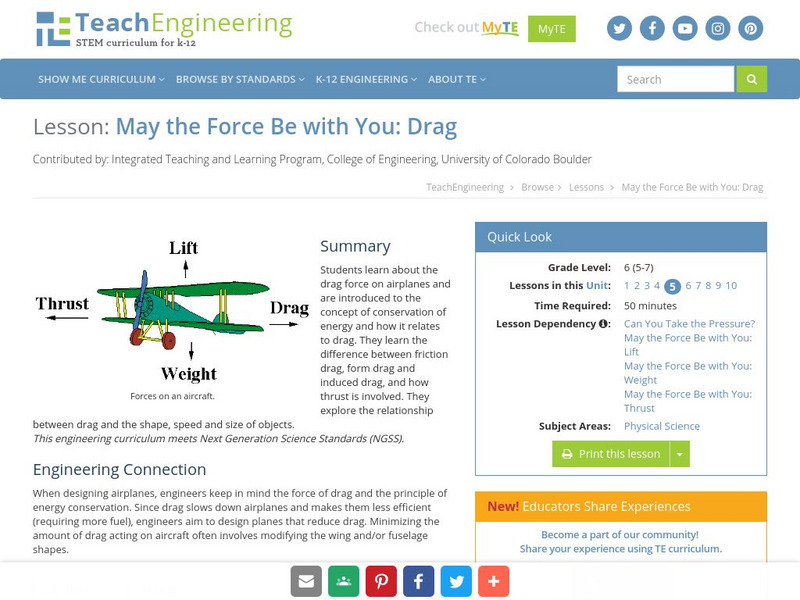
Teach Engineering: May the Force Be With You: Drag
This lesson explores the drag force on airplanes. The young scholars will be introduced to the concept of conservation of energy and how it relates to drag. Students will explore the relationship between drag and the shape, speed and...