Hi, what do you want to do?





Concord Consortium
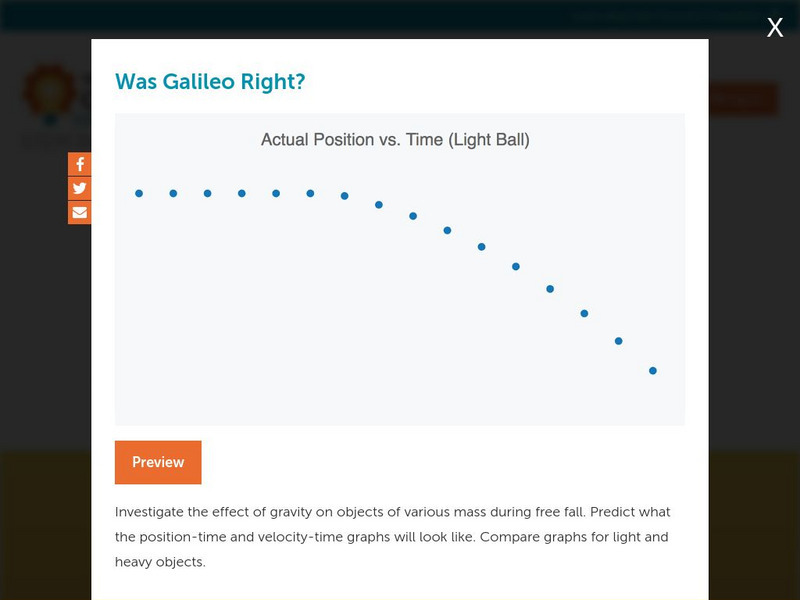
Concord Consortium: Was Galileo Right?
Investigate the effect of gravity on objects of various mass during free fall. Predict what the position-time and velocity-time graphs will look like. Compare graphs for light and heavy objects.

Physics Classroom
The Physics Classroom: Elephant & Feather (Free Fall)
A demonstration involving an elephant and a feather and explanation of why all objects maintain the same acceleration in the state of free fall without any air resistance.

TeachEngineering
Teach Engineering: How Do Things Fall?
Students learn that it is incorrect to believe that heavier objects fall faster than lighter objects. By close observation of falling objects, they see that it is the amount of air resistance, not the weight of an object, which...
Wikimedia
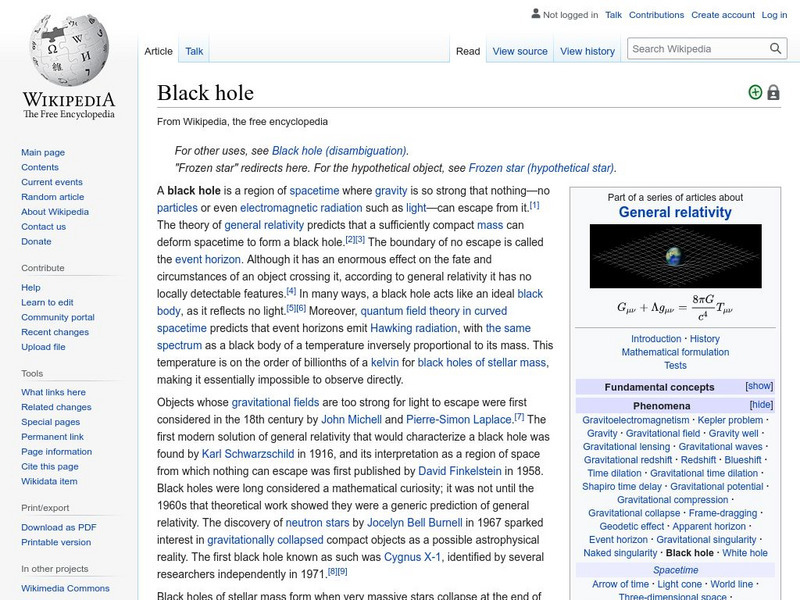
Wikipedia: The Black Hole
This site examines the black hole as an object in astrophysics. Delve into this comprehensive resource that covers this concept from its history, to qualitative physics, the reality of black holes, mathematical physics and more.
Other
Uc Riverside: Usenet Relativity Faq
A physics usenet listing of frequently asked questions relating to relativity, answered by a number of scientists. Administrivia and Reference, Speed of Light, Special Relativity, General Relativity and Cosmology, Black Holes. Loads of...
Other
Wikibooks: Physics Study Guide
A handy resource that gives an overview of equations and definitions pertinent to an introductory, college-level physics course, with two of its three sections focusing on motion-related topics and principles.
Soft Schools
Soft Schools: Physics Quizzes: Newton's Three Laws
Assess your understanding of Newton's three laws of motion and the ability to distinguish between the three with this interactive multiple choice quiz. Receive immediate feedback to your answers.
Texas Education Agency
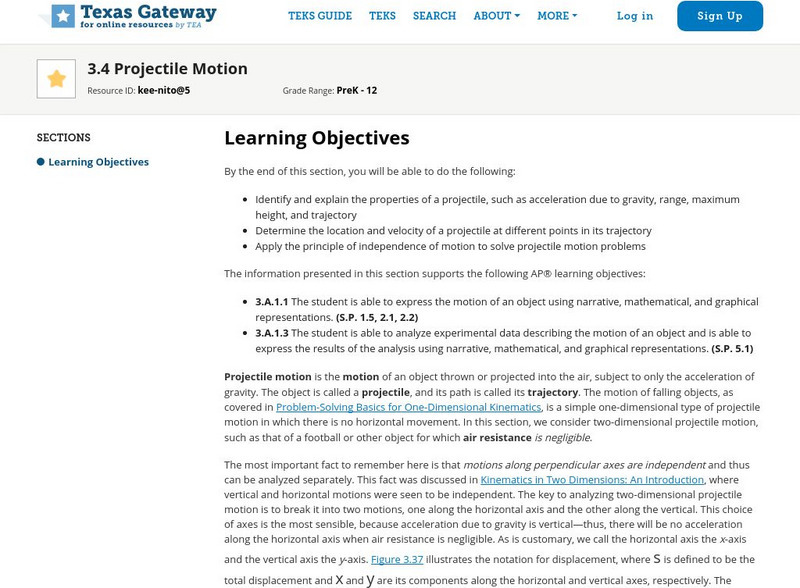
Texas Gateway: Kinematics in Two Dimensions: Projectile Motion
By the end of this section, you will be able to identify and explain the properties of a projectile, such as acceleration due to gravity, range, maximum height, and trajectory; determine the location and velocity of a projectile at...
OpenStax
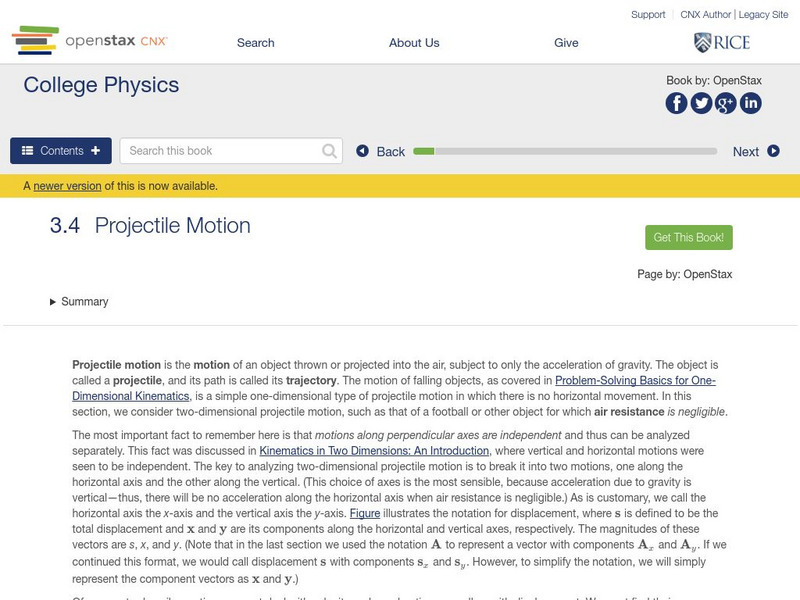
Open Stax: Projectile Motion
The following interactive helps students understan how to identify and xplain the properties of a projectile, such as acceleration due to gravity, range, maximum height, and trajectory. They will determine the location and velocity of a...

Georgia Department of Education
Ga Virtual Learning: Physical Science: Force and Motion
In this student-paced module, students apply Newton's Laws of Motion to everyday life, calculate mathematical relationships involving force and motion using algebraic formulas, and understand the difference between mass and weight.
Other
Fermi Laboratory:how Strong Is the Strong Force?
Use this site to learn about the four forces of nature. Also learn what determines the strength of a force. This question and answer site is a link of the Fermi National Accelerator Laboratory.
PBS
Pbs Learning Media: Galileo: His Experiments
This interactive activity from the NOVA Web site samples Galileo's experiments with falling objects, projectiles, inclined planes, and pendulums.

Concord Consortium
The Concord Consortium: Molecular Workbench: A Pendulum
Change the mass of a suspended object to see how its movement and forces are affected by gravity.
Other
National Research Council: Elementary Particle Physics
The Committee on Elementary-Particle Physics, part of the U.S. National Research Council, presents this massive report on particle physics. It's a definitive document. Surprisingly readable, totally detailed. Start with the Table of...
Boston University
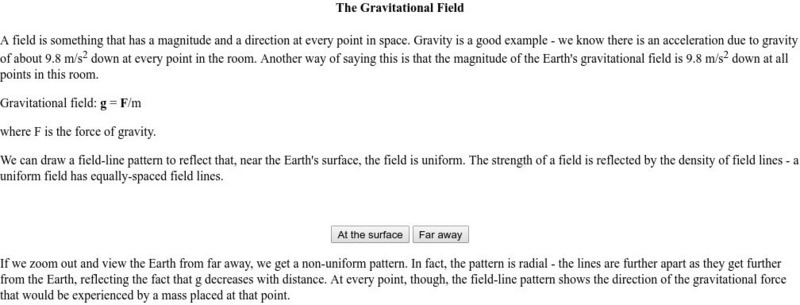
Boston University: The Gravitational Field
Defines what a gravitational field is, its value, and how to calculate it. Field-line patterns are also drawn and explained.
Curated OER
Hyper Physics: Earth Orbits
An equation for the law of universal gravitation is stated. The weight equation (W=m*g) is related to the law. An interactive Javascript form allows the user to practice determining the force of gravity and the acceleration of gravity...
Curated OER
Hyper Physics: Earth Orbits
An equation for the law of universal gravitation is stated. The weight equation (W=m*g) is related to the law. An interactive Javascript form allows the user to practice determining the force of gravity and the acceleration of gravity...
Physics Classroom
The Physics Classroom: Circular, Satellite, Rotational: Roller Coaster G Forces
Roller coaster rides are notorious for creating accelerations and g-forces. The magnitude and direction of normal force and gravity during the motion through a coaster's loop are depicted this animation.
Physics Aviary
Physics Aviary: Practice Problems: High School Toss Level 1
Students will determine maximum height obtained by an object tossed upward off the roof of a high school. They will also find the total time aloft and the speed with which the object will impact the ground. The acceleration due to...

Khan Academy
Khan Academy: Freefall Review
Review the key concepts and skills for acceleration due to gravity, including analyzing motion of objects in freefall.
Science Education Resource Center at Carleton College
Serc: Egg Drop
In this physics lab, students build a container to safely deliver two eggs from the top of the school. Students calculate average velocity, acceleration, momentum, and the amount of force as it hits the ground. If their egg breaks, they...
Physics Classroom
The Physics Classroom: 1 D Kinematics: The Big Misconception
An introduction to the ideas behind the misconception and misunderstanding of why all objects accelerate at the same rate. This explanation involves the concepts of force and mass.
Physics Aviary
Physics Aviary: Practice Problems: Dump Tower Level 1
Students must find the acceleration due to gravity on a planet and the impact speed of an object that has been falling from the top of a garish tower.
Science Education Resource Center at Carleton College
Serc: Newton's Second: Having a Ball With Motion
Students will create a gravity ball launcher to demonstrate their understanding of mass, force, momentum, and motion. The students will use critical thinking, measurement, and observation and analysis of data to make changes and improve...