Hi, what do you want to do?






Other
University of Aberdeen: The Phyla of Kingdom Animalia
Very systematic breakdown of the animal kingdom starting with the simplest type the sponge, all the way to the chordate or vertebrate. Each phylum has a link with information.

Biology 4 kids
Biology4 Kids: Bird Anatomy Beautiful Birds
Next to fish, birds are the most abundant vertebrates around. Take a look at the physical traits of birds and how well they adapt to their environments.
Other
American Association for Laboratory Animal Science: Humane Care and Use
Guidelines and recommendations encouraging responsible use of vertebrate animals for scientific laboratory study.

PBS
Idaho Ptv: Dialogue for Kids: Zoology
A collection of facts and links on the field of zoology. The facts cover what zoology is, the diversity of vertebrate and invertebrate animals studied in zoology, scientific names for animals, where zoologists work, zoos around the...
Bagheera
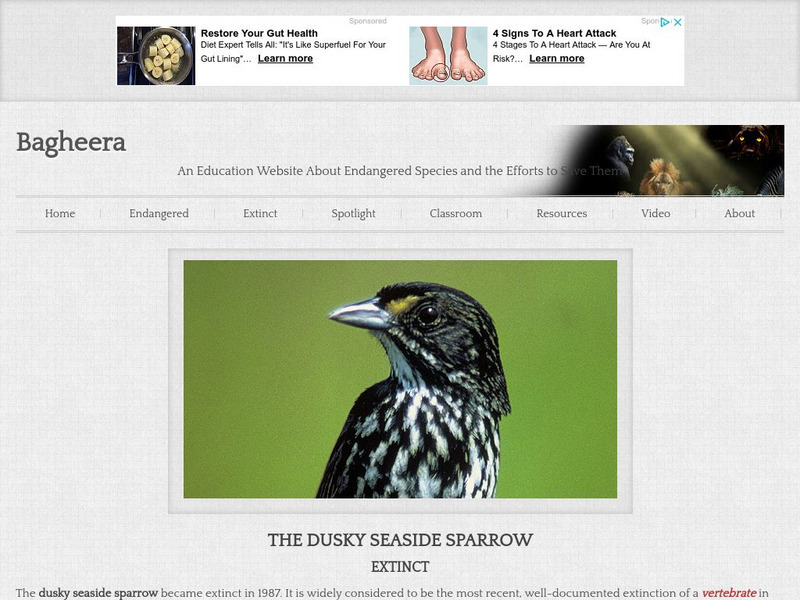
Bagheera.com: Extinct in the Wild Dusky Seaside Sparrow
The dusky seaside sparrow is the most recent extinction of a vertebrate animal in the US. This article provides information about causes for extinction.

CK-12 Foundation
Ck 12: Life Science: Amphibians
[Free Registration/Login may be required to access all resource tools.] Amphibians are a group of vertebrates that have adapted to live in both water and on land. Amphibian larvae are born and live in water, and they breathe using gills....
CK-12 Foundation
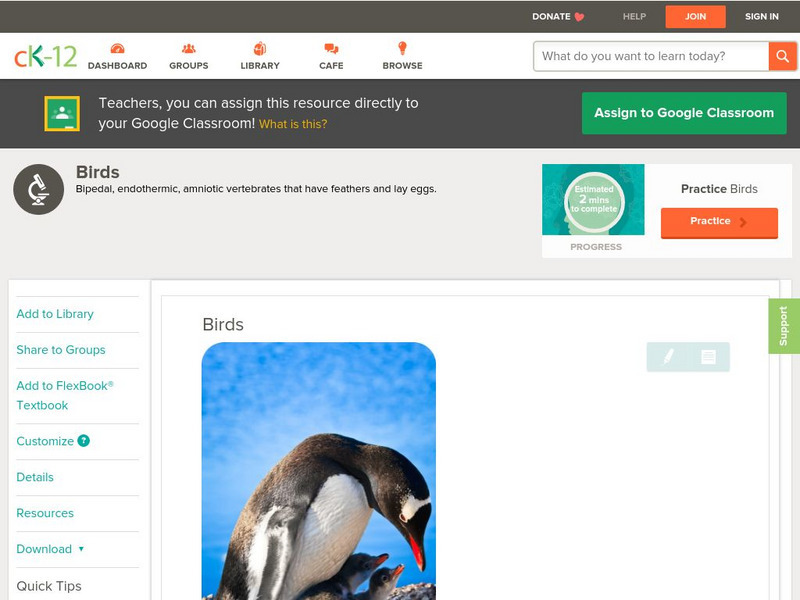
Ck 12: Life Science: Birds
[Free Registration/Login may be required to access all resource tools.] There is an amazingly wide variety of birds. Birds are vertebrates. Almost all have forelimbs modified as wings, but not all birds can fly. Learn more about birds in...

CK-12 Foundation
Ck 12: Life Science: Chordates
[Free Registration/Login may be required to access all resource tools.] Did you know that fish, amphibians, reptiles, birds, and mammals are all related? They are all chordates. Chordates are a group of animals that includes vertebrates,...
CK-12 Foundation
Ck 12: Third Grade Science: Life Sci: Animal Characteristics and Classification
[Free Registration/Login may be required to access all resource tools.] Presents an overview of the major animals groups (mammals, birds, reptiles, amphibians, fish, arthropods, vertebrates, invertebrates, those having live births and...

TED Talks
Ted: Ted Ed: The Coelacanth: A Living Fossil of a Fish
Erin Eastwood details the surprising "back from the dead" discovery of the coelacanth and explains how this fish's fins shed light on the evolutionary movement of vertebrates from water to land. [4:17]

PBS
Pbs: The Shape of Life
Companion site for the 8-part PBS series, "The Shape of Life." Each section focuses on a different phylum, from porifera through chordata. This site is highly informative, with beautiful photography.
eSkeletons
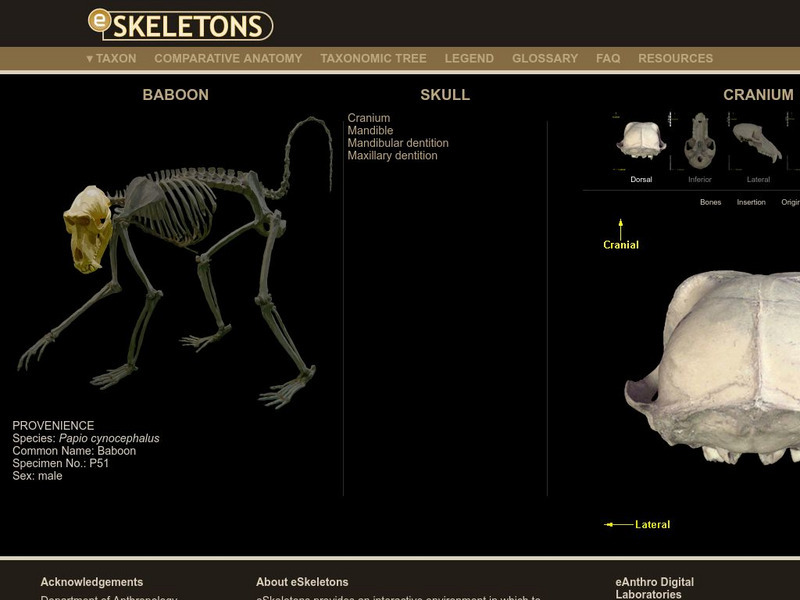
E Skeletons: Baboon
This interactive, digital laboratory provides students with a way to examine and learn about the skeletal anatomy of the Baboon.

eSkeletons
E Skeletons: Slow Loris
This digital laboratory provides an interactive environment in which to examine and learn about skeletal anatomy, in particular the skeleton of the slow loris.

eSkeletons
E Skeletons: Lesser Bushbaby
This digital laboratory provides an interactive environment in which to examine and learn about skeletal anatomy, in particular the skeleton of the lesser bushbaby.

eSkeletons
E Skeletons: Gibbon
This digital laboratory provides an interactive environment in which to examine and learn about skeletal anatomy, in particular the skeleton of the gibbon.
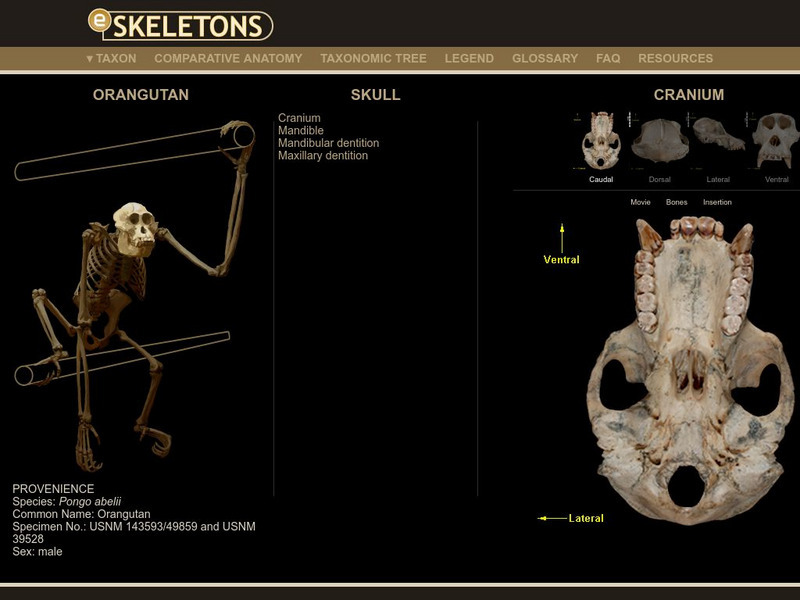
eSkeletons
E Skeletons: Orangutan
This digital laboratory provides an interactive environment in which to examine and learn about skeletal anatomy, in particular the skeleton of the orangutan.
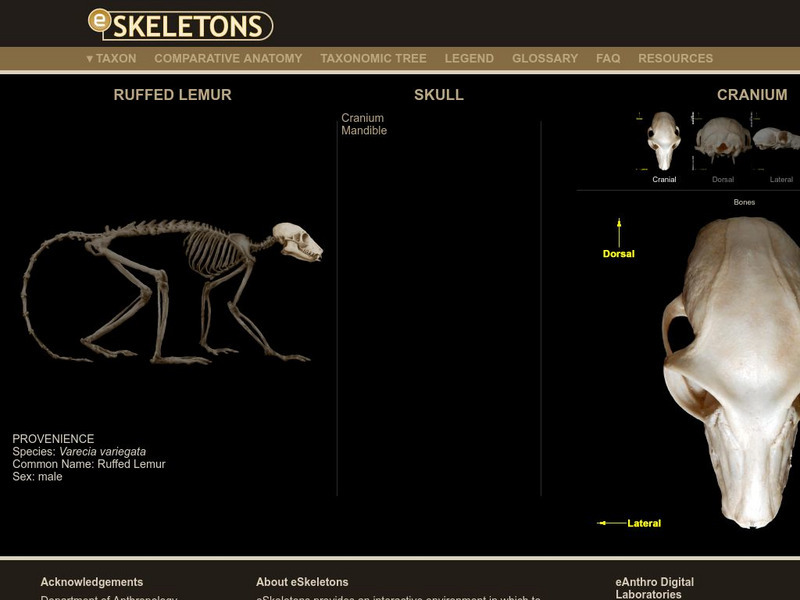
eSkeletons
E Skeletons: Ruffed Lemur
This digital laboratory provides an interactive environment in which to examine and learn about skeletal anatomy, in particular the skeleton of the ruffed lemur.

Georgia Department of Education
Ga Virtual Learning: Biology: Animals
Through video clips. informational text, interactive activities, and assessment opportunities, students study and learn about the classification of animals.
Other
Science4 Us: Animals
In online and offline activities, students broaden their understanding of animals by learning to identify and classify animals into six categories: mammals, birds, fish, amphibians, reptiles, and invertebrates.

CK-12 Foundation
Ck 12: Flex Book Textbooks: Biology Concepts
[Free Registration/Login may be required to access all resource tools.] A complete, web-based, multi-media textbook which serves as a comprehensive overview of Biology concepts.
CK-12 Foundation
Ck 12: Flex Book Textbooks: Life Science Concepts for Middle School
[Free Registration/Login may be required to access all resource tools.] A complete, web-based, multi-media textbook covering a wide variety of Biological science concepts for middle grades.
Other
University of Scranton: The Sheep Brain Dissection Guide
This resource provides a guide to dissecting sheep brains. The guide goes through the process step by step. An image of the brain being dissected is shown with dissection instrutions or details on the particular structure on each page.
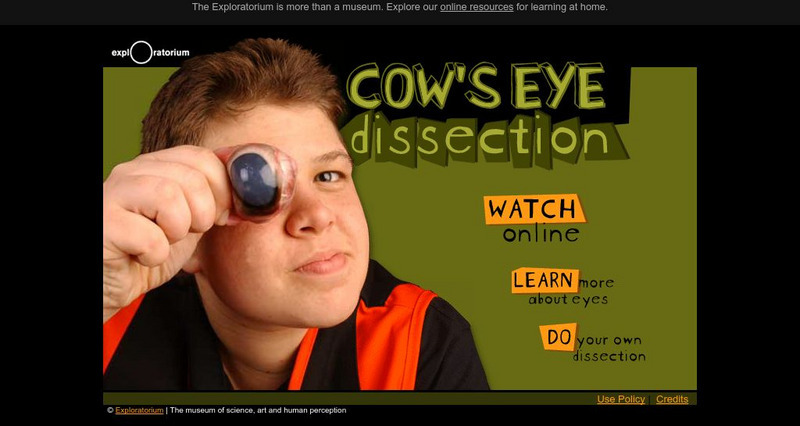
Exploratorium
Exploratorium: Cow Eye Dissection
Get your lab coat ready! This particular lab experience is a must for any middle or high school biology/anatomy lab science classroom. This site provides a printable version of a cow's eye diagram, a step-by-step dissection guide, a...
Other popular searches
- Invertebrates and Vertebrates
- Life Science Vertebrates
- Five Classes of Vertebrates
- Invertebrates Vertebrates
- Vertebrates an Invertebrates
- Characteristics of Vertebrates
- Invertebrates + Vertebrates
- Biology and Vertebrates
- Vertebrates Lesson Plans
- Classify Vertebrates
- Vertebrates Lesson
- Animal Families Vertebrates