Hi, what do you want to do?






Achievement Strategies
Unit/Chapter Design Template
A thorough lesson plan template allows teachers to design balanced and standards-based lessons for any grade. The template includes spaces for unit vocabulary and concepts, objectives, and additional resources.

Scholastic
Collaborative Year-End Projects
Coming up with a menu of engaging year-end projects can be a challenge. Never fear, help is here with an article that suggests eight projects sure to capture the interest of learners of all ages.

New York State Education Department
TASC Transition Curriculum: Workshop 4
Why is it important to use precise language? Participants explore this question in the fourth activity in a series of 15 on effective instruction. Perfect for all content areas, the activity promotes appropriate language choice through...

Mountain View High School
The Big Religion Chart
This resource includes a list of over 40 world religions and their major features, such as brief summaries of their origins and history, beliefs in god and an afterlife, practices, foundational texts, etc. The document also...
Texas Education Agency
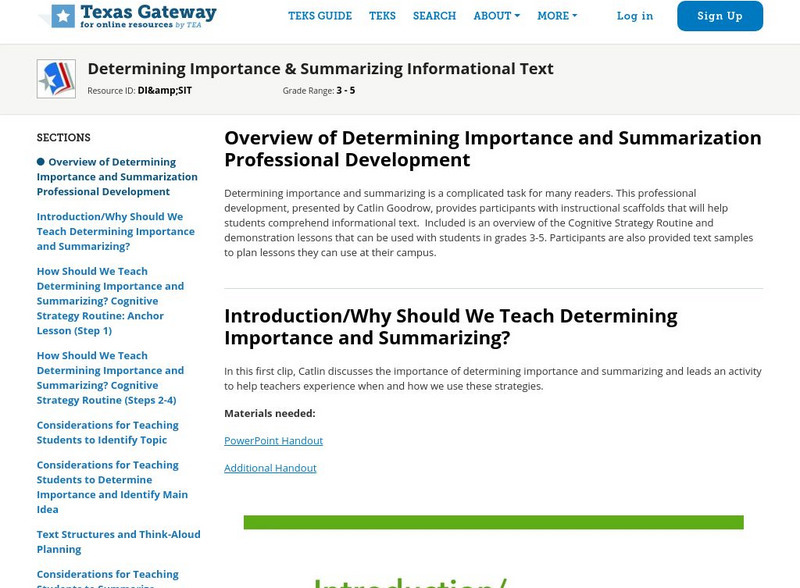
Texas Gateway: Determining Importance & Summarizing Informational Text
These teacher resources focuses on why it is important to teach elementary students to determine the importance and to summarize informational text. It leads an activity to help teachers experience when and how we use these strategies.

North Central Regional Educational Laboratory
North Central Regional Educational Laboratory: Reciprocal Teaching
This site offers a comprehensive description of reciprocal teaching.
Austin Independent School District
Austin Independent School District: Summary of Fiction and Nonfiction Text [Pdf]
This 31-page document focuses on teaching summarizing strategies for use with fiction and nonfiction texts. This series of lesson plans starts with fiction summarizing strategies such as "Somebody-Wanted-But-So-Then" and "Story Arch."...

AdLit
Ad lit.org: Teach the Seven Strategies of Highly Effective Readers
To improve students' reading comprehension, teachers should introduce the seven cognitive strategies of effective readers: activating, inferring, monitoring-clarifying, questioning, searching-selecting, summarizing, and...
AdLit
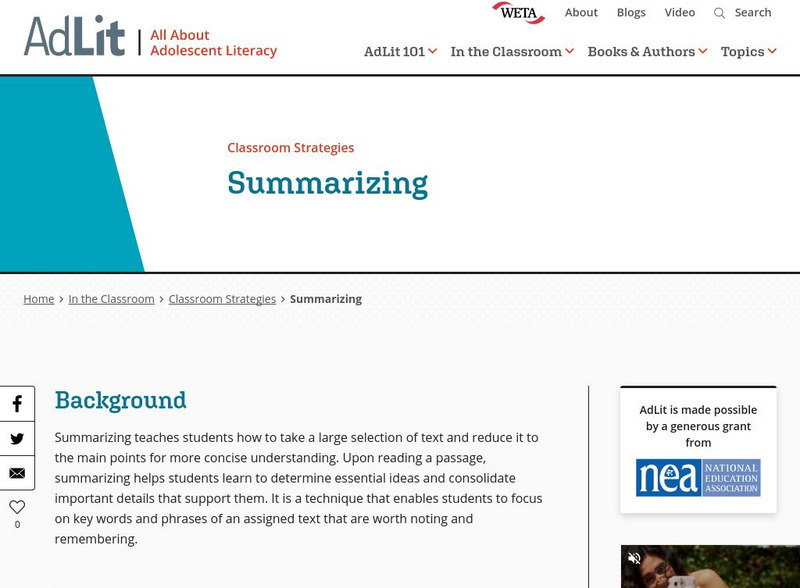
Ad lit.org: Classroom Strategies: Summarizing
Summarizing teaches students how to take a large selection of text and reduce it to the main points for a more concise understanding. Upon reading a passage, summarizing helps students learn to determine essential ideas and consolidate...
AdLit
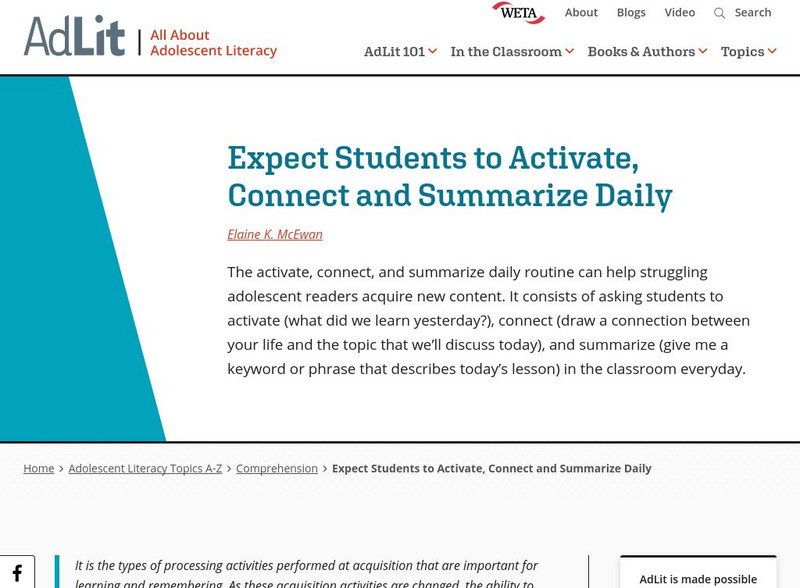
Ad lit.org: Expect Students to Activate, Connect and Summarize Daily
The activate, connect, and summarize daily routine can help struggling adolescent readers acquire new content. It consists of asking students to activate (what did we learn yesterday?), connect (draw a connection between your life and...
McGraw Hill
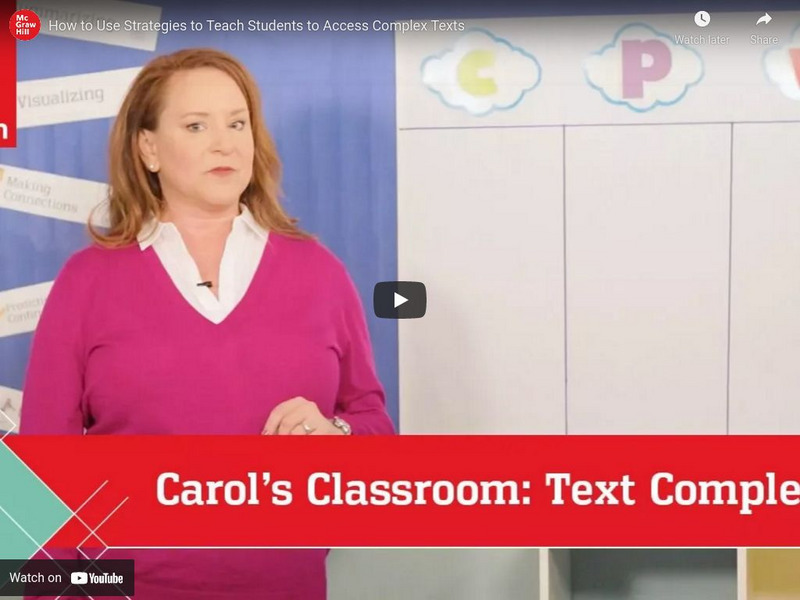
Mc Graw Hill: How to Use Strategies to Teach Students to Access Complex Texts
In this short video, the strategies of summarizing, clarifying, and asking-answering questions are used. These instructional tools will help teachers show students how to access complex texts. [5:54] CCSS.ELA-Literacy.CCRA.R.10
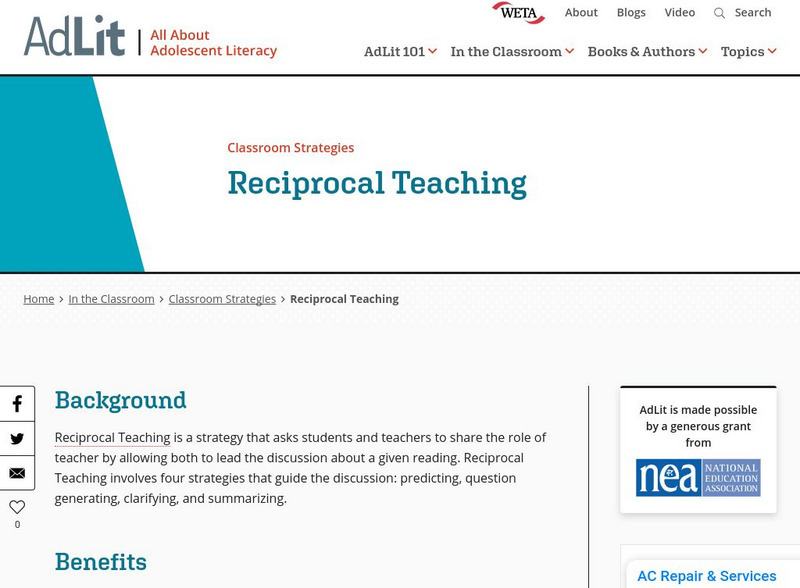
AdLit
Ad lit.org: Classroom Strategies: Reciprocal Teaching
Reciprocal Teaching is a strategy that asks students and teachers to share the role of teacher by allowing both to lead the discussion about a given reading. Reciprocal Teaching involves four strategies that guide the discussion:...
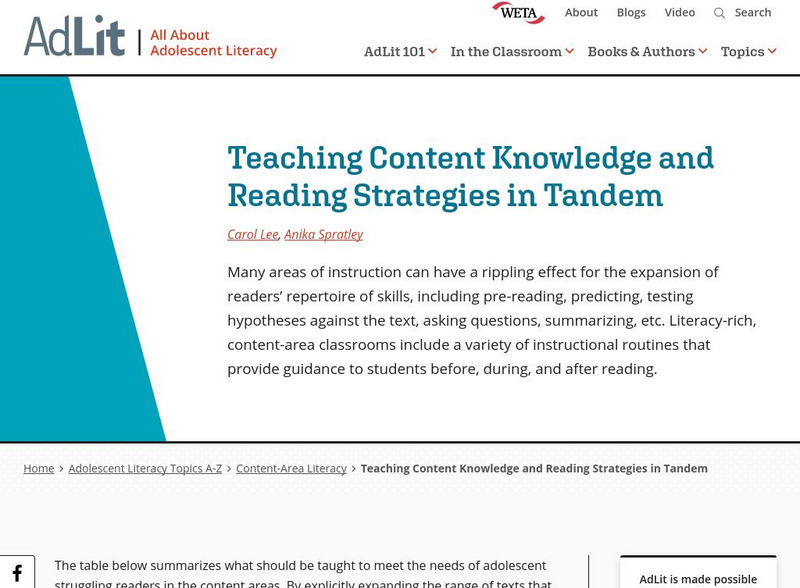
AdLit
Ad lit.org: Teaching Content Knowledge and Reading Strategies in Tandem
Many areas of instruction can have a rippling effect for the expansion of readers' repertoire of skills, including pre-reading, predicting, testing hypotheses against the text, asking questions, summarizing, etc. Literacy-rich,...
Incredible Art Department
The Incredible Art Department: Best Practices in Education
Summarizes what is known about best practices in education and how they apply in teaching art. Discusses the instructional techniques popularized by Howard Garner and what they look like in art education.
Incredible Art Department
The Incredible Art Department: Strategies and Research in Instruction
Summarizes what is known about learning from research on the brain and suggests related strategies to use in the classroom. Also discusses the main techniques and strategies that are in wide use today including, for example,...
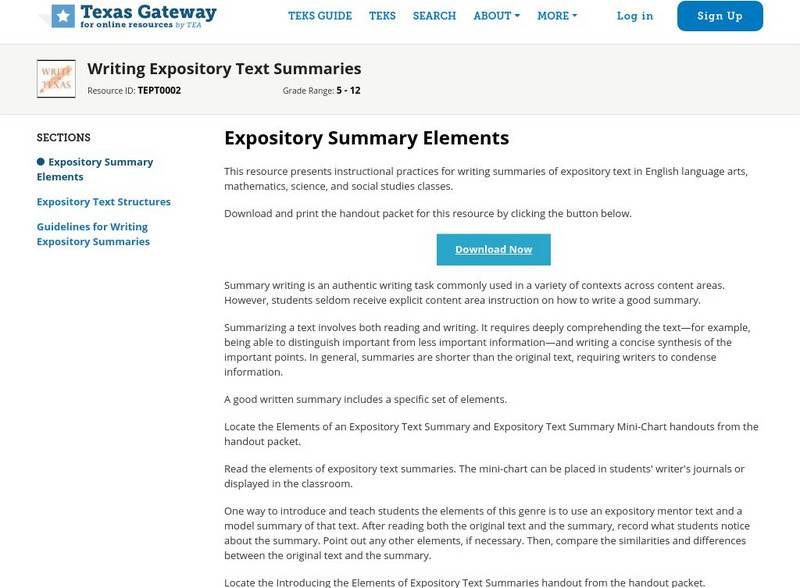
Texas Education Agency
Texas Gateway: Writing Expository Text Summaries
This resource presents instructional practices for writing summaries of expository text in English language arts, mathematics, science, and social studies classes.
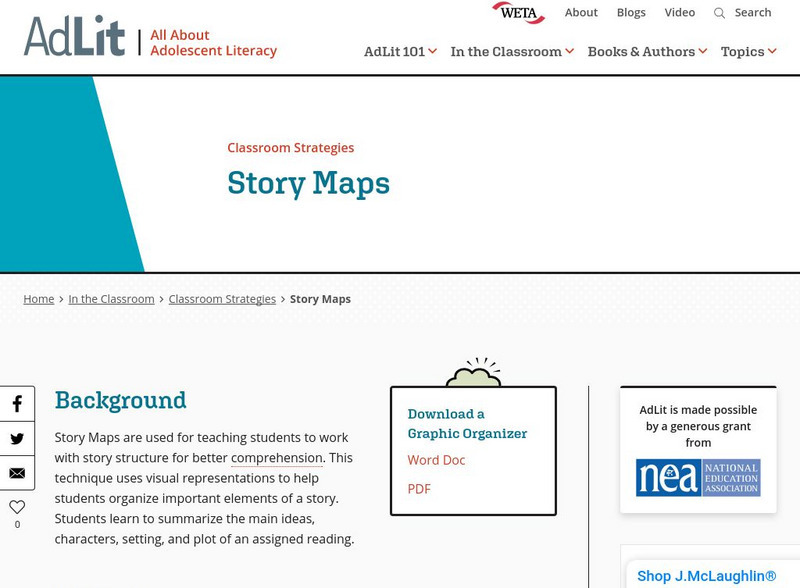
AdLit
Ad lit.org: Classroom Strategies: Story Maps
Story Maps are used for teaching students to work with story structure for better comprehension. This technique uses visual representations to help students organize important elements of a story. Students learn to summarize the main...
AdLit
Ad lit.org: Classroom Strategies: Selective Highlighting
Selective Highlighting/Underlining is used to help students organize what they have read by selecting what is important. This strategy teaches students to highlight/underline ONLY the key words, phrases, vocabulary, and ideas that are...

AdLit
Ad lit.org: Recommendations for Improving Adolescent Literacy
In its practice guide Improving Adolescent Literacy: Effective Classroom and Intervention Practices, the Dept. of Education offers five recommendations for increasing the reading ability of adolescents. Those recommendations are...
AdLit
Ad lit.org: A Summary of "Writing Next"
What does research tell us about effective teaching techniques to help adolescents develop their writing skills? This article summarizes Writing Next, a 2007 study of adolescent writing instruction.
Science Education Resource Center at Carleton College
Serc: Writing Your Own Activities Ph Et Activity Guidelines
The PhET website at the University of Colorado in Boulder has a large collection of science simulations for teaching chemistry and physics, available in many languages. This page summarizes how to write activities for the simulations,...