Hi, what do you want to do?






Curated OER
Pottery Analysis
Students study how archaeologists analyze artifacts to answer questions about past cultures. They explain why pottery is important to archaeologists and how they use classification to answer their research questions.

Curated OER
Who am I? Bookmaking
Young scholars explore the process of bookmaking that has its origins from many different international cultures. The multicultural symbolism represented by the medium is utilized by students to expres their identity.

Curated OER
Sliding and Stuttering
Learners measure frictional force existing between a moving cup and the surface it slides on. They conduct the experiment and answer discussion questions.

Curated OER
Wings and Othe Things
Students work in groups that are engaged in different activities at different times. They watch the video "Madagascar" and collect data pertaining to the Fish Eagle's arm spam. They work together to perform mathematical computations...

Curated OER
Five Senses-Introduction
Students explore the parts of the body that are used to develop the five senses. They conduct a nature walk. Students identify the things they see, hear, smell, and touch. They create a graphic organizer to organize their answers.

Curated OER
Mythical Animals
Students create imaginary animals by assembling pictures of body parts from pictures of real animals. This is one of three linked tasks. The others are "Who's Parts Do I Have?" and "Animals Piece by Piece."

Curated OER
Spiders Are Fun
Students study facts about spiders using a number of literary forms, including stories, poems, and songs. They work with consonant sounds by matching pictures with the beginning consonant sounds. They design art projects that emphasize...

Curated OER
Angles, Parallel Lines, and Polygons
Students examine how to investigate polygons using an instrument of their own construction. They should be able to prove the general formula for the number of degrees in any polygon (including a triangle). Finally they investigate an...

Curated OER
Up, Up and Away
Third graders are presented with the problem of: Do all liquids evaporate at the same rate? The lesson contains adequate background information for the teacher. They participate in a lab experiment in order to test the scientific...

Curated OER
What Makes a Kite Fly?
Ninth graders compare the nature of forces of gravity, lift, thrust, and drag. They select proper materials for making a kite and attach a proper tail. Students interpret and summarize the observations made during the flight of the kites.

Curated OER
Investigating Earth's Materials
First graders compare and contrast water from different sources. After collecting water from various sources, 1st graders create a list of observable properties of the water. Students then pour the water into a filter and observe the...

Curated OER
Five Senses: Brave Little Monster
Students identify which of the five senses is being used at a given time. They read "Brave Little Monster" by Ken Baker and then read the story again as they match student-made cards depicting the five senses to moments in the story.

Curated OER
Iggy and the Icky Sticky Inchworm
Students read and spell words. They have to recognize that letters stand for phonemes and spellings map out spoken words. Long and short vowels are hard to recognize and this lesson focuses on that. The short i is taught in the...

Curated OER
Open Wide
Students recognize the short vowel o in written and spoken language. Through matching activities, students discriminate the short vowel o from the long vowel o. They associate the phoneme with its letter representation and identify the...

Curated OER
Tiling the Plane
Young scholars use pattern blocks and triangular grid paper to review shape names, be introduced to the concept of a tiling of the plane, and determine which pattern blocks tile the plane. They are asked: "Have you ever seen a floor or...

Curated OER
What Happens When A Cell Divides?
Students investigate the cycle of mitosis. In this biology lesson, students discuss the different stages of mitosis through cell reproduction. They further their investigation through laboratory analysis.

Curated OER
Book Swap
Students swap books. In this book lesson, students bring good condition books they have finished reading. They get together with a group of friends and swap their old books for "new" ones.

Mangahigh
Mangahigh: Data: Sort Objects
Students explore the concept of sorting objects by working through an online tutorial and then attempting a ten question quiz that increases in difficulty as questions are answered correctly.
Education.com
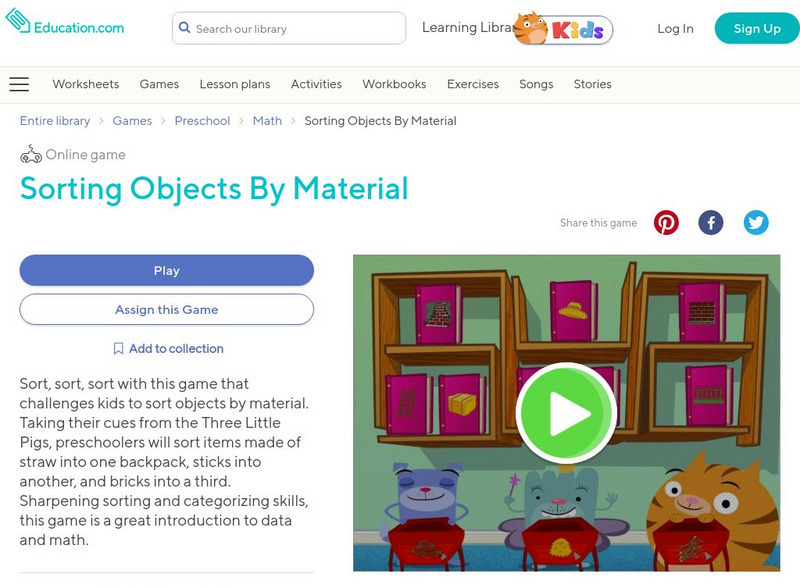
Education.com: Sorting Objects by Material
[Free Registration/Login Required] This game challenges kids to sort objects by material. Taking their cues from the Three Little Pigs, preschoolers will sort items made of straw into one backpack, sticks into another, and bricks into a...

Better Lesson
Better Lesson: Size Sorting on the Big Screen
SWBAT sort objects by size. The instructor will use a Promethean board (interactive projection) to facilitate this lesson.
Other
National Center on Intensive Intervention: Identify and Sort Common Objects
This individual or small group activity helps teach the common core standard of sorting common objects into categories to gain a sense of the concepts the categories represent. Materials and detailed instructions are included.
PBS
Pbs Learning Media: Curious George Stem: Sort It Out! Lesson Plan
A lesson where students will talk about how to sort different objects based on their characteristics. After viewing a clip from Curious George, students sort and label objects into categories.
Better Lesson
Better Lesson: Grandma's Button Box Sorting
Students will be able to compare objects and sort objects by color.
Better Lesson
Better Lesson: Floating and Sinking Sorting in Science
Students sort objects according to whether they sink or float.