Hi, what do you want to do?






Internet Encyclopedia of Philosophy
Internet Encyclopedia of Philosophy: Moral Development
A comprehensive entry detailing the research and theories behind psychology's moral development. Identify the scientists, discoveries, philosophies, and related research in the field.
Internet Encyclopedia of Philosophy
Internet Encyclopedia of Philosophy: Origen of Alexandria
The Internet Encyclopedia of Philosophy offers an excellent detailed overview of Origen's life and philosophical views.
Internet Encyclopedia of Philosophy
Internet Encyclopedia of Philosophy: Lucretius
As one of the primary spokesmen for the Epicurean philosophy, Lucretius (99-55 BCE) wrote a philosophical epic "De Rerum Naturum," in which the Epicurean belief in the atomic nature of matter is presented. Look for the section entitled...
Stanford University
Stanford Encyclopedia of Philosophy: Aristotle
Looks at the life of Aristotle (384-322 B.C.E.) and the far-reaching scope of his intellectual ideas. The article examines in depth his theories in the disciplines of philosophy, politics, mathematics and science, and his legacy.
Stanford University
Stanford Encyclopedia of Philosophy: Pythagoras
Encyclopedia article about Pythagoras from the Stanford Encyclopedia of Philosophy that discusses not only his life, but his major contributions as well. Also includes a lengthy bibliography and links to additional information.
Stanford University
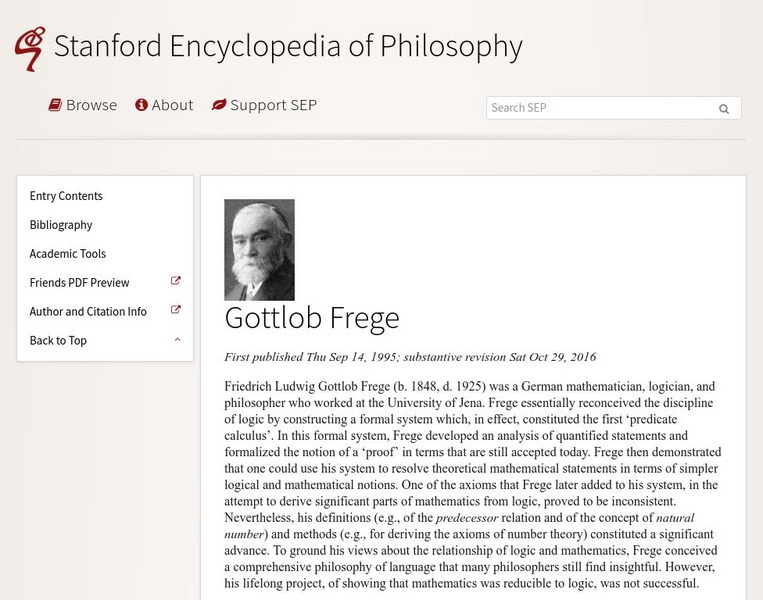
Stanford Encyclopedia of Philosophy: Gottlob Frege
Good summary of Frege's thought. Some sections are more technical, but the explanation of his philosophy of language and other sections are more readable.
Stanford University
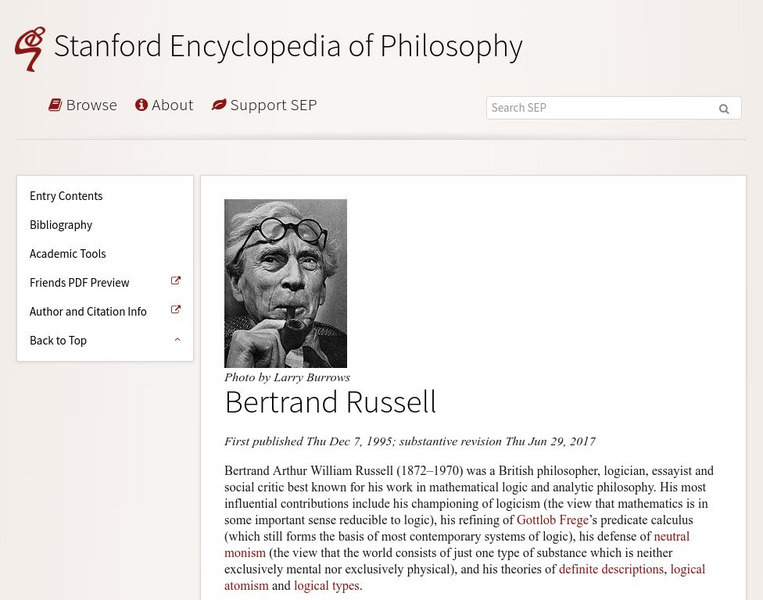
Stanford Encyclopedia of Philosophy: Bertrand Russell
Excellent article summarizing Bertrand Russell's thought. Includes chronology of major events in his life, but most of the article spends time on Russell's contributions in logic, analytic philosophy, and social criticism. Also includes...
Stanford University
Stanford Encyclopedia of Philosophy: Plato
Detailed summary of the major ideas of Plato's philosophy provided by the Stanford University Encyclopedia of Philosophy. Also includes a lengthy bibliography.
Internet Encyclopedia of Philosophy
Internet Encyclopedia of Philosophy: Francis Bacon
This site from the Internet Encyclopedia of Philosophy provides a biography as well as a brief explanation of Francis Bacon's most significant philosophical work, "Novum Organum."
Internet Encyclopedia of Philosophy
Internet Encyclopedia of Philosophy: Hannah Arendt
This site provides a very thorough and detailed look at the life and philosophies of Hannah Arendt (1906-1975 CE). This site focuses on Arendt's influences and thoughts on Totalitarianism, the human condition and Revolution among others.
Internet Encyclopedia of Philosophy
Internet Encyclopedia of Philosophy: Philosophy of Love
Overview from the Internet Encyclopedia of Philosophy of the threefold Greek typology for love: agape, eros, and philia. Summarizes also the Neoplatonic-Christian view of "love" and, in later centuries, "romantic love."
Internet Encyclopedia of Philosophy
Internet Encyclopedia of Philosophy: Empedocles
Good introduction to his life and thought from the Internet Encyclopedia of Philosophy. Focuses especially on Empedocles' relationship to Pythagoras and his account of Love and Strife.
Internet Encyclopedia of Philosophy
Internet Encyclopedia of Philosophy: Protagoras
Good introduction from the Internet Encyclopedia of Philosophy to Protagoras and his significance within ancient philosophy.
Internet Encyclopedia of Philosophy
Internet Encyclopedia of Philosophy: Johann Gottleib Fichte
Entry from the Internet Encyclopedia of Philosophy. Has a thorough biography and includes links to major works in translation. Also has an excellent bibliography for extensive research.
Wikimedia
Wikipedia: Philosophy of Law
Wikipedia offers detailed information on the Philosophy of Law, including a long list of philosophers of law with links to more information.
Internet Encyclopedia of Philosophy
Internet Encyclopedia of Philosophy: The Academy
Brief history of Plato's Academy, its original members and aims provided for by the Internet Encyclopedia of Philosophy.
Internet Encyclopedia of Philosophy
Internet Encyclopedia of Philosophy: John Stuart Mill
Detailed discussion from the Internet Encyclopedia of Philosophy of Mill's thought including biographical summary. Although it chiefly addresses his achievements in logic, Mill's opinion on religion are also presented in closing.
Stanford University
Stanford Encyclopedia of Philosophy: Zeno of Elea
Looks at what is known about the life and work of Zeno of Elea, and explains several of his Paradoxes and how others, including Aristotle, viewed them.
Stanford University
Stanford Encyc. Of Philosophy: William Godwin
This is a substantial exploration of Godwin's life and ideas. Includes a section of other internet resources and a bibliography.
Internet Encyclopedia of Philosophy
Internet Encyclopedia of Philosophy: Aristotle on Motion and Its Place in Nature
Lengthy discussion of Aristotle's theory of motion, its presentation by Aquinas, and its relation to Zeno's paradoxes.
Internet Encyclopedia of Philosophy
Internet Encyclopedia of Philosophy: Natural Law
Review this site for the definition of "natural law" based on varying theories with respect to morality in determining the authority of legal norms. Contents of the writing cover Two Kinds of Natural Law, Conceptual Naturalism,...
Internet Encyclopedia of Philosophy
Internet Encyclopedia of Philosophy: Thomas Hobbes: Methodology
This site, which is provided for by the Internet Encyclopedia of Philosophy, gives a detailed biography of the life of Thomas Hobbes, including a discussion of his philosophy.
Internet Encyclopedia of Philosophy
Internet Encyclopedia of Philosophy: Neoplatonism
Good introduction from the Internet Encyclopedia of Philosophy to the history of the Neoplatonic vein of ancient Greek philosophy. Includes information on Porphyry, Jamblichus, and the Athenian school. Not a substantial treatment of...
Stanford University
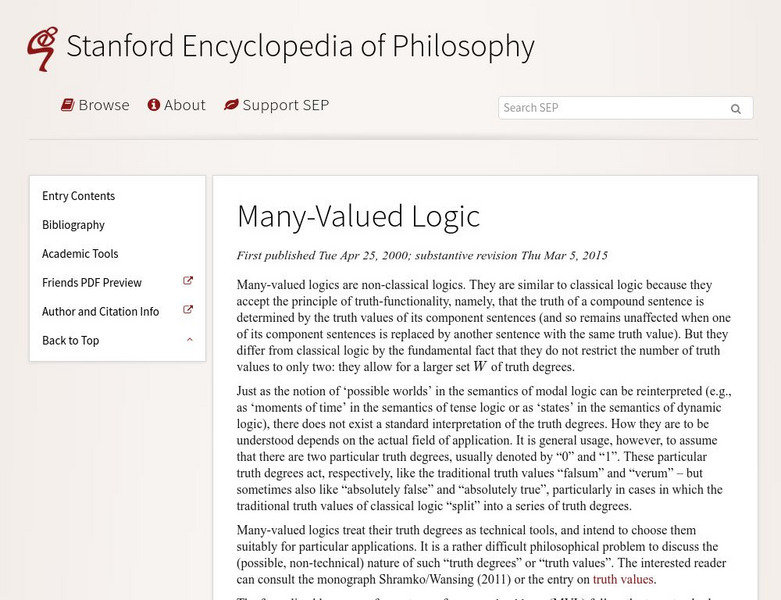
Many Valued Logic/stanford Encyclopedia of Philosophy
Explains the logical theory of "many-valued logic," a modern alternative to classic logic. Sections address its history, notation and proofs, and applications to linguistics, mathematics, philosophy, and artificial intelligence. For the...
Other popular searches
- Greek Philosophy
- General Philosophy
- Philosophy for Kids
- Meaning of Life Philosophy
- Political Philosophy
- Free Will Philosophy
- Philosophy of Education
- Chinese Philosophy
- Philosophy of Democracy
- Architectural Philosophy
- Philosophy of Us Government
- Philosophy of Science