Concord Consortium
Concord Consortium: Molecular Workbench: Molecular Sorter
Observe the sorting process of a hypothetical nano purification machine.
Concord Consortium
Concord Consortium: Molecular Workbench: Sorting Molecules With a Nano Conveyor
Observe how molecules can be sorted in a hypothetical nano conveyor-belt mechanism.
National High Magnetic Field Laboratory
Magnet Academy: Heinrich Rohrer
Swiss physicist Heinrich Rohrer co-invented the scanning tunneling microscope (STM), a non-optical instrument that allows the observation of individual atoms in three dimensions, with Gerd Binnig. The achievement garnered the pair half...
Lawrence Berkeley National Laboratory
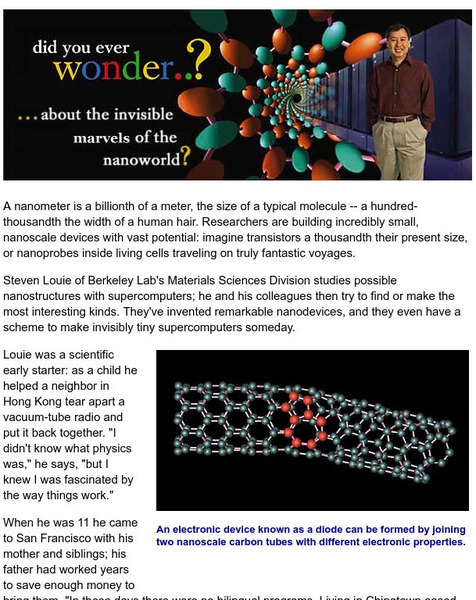
Berkeley Lab: Did You Ever Wonder? The Invisible Wonders of the Nanoworld
Students investigate the invisible marvels of the nanoworld. Some topics examined are nanometer, nanostructures, and a diode. The resource consists of pictures, quotes, and links to additional resources.
University of Virginia
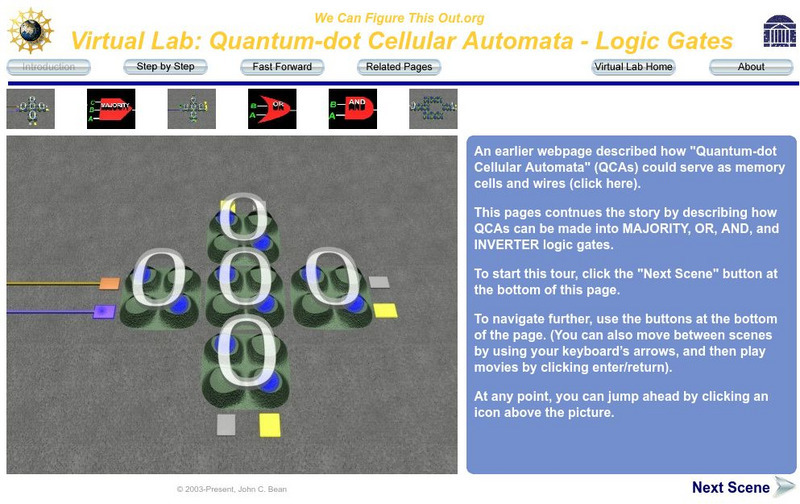
Uva Virtual Lab: Quantum Dot Cellular Automata (Qca) Logic Gates
"Quantum-dot Cellular Automata" (QCAs) can serve as memory cells and wires. This lab describes how QCAs can be made into MAJORITY, OR, AND, and INVERTER logic gates.

Stanford University
Stanford University: Invisible Rays
This lesson focuses on investigating the electromagnetic spectrum using ultraviolet beads. Students learn how material properties change as the size of the material decreases to the nanoscale.

University of California
University of California: Geometry in Action
This page collects various areas in which ideas from discrete and computational geometry (meaning mainly low-dimensional Euclidean geometry) meet some real-world applications.

Other
Nanozone: Nanoconverter
Use the nanoconverter to convert inches, feet, or miles (or millimeters, centimeters, or meters) into nanometers.

Other
Nanozone: How Small Is Small?
Learn about the relative size of nanometers, micrometers, centimeters, and meters by arranging objects, such as red blood cells, hair, and a penny, from smallest to largest.

Other
Nanozone Comics: They Came From His Lab!
Follow the adventures Of Kris Pister as he evolves from love of rockets to an interest electrical enginering. Interesting ideas are presented on how smaller and smaller robots can be used in everyday life.

Other
Nanozone Comics: Dr. Lydia Sohn Saves the World
Follow the life of Dr. Lydia as she evolves from a love of science as a young girl to solving tough questions in biology using nanotechonology.

Other
Nanozone Comics: The Perils of Dr. Paul Alivisatos
Trace the life of Dr. Paul from his interest in chemistry as a young boy to a career working with some of the smallest solids we can make, called nanocrystals.
Other popular searches
- Nanotechnology Medicine
- Chemistry Nanotechnology
- Nanotechnology Worksheet
- Nanotechnology Article
- Nanotechnology Nuclear
- Nanotechnology Lessons
- Science 5 E's Nanotechnology
- Nanotechnology \ Medicine