Hi, what do you want to do?





Sumanas
Sumanas Inc: Microbial Life: The Winogradsky Column
Nice animation of how to create a Winogradsky column using bacteria from pond mud. Learn how "mud can be mixed with several ingredients to provide food and other substrates for the bacteria to use" to survive.
Cells Alive
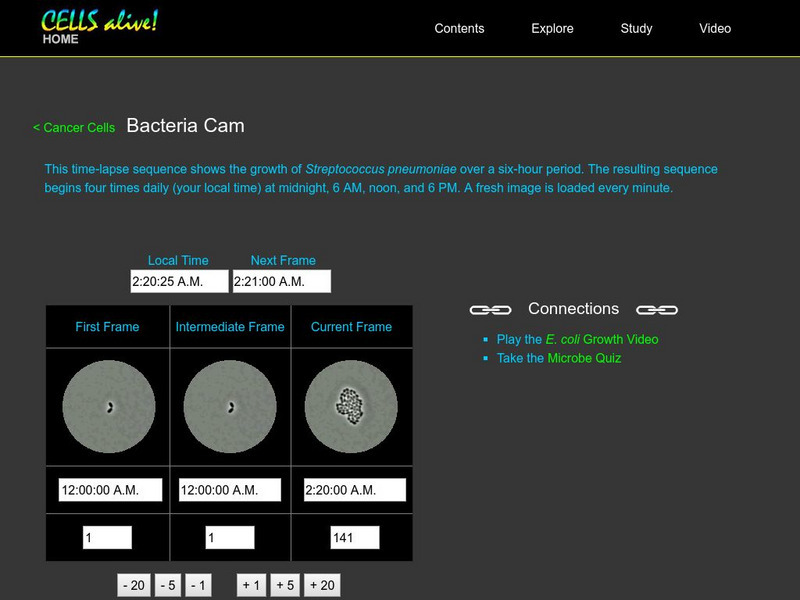
Cells Alive!: Bacteria Cam: Growth of Streptococcus Pneumoniae
Explore this bacterial growth sequence which begins four times daily (your local time) at midnight, 6 AM, noon, and 6 PM. A fresh image is loaded every minute.
Utah Education Network
Uen: Lesson Plan: Microbes on My Mind
A four-day sixth-grade science lesson on the topic of microbes. Learners learn information about microbes and their functions through personal observation and several non-fiction texts, some of which are provided.
Sophia Learning
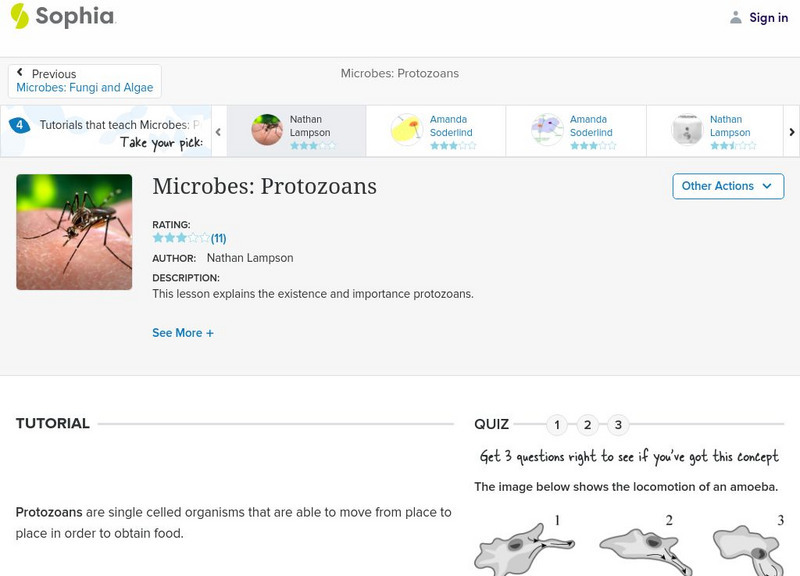
Sophia: Microbes: Protozoans
This lesson describes single-celled protozoans, highlighting their modes of movement. [46 secs]
Soft Schools
Soft Schools: Protists Quiz
Take an interactive quiz over protists. After completing the quiz, check your score, and then revisit any incorrect question for further review.
Soft Schools
Soft Schools: Kingdom Fungi Quiz
Take this interactive quiz over fungi, then review your score and any missed questions at the end.
Soft Schools
Soft Schools: Virus Quiz
Take an interactive quiz over viruses. After completing the quiz, check your score, and then revisit any incorrect question for further review.
Soft Schools
Soft Schools: Protists Quiz Ii
Take this interactive, multiple-choice quiz over protists, then review your score and any missed questions at the end.
Soft Schools
Soft Schools: Fungi Quiz
Take an interactive quiz over fungi. After completing the quiz, check your score, and then revisit any incorrect question for further review.
University of Ottawa (Canada)
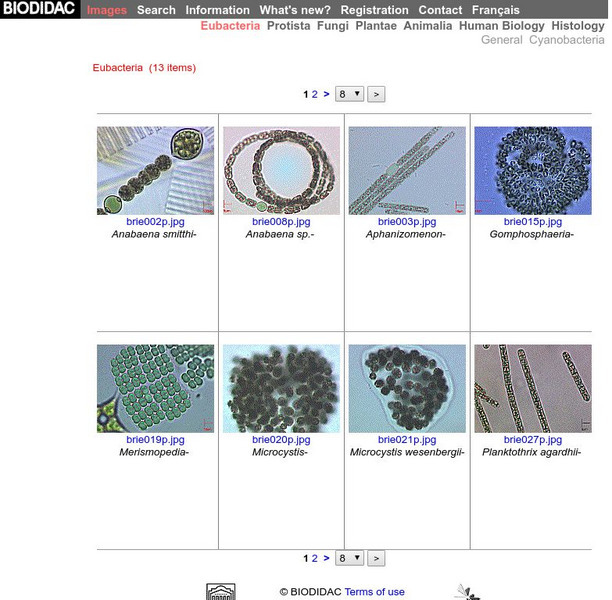
Biodidac: Images: Eubacteria
An image collection of specimens from the Kingdom Eubacteria. Includes some photographs as well as diagrams of various species of bacteria.

McGraw Hill
Glencoe Biology: Chapter 19: Protists: Chapter Test Practice
Try these fifteen multiple choice review questions about the Kingdom Protista.
Centers for Disease Control and Prevention
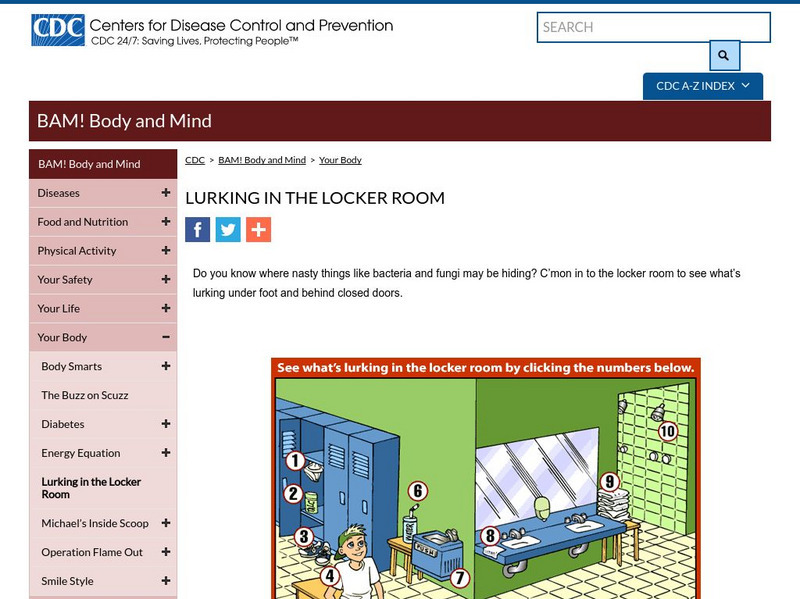
Centers for Disease Control: Bam! Body and Mind: Lurking in the Locker Room
Explore a boys' or a girls' locker room to see where bacteria and fungi are commonly found, and learn how to protect oneself.

Other
Alternative Classifications of Life
The Linnaean system (1758) classified all macroscopic living organisms as either Animals or Plants, based on whether they moved [anima, with a soul] or not. Thus, Fungi were included as plants. With the invention of the microscope and...
US Department of Agriculture
Agricultural Research Service: Salmonella Uses Chemical to Communicate
This site from the Agricultural Research Service cites a study that has found that Salmonella bacteria release a chemical that directly affects the growth of microorganisms. (January 27, 2000)

Science Daily
Science Daily: Antibiotic Resistance
Antibiotic resistance is the ability of a microorganism to withstand the effects of an antibiotic. It is a specific type of drug resistance. Antibiotic resistance evolves naturally via natural selection through random mutation, but it...
Ducksters
Ducksters: Biography for Kids: Scientist: Louis Pasteur
Kids learn about Louis Pasteur's biography. He was a scientist who studied microorganisms like bacteria. He discovered pasteurization, vaccines, and proved that germs cause disease.

Davidson College
Alternatives to Herbicides
This informative site discusses the use of organic farming, microorganisms, goats, and herbicide resistant crops as an alternative to the use of herbicides to control weeds.
Exploratorium
Exploratorium: The Science of Pickles
What is pickling? What role does fermentation play in food? What is salt brine? Understand this and more at the Exploratorium.
Florida State University
Florida State University: Pond Life
Explore the microscopic organisms that live in the freshwater ponds with this video collection. These video clips feature unicellular organisms, from under the microscope, showing off their daily activities. Collection includes videos of...
Next.cc
Next: Germs
Engage in the activities provided to learn what you can do to protect your body from harmful germs. Click on the links for further exploration.
Science Education Resource Center at Carleton College
Serc: Ecology in a Jar
This journal article discusses incorporation of the Winogradsky Column into high school science classrooms to demonstrate nutrient cycles and inter-relatedness of organisms in the environment.
Science Education Resource Center at Carleton College
Serc: Nanobacteria: Are They or Aren't They Alive?
For this five-part activity, young scholars will learn whether or not nanobacteria are alive.
National Institute of Educational Technologies and Teacher Training (Spain)
Ministerio De Educacion: Biotecnologia 2 Bachillerato
Thanks to today's technology we can cure or alleviate many illnesses. In this unit you will broaden your knowledge about biotechnology. It contains 13 interactive activities.

TED Talks
Ted: Ted Ed: The Microbial Jungles All Over the Place (And You)
As we walk through our daily environments, we're surrounded by exotic creatures that are too small to see with the naked eye. We usually imagine these microscopic organisms, or microbes, as asocial cells that float around by themselves....
Other popular searches
- Pond Water Microorganisms
- Classifying Microorganisms
- Microorganisms and Food
- Soil Microorganisms
- Good and Bad Microorganisms
- Stage 4 Microorganisms
- Microorganisms Sheets
- Lesson on Microorganisms
- Microorganisms Read Aloud
- Marine Microorganisms
- Gram Stain Microorganisms
- Microorganisms Use Citrate