Hi, what do you want to do?






Alabama Learning Exchange
Alex: Hair Design (Computer Simulation)
Computer simulation allows learners a realistic and risk-free way to experiment with different face shapes, skin tones, anatomical proportions, and hair texture and visualize how various hairstyles will appear on the client. Students...
National Council of Teachers of Mathematics
Nctm: Illuminations: Shape Sorter
Students learn how to categorize plane figure polygons using Venn Diagrams with this computer based tool.

Alabama Learning Exchange
Alex: Nifty Nets
During this activity, middle schoolers will create nets for prisms. They will find the volume and surface area of the shapes. They will also use interactive activities to review three-dimensional shapes.This lesson plan was created as a...
Texas Instruments
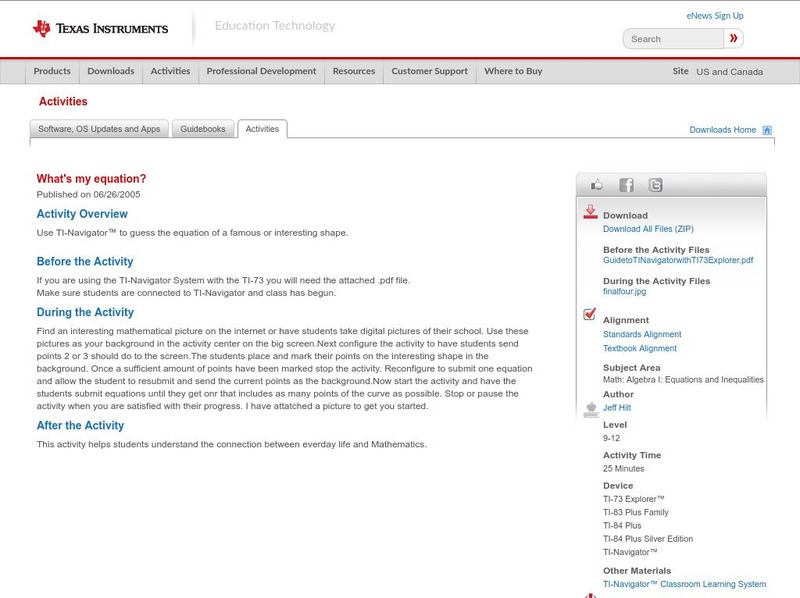
Texas Instruments: What's My Equation?
Use TI-Navigator to guess the equation of a famous or interesting shape.

Alabama Learning Exchange
Alex: Geometric Man
The learners will explore angles, rays, line segments, perpendicular lines, parallel lines, and two-dimensional figures through the use of the book Shape Up! Fun With Triangles and Other Polygons by David A. Adler. They will also...

Alabama Learning Exchange
Alex: A What? A What? A Quadrilateral
In this lesson, students will identify the characteristics of a quadrilateral. Students will have a chance categorize quadrilaterals into subgroups such as squares, rhombuses, rectangles, and nonregular quadrilaterals. This lesson using...
Texas Instruments
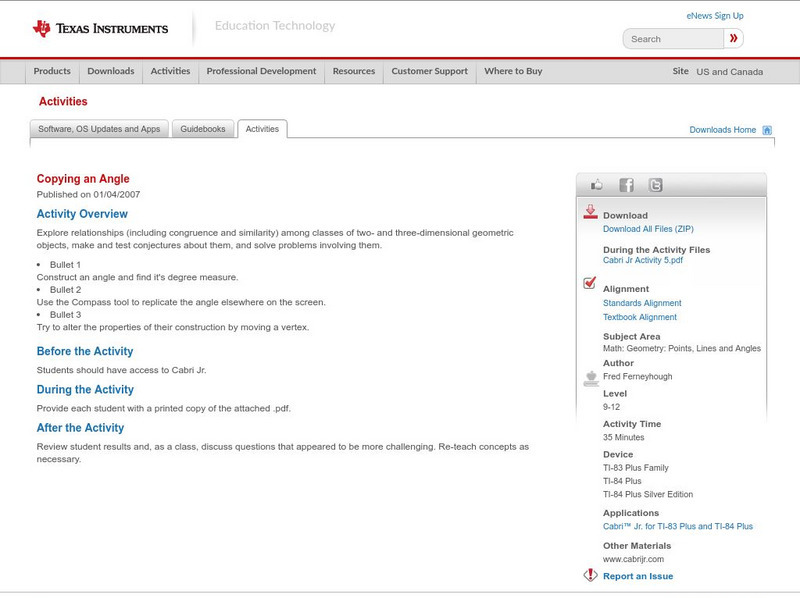
Texas Instruments: Copying an Angle
Explore relationships (including congruence and similarity) among classes of two- and three-dimensional geometric objects, make and test conjectures about them, and solve problems involving them.
Education Place
Houghton Mifflin: Eduplace: Extra Practice Quiz Draw a Picture 1
Use the problem solving strategy, draw a picture, to identify the characteristics described in the correct picture. Read the interactive quiz rules and then click on the "Begin" ticket. If you answer incorrectly you get one more chance...
National Council of Teachers of Mathematics
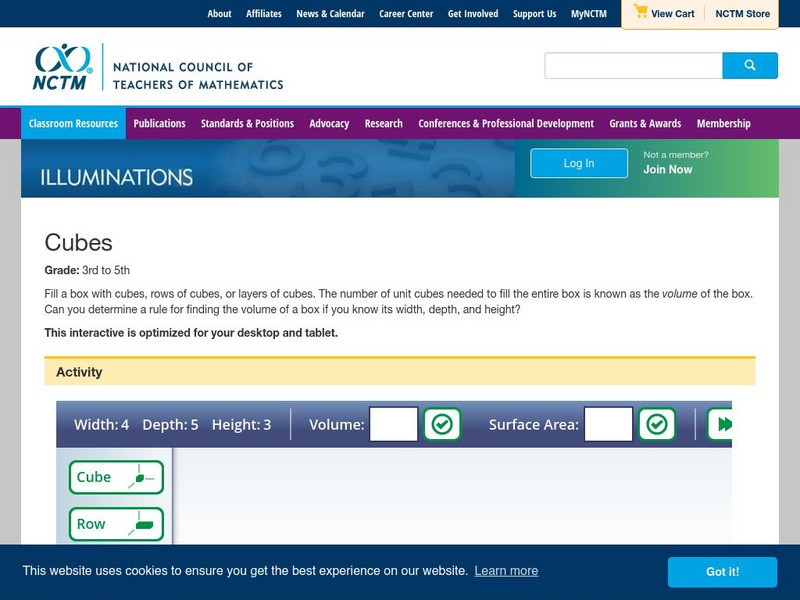
Nctm: Illuminations: Volume of a Cube
"The volume of a cube can be developed by considering unit cubes, a single row (longs) of unit cubes or a single layer (flats) of cubes using this applet." This easy software makes it possible to easily construct a cube and take it...

Alabama Learning Exchange
Alex: Shaping the Future
Students will utilize new found knowledge of architectural design and engineering to apply math and science skills in building a structure. By using interactive websites, they will create scale drawing plans and design and engineer a...

George Eastman Museum
African Americans: Black History Through Photography
A collection of photographs from the Eastman House collection. They include portraits of important figures who shaped American history, as well as many other African Americans, whose names are unknown.

American Association of Physics Teachers
Com Padre Digital Library: Open Source Physics: Lorenz Attractor Periodic Orbits
Simulation of a Lorenz attractor which is shaped like a butterfly. Manipulate the image and observe from all sides as the orbits about two fixed points are drawn.

Alabama Learning Exchange
Alex: Polygon Perimeters
Lesson providing practice for finding the perimeters of polygons. Students draw polygons using sidewalk chalk and then measure the perimeters of each shape.
National Council of Teachers of Mathematics
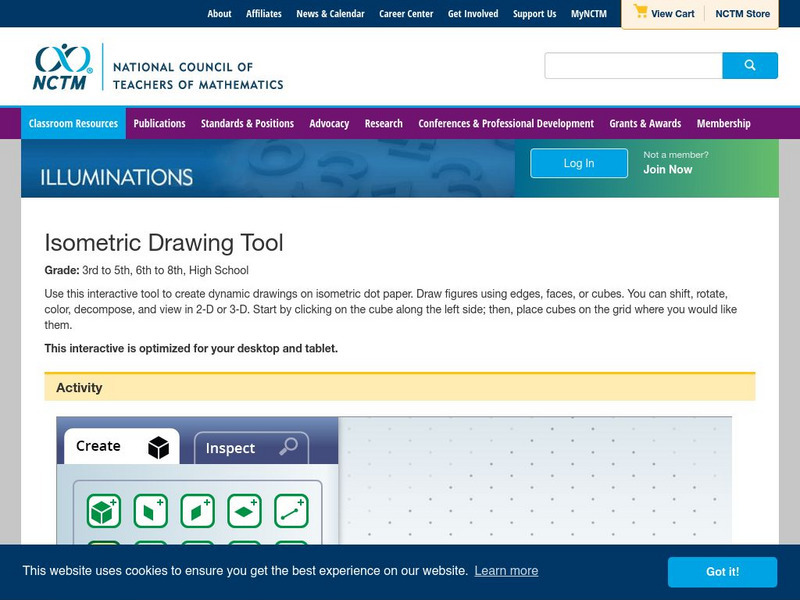
Nctm: Illuminations: Isometric Drawing Tool
This site includes an interactive math tool to create drawings on isometric dot paper. You can draw figures using edges, faces, or cubes. Rotate and color your drawings, and view them in 3D or 2D.
Texas Instruments
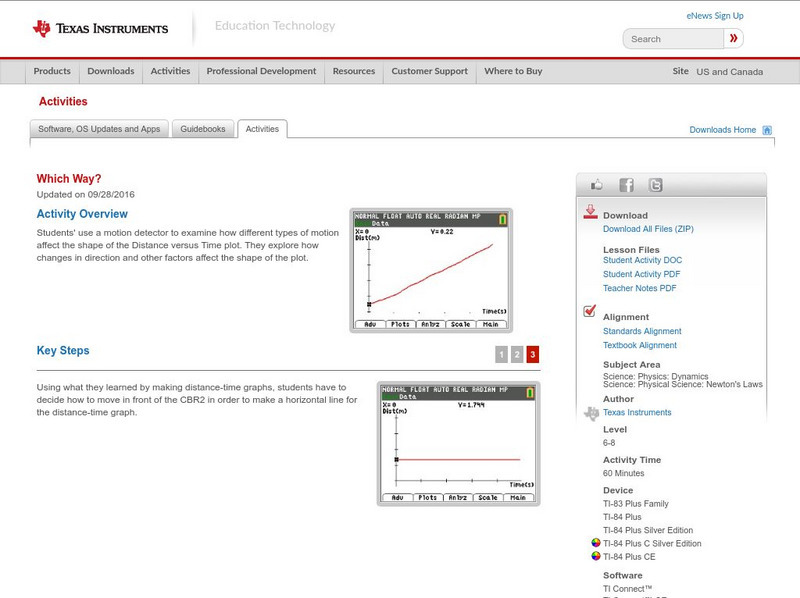
Texas Instruments: Which Way?
Students' use a motion detector to examine how different types of motion affect the shape of the distance versus time plot. They explore how changes in direction and other factors affect the shape of the plot.
Texas Instruments
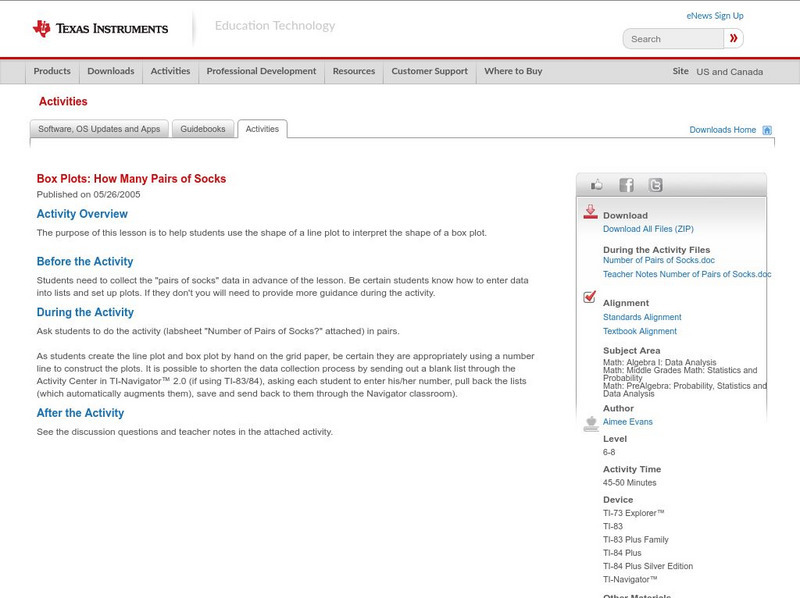
Texas Instruments: Box Plots: How Many Pairs of Socks
The purpose of this lesson is to help students use the shape of a line plot to interpret the shape of a box plot.

Alabama Learning Exchange
Alex: Bubble Bubble
This lesson will help young students understand the shape and movement of bubbles. Students will predict, practice, and record results as they blow bubbles with different-shaped objects.
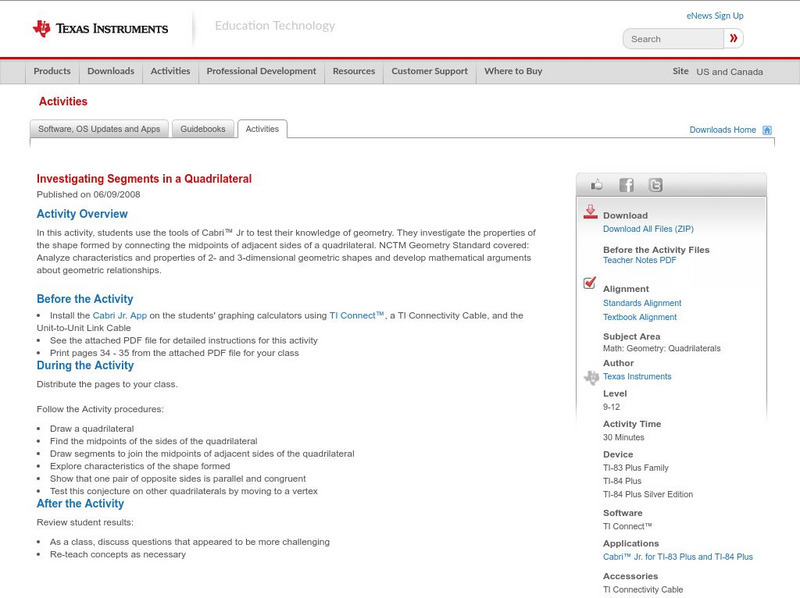
Texas Instruments
Texas Instruments: Investigating Segments in a Quadrilateral
In this activity, students use the tools of Cabri Jr to test their knowledge of geometry. They investigate the properties of the shape formed by connecting the midpoints of adjacent sides of a quadrilateral.
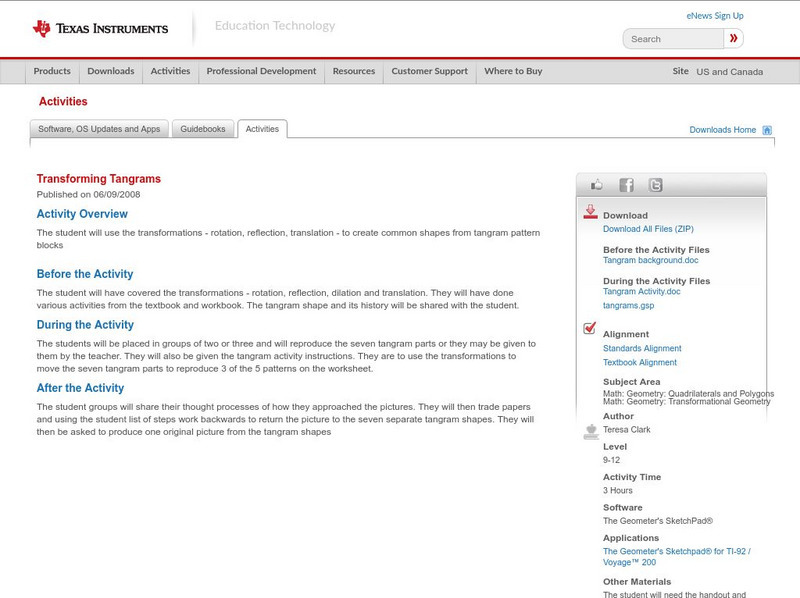
Texas Instruments
Texas Instruments: Transforming Tangrams
The student will use the transformations - rotation, reflection, translation - to create common shapes from tangram pattern blocks
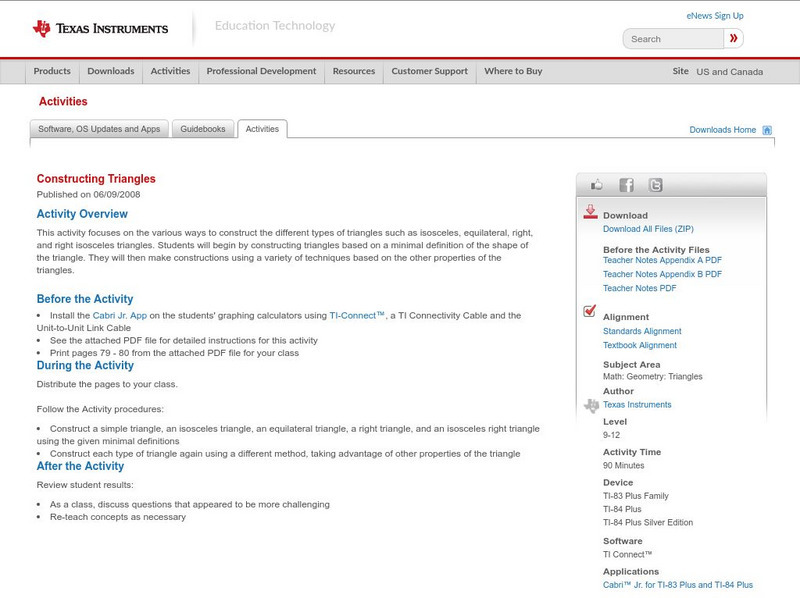
Texas Instruments
Texas Instruments: Constructing Triangles
This activity focuses on the various ways to construct the different types of triangles such as isosceles, equilateral, right, and right isosceles triangles. Students will begin by constructing triangles based on a minimal definition of...
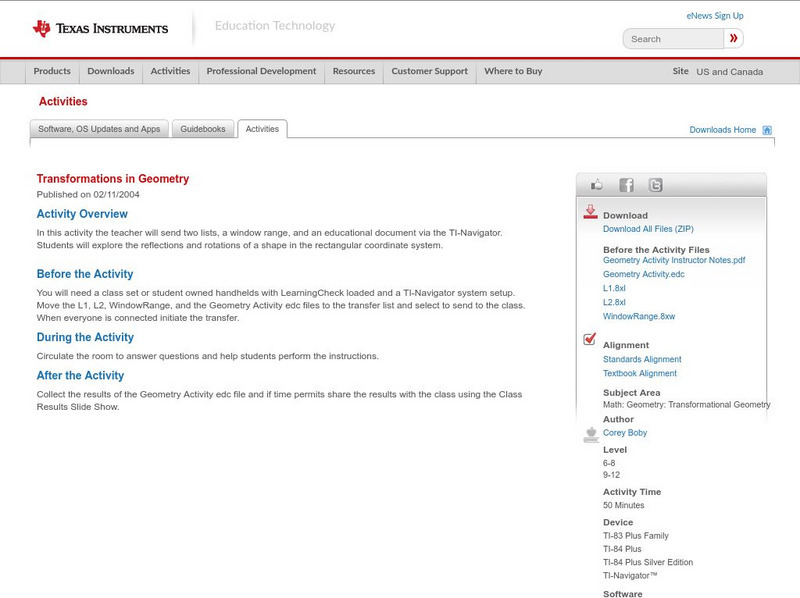
Texas Instruments
Texas Instruments: Transformations in Geometry
In this activity the teacher will send two lists, a window range, and an educational document via the TI-Navigator. Students will explore the reflections and rotations of a shape in the rectangular coordinate system.
Texas Instruments
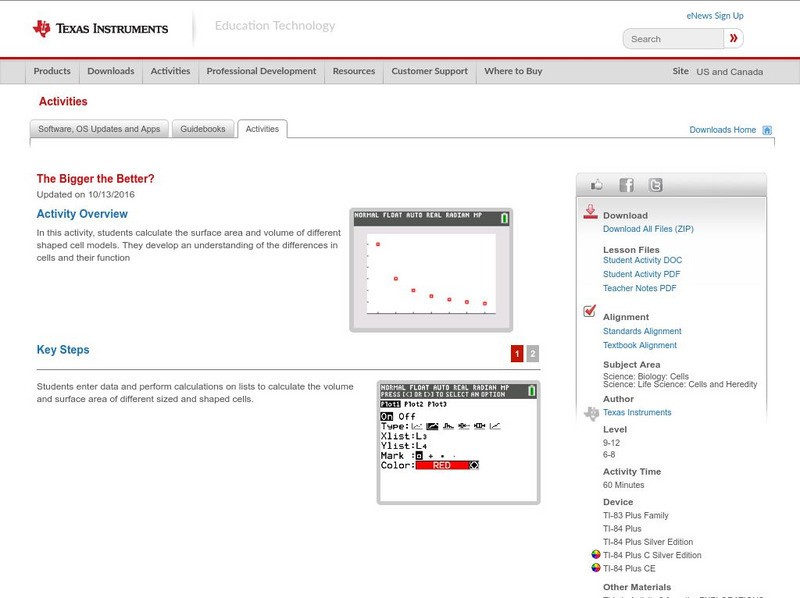
Texas Instruments: The Bigger the Better?
In this activity, students calculate the surface area and volume of different shaped cell models. They develop an understanding of the differences in cells and their function
Texas Instruments
Texas Instruments: Plate Tectonics
This plate tectonic activity is designed to assess the comprehension of concepts related to the physical processes that shape the Earth's surface.
Texas Instruments
Texas Instruments: What Goes Around Comes Around but Can You Measure It?
In this activity, students find the area and the perimeter for several geometric shapes. They also determine the surface area and volume of spheres.