Hi, what do you want to do?






Curated OER
Is There A Fungus Among Us?
Sixth graders classify fungus into two different groups. In this fungus lesson, 6th graders collect as many pieces of fungus as possible. Students then classify these pieces of fungus as saprophytic or parasitic.

Curated OER
Scavenger Hunt: Simulating Natural Selection
Young scholars simulate natural selection using pinto beans. In this biology activity, students identify the factors affecting organism evolution. They record data from the experiment and formulate a conclusion.

Curated OER
Seeing Interference Fringes with a Telescope
Learners construct an interferometer using a simple telescope. In this physics lesson, students explain how light waves create the fringe patterns. They observe patterns made by different objects in the sky and compare them.

Curated OER
Horsing Around! Trivia Quiz
In this online quiz worksheet, students answer a set of trivia questions about horses. Page has a link to submit answers for review.

Curated OER
Socializing your Puppy
In this online quiz worksheet, students answer a set of questions about how to socialize puppies. Answers may be submitted for review by clicking a link at the bottom of the page.

Curated OER
WRITE? NO WAY!
Young scholars discover the right brain-left brain differences and then think about how to break down some of their self-criticism to try writing.

Curated OER
Sign Language 1
Third graders explore signs and vocabulary linked to the work of Keith Haring.

Curated OER
Location, Location
Third graders draw and interpret simple scale maps, use maps to move around efficiently or plans to propose actions. They use of a compass to specify and find directions. They display and discuss a map of the local region.

Curated OER
Triangle Sums
Fourth graders determine a way to place numbers in the nine circles that are arranged in a triangular pattern so that each side has an equal sum. They use each number once and practice adding single digit numbers.

Curated OER
Hungry Ollie Octopus
Students recognize the short vowel o in written and spoken language. Through matching and listening activities, they discriminate the short vowel /o/ from other phonemes. Students associate the phoneme with its letter representation and...

Curated OER
K-2 Valentine's Day Heart Purse
Learners create purses for students to collect classroom Valentine's or treats in. In this Valentine's Day lesson plan, learners create valentines purses out of the given materials to collect their valentine messages in.

Curated OER
Fancy Goldfish Quiz
In this online quiz worksheet, students answer a set of questions about fancy goldfish. Page has a link to submit answers for correction.

Alabama Learning Exchange
Alex: Searching Solid Shapes
Lesson introducing the basic three-dimensional shapes (sphere, cylinder, cone, cube). Common items with those shapes are hidden on the playground for learners to find and photograph. Pictures are then used to create a photostory....
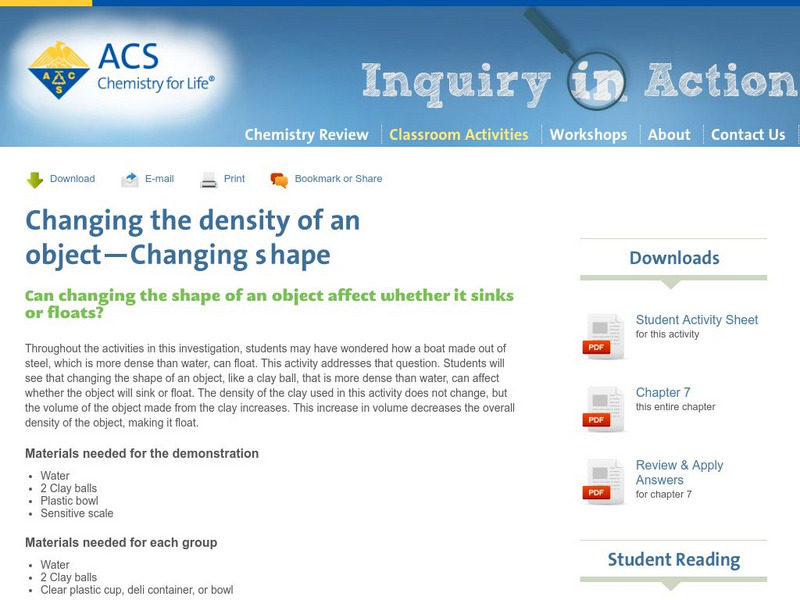
American Chemical Society
Inquiry in Action: Changing the Density of an Object: Changing Shape
Throughout the activities in this investigation, students may have wondered how a boat made out of steel, which is more dense than water, can float. This activity addresses that question. Students will see that changing the shape of an...
National Council of Teachers of Mathematics
Nctm: Illuminations: Shape Cutter
This computer tool allows students to compose and decompose shapes by making cuts and rearranging the pieces. The tool has an exploration section for learning exercises.

Alabama Learning Exchange
Alex: Shape Makers
In this Five E's AMSTI instructional activity, students discover relationships between shapes. Students discover multiple ways to combine shapes to fill the area of a given shape using real and virtual pattern blocks, and share their...

Alabama Learning Exchange
Alex: Guess My Shape
The students will make the connection between 2-D and 3-D shapes using modeling clay and geometric solids and participate in an interactive web lesson plan. Students will make predictions about what 2-D shape they think will be made when...

Alabama Learning Exchange
Alex: What Can Shapes Be
This is a hands-on lesson that will help students explore shapes in their environment. Students will work in diverse groups to complete this activity. Students will make a class book of their findings.This lesson plan was created as a...

Alabama Learning Exchange
Alex: What Shape Are You?
This lesson plan walks students through an exploration of two- and three-dimensional shapes. Students will create a PowerPoint and poster of themselves as a chosen shape. It also gives assessment and remediation ideas as well as ways to...

George Eastman Museum
George Eastman House: Shapes and Shelters Discovery Kits
Find a classroom-ready annotated slideshow and lesson plans designed to introduce students to fundamental architectural concepts and to improve their skills in recognizing the structural components of architecture. Slideshow uses...
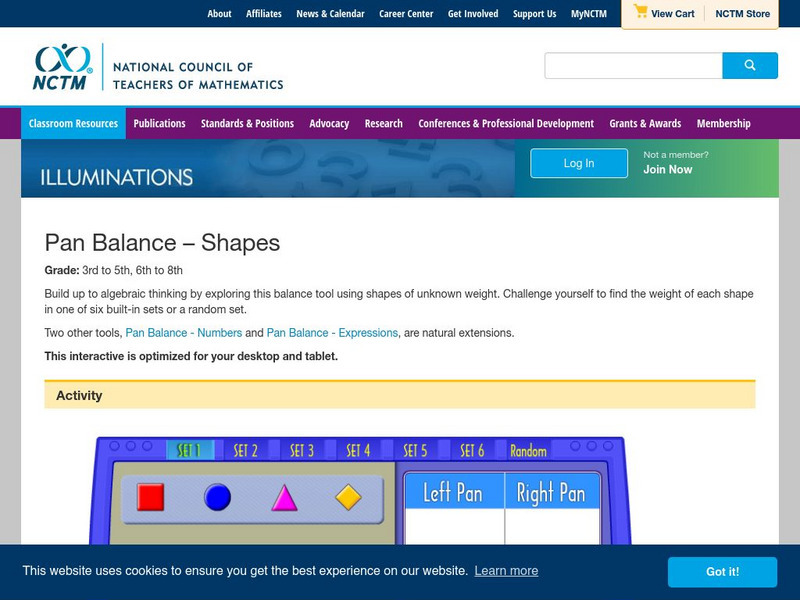
National Council of Teachers of Mathematics
Nctm: Illuminations: Pan Balance Shapes
Use this virtual, double pan balance and explore what shapes and amounts of shape balance each other. Great introduction to beginning algebra concepts.
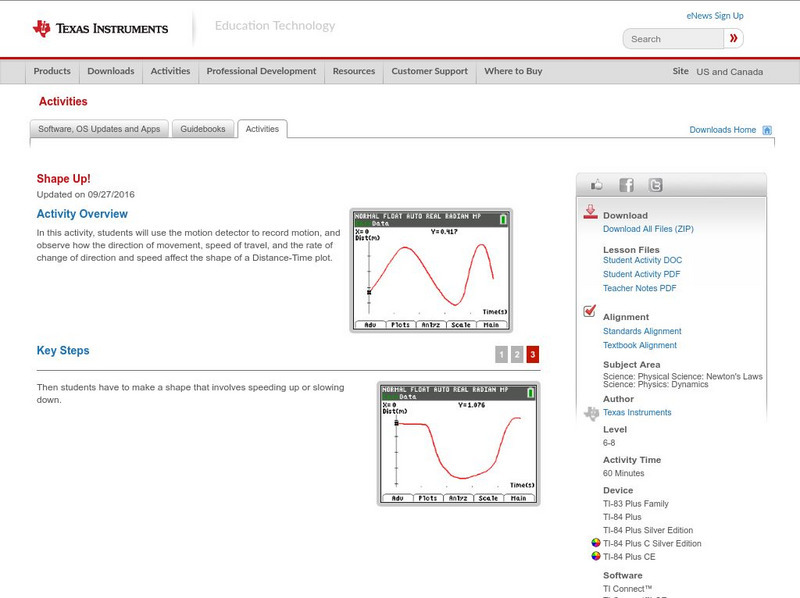
Texas Instruments
Texas Instruments: Shape Up!
In this activity, students can use the motion detector to record motion, and observe how the direction of movement, speed of travel, and the rate of change of direction and speed affect the shape of a distance-time plot.

Texas Instruments
Texas Instruments: Traveling Shapes Motion Geometry
In this activity, students describe how to move a shape from one place to another in a plane. They learn about translations, rotations, and line reflections. [Requires Adobe Reader.]
Texas Instruments
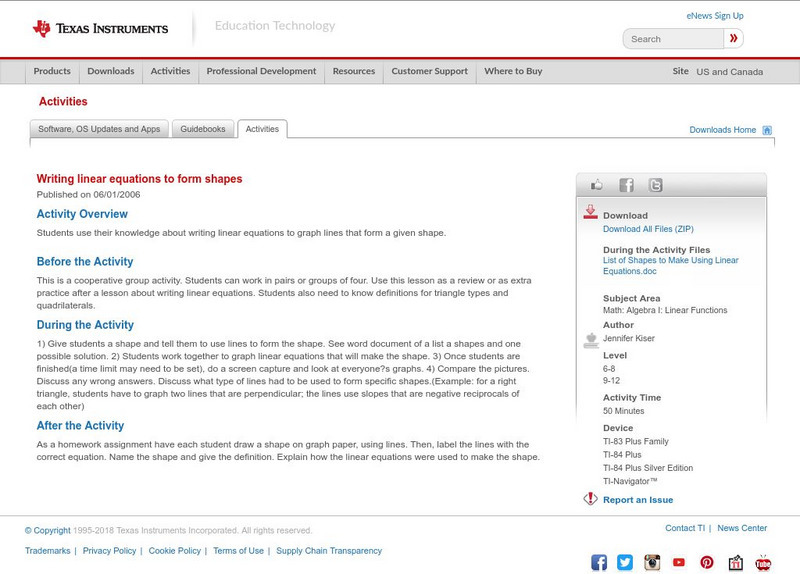
Texas Instruments: Writing Linear Equations to Form Shapes
Students use their knowledge about writing linear equations to graph lines that form a given shape.