Hi, what do you want to do?






eSchool Today
E School Today: Earth System
Learn about the systems that make up Earth, and find out how they interact.

Utah Education Network
Uen: How Big Are Earth, Sun, and Moon?
Understand where the sun is in the solar system and how big the earth, moon, and sun are.
Utah Education Network
Uen: Trb 3:1 Investigation 1 Comparing the Earth & Moon
Third graders compare the earth and the moon in this activity.
Smithsonian Institution
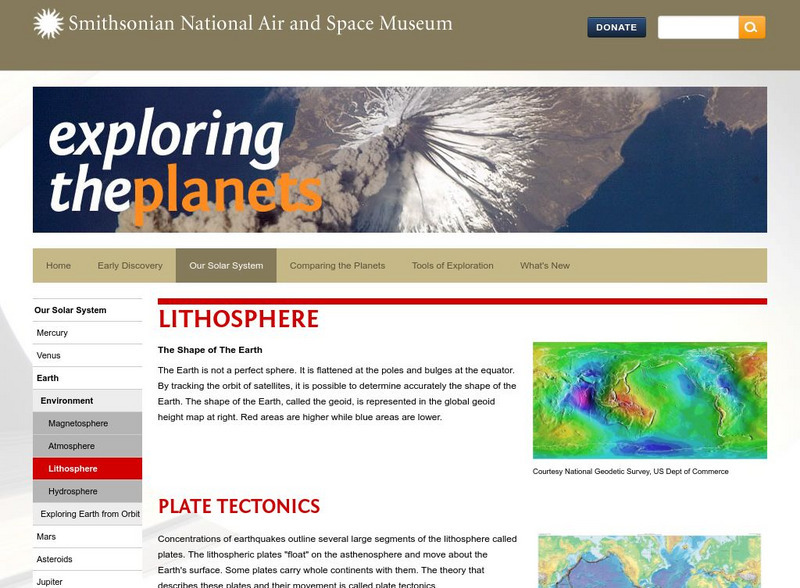
National Air and Space Museum: Exploring the Planets: Earth's Lithosphere
The plate tectonics and other features of the Earth's lithosphere are explained and illustrated. Has links to definitions of the magnetosphere, atmosphere, and hydrosphere.
CK-12 Foundation
Ck 12: Earth Science: Climate Zones and Biomes Study Guide
This comprehensive study guide covers the main terms and concepts needed for an earth science unit on climate zones and biomes. Review questions are included at the bottom of the study guide.
The Wonder of Science
The Wonder of Science: Ms Ess1 1: Earth Sun Moon System
Develop and use a model of the earth-sun-moon system to describe the cyclic patterns of lunar phases, eclipses of the sun and moon, and seasons.
American Geosciences Institute
American Geosciences Institute: Earth Science Week: Mapping Quake Risk
Students use GIS to observe worldwide patterns of earthquakes and volcanoes and analyze the relationships of those patterns to tectonic plate boundaries. Then they identify cities at risk.
European Space Agency
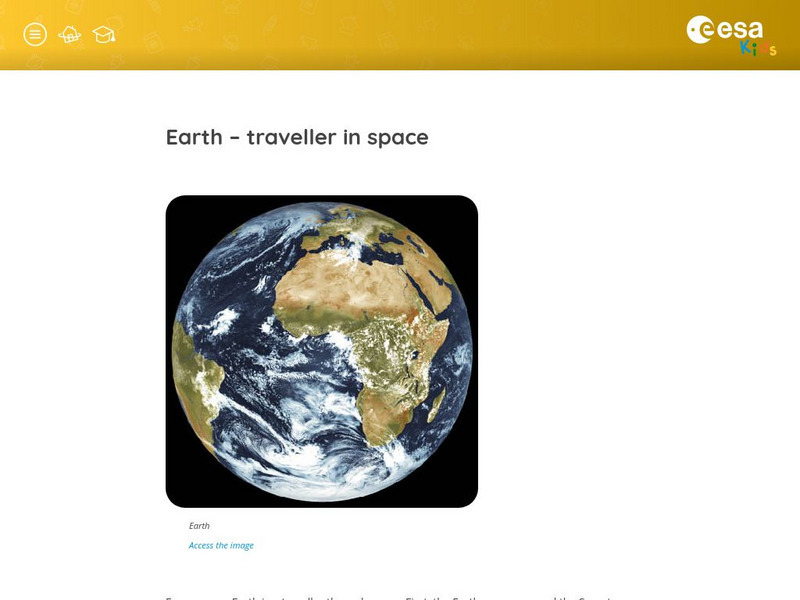
European Space Agency: Esa Kids: Our Universe: Earth
A basic overview of the planet Earth. Links to information about the other planets and objects in our solar system are included.

Alabama Learning Exchange
Alex: If Earth No Longer Existed. . .
Young scholars will work in cooperative groups to research characteristics of each of the planets in our solar system. Students will design a travel brochure outlining the characteristics of each planet. Each group will make an oral...
Other
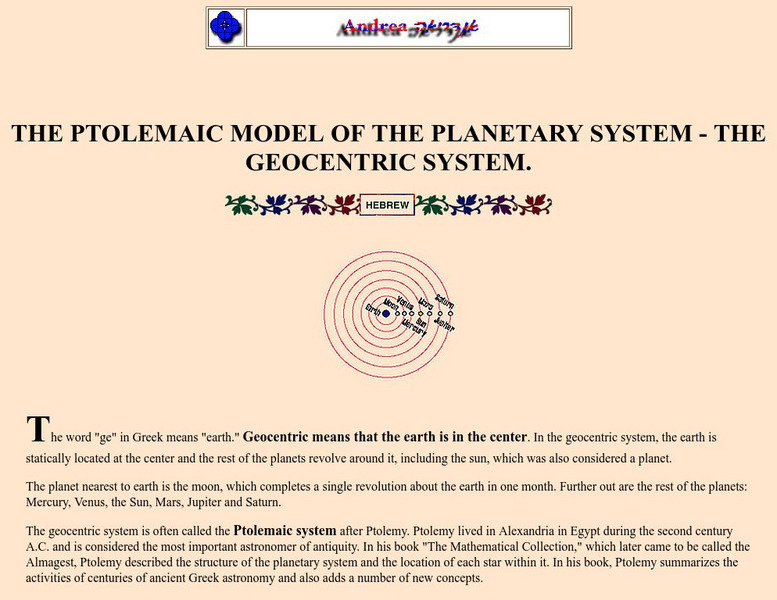
The Ptolemaic Model of the Planetary System
An easy-to-read description and history of Ptolemy's geocentric model of the universe. Geocentric means that Ptolemy believed the Earth was the center of the universe.
American Geosciences Institute
American Geosciences Institute: Earth Science Week: Water Filtration
Student groups design a water filtration system and present to the class why they picked their design.
CK-12 Foundation
Ck 12: Earth Science: Gravity in the Solar System Study Guide
Understand gravity using this study guide.
Cosmos 4 kids
Cosmos4 Kids: Solar System Details: Heliopause
Travel to the outer edge of our solar system to the far reaches of the sun. Learn about this region called the heliopause and what information the Voyager probes send back to Earth.

Exploratorium
Exploratorium: A Guide to Astronomy Resources
A portal to resources on the sun, the Earth's neighboring planets, and the weather in space. Find out why Saturn is the "jewel of the Solar System" and explore what happens when Venus and Mercury make their rare transits across the sun.
NASA
Nasa: The Space Place: Planet X Treme Weather
Ever wonder what the weather is like on other planets besides Earth? This resource explores the extreme weather that occurs on other planets.

PBS
Pbs Teachers:biodome
Investigate biological systems that support plant life by constructing a self-sufficient, enclosed environment for growing plants.
TeachEngineering
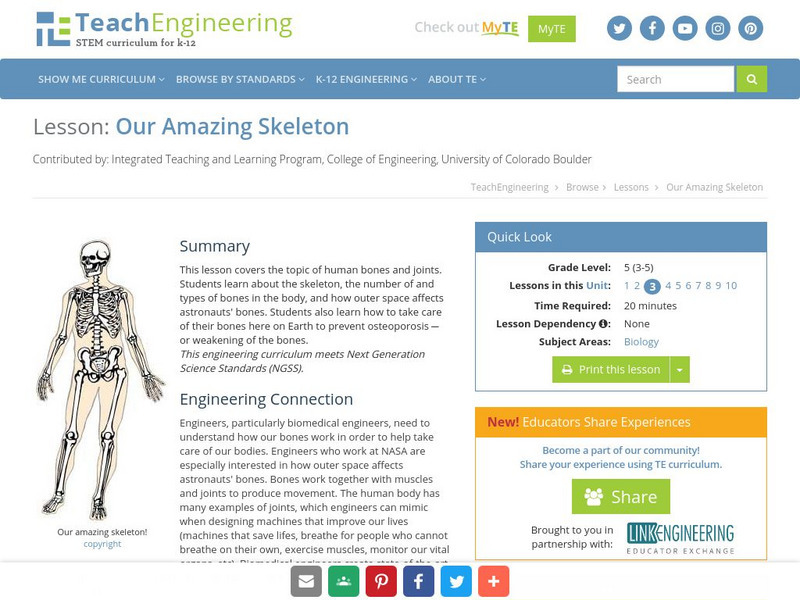
Teach Engineering: Our Amazing Skeleton
This instructional activity covers the topic of human bones and joints. Students learn about the skeleton, the number of and types of bones in the body, and how outer space affects astronauts' bones. Students also learn how to take care...
NASA
Nasa: Sci Jinks: How's the Weather on Other Planets?
Compare weather here on Earth to other planets and moons in our solar system. You will find many similarities and differences.
Cool Math
Coolmath: Science Monster: Pluto
A cool fact sheet about Pluto including a place for students to enter their weight on Earth to convert it to what it would be on Pluto.
Cool Math
Coolmath: Science Monster: Saturn
A cool fact sheet about Saturn including a place for students to enter their weight on Earth to convert it to what it would be on Saturn.
Cool Math
Coolmath: Science Monster: Neptune
A cool fact sheet about Neptune including a place for students to enter their weight on Earth to convert it to what it would be on Neptune.
Cool Math
Coolmath: Science Monster: Mercury
A cool fact sheet about Mercury including a place for students to enter their weight on Earth to convert it to what it would be on Mercury.
American Geosciences Institute
American Geosciences Institute: Earth Science Week: Find Your Bearing: Mapping
In this exercise, learners use compasses to make a map of the school's campus.
Science Struck
Science Struck: A Scientific Explanation to What Causes Day and Night
Explains how the rotation and the axial tilt of the Earth are responsible for the phenomenon of day and night. Provides information about the Sun, the solar system, and the Earth, and how the circumference of the Earth was first measured...
Other popular searches
- Earth System Origins
- 4 Major Earth Systems
- Moon Earth System
- Earth Systems Unit
- Major Earth Systems
- Earth Systems Interactions
- Earth Systems Global Winds
- Sun Earth Moon System
- Earth Systems 3209
- Earth Systems Science
- Earth Systems and Patterns
- Earth System Atmosphere