Hi, what do you want to do?





Science Buddies
Science Buddies: Which Stars Can You Use for Navigation
A great science project from Science Buddies that examines how ancient peoples navigated without the benefit of a GPS. Find out which stars are important in navigation in the northern and southern hemispheres. The Science Buddies project...
TeachEngineering
Teach Engineering: How to Be a Great Navigator!
In this instructional activity, learners will learn how great navigators of the past stayed on course - that is, the historical methods of navigation. The concepts of dead reckoning and celestial navigation are discussed.
TeachEngineering
Teach Engineering: The North (Wall) Star
Celestial navigation is the art and science of finding one's geographic position by means of astronomical observations, particularly by measuring altitudes of celestial objects - sun, moon, planets or stars. This activity starts with a...
Other
Sea and Sky: Celestial Objects
Empty space in outer space is not truly empty. Celestial objects fill the space not occupied by planets, stars, and such. This resource identifies these objects and further explains their existence.
TeachEngineering
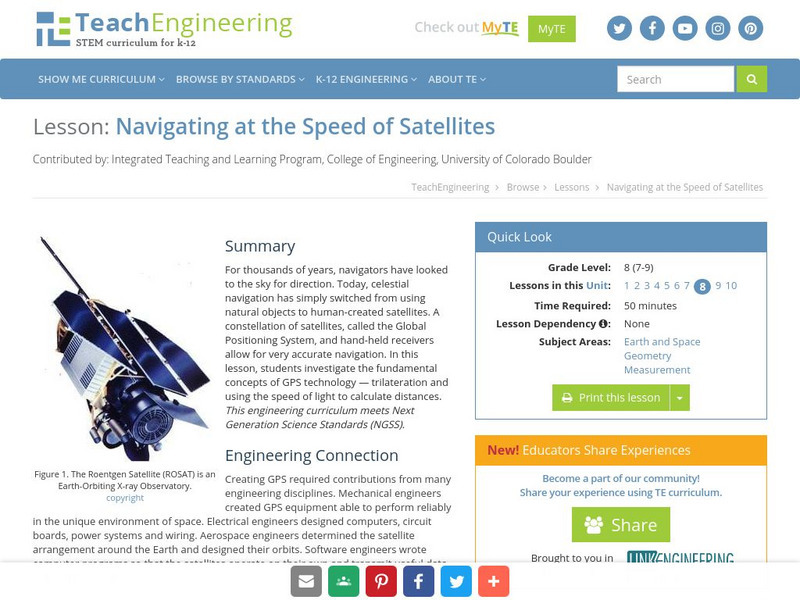
Teach Engineering: Navigating at the Speed of Satellites
For thousands of years, navigators have looked to the sky for direction. Today, celestial navigation has simply switched from using natural objects to human-created satellites. A constellation of satellites, called the Global Positioning...
Massachusetts Institute of Technology
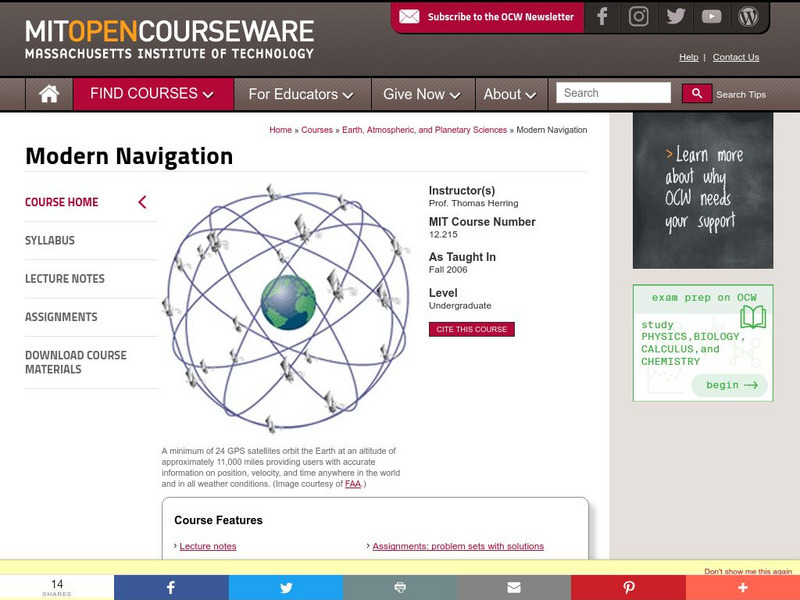
Mit: Open Course Ware: Courses: Modern Navigation
College-level planetary science course highlighting modern navigation. Course introduces the concepts and applications of navigation techniques using celestial bodies and satellite positioning systems (GPS). Course features include...
TeachEngineering
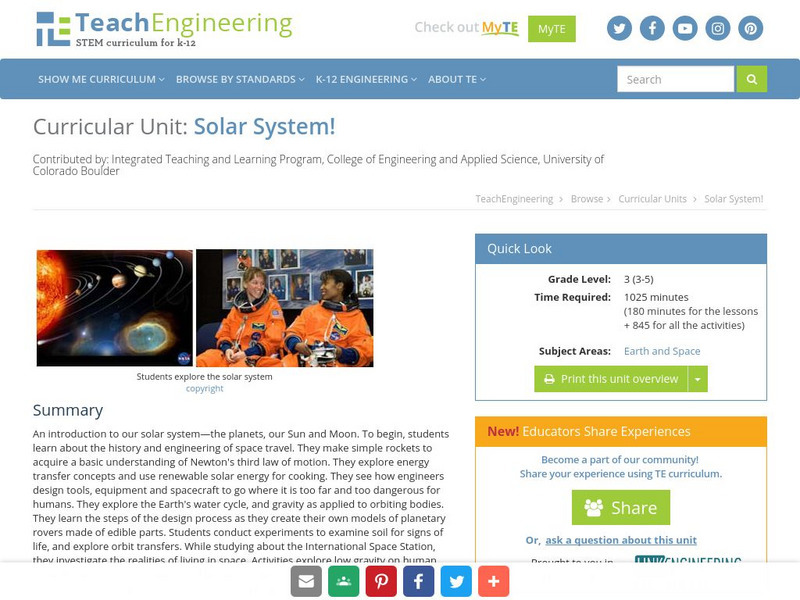
Teach Engineering: Solar System!
An introduction to our solar system: the planets, our Sun and our Moon. Students begin by learning the history and engineering of space travel. They make simple rockets to acquire a basic understanding Newton's third law of motion. They...
TeachEngineering
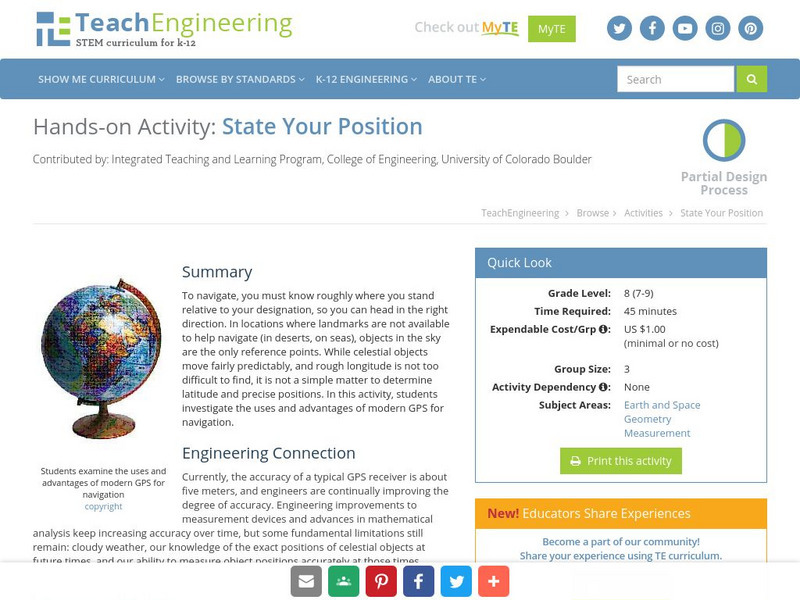
Teach Engineering: State Your Position
To navigate, you must know roughly where you stand relative to your designation, so you can head in the right direction. In locations where landmarks are not available to help navigate (in deserts, on seas), objects in the sky are the...
![Noaa: Make Your Own Astrolabe [Pdf] Activity](https://static.lp.lexp.cloud/images/attachment_defaults/resource/large/FPO-knovation.png "Noaa: Make Your Own Astrolabe [Pdf] Activity")
NOAA
Noaa: Make Your Own Astrolabe [Pdf]
Create your own astrolabe after reading to find out what one is. Measure heights of objects around you using the astrolabe.