Hi, what do you want to do?






Science Buddies
Science Buddies: Give It a Lift With a Lever
Simple machines allow us to do difficult tasks like lifting objects heavier than our body weight. In this science project you'll build a tabletop lever and measure how much effort it takes to lift an object by altering the length of the...

Science Buddies
Science Buddies: Levitating Magnets: Floating Isn't Just for Magicians
If you ever seen a magician float an object in the air, you might think that levitation is just a magic trick, but the truth is you can use an invisible physical force to levitate a magnet. Try this simple, week-long science project to...

Science Buddies
Science Buddies: Slime Chemistry
Have you ever wondered how fun toys like Silly Putty, Gak, and Slime are made? These products are so much fun because of the properties of polymers, which make them delightfully bouncy, stretchy, sticky, moldable, breakable, hard, soft,...

Science Buddies
Science Buddies: Make Your Own Markers
Do you ever wonder how markers are made? Where do all of those colors come from? Many of the colorful dyes we use come from plant pigments. Pigments are what make the world around us so colorful. How do chemists turn those natural plant...
Science Buddies
Science Buddies: Craters and Meteorites
Have you ever heard that the moon is made of cheese? Even though the craters on the surface of the moon resemble holes in Swiss cheese, we know that this common myth is not true. Find out how craters are formed and why they are different...
Science Buddies
Science Buddies: Do Preferences Bias Our Choices?
In this science project you will test whether color preference will affect repetitive tasks that require fine motor coordination, like picking up small objects very quickly. Find out if your color preferences will bias these repetitive...
Science Buddies
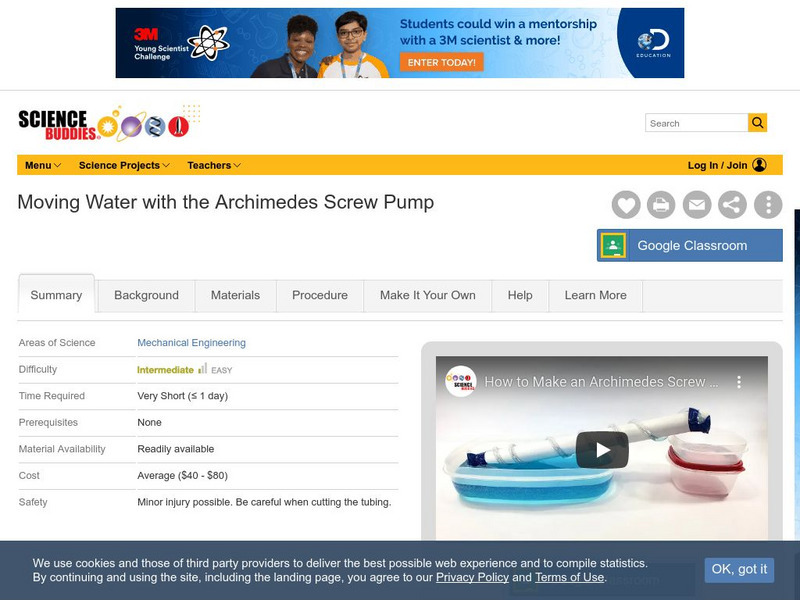
Science Buddies: Moving Water With the Archimedes Screw Pump
Amaze your friends and family by moving water with just a few turns of your wrist, this is known as an Archimedes screw. In this science project, you will build a very simple Archimedes screw, to transfer water from a low-lying location...

Discovery Education
Discovery Education: Science Fair Central: Practice Investigation Virtual Labs
Two virtual labs offer practice for creating your own or science project: "How Does Your Garden Grow" and "Critters!" Learn how investigations are conducted from the first step to the finished product.
Science Buddies
Science Buddies: Which Fruits Can Ruin Your Dessert?
Here is a basic project for investigating enzymes that prevent gelatin from solidifying. This way you can understand why it is some fruits are not recommended for inclusion when it comes to making gelatin.
Science Buddies
Science Buddies: How Do You Make the 'Best' Cookie?
The benefit to cooking food from scratch versus store bought food is that you determine the taste. In this science fair project, discover if you can perfect the taste of your favorite cookie right in your own kitchen by experimenting...
Science Buddies
Science Buddies: Spread the Soap, Not the Germs
Washing your hands is the best way to prevent the spread of germs. But germs can be tricky; they find nooks and crannies to hide in, so it takes good hand-washing technique to get rid of them. This science project investigates which...
Science Buddies
Science Buddies: Suck It Up: Capillary Action of Water in Plants
We know that plants, and even bouquets of cut flowers need water to survive, but we often do not think about how water moves within a plant. In this science project, you will use colored water and carnations to discover how water travels...
Science Buddies
Science Buddies: Do Submarines Need Fins?
In this science project, you can investigate how submarines use stabilizing fins to move forward. Exploring friction and buoyant force you will get closer to understanding how these large ships function. Research resources are included...
Science Buddies
Science Buddies: Is That Cat Fat?
There are over 58 million overweight cats and dogs in the United States alone. In this science project you will determine what percentage of the pets you know are overweight and how their weights compare to weight of pets throughout the...
Science Buddies
Science Buddies: How Does a Chick Breathe Inside Its Shell?
Whether a chick can breathe inside its shell is an interesting question. Every animal needs oxygen to survive, so the chick must get air somehow. Try this science project to discover if the pores in a chicken egg shell allow water to...
Ducksters
Ducksters: Kids Science Projects and Experiments: Coriolis Effect
Kids learn by experimenting with science. Project showing how the Coriolis Effect works.
Ducksters
Ducksters: Kids Science Projects and Experiments: Batteries
Kids learn by experimenting with science. Project on electricity with homemade batteries.
Ducksters
Ducksters: Kids Science Projects and Experiments: Light Spectrum
Kids learn by experimenting with science. Project about the light spectrum.
Ducksters
Ducksters: Kids Science Projects and Experiments: Sound Pitch
Kids learn by experimenting with science. Project showing how sound waves effect pitch.
Ducksters
Ducksters: Kids Science Projects and Experiments: Sound Vibrations
Kids learn by experimenting with science. Project showing how sound vibrations work by making a kazoo.
Science Struck
Science Struck: 5 Creative Solar System Project Ideas Kids Can Try
Detailed descriptions of five solar system science projects for students.
Science Buddies
Science Buddies: Which Animals Have Genome Projects?
All animals have a genome, but do they all have genome projects? Find out which animals are currently having their genomes sequenced and how much we know already by performing some simple bioinformatics data digging.
Science Buddies
Science Buddies: Strength in Numbers?
Ever try to tear a telephone book in half? Even though you can easily rip one or a few pages to shreds, the entire phone book has strength in numbers and holds together. This project is an introduction to measuring and comparing the...
Science Buddies
Science Buddies: Testing Sunscreen Effectiveness
The goal of this project is to measure the effectiveness of different sunscreen products for blocking ultraviolet-A (UVB) and ultraviolet-B (UVB) rays from sunlight. This project shows you how to use a UV detector to measure rays of light.
Other popular searches
- 4th Grade Science Project
- Physical Science Projects
- Science Project on Pulleys
- Science Project Volcano
- Science Project Gravity
- Science Project Ideas
- Forensic Science Project
- Science Fair Project Ideas
- Rock Science Project
- Science Project Food
- Science Project Terrarium
- Science Fair Project Data