Hi, what do you want to do?






Buck Institute
Buck Institute for Education: Pblu: The 22nd California Mission
When fourth graders are required to learn their state history, this California teacher takes it across the curriculum implementing a project-based learning unit highlighting the Spanish Mission Era of California in the 18th and 19th...

Gilder Lehrman Institute of American History
Gilder Lehrman Institute: History Now: Immigration: Framing Soo Hoo Lem Kong
[Free Registration/Login Required] This resource presents a primary lesson plan that looks at primary sources to learn about Chinese immigration to California.
Smithsonian Institution
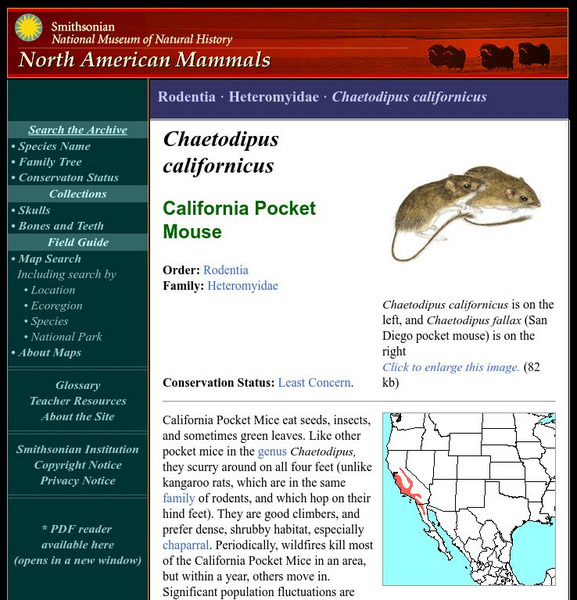
National Museum of Natural History: American Mammals: California Pocket Mouse
California Pocket Mice eat seeds, insects, and sometimes green leaves. Like other pocket mice in the genus Chaetodipus, they scurry around on all four feet (unlike kangaroo rats, which are in the same family of rodents, and which hop on...
Smithsonian Institution
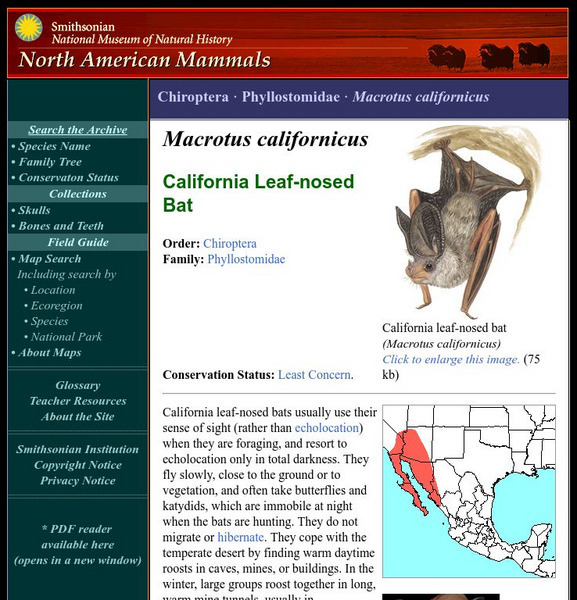
National Museum of Natural History: American Mammals: California Leaf Nosed Bat
California leaf-nosed bats usually use their sense of sight (rather than echolocation) when they are foraging, and resort to echolocation only in total darkness. They fly slowly, close to the ground or to vegetation, and often take...
Smithsonian Institution
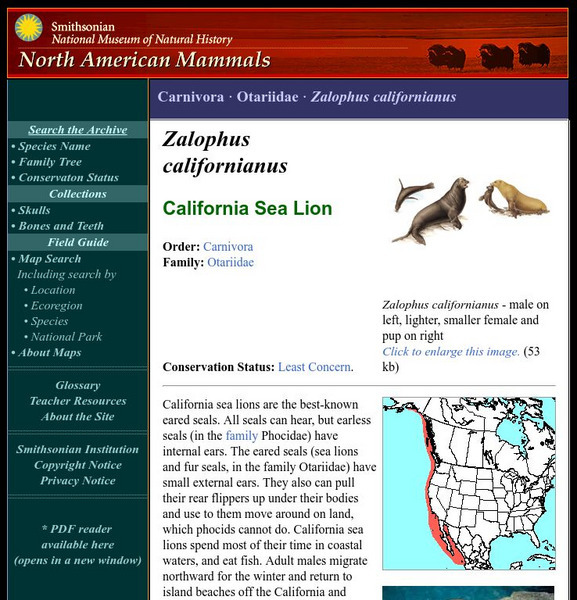
National Museum of Natural History: American Mammals: California Sea Lion
California sea lions are the best-known eared seals. All seals can hear, but earless seals (in the family Phocidae) have internal ears. Learn more about the Zalophus californianus, more commonly known as a California Sea Lion, in this...

University of California
University of California, Berkeley Art Museum: Han Dynasty Tomb Artifact
Learn about Han Dynasty culture through an examination of a tomb artifact created to be buried with a rich landowner.
Smithsonian Institution
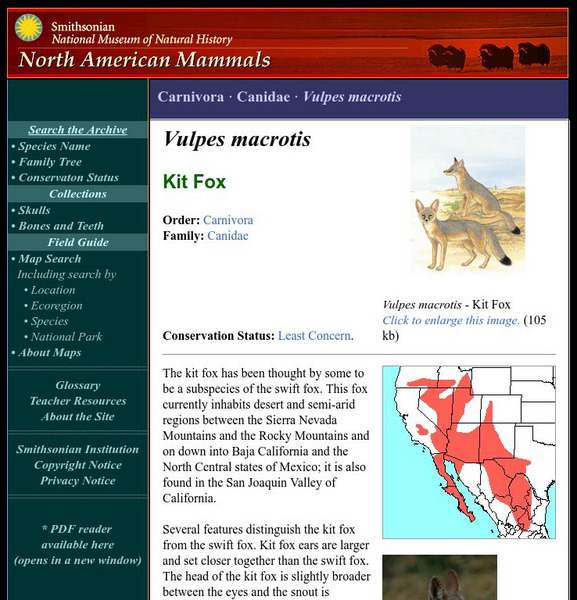
National Museum of Natural History: American Mammals: Kit Fox
The kit fox has been thought by some to be a subspecies of the swift fox. This fox currently inhabits desert and semi-arid regions between the Sierra Nevada Mountains and the Rocky Mountains and on down into Baja California and the North...
Smithsonian Institution
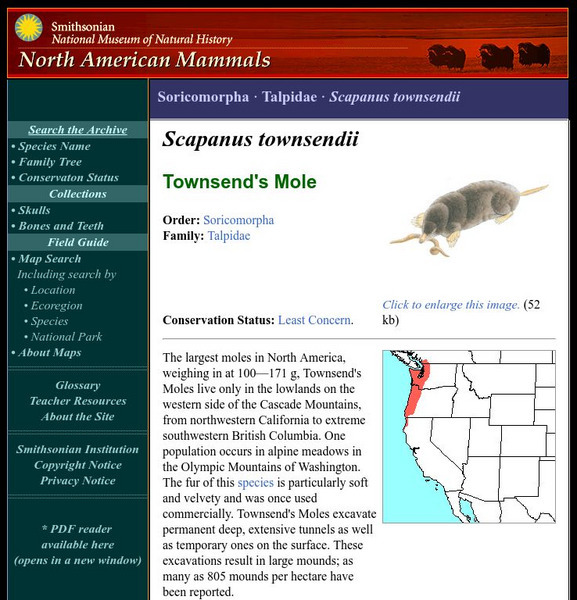
National Museum of Natural History: American Mammals: Townsend's Mole
The largest moles in North America, weighing in at 100 - 171 grams, Townsend's Moles live only in the lowlands on the western side of the Cascade Mountains, from northwestern California to extreme southwestern British Columbia. One...
Smithsonian Institution
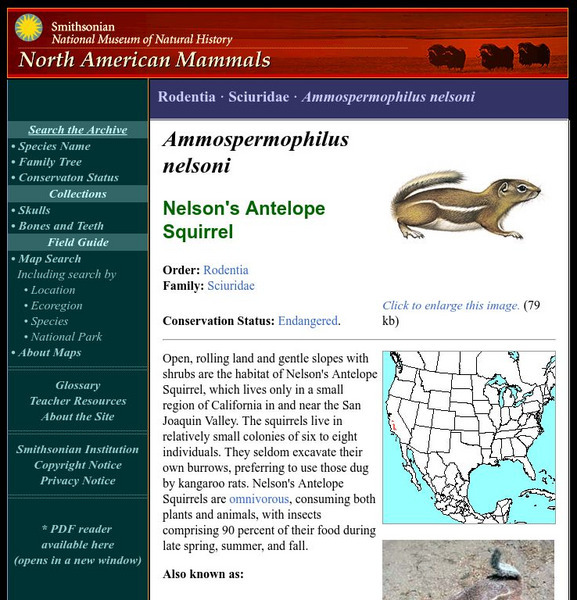
National Museum of Natural History: American Mammals: Nelson's Antelope Squirrel
Open, rolling land and gentle slopes with shrubs are the habitat of Nelson's Antelope Squirrel, which lives only in a small region of California in and near the San Joaquin Valley. The squirrels live in relatively small colonies of six...
Smithsonian Institution
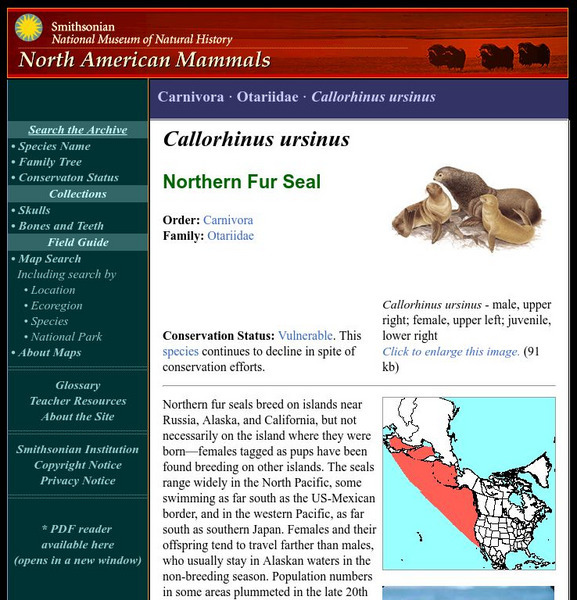
National Museum of Natural History: American Mammals: Northern Fur Seal
Northern fur seals breed on islands near Russia, Alaska, and California, but not necessarily on the island where they were born females tagged as pups have been found breeding on other islands. The seals range widely in the North...
Smithsonian Institution
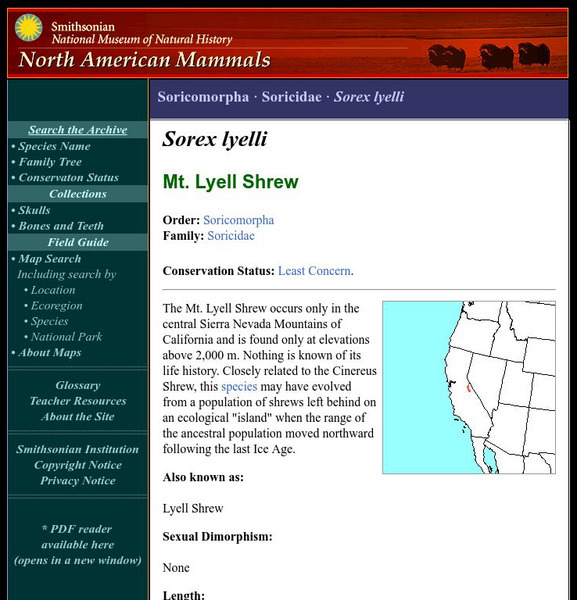
National Museum of Natural History: American Mammals: Mt. Lyell Shrew
The Mt. Lyell Shrew occurs only in the central Sierra Nevada Mountains of California and is found only at elevations above 2,000 m. Learn more about the Sorex lyelli, more commonly known as a Mt. Lyell Shrew, in this easy-to-read species...
Smithsonian Institution
National Museum of Natural History: American Mammals: Fog Shrew
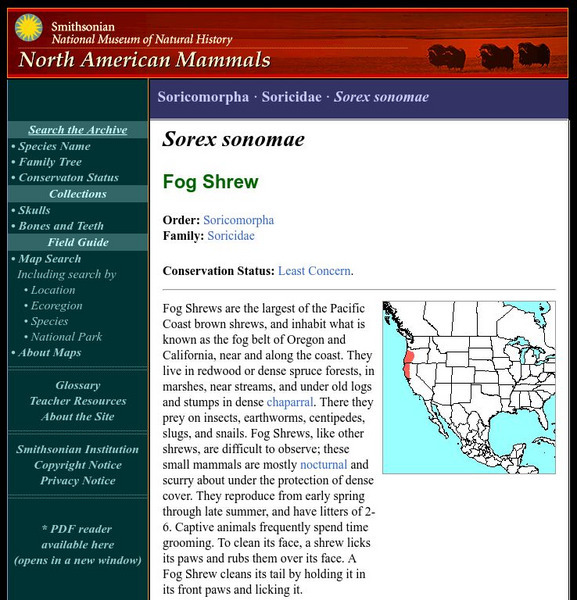
Fog Shrews are the largest of the Pacific Coast brown shrews, and inhabit what is known as the fog belt of Oregon and California, near and along the coast. They live in redwood or dense spruce forests, in marshes, near streams, and under...
Smithsonian Institution
National Museum of Natural History: American Mammals: Hubbs's Beaked Whale
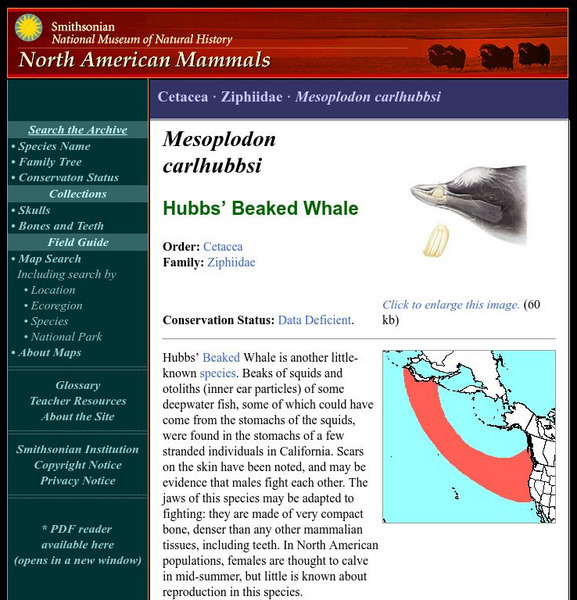
Hubbs's beaked whale is another little-known species. Beaks of squids and otoliths (inner ear particles) of some deepwater fish, some of which could have come from the stomachs of the squids, were found in the stomachs of a few stranded...
University of California
Cal Heritage Collection: Using Primary Sources
This resource covers what primary sources are, where we can find them, and how we can assess them in the classroom.
Other popular searches
- 4th Grade California History
- California History Missions
- California History Unit Plan
- Folktales California History
- California History in 1920s
- California History Ranchos
- California History Gold Rush
- California History 8.3.7
- California History Skit
- California History Lessons
- California History 837
- California History Ranch's