Hi, what do you want to do?






Better Lesson
Better Lesson: Where Is Water Found on Earth?
Water on Earth comes in many different forms. Students will collaborate as a team to locate forms of water on Earth. This in-depth lesson utilizes technology, specifically QR codes, to go on a hunt for where water is located on Earth...
Better Lesson
Better Lesson: Comparing & Contrasting Inventors
What do inventors have that are alike? How are they different? Why do they invent? Learning about them may inspire you to invent new technology! In this lesson, students will compare and contrast key details in two texts on the topic of...
Better Lesson
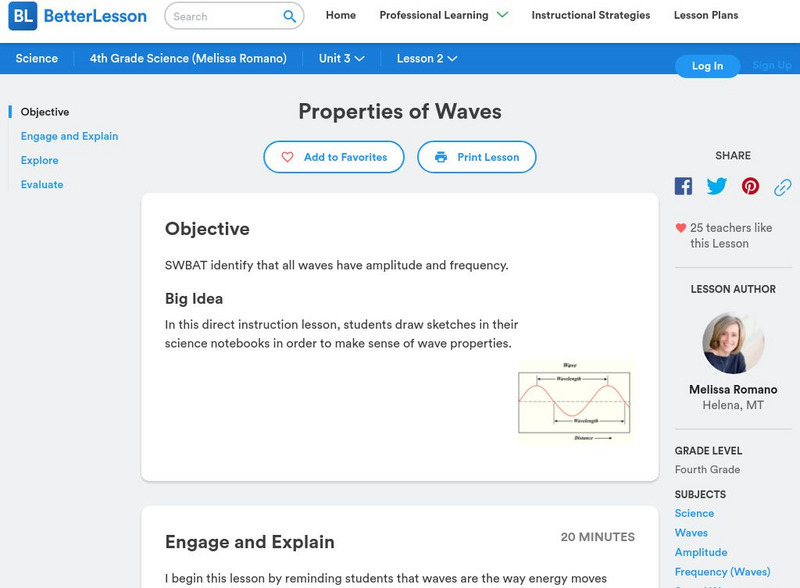
Better Lesson: Properties of Waves
In this direct instruction lesson, students draw sketches in their science notebooks in order to make sense of wave properties. Resources include a slideshow presentation on the properties of waves and multiple examples of student work.

Better Lesson
Better Lesson: Goody Goody Gumdrop! Building Structures Are Fun!
In this lesson, the children will be building a physical model to illustrate how the shape of an object, such as triangles, helps it function. At the end, the children will test their gumdrop structures and the class will collectively...

Better Lesson
Better Lesson: Making a Landform Model
In the NGSS, one of the performance expectations is for the children to develop a model to represent the shapes and kinds of land and bodies of water in an area. In the science practices, the children also must develop and use models....
Better Lesson
Better Lesson: Quick or Slow? I've Got to Know!
Earth changes can happen quickly or slowly. The students will work in teams to stake a claim about these changes and then use texts to find evidence to prove their claims. Included in this instructional activity are video clips of the...
Better Lesson
Better Lesson: And the Author Is...using Digital Tools for Writing
Empower students to recognize that they are thinkers and writers! They will collaborate on a writing piece to brainstorm, organize and publish ideas with a digital tool. This lesson highlights different website creations as examples of...
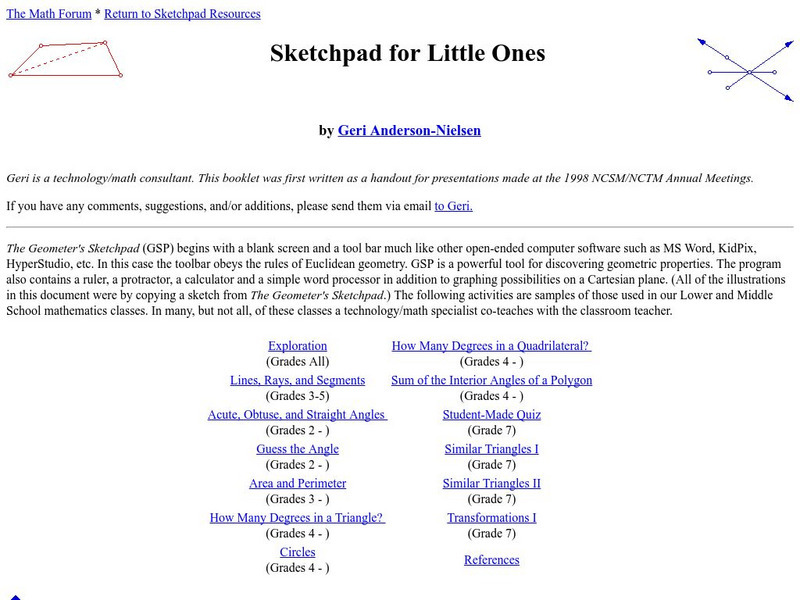
National Council of Teachers of Mathematics
The Math Forum: Geometer's Sketch Pad Lessons
This site contains lessons using Geometer's Sketch Pad for elementary and middle school aged students.

CPALMS
Cpalms: The Lesson Formerly Known as "Wassssuuup"
[Free Registration/Login Required] In this lesson, students are actively engaged in learning how formal and informal language are used in written and oral communications. Downloadable handouts are provided.
Other
Bscs: Forces Lesson 1: What Makes Something Start to Move?
Through hands-on activities, this lesson plan will show students that a force is a push or a pull and forces cause changes in motion. Included are a minute-by-minute lesson plan, activities, and teacher discussion points and questions.
Other
Bscs: Earth's Changing Surface Lesson 1: Our Land
This hands-on lesson focuses on the land and its many different types of landforms and bodies of water. Included are a minute-by-minute lesson plan, activities, and teacher discussion points and questions.
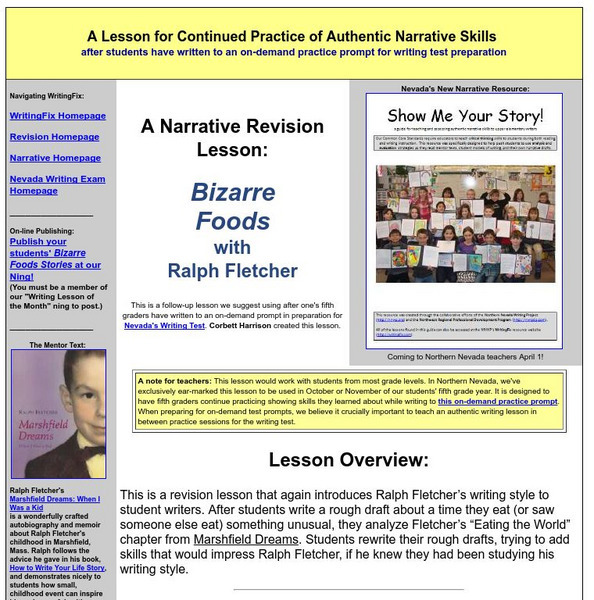
Writing Fix
Writing Fix: Bizarre Foods With Ralph Fletcher: A Narrative Revision Lesson
In this lesson, Ralph Fletcher's writing style is introduced to student writers. Learners will write a rough draft about a time they ate, or a time when they saw someone else eat, something unusual. Then students will read and analyze...
PBS
Pbs Mathline: Magic Box Lesson Plan [Pdf]
As a teacher jumps rope, students determine the arithmetic pattern. Printable lesson plan.
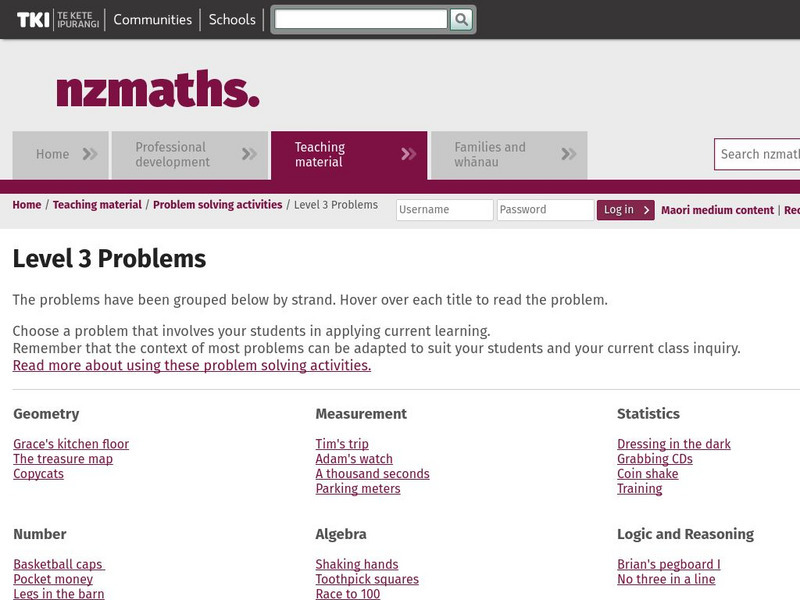
Other
Nz Maths: Problem Solving Lesson Plans: Level 3 Problems
This New Zealand Problems website is an excellent resource for lesson plans in problem-solving. They are organized into the following categories: algebra, geometry, measurement, numbers, statistics, and logic and reasoning.

Scholastic
Scholastic: Adventures in Math: Lesson 2: Plans and Goals
Planning is essential to financial success. In this lesson plan, students will define the word "budget" and identify the three key components associated with creating a budget, evaluate wants versus needs, and demonstrate an...
Common Sense Media
Common Sense Media: Education: Lesson: Talking Safely Online (Grades 3 5)
During the course of this instructional activity students learn that while people can develop rewarding friendships online, they should be cautious with online-only friends and never reveal private information without asking a parent or...

Read Works
Read Works: 4th Grade Lesson: Similes and Metaphors
[Free Registration/Login Required] A instructional activity in which students use the book Poetry for Young People: Langston Hughes edited by David Roessel and Arnold Rampersad to learn to identify and understand the use of simile and...
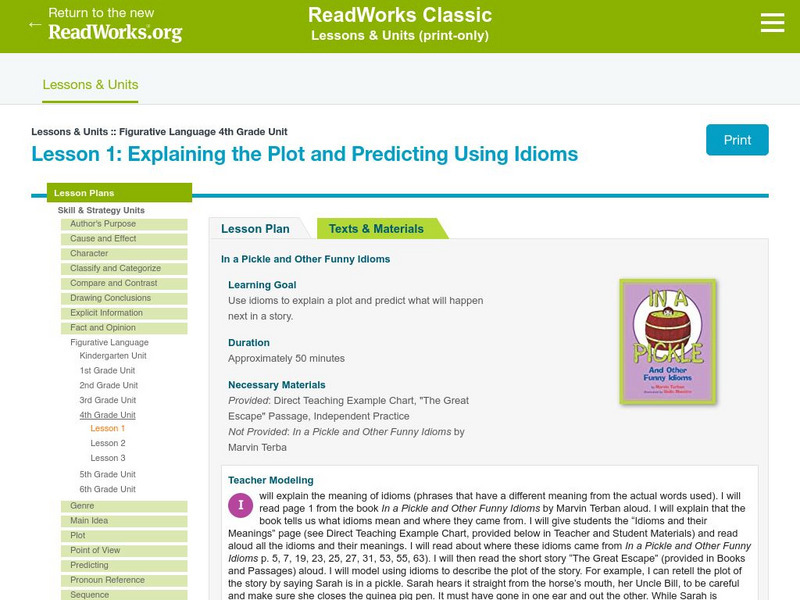
Read Works
Read Works: Fourth Grade: Three Lesson Unit: Figurative Language
[Free Registration/Login Required] A lesson plan, based on In a Pickle and Other Funny Idioms by Marvin Terba, in which students learn how understand idioms and use them to explain the plot and to make predictions. With free login, users...
Love To Know Media
Your Dictionary: 2nd Grade Lesson Plans for Forming Possessives
This article focuses on teaching 2nd graders to form possessive. It provides two complete lesson plans with activities for teaching them how to form possessives.
Love To Know Media
Your Dictionary: Lesson Plan on How to Teach Conjunctions
This lesson plan focuses on teaching conjunctions including activities, links to conjunction lists and online resources, and lesson plan ideas.
Love To Know Media
Your Dictionary: Lessons About Adjectives vs. Adverbs
This site offers six fun lessons to help students learn the correct usage of adjectives and adverbs.
Shodor Education Foundation
Shodor Interactivate: Lesson: Probability and Sports
The Shodor Education Foundation provides this lesson plan. In it, students explore where probability can be applied to professional sports. NCTM standards are listed for this lesson plan.
Vocabulary University
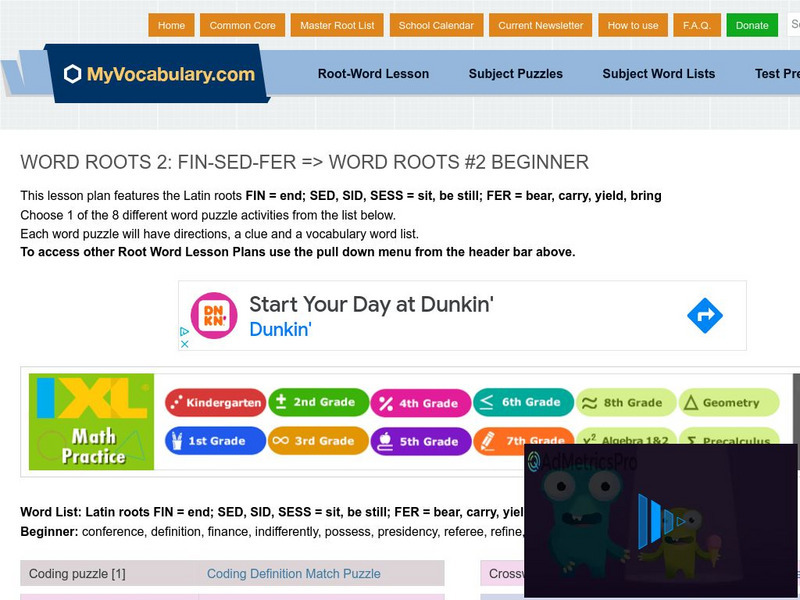
My vocabulary.com: Word Roots Lesson 2: Fin Sed Fer: Word Roots #2 Beginner
This lesson plan features the Latin roots FIN = end; SED, SID, SESS = sit, be still; FER = bear, carry, yield, bring. Choose 1 of the 8 different word puzzle activities from the list below. Each word puzzle will have directions, a clue....

Vocabulary University
My vocabulary.com: Word Roots Lesson 5: Nat Tract Sequ: Word Roots #5 Beginner
This lesson plan features the Latin roots NAT = be born; TRACT = pull, draw; SEQU/SECU = follow. Choose 1 of the 8 different word puzzle activities from the list below. Each word puzzle will have directions, a clue, and a vocabulary word...
Other popular searches
- Esl Lessons
- Elementary Lessons
- Math Lessons
- Art Lessons
- Money Lessons
- Preschool Lessons
- 2nd Grade Lessons
- Art Lessons Primary
- Esl Lessons Grammar
- High School Lessons
- 3rd Grade Lessons
- Middle School Lessons