Hi, what do you want to do?






Illustrative Mathematics
3-D Shape Sort
From the apple on your desk and the coffee cup in your hand, to the cabinets along the classroom wall, basic three-dimensional shapes are found everywhere in the world around us. Introduce young mathematicians to the these common figures...

North Carolina State University
Shapes
Expose youngsters to 3-D objects in a hands-on learning activity involving marshmallows and toothpicks. Engage your young mathematicians by introducing them to 3-D shapes by means of a story book. Explore 3-D shapes by manipulating...

Teach Engineering
Seeing All Sides: Orthographic Drawing
How can your draw three-dimensional figures on paper? The lesson shows pupils how to draw orthographic projections of three-dimensional figures composed of cubes. After viewing a PowerPoint presentation, they practice this skill with...

DiscoverE
LIDAR: Mapping with Lasers
We would be lost without maps! How are they made? Introduce junior topographers to LIDAR technology with a fascinating activity. Set up a mock city, then have learners operate a laser measure to determine the shape of the landscape using...

Teach Engineering
Circuits and Magnetic Fields
Have your class use compasses to try to find the magnetic field around an electric current. Groups use the same technique to visualize magnetic fields as they did in the second activity in the series, but this time, the field is...

Curated OER
Papier-Mâché Globe
Paper mache projects are great for using up paper from the recycle bin. Give your class the chance to create a three-dimensional globe out of paper mache. They'll work to make their globes as accurate as possible, adding proper colors...

Teach Engineering
Connect the Dots: Isometric Drawing and Coded Plans
Individuals discover how to draw cubes on triangle-dot paper. They use cubes to build structures and draw corresponding isometric drawings on dot paper in the second lesson of the series of five. The activity also introduces the concept...

Curated OER
Color in 3-D: A Nature Design Project
Students view a film about Hans Hofman and consider his use of color and layering. They experiment with the concept of 'push and pull' by using warm and cool color schemes in a tracing of leaves and shapes. Students view their work using...

Illustrative Mathematics
Toilet Roll
Potty humor is always a big hit with the school-age crowd, and potty algebra takes this topic to a whole new level. Here the class develops a model that connects the dimensions (radii, paper thickness, and length of paper) of a...

Southwestern Medical Center
A Classroom Demonstration of Protein Folding
Does the mention of proteins and polypeptide relationships in your classroom result in mass confusion? Does the attempt to teach this important concept generate multiple questions and, at times, lead to a room filled with blank...

It's About Time
Organic Substances
Host an exciting lab in which learners burn fruit rinds to better understand hydrocarbons. A reading passage and analysis questions wrap up the lesson.

Curated OER
Narrow Corridor
Buying a new sofa? Learn how to use the Pythagorean Theorem, as well as algebra and graphing techniques, to determine whether the sofa will fit around a corner (which I'm sure you'll agree is a very important consideration!).

Chandler Unified School District
Art Masterpiece—Leonardo da Vinci Inventions
After getting to know the inventor, Leonardo da Vinci and his many inventions, scholars think up their own invention. Following a written description and a hand-drawn picture, learners use a method of mirror writing and antiquing to give...
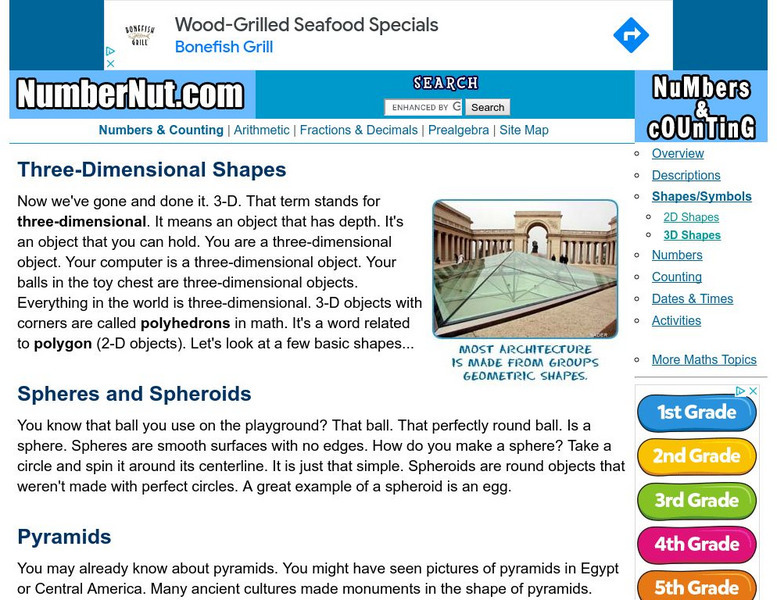
NumberNut
Number Nut: Shapes, Symbols, and Colors: 3 D Shapes
This lesson describes three dimensional shapes and provides two interactive practice activities.
National Council of Teachers of Mathematics
The Math Forum: The Cylinder Problem: Elementary Lesson
Use this lesson plan to help students learn about cylinders. Students will be creating cylinders, and comparing them and their capacity. This engaging, hands-on lesson will hold student interest and be very beneficial to student learning.
National Council of Teachers of Mathematics
The Math Forum: The Cylinder Problem: Middle School Lesson
This lesson offers an interesting, hands-on experience for middle school students studying cylinders. Students will create cylinders, and measure and compare their volumes.

NumberNut
Number Nut: Shapes, Symbols, and Colors: 2 D Shapes
Did you know that two-dimensional shapes are also called polygons? This lesson describes the various 2-D shapes and includes two interactive games to reinforce skills.
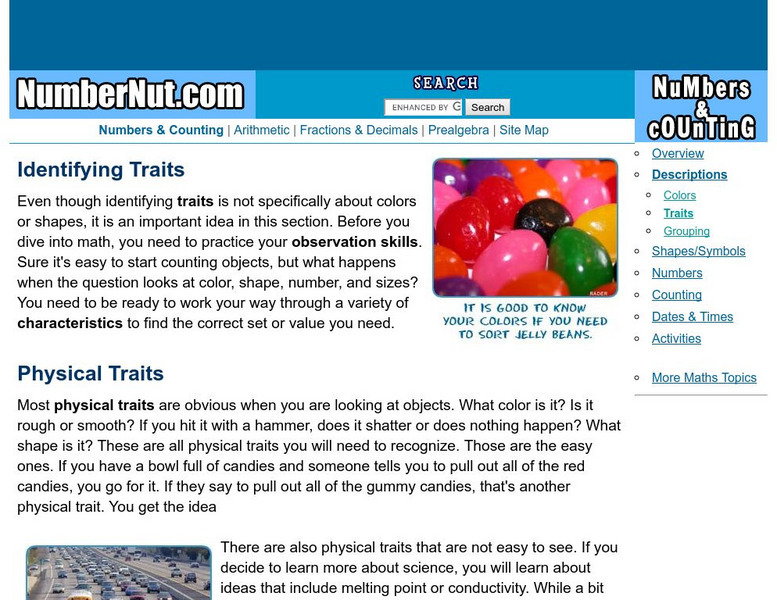
NumberNut
Number Nut: Identifying Traits
Investigate the relationship between shapes and identifying traits or characteristics. A concise lesson that explores physical, chemical, and observable traits in the shapes around us. Build on this knowledge by playing the Web Colors...